Introduction
Search Relevance Tuning Tools are specialized platforms designed to optimize the quality and accuracy of search results in digital systems. They help organizations improve the ranking and relevance of search outputs, enabling users to quickly find what they need in large datasets or online platforms. These tools are essential for e-commerce websites, enterprise search engines, content platforms, and knowledge management systems where precise search results drive engagement and business outcomes.
They matter because users expect instant, accurate, and personalized search experiences. Businesses that fail to tune relevance risk reduced engagement, missed opportunities, and lower customer satisfaction. Common use cases include e-commerce product search optimization, enterprise knowledge base search, recommendation system refinement, semantic search for content platforms, and AI-driven personalized search experiences. Buyers should evaluate algorithm flexibility, query handling, analytics, AI/ML capabilities, integration with existing search engines, real-time tuning, personalization features, ease of use, scalability, and pricing.
Best for: Digital marketers, search engineers, e-commerce managers, and product teams aiming to enhance search experiences.
Not ideal for: Organizations with minimal search traffic or those relying on simple keyword search without personalization needs.
Key Trends in Search Relevance Tuning Tools
- Integration with AI/ML for automatic ranking adjustments
- Real-time feedback loops for dynamic tuning
- Support for personalized search based on user behavior
- Low-code or no-code relevance tuning interfaces
- Cloud-native, scalable architectures
- Query analytics and relevance reporting dashboards
- Interoperability with major search engines and data platforms
- A/B testing for search result optimization
- Semantic search capabilities using NLP
- Subscription-based and usage-based pricing models
How We Selected These Tools (Methodology)
- Market adoption and mindshare among enterprises
- Feature completeness including ranking, analytics, and AI support
- Reliability and performance under large search traffic
- Security posture including encryption, RBAC, and audit logging
- Integration flexibility with existing search engines and databases
- Customer fit across industries and organizational sizes
- Ease of deployment: cloud, self-hosted, or hybrid options
- Support quality and community strength
- Scalability and multi-language support
- Value proposition and pricing transparency
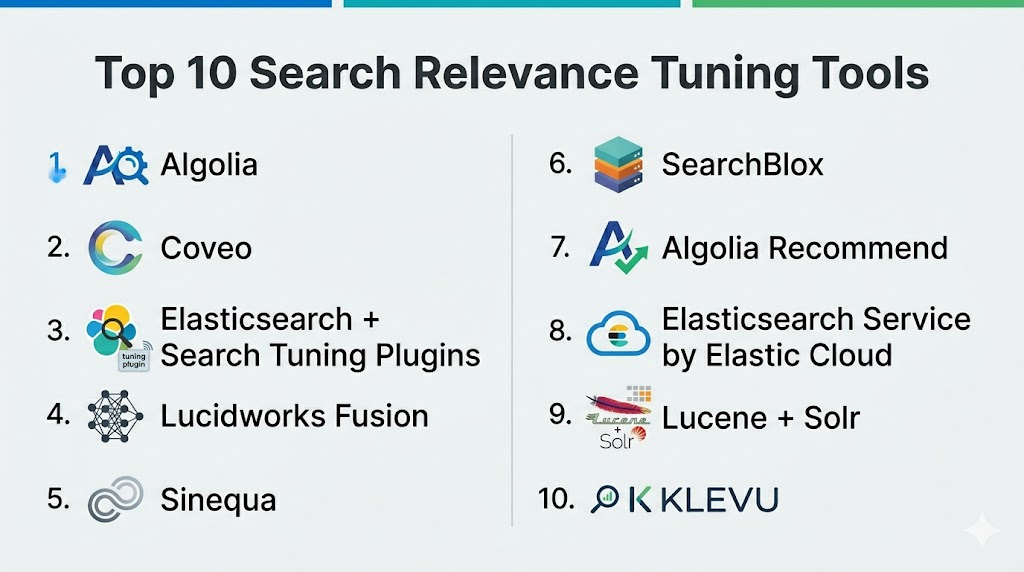
Top 10 Search Relevance Tuning Tools
#1 — Algolia
Short description: Algolia is a hosted search API that enables developers and marketers to fine-tune search relevance for web and mobile applications. It supports instant search and dynamic ranking adjustments for personalized experiences.
Key Features
- AI-driven relevance and ranking adjustments
- Instant search with typo tolerance
- Multi-language support
- Analytics dashboard for query performance
- Custom ranking rules
- A/B testing for relevance experiments
- Cloud-based API integration
Pros
- Easy to integrate with modern applications
- Strong personalization and analytics capabilities
Cons
- Pricing can be high for large datasets
- Limited control over backend indexing
Platforms / Deployment
- Web / iOS / Android
- Cloud
Security & Compliance
- Encryption in transit and at rest
- SSO/SAML support
- SOC 2 compliant
Integrations & Ecosystem
- REST API and SDKs for multiple languages
- Integrates with e-commerce platforms, CMS, and analytics tools
- Webhooks for real-time updates
Support & Community
- Strong documentation, developer community, and enterprise support
#2 — Coveo
Short description: Coveo provides AI-powered search and recommendation tools designed for enterprises. It enables tuning relevance based on behavioral analytics and content insights.
Key Features
- Machine learning-based ranking
- AI-driven personalization
- Search analytics and reporting
- Multi-source indexing
- Integration with CRM and CMS platforms
- Recommendation engine
- Security controls for access management
Pros
- Advanced AI for personalized relevance
- Strong analytics and integration options
Cons
- Complexity in setup for smaller teams
- Subscription pricing may be high
Platforms / Deployment
- Web
- Cloud / Hybrid
Security & Compliance
- RBAC, SSO/SAML, audit logs
- GDPR compliant
Integrations & Ecosystem
- APIs for CRM, CMS, and analytics
- SDKs for front-end customization
- Webhooks for dynamic content updates
Support & Community
- Enterprise support packages and training available
#3 — Elasticsearch + Search Tuning Plugins
Short description: Elasticsearch is an open-source search engine that can be customized for relevance tuning using plugins and configuration rules, widely used in enterprise search and e-commerce platforms.
Key Features
- Full-text search and indexing
- Query boosting and custom ranking rules
- Real-time analytics
- Multi-language and synonym support
- Integration with Kibana for dashboards
- Open-source plugin ecosystem
Pros
- Highly customizable and flexible
- Strong community support and documentation
Cons
- Requires technical expertise for optimal tuning
- Self-hosting requires maintenance
Platforms / Deployment
- Web / Linux / Windows / macOS
- Cloud / Self-hosted / Hybrid
Security & Compliance
- TLS/SSL encryption, RBAC, audit logging
- Not publicly stated
Integrations & Ecosystem
- Integrates with BI, analytics, and CMS platforms
- APIs for real-time data ingestion
- Extensive plugin support
Support & Community
- Large open-source community, optional enterprise support
#4 — Lucidworks Fusion
Short description: Lucidworks Fusion is an enterprise search platform that provides AI-powered search relevance tuning, personalization, and analytics for large-scale applications.
Key Features
- Machine learning ranking and query understanding
- Personalization engine
- Search analytics and reporting
- Data connectors for multiple sources
- Real-time tuning capabilities
- Rule-based relevance adjustments
Pros
- Enterprise-grade AI and analytics
- Flexible integrations with data sources
Cons
- Steep learning curve
- Premium pricing
Platforms / Deployment
- Web
- Cloud / Self-hosted / Hybrid
Security & Compliance
- RBAC, SSO, encryption
- SOC 2 compliant
Integrations & Ecosystem
- Connectors for databases, CMS, e-commerce platforms
- APIs for front-end integration
Support & Community
- Dedicated enterprise support and training resources
#5 — Sinequa
Short description: Sinequa is an AI-powered search platform for enterprises, enabling search relevance tuning across structured and unstructured data.
Key Features
- Machine learning-based relevance adjustments
- Natural language processing for semantic search
- Analytics dashboards
- Multi-source indexing
- Personalization engine
- Integration with enterprise content sources
Pros
- Excellent semantic search and NLP capabilities
- Strong analytics and monitoring
Cons
- Implementation complexity
- Licensing cost
Platforms / Deployment
- Web
- Cloud / Self-hosted / Hybrid
Security & Compliance
- RBAC, SSO, encryption
- GDPR compliant
Integrations & Ecosystem
- APIs for CRM, CMS, and analytics
- SDKs for front-end development
Support & Community
- Enterprise support and knowledge base
#6 — SearchBlox
Short description: SearchBlox provides search relevance tuning for enterprise and e-commerce applications, leveraging AI for personalized and optimized search results.
Key Features
- Customizable ranking rules
- Analytics and reporting
- AI and machine learning-based relevance
- Multi-language support
- Data connectors for structured and unstructured data
Pros
- Easy to implement
- Affordable for mid-market organizations
Cons
- Limited advanced AI features compared to enterprise solutions
- UI could be improved
Platforms / Deployment
- Web
- Cloud / Self-hosted
Security & Compliance
- SSO/SAML, RBAC
- Not publicly stated
Integrations & Ecosystem
- REST API, Python, Java SDKs
- CMS, e-commerce, and BI integration
Support & Community
- Commercial support and documentation
#7 — Algolia Recommend
Short description: Algolia Recommend focuses on AI-powered recommendations and relevance tuning for e-commerce and content platforms.
Key Features
- AI-driven ranking and personalization
- Analytics for query performance
- Real-time updates
- Multi-platform support
- APIs and SDKs for integration
Pros
- Strong e-commerce relevance optimization
- Rapid deployment
Cons
- Limited advanced analytics features
- Pricing can increase with traffic
Platforms / Deployment
- Web / iOS / Android
- Cloud
Security & Compliance
- Encryption, SSO
- SOC 2
Integrations & Ecosystem
- REST APIs
- SDKs for web and mobile apps
- CMS and e-commerce connectors
Support & Community
- Developer documentation and enterprise support
#8 — Elasticsearch Service by Elastic Cloud
Short description: Elastic Cloud provides managed Elasticsearch with enhanced search relevance tuning features, analytics, and AI-driven insights.
Key Features
- Machine learning for ranking and relevance
- Custom boosting rules
- Analytics dashboards
- Multi-language support
- API and SDK integration
Pros
- Fully managed cloud service
- Integration with Kibana for visualization
Cons
- Limited to Elastic ecosystem
- Requires configuration for complex relevance
Platforms / Deployment
- Web
- Cloud
Security & Compliance
- RBAC, SSO, encryption
- SOC 2, GDPR
Integrations & Ecosystem
- Elastic Stack integration
- REST APIs
- BI and analytics connectors
Support & Community
- Enterprise support and active community
#9 — Lucene + Solr
Short description: Apache Solr, built on Lucene, is an open-source search platform for relevance tuning, offering advanced query customization and ranking rules for enterprise applications.
Key Features
- Full-text search and indexing
- Custom relevance scoring
- Faceted search
- Query analytics
- Multi-language support
Pros
- Flexible and open-source
- Large developer community
Cons
- Requires technical expertise
- Self-hosting maintenance overhead
Platforms / Deployment
- Web / Linux / Windows
- Self-hosted / Cloud
Security & Compliance
- SSL/TLS, basic auth
- Not publicly stated
Integrations & Ecosystem
- APIs for indexing and querying
- BI, CMS, and e-commerce integrations
Support & Community
- Open-source community, commercial support available
#10 — Klevu
Short description: Klevu is an AI-powered search platform for e-commerce sites, focusing on relevance tuning and personalized search experiences.
Key Features
- AI-driven search ranking
- Query understanding and autocomplete
- Analytics dashboards
- Multi-language support
- API and SDK integration
Pros
- Optimized for e-commerce
- Easy integration and quick setup
Cons
- Limited to retail use cases
- Less suitable for enterprise knowledge search
Platforms / Deployment
- Web
- Cloud
Security & Compliance
- Encryption, SSO
- Not publicly stated
Integrations & Ecosystem
- REST API and SDKs
- E-commerce platform connectors
Support & Community
- Documentation and commercial support
Comparison Table (Top 10)
| Tool Name | Best For | Platform(s) Supported | Deployment | Standout Feature | Public Rating |
|---|---|---|---|---|---|
| Algolia | Web & mobile search | Web, iOS, Android | Cloud | AI-driven relevance | N/A |
| Coveo | Enterprise search | Web | Cloud / Hybrid | Personalized AI ranking | N/A |
| Elasticsearch + Plugins | Enterprise & e-commerce | Web, Linux, Windows, macOS | Cloud / Self-hosted / Hybrid | Flexible ranking rules | N/A |
| Lucidworks Fusion | Enterprise search | Web | Cloud / Self-hosted / Hybrid | AI & ML relevance tuning | N/A |
| Sinequa | Enterprise knowledge search | Web | Cloud / Self-hosted / Hybrid | Semantic search & NLP | N/A |
| SearchBlox | Mid-market & enterprise | Web | Cloud / Self-hosted | Affordable AI relevance | N/A |
| Algolia Recommend | E-commerce | Web, iOS, Android | Cloud | Real-time personalization | N/A |
| Elasticsearch Service | Cloud-managed search | Web | Cloud | Managed ML relevance tuning | N/A |
| Lucene + Solr | Open-source & enterprise | Web, Linux, Windows | Cloud / Self-hosted | Full-text search with boosting | N/A |
| Klevu | E-commerce | Web | Cloud | AI-powered search ranking | N/A |
Evaluation & Scoring of Search Relevance Tuning Tools
| Tool Name | Core (25%) | Ease (15%) | Integrations (15%) | Security (10%) | Performance (10%) | Support (10%) | Value (15%) | Weighted Total (0–10) |
|---|---|---|---|---|---|---|---|---|
| Algolia | 9 | 9 | 8 | 8 | 9 | 8 | 8 | 8.7 |
| Coveo | 8 | 8 | 8 | 8 | 8 | 7 | 7 | 7.9 |
| Elasticsearch + Plugins | 8 | 7 | 8 | 7 | 8 | 7 | 8 | 7.8 |
| Lucidworks Fusion | 8 | 7 | 8 | 7 | 8 | 7 | 7 | 7.7 |
| Sinequa | 8 | 7 | 8 | 7 | 8 | 7 | 7 | 7.7 |
| SearchBlox | 7 | 8 | 7 | 7 | 7 | 7 | 8 | 7.4 |
| Algolia Recommend | 9 | 8 | 8 | 8 | 8 | 7 | 7 | 8.1 |
| Elasticsearch Service | 8 | 8 | 7 | 8 | 8 | 7 | 7 | 7.8 |
| Lucene + Solr | 8 | 6 | 7 | 7 | 7 | 6 | 8 | 7.2 |
| Klevu | 7 | 8 | 7 | 7 | 7 | 7 | 7 | 7.3 |
Scores are comparative; higher weighted totals indicate stronger overall capabilities across relevance tuning, integrations, and usability.
Which Search Relevance Tuning Tools Tool Is Right for You?
Solo / Freelancer
Open-source or cloud-based services like Elasticsearch, Klevu, or SearchBlox provide flexibility and low cost for individual projects or experimentation.
SMB
Cloud-hosted solutions like Algolia or Algolia Recommend reduce operational overhead and provide easy personalization for growing businesses.
Mid-Market
Lucidworks Fusion and Elasticsearch Service offer robust analytics, AI ranking, and integration capabilities suitable for mid-sized enterprises.
Enterprise
Coveo, Sinequa, and Lucidworks Fusion provide enterprise-grade AI, personalization, and semantic search for high-scale, multi-department implementations.
Budget vs Premium
Open-source and cloud-subscription models cater to cost-conscious teams, whereas enterprise platforms provide advanced AI and analytics at higher cost.
Feature Depth vs Ease of Use
Choose tools with AI and NLP for advanced search relevance, while simpler GUI-based tools allow faster deployment for smaller teams.
Integrations & Scalability
Evaluate compatibility with existing CMS, BI, e-commerce platforms, and ML pipelines to ensure seamless adoption and growth.
Security & Compliance Needs
Enterprise teams should select platforms with encryption, RBAC, SSO, and regulatory compliance to protect data and maintain audit readiness.
Frequently Asked Questions (FAQs)
1. How are pricing models structured?
Tools offer subscription, usage-based, or open-source free tiers; enterprise editions often have annual licenses.
2. Can these tools integrate with existing search engines?
Yes, APIs and SDKs enable integration with Elasticsearch, Solr, CMS, e-commerce platforms, and analytics pipelines.
3. Which programming languages are supported?
Python, Java, JavaScript, and REST APIs are commonly supported for integration and tuning.
4. How is relevance measured?
Relevance is tuned using AI ranking, query analytics, click-through data, and A/B testing.
5. Do these tools support multi-language search?
Yes, most enterprise tools support multiple languages, synonyms, and localization features.
6. Can these tools handle high search volumes?
Cloud-native platforms like Algolia and Coveo are optimized for high-volume, low-latency search queries.
7. Are there visualization features?
Some platforms include dashboards and analytics visualizations for search performance and tuning insights.
8. How much training is required for teams?
Open-source solutions require technical expertise; enterprise SaaS tools provide onboarding, documentation, and support.
9. Can multiple users collaborate on tuning?
Cloud solutions like Algolia and Coveo support team collaboration and shared configuration dashboards.
10. What alternatives exist?
For simple search applications, relational databases or traditional keyword search engines may suffice, but they lack advanced AI-driven relevance tuning.
Conclusion
Search Relevance Tuning Tools are essential for organizations seeking to deliver accurate, personalized, and optimized search experiences. Platforms like Algolia, Coveo, and Lucidworks Fusion provide AI-driven ranking, analytics, and personalization capabilities, while open-source options like Elasticsearch and Solr offer flexibility and extensibility. Choosing the right platform depends on organizational size, search complexity, AI and NLP requirements, integration needs, and budget. Businesses should evaluate security, scalability, and cost to ensure maximum ROI and superior user experience

Find Trusted Cardiac Hospitals
Compare heart hospitals by city and services — all in one place.
Explore Hospitals
A ranking rule may improve results for one common query but make other searches less useful. Teams should test important query groups before and after major changes instead of looking at only one metric. This helps prevent small tuning changes from creating new search problems elsewhere.