Introduction
Knowledge Graph Construction Tools are platforms designed to help organizations structure, organize, and connect complex data into interconnected graphs. They enable companies to represent relationships between entities, making it easier to search, analyze, and derive insights from large and heterogeneous datasets.These tools are critical for enterprises looking to implement AI-driven insights, improve semantic search, enhance recommendation systems, and streamline data integration across departments. They help organizations understand relationships within their data, support decision-making, and unlock the value of unstructured and structured datasets.
Common use cases include semantic search optimization, AI and NLP model training, recommendation engines, fraud detection, and enterprise data integration. Buyers should evaluate scalability, multi-source data integration, graph query performance, visualization capabilities, machine learning support, collaboration features, security, deployment flexibility, and pricing.
Best for: Data engineers, knowledge managers, AI teams, and enterprises needing structured insights from large datasets.
Not ideal for: Small teams or organizations that do not rely on connected datasets, as simpler database or BI tools may suffice.
Key Trends in Knowledge Graph Construction Tools
- Integration with AI and NLP for automatic entity and relationship extraction
- Cloud-native deployments with scalable graph storage
- Real-time graph updates and streaming capabilities
- Enhanced visualization and exploration dashboards
- Interoperability with relational and NoSQL databases
- Low-code interfaces for faster graph building
- Support for SPARQL, Gremlin, and Cypher query languages
- Enterprise-grade security and compliance
- Collaboration features for distributed teams
- Pay-as-you-go and subscription-based pricing models
How We Selected These Tools (Methodology)
- Market adoption and popularity in AI and data integration projects
- Feature completeness including graph modeling, querying, and visualization
- Performance and scalability across large datasets
- Security and compliance features including encryption, RBAC, and audit logging
- Integration capabilities with existing enterprise data sources and ML pipelines
- Support for team collaboration and version control
- Deployment flexibility: cloud, on-premise, or hybrid
- Community strength and documentation quality
- Customer success and enterprise adoption case studies
- Pricing transparency and total cost of ownership
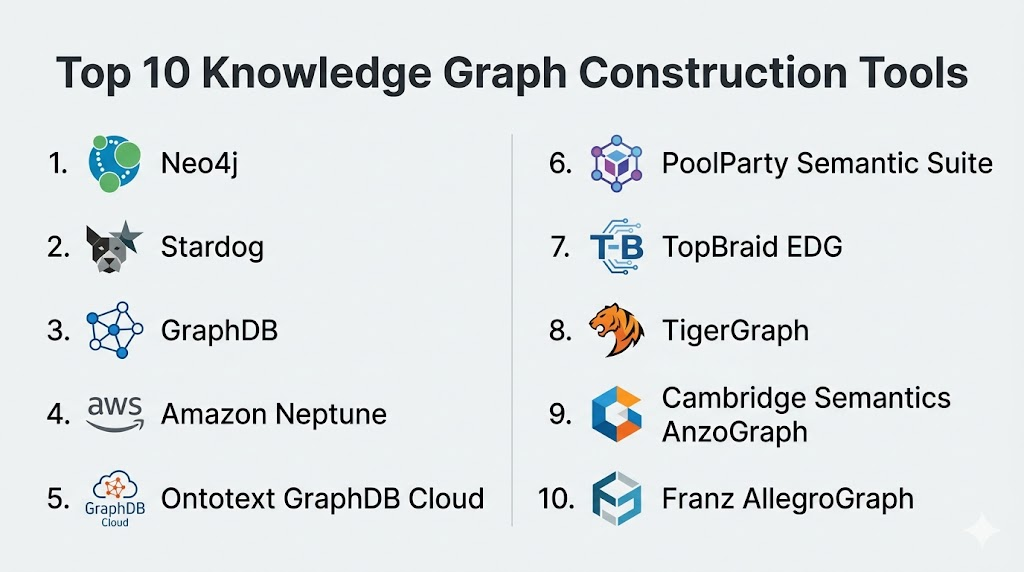
Top 10 Knowledge Graph Construction Tools
#1 — Neo4j
Short description: Neo4j is a leading graph database and construction tool that enables building highly connected knowledge graphs. It is widely used for enterprise-scale graph analytics, AI applications, and real-time recommendations.
Key Features
- Cypher query language for graph manipulation
- Native graph storage for performance
- Visualization dashboards
- Integration with Python, Java, and Spark
- Enterprise clustering and high availability
- Graph Data Science libraries
- Real-time analytics support
Pros
- Strong ecosystem for enterprise applications
- High-performance graph queries
Cons
- Requires graph modeling expertise
- Self-hosted configuration can be complex
Platforms / Deployment
- Web / Windows / macOS / Linux
- Cloud / Self-hosted / Hybrid
Security & Compliance
- RBAC, LDAP/SSO integration
- Not publicly stated
Integrations & Ecosystem
- Python, Java, Spark
- GraphQL support
- APIs for external data ingestion
Support & Community
- Extensive documentation and active community forums
#2 — Stardog
Short description: Stardog is an enterprise knowledge graph platform that unifies data from multiple sources using semantic graph models. It supports AI-driven insights and advanced data reasoning.
Key Features
- RDF and SPARQL support
- Data virtualization across sources
- Reasoning and inference engines
- Graph visualization tools
- Cloud-native and on-prem deployment
- Role-based access control
- Integration with ML pipelines
Pros
- Enterprise-ready with strong reasoning capabilities
- Flexible data source integration
Cons
- Licensing can be costly
- Learning curve for SPARQL
Platforms / Deployment
- Web / Windows / Linux / macOS
- Cloud / Self-hosted / Hybrid
Security & Compliance
- RBAC, encryption, SSO
- SOC 2, GDPR
Integrations & Ecosystem
- Relational and NoSQL databases
- BI tools integration
- APIs for external services
Support & Community
- Enterprise support with documentation
#3 — GraphDB
Short description: GraphDB is a semantic graph database ideal for managing linked data. It excels in knowledge representation, semantic search, and AI applications requiring rich data connections.
Key Features
- RDF and SPARQL 1.1 support
- Ontology management
- Reasoning engine
- Integration with enterprise data warehouses
- REST API support
- Scalable graph storage
Pros
- Strong semantic search capabilities
- Supports complex reasoning
Cons
- Enterprise features require licensing
- Visualization options limited
Platforms / Deployment
- Web / Linux / Windows
- Cloud / Self-hosted
Security & Compliance
- Not publicly stated
Integrations & Ecosystem
- APIs for data integration
- BI tool connectors
Support & Community
- Commercial support available
#4 — Amazon Neptune
Short description: Amazon Neptune is a managed graph database service for building highly connected knowledge graphs. It supports both property graph and RDF models for diverse applications.
Key Features
- Gremlin and SPARQL query support
- Fully managed service with high availability
- Integration with AWS ecosystem
- Automatic backups and scaling
- Encryption at rest and in transit
Pros
- Fully managed cloud solution
- Scalable and reliable
Cons
- Limited to AWS environment
- Proprietary pricing model
Platforms / Deployment
- Web
- Cloud (AWS)
Security & Compliance
- IAM integration, encryption, audit logs
- SOC 2, ISO 27001, GDPR
Integrations & Ecosystem
- AWS S3, Redshift, Lambda
- APIs and SDKs for development
Support & Community
- AWS enterprise support and forums
#5 — Ontotext GraphDB Cloud
Short description: Ontotext GraphDB Cloud enables building semantic knowledge graphs with reasoning and analytics capabilities for AI and NLP projects.
Key Features
- RDF and SPARQL support
- Cloud-hosted graph management
- Inference engine for relationships
- Data connectors for structured and unstructured data
- Visualization tools
Pros
- Cloud convenience with reasoning capabilities
- Scalable for enterprise datasets
Cons
- Subscription pricing
- Limited offline usage
Platforms / Deployment
- Web
- Cloud
Security & Compliance
- SSO/SAML
- Not publicly stated
Integrations & Ecosystem
- REST APIs
- BI and analytics integration
Support & Community
- Vendor support and community forums
#6 — PoolParty Semantic Suite
Short description: PoolParty is a semantic platform for building knowledge graphs, ontology management, and linked data integration for enterprises.
Key Features
- Ontology editor and management
- Linked data connectors
- Semantic search and recommendations
- Integration with Elasticsearch and SPARQL
- APIs for automation
Pros
- Strong ontology and semantic capabilities
- Enterprise-focused integrations
Cons
- Requires specialized knowledge
- Higher setup complexity
Platforms / Deployment
- Web / Windows / Linux
- Cloud / Self-hosted / Hybrid
Security & Compliance
- RBAC, SSO/SAML
- GDPR
Integrations & Ecosystem
- Elasticsearch, APIs, BI tools
- Data pipelines
Support & Community
- Enterprise support and documentation
#7 — TopBraid EDG
Short description: TopBraid Enterprise Data Governance provides a knowledge graph platform for enterprise-scale metadata and ontology management.
Key Features
- Semantic modeling and reasoning
- SPARQL and RDF support
- Data governance workflows
- Collaboration and version control
- Integration with enterprise databases
Pros
- Enterprise governance capabilities
- Scalable and compliant
Cons
- High complexity for smaller teams
- Licensing costs
Platforms / Deployment
- Web / Windows / Linux
- Cloud / Self-hosted / Hybrid
Security & Compliance
- RBAC, audit logs
- ISO 27001, GDPR
Integrations & Ecosystem
- ERP, CRM, relational databases
- APIs for external applications
Support & Community
- Vendor support and training
#8 — TigerGraph
Short description: TigerGraph provides a high-performance graph database for real-time analytics and building large-scale knowledge graphs.
Key Features
- GSQL query language
- Real-time graph analytics
- Scalable distributed architecture
- Integration with ML pipelines
- Visualization tools
Pros
- High-performance for large datasets
- Real-time analytics
Cons
- Learning curve for GSQL
- Enterprise pricing
Platforms / Deployment
- Web / Linux / Windows
- Cloud / Self-hosted / Hybrid
Security & Compliance
- RBAC, SSO
- Not publicly stated
Integrations & Ecosystem
- Python, Java SDKs
- BI and ML integration
Support & Community
- Vendor support and community forums
#9 — Cambridge Semantics AnzoGraph
Short description: AnzoGraph is a massively parallel graph analytics platform for building knowledge graphs and performing complex analytics at scale.
Key Features
- SPARQL support
- Distributed graph engine
- Analytics and reasoning
- Integration with data lakes
- Visualization dashboards
Pros
- Handles very large datasets
- Strong analytical capabilities
Cons
- Complexity for small deployments
- Enterprise-focused pricing
Platforms / Deployment
- Web / Linux
- Cloud / Self-hosted / Hybrid
Security & Compliance
- Not publicly stated
Integrations & Ecosystem
- Data lakes, REST APIs
- Python SDKs
Support & Community
- Vendor support and documentation
#10 — Franz AllegroGraph
Short description: AllegroGraph is a high-performance RDF graph database for knowledge graph construction, reasoning, and semantic analytics.
Key Features
- RDF and SPARQL support
- Rule-based reasoning
- Geospatial and temporal analytics
- Scalable for enterprise workloads
- Integration with Python, Java, and Prolog
Pros
- Advanced reasoning and analytics
- Enterprise-grade scalability
Cons
- Licensing costs
- Complexity for beginners
Platforms / Deployment
- Web / Windows / Linux / macOS
- Cloud / Self-hosted / Hybrid
Security & Compliance
- RBAC, encryption
- Not publicly stated
Integrations & Ecosystem
- Python, Java SDKs
- APIs for ETL and ML pipelines
Support & Community
- Enterprise support and active community
Comparison Table (Top 10)
| Tool Name | Best For | Platform(s) Supported | Deployment | Standout Feature | Public Rating |
|---|---|---|---|---|---|
| Neo4j | Enterprise knowledge graphs | Web, Windows, macOS, Linux | Cloud / Self-hosted / Hybrid | High-performance graph queries | N/A |
| Stardog | AI-driven semantic graphs | Web, Windows, Linux, macOS | Cloud / Self-hosted / Hybrid | Reasoning and inference | N/A |
| GraphDB | Semantic search | Web, Linux, Windows | Cloud / Self-hosted | Ontology management | N/A |
| Amazon Neptune | Cloud-based graph DB | Web | Cloud (AWS) | Managed graph database | N/A |
| Ontotext GraphDB Cloud | Linked data | Web | Cloud | Reasoning engine | N/A |
| PoolParty | Ontology & semantic management | Web, Windows, Linux | Cloud / Self-hosted / Hybrid | Ontology editor | N/A |
| TopBraid EDG | Enterprise data governance | Web, Windows, Linux | Cloud / Self-hosted / Hybrid | Governance workflows | N/A |
| TigerGraph | Real-time analytics | Web, Linux, Windows | Cloud / Self-hosted / Hybrid | High-performance analytics | N/A |
| AnzoGraph | Large-scale analytics | Web, Linux | Cloud / Self-hosted / Hybrid | Parallel graph engine | N/A |
| AllegroGraph | Semantic analytics | Web, Windows, Linux, macOS | Cloud / Self-hosted / Hybrid | Rule-based reasoning | N/A |
Evaluation & Scoring of Knowledge Graph Construction Tools
| Tool Name | Core (25%) | Ease (15%) | Integrations (15%) | Security (10%) | Performance (10%) | Support (10%) | Value (15%) | Weighted Total (0–10) |
|---|---|---|---|---|---|---|---|---|
| Neo4j | 9 | 8 | 8 | 7 | 9 | 8 | 8 | 8.5 |
| Stardog | 8 | 7 | 8 | 8 | 8 | 7 | 7 | 7.8 |
| GraphDB | 7 | 7 | 7 | 7 | 7 | 7 | 7 | 7.0 |
| Amazon Neptune | 8 | 8 | 7 | 8 | 8 | 7 | 7 | 7.8 |
| Ontotext GraphDB Cloud | 7 | 8 | 7 | 7 | 7 | 7 | 7 | 7.1 |
| PoolParty | 7 | 7 | 7 | 7 | 7 | 7 | 6 | 6.9 |
| TopBraid EDG | 8 | 6 | 7 | 8 | 8 | 7 | 6 | 7.3 |
| TigerGraph | 9 | 7 | 8 | 7 | 9 | 8 | 7 | 8.1 |
| AnzoGraph | 8 | 6 | 7 | 7 | 9 | 7 | 7 | 7.6 |
| AllegroGraph | 8 | 6 | 7 | 7 | 8 | 7 | 7 | 7.5 |
Scores are comparative; higher weighted totals indicate stronger overall capabilities considering features, usability, security, and value.
Which Knowledge Graph Construction Tools Tool Is Right for You?
Solo / Freelancer
Open-source options like Neo4j Community and GraphDB provide flexibility without high costs, ideal for experimentation and learning.
SMB
Cloud-hosted solutions like TigerGraph Cloud or Stardog Cloud reduce operational overhead and provide managed services.
Mid-Market
Platforms like Amazon Neptune or PoolParty balance performance and ease-of-integration for growing organizations.
Enterprise
TopBraid EDG, Neo4j Enterprise, and AllegroGraph provide governance, security, and scalability for large-scale deployments.
Budget vs Premium
Open-source and cloud-based subscriptions cater to budget constraints, while enterprise-grade solutions offer advanced features at higher cost.
Feature Depth vs Ease of Use
Choose tools with rich reasoning and analytics for advanced use cases; simpler GUIs are suitable for faster deployment and smaller teams.
Integrations & Scalability
Assess connectivity to existing databases, ETL pipelines, and ML platforms to ensure seamless adoption and future growth.
Security & Compliance Needs
Select platforms with RBAC, SSO, encryption, and compliance certifications if operating in regulated environments.
Frequently Asked Questions (FAQs)
1. What is the cost model for knowledge graph tools?
Pricing varies; open-source options are free, cloud solutions often use subscription or pay-as-you-go, and enterprise editions have annual licensing.
2. How easy is it to integrate with existing databases?
Most tools support REST APIs, connectors for relational and NoSQL databases, and cloud services, though setup complexity varies.
3. Which programming languages are supported?
Python, Java, and SPARQL are widely supported; some platforms also support JavaScript, R, and Prolog.
4. Can these tools handle large-scale datasets?
Yes, distributed graph databases like TigerGraph and AnzoGraph are optimized for high-volume datasets.
5. Are there visualization features included?
Most tools provide dashboards and visualization support; Observable and PoolParty focus on interactive visualizations.
6. Do they support AI and ML integrations?
Many integrate with TensorFlow, PyTorch, and Spark for ML model training and inference.
7. What about security compliance?
Enterprise-grade tools include RBAC, SSO/SAML, encryption, and some maintain SOC 2, ISO 27001, and GDPR compliance.
8. How long does onboarding typically take?
It depends on platform complexity; open-source tools can be faster, while enterprise solutions may require dedicated training.
9. Can multiple users collaborate simultaneously?
Cloud-native platforms like Deepnote, Databricks, and PoolParty enable real-time collaboration.
10. What are alternatives to knowledge graph tools?
For simpler relationships, relational databases, data catalogs, or BI tools may suffice, though they lack graph reasoning capabilities.
Conclusion
Knowledge Graph Construction Tools enable organizations to unlock insights from complex, interconnected data. Platforms such as Neo4j, Stardog, and Amazon Neptune provide enterprise-grade scalability and reasoning, while open-source solutions like GraphDB and AllegroGraph offer flexibility for experimentation. Selecting the right platform depends on data complexity, collaboration needs, integration requirements, and regulatory considerations. Organizations should evaluate security, performance, and cost to ensure a solution that maximizes ROI and enables actionable insights.

Find Trusted Cardiac Hospitals
Compare heart hospitals by city and services — all in one place.
Explore Hospitals
Data can change over time, and an old relationship may lead to wrong search results or AI decisions. Teams should have a simple process to review, update, or remove outdated connections. This can help keep the graph useful as the underlying data changes.