Introduction
Recommendation System Toolkits are specialized platforms that allow organizations to build, deploy, and optimize personalized recommendation engines. These tools leverage AI, machine learning, and data analytics to deliver tailored content, products, or services to users, enhancing engagement, conversion rates, and customer satisfaction. They are essential for e-commerce platforms, media streaming services, content portals, and enterprise knowledge systems where personalized experiences drive user retention and business outcomes.
Organizations use recommendation toolkits for personalized product recommendations, content curation, cross-selling and upselling, user behavior analysis, and predictive analytics. Buyers should evaluate algorithm flexibility, ease of model training, support for collaborative or content-based filtering, scalability, integration options, AI/ML capabilities, real-time recommendations, analytics and monitoring, deployment flexibility, and pricing models.
Best for: Data scientists, machine learning engineers, product managers, and business analysts in medium to large enterprises aiming to enhance personalization.
Not ideal for: Small businesses with limited data, teams lacking technical resources, or applications that do not require personalization.
Key Trends in Recommendation System Toolkits
- AI-driven personalized recommendations with adaptive learning
- Real-time inference and streaming data support
- Low-code and no-code model deployment interfaces
- Integration with cloud and on-premises data sources
- Hybrid recommendation approaches combining collaborative and content-based methods
- Automated feature engineering and model retraining
- Support for multi-channel deployment including web, mobile, and email
- Enhanced analytics and visualization dashboards for recommendation performance
- Privacy-preserving techniques like federated learning and differential privacy
- Subscription-based, usage-based, and pay-as-you-go pricing models
How We Selected These Tools (Methodology)
- Market adoption and mindshare across industries
- Feature completeness including model building, deployment, and analytics
- Performance and reliability under high user load
- Security posture including encryption, RBAC, and audit logging
- Integration flexibility with data sources, analytics platforms, and front-end applications
- Customer fit for small, medium, and large enterprises
- Ease of use for data scientists and engineers
- Availability of pre-built models, templates, and frameworks
- Community and enterprise support quality
- Pricing transparency and value for scalability
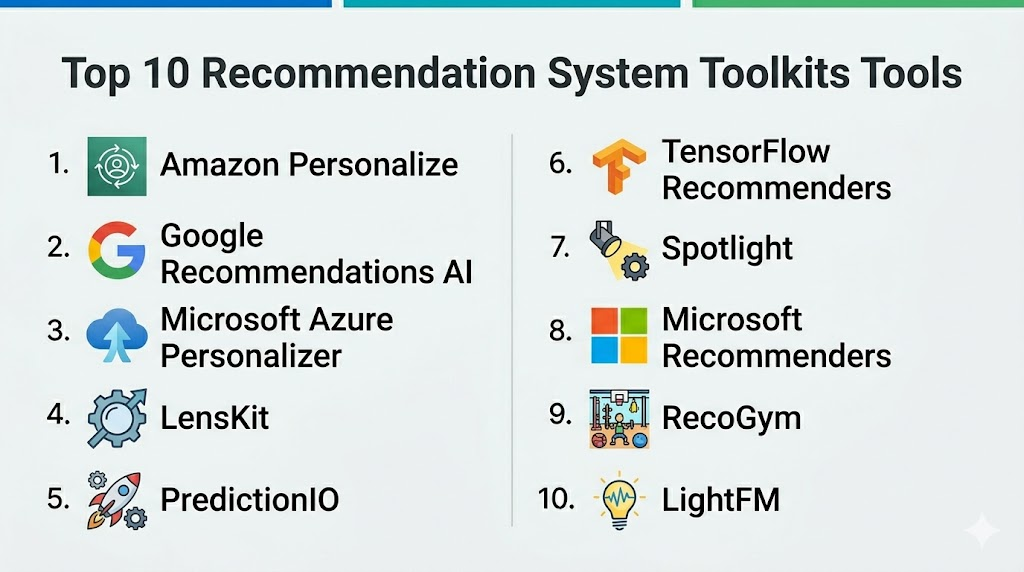
Top 10 Recommendation System Toolkits Tools
#1 — Amazon Personalize
Short description: Amazon Personalize is a managed service that enables developers to create real-time personalized recommendations. It leverages machine learning to provide product and content suggestions with minimal setup.
Key Features
- Real-time personalization and recommendations
- Automated machine learning model creation
- Multi-channel deployment for web, mobile, and email
- Collaborative and content-based filtering
- Customizable ranking and business rules
- Integration with AWS ecosystem
- Monitoring and analytics dashboards
Pros
- Fully managed with minimal infrastructure management
- Real-time recommendation support
- Scalable for enterprise workloads
Cons
- Tightly coupled with AWS ecosystem
- Cost can grow with high usage
Platforms / Deployment
- Web / iOS / Android
- Cloud
Security & Compliance
- SSO, encryption, audit logging
- SOC 2, ISO 27001, GDPR
Integrations & Ecosystem
- AWS Lambda, S3, Redshift
- REST APIs for integration with applications
- SDKs for multiple programming languages
Support & Community
- Enterprise support via AWS Support plans, strong documentation, and active developer community
#2 — Google Recommendations AI
Short description: Google Recommendations AI is a machine learning-based recommendation service designed to provide personalized product and content suggestions at scale for e-commerce and content platforms.
Key Features
- Real-time, personalized recommendations
- Integration with Google Cloud ecosystem
- Support for multi-channel experiences
- Automated feature extraction and model training
- Analytics and performance monitoring
- Dynamic ranking and business rule support
Pros
- Seamless integration with Google Cloud
- Powerful AI models optimized for large-scale personalization
Cons
- Limited flexibility outside Google Cloud
- Cost can escalate for large datasets
Platforms / Deployment
- Web / iOS / Android
- Cloud
Security & Compliance
- Encryption at rest and in transit
- GDPR and ISO 27001 compliance
Integrations & Ecosystem
- BigQuery, Cloud Storage, Firebase
- REST APIs for application integration
- SDKs for data ingestion and monitoring
Support & Community
- Google Cloud Support, extensive documentation, community forums
#3 — Microsoft Azure Personalizer
Short description: Azure Personalizer is a cloud-based recommendation service that uses reinforcement learning to provide context-aware personalized experiences across applications and devices.
Key Features
- Contextual bandit reinforcement learning
- Real-time and adaptive personalization
- Multi-channel recommendation support
- Integration with Azure ecosystem
- Performance tracking and analytics
- Customizable features and reward signals
Pros
- Reinforcement learning for dynamic personalization
- Seamless integration with Microsoft services
Cons
- Primarily tied to Azure ecosystem
- Requires understanding of reward signal configuration
Platforms / Deployment
- Web / iOS / Android
- Cloud
Security & Compliance
- SSO, encryption, audit logging
- SOC 2, ISO 27001
Integrations & Ecosystem
- Azure Data Lake, Cosmos DB, Power BI
- REST APIs and SDKs
- Supports integration with web and mobile applications
Support & Community
- Microsoft enterprise support, extensive guides, and forums
#4 — LensKit
Short description: LensKit is an open-source toolkit for building and evaluating recommendation algorithms. It supports collaborative filtering, content-based, and hybrid recommendation approaches for research and production.
Key Features
- Collaborative filtering algorithms
- Content-based recommendation support
- Hybrid recommender implementations
- Offline evaluation and benchmarking
- Extensible open-source framework
- Python and Java APIs
Pros
- Fully open-source and customizable
- Strong research community and flexibility
Cons
- Requires in-house expertise
- Lacks managed cloud infrastructure
Platforms / Deployment
- Web / Linux / Windows / macOS
- Self-hosted / Cloud (via own deployment)
Security & Compliance
- Varies / N/A
Integrations & Ecosystem
- Python and Java APIs
- Integration with data processing pipelines
- Extensible modules for custom algorithms
Support & Community
- Community support, active research community
#5 — PredictionIO
Short description: Apache PredictionIO is an open-source machine learning server for building predictive engines, including recommendation systems, with RESTful APIs for integration.
Key Features
- Template-based recommendation engines
- Collaborative filtering and content-based models
- REST API for easy integration
- Support for multiple data sources
- Extensible ML algorithms
- Open-source community-driven development
Pros
- Free and open-source
- Extensible for custom use cases
Cons
- Requires infrastructure management
- Community support may be limited for enterprise issues
Platforms / Deployment
- Web / Linux / Windows / macOS
- Self-hosted / Cloud
Security & Compliance
- Varies / N/A
Integrations & Ecosystem
- APIs for integration with applications
- SDKs for Python, Java, and Scala
- Supports integration with Spark and Hadoop
Support & Community
- Community-driven documentation and forums
#6 — TensorFlow Recommenders
Short description: TensorFlow Recommenders is an open-source library built on TensorFlow for developing scalable recommendation models with deep learning capabilities.
Key Features
- Collaborative filtering and ranking models
- TensorFlow integration for deep learning
- Evaluation metrics for recommendation quality
- Extensible for custom ML architectures
- Support for large-scale data processing
Pros
- Deep learning-based recommendation models
- Integration with TensorFlow ecosystem
Cons
- Requires ML expertise
- No managed service available
Platforms / Deployment
- Web / Linux / Windows / macOS
- Self-hosted / Cloud (via custom deployment)
Security & Compliance
- Varies / N/A
Integrations & Ecosystem
- TensorFlow, Keras, TFX
- Integration with cloud storage and data pipelines
Support & Community
- TensorFlow community and forums
#7 — Spotlight
Short description: Spotlight is an open-source recommendation toolkit for Python, designed for collaborative filtering, ranking, and hybrid models.
Key Features
- Matrix factorization and ranking algorithms
- Cross-validation and evaluation tools
- Python API for integration
- Hybrid recommendation models
- Easy experiment setup
Pros
- Lightweight and flexible
- Python ecosystem integration
Cons
- Limited to Python
- Requires custom deployment
Platforms / Deployment
- Linux / Windows / macOS
- Self-hosted
Security & Compliance
- Varies / N/A
Integrations & Ecosystem
- Python libraries, data connectors
- API integration for web apps
Support & Community
- Community support
#8 — Microsoft Recommenders
Short description: Microsoft Recommenders is an open-source toolkit with best-practice algorithms for building personalized recommendation solutions on Azure or local environments.
Key Features
- Collaborative filtering, ranking, and deep learning models
- Integration with Azure ML
- Sample notebooks and tutorials
- Evaluation metrics for recommendation quality
- Support for large-scale datasets
Pros
- Strong Azure integration
- Open-source best-practice algorithms
Cons
- Learning curve for non-Azure users
- Requires ML knowledge
Platforms / Deployment
- Web / Linux / Windows / macOS
- Self-hosted / Cloud
Security & Compliance
- Varies / N/A
Integrations & Ecosystem
- Azure ML, Python, PyTorch, TensorFlow
- API support for custom deployment
Support & Community
- Community forums, Microsoft documentation
#9 — RecoGym
Short description: RecoGym is a simulation environment for evaluating reinforcement learning-based recommendation systems, primarily used for research and experimentation.
Key Features
- Reinforcement learning environment
- User interaction simulation
- Python API
- Evaluation of recommendation strategies
- Supports large-scale experiments
Pros
- Excellent for research and model validation
- Open-source and flexible
Cons
- Not for production deployment
- Requires ML expertise
Platforms / Deployment
- Linux / Windows / macOS
- Self-hosted
Security & Compliance
- Varies / N/A
Integrations & Ecosystem
- Python, TensorFlow, PyTorch
- APIs for simulation and analytics
Support & Community
- Research community, GitHub support
#10 — LightFM
Short description: LightFM is a Python library for building hybrid recommendation models combining collaborative and content-based filtering, suitable for both research and production.
Key Features
- Hybrid recommendation support
- Fast training for large datasets
- Python API integration
- Evaluation and ranking metrics
- Extensible with custom features
Pros
- Lightweight and efficient
- Easy to integrate with Python pipelines
Cons
- Limited support for real-time recommendations
- Requires Python expertise
Platforms / Deployment
- Linux / Windows / macOS
- Self-hosted
Security & Compliance
- Varies / N/A
Integrations & Ecosystem
- Python libraries, Pandas, Numpy
- Integrates with ML pipelines
Support & Community
- Community-driven documentation and GitHub support
Comparison Table (Top 10)
| Tool Name | Best For | Platform(s) Supported | Deployment | Standout Feature | Public Rating |
|---|---|---|---|---|---|
| Amazon Personalize | Web & mobile personalization | Web, iOS, Android | Cloud | Real-time AI recommendations | N/A |
| Google Recommendations AI | E-commerce & content | Web, iOS, Android | Cloud | Multi-channel AI recommendations | N/A |
| Azure Personalizer | Enterprise apps | Web, iOS, Android | Cloud | Reinforcement learning personalization | N/A |
| LensKit | Research & prototyping | Web, Linux, Windows, macOS | Self-hosted / Cloud | Collaborative & hybrid models | N/A |
| PredictionIO | Custom ML pipelines | Web, Linux, Windows, macOS | Self-hosted / Cloud | Template-based recommendation engines | N/A |
| TensorFlow Recommenders | Deep learning recommender models | Web, Linux, Windows, macOS | Self-hosted / Cloud | Integration with TensorFlow for ML | N/A |
| Spotlight | Python-based collaborative filtering | Linux, Windows, macOS | Self-hosted | Lightweight and flexible | N/A |
| Microsoft Recommenders | Azure integration & research | Web, Linux, Windows, macOS | Self-hosted / Cloud | Best-practice algorithms | N/A |
| RecoGym | Research & reinforcement learning | Linux, Windows, macOS | Self-hosted | Simulation of RL recommendation | N/A |
| LightFM | Hybrid models | Linux, Windows, macOS | Self-hosted | Fast training on large datasets | N/A |
Evaluation & Scoring of Recommendation System Toolkits
| Tool Name | Core (25%) | Ease (15%) | Integrations (15%) | Security (10%) | Performance (10%) | Support (10%) | Value (15%) | Weighted Total |
|---|---|---|---|---|---|---|---|---|
| Amazon Personalize | 9 | 9 | 8 | 8 | 9 | 8 | 8 | 8.7 |
| Google Recommendations AI | 9 | 8 | 8 | 8 | 9 | 8 | 8 | 8.5 |
| Azure Personalizer | 8 | 8 | 8 | 8 | 8 | 7 | 8 | 8.0 |
| LensKit | 8 | 7 | 7 | 7 | 8 | 7 | 8 | 7.6 |
| PredictionIO | 8 | 7 | 7 | 7 | 7 | 7 | 8 | 7.5 |
| TensorFlow Recommenders | 9 | 7 | 8 | 7 | 8 | 7 | 8 | 7.9 |
| Spotlight | 7 | 8 | 7 | 7 | 7 | 7 | 7 | 7.2 |
| Microsoft Recommenders | 8 | 7 | 8 | 7 | 8 | 7 | 8 | 7.7 |
| RecoGym | 7 | 6 | 7 | 7 | 7 | 6 | 7 | 6.8 |
| LightFM | 8 | 7 | 7 | 7 | 7 | 7 | 8 | 7.5 |
Scores are comparative and indicate overall suitability based on features, integration capabilities, usability, and value.
Which Recommendation System Toolkits Tool Is Right for You?
Solo / Freelancer
Open-source libraries like LensKit, Spotlight, LightFM, or TensorFlow Recommenders allow independent developers to experiment and deploy prototypes with minimal cost.
SMB
Cloud-based managed services like Amazon Personalize or Google Recommendations AI enable small to medium businesses to quickly implement personalized recommendations without heavy infrastructure.
Mid-Market
Azure Personalizer and PredictionIO provide scalable recommendation capabilities with analytics and multi-channel deployment options.
Enterprise
Amazon Personalize, Google Recommendations AI, and Microsoft Recommenders offer advanced AI, reinforcement learning, and enterprise-grade support for large-scale deployments.
Budget vs Premium
Open-source frameworks minimize cost but require in-house expertise, whereas cloud-managed services provide full support and AI capabilities at higher subscription costs.
Feature Depth vs Ease of Use
For advanced personalization, choose AI-powered platforms; for faster deployment, low-code or pre-configured frameworks are ideal.
Integrations & Scalability
Ensure the toolkit integrates with your data pipelines, web/mobile apps, and analytics systems to maximize effectiveness and scale recommendations.
Security & Compliance Needs
Enterprise teams should select solutions with encryption, access controls, SSO, and compliance certifications to protect user data and meet regulatory requirements.
Frequently Asked Questions (FAQs)
1. Are these tools only for e-commerce?
No, recommendation system toolkits are applicable to media platforms, content portals, knowledge bases, and other personalized applications.
2. Can these tools work in real-time?
Yes, platforms like Amazon Personalize, Google Recommendations AI, and Azure Personalizer support real-time recommendations.
3. What programming languages are supported?
Most toolkits provide Python, Java, and REST API integration.
4. Do these tools require large datasets?
Larger datasets improve AI model accuracy, but open-source tools allow experimentation with smaller data.
5. Can multiple models be deployed simultaneously?
Yes, many toolkits support multiple models for different user segments or recommendation strategies.
6. How are recommendations evaluated?
Evaluation uses metrics like precision, recall, click-through rate, and conversion rates.
7. Are open-source toolkits production-ready?
Yes, but deployment and scaling must be managed in-house.
8. Can these tools handle personalization across multiple channels?
Yes, enterprise platforms support web, mobile, email, and in-app recommendations.
9. Do these tools provide analytics dashboards?
Many managed services include dashboards for monitoring recommendation performance and user engagement.
10. What alternatives exist?
Simple rule-based recommendation engines, collaborative filtering via databases, or basic analytics can be alternatives for small-scale or low-complexity scenarios.
Conclusion
Recommendation System Toolkits are vital for delivering personalized user experiences that drive engagement, retention, and revenue. Cloud-managed services like Amazon Personalize and Google Recommendations AI provide fast, scalable, AI-powered recommendations, while open-source options like LensKit, Spotlight, and TensorFlow Recommenders allow flexibility for experimentation and custom solutions. Selecting the right toolkit depends on organizational size, technical expertise, integration requirements, scalability, and budget. Businesses should evaluate deployment options, security compliance, and model capabilities before implementation to maximize ROI and deliver high-quality personalization

Find Trusted Cardiac Hospitals
Compare heart hospitals by city and services — all in one place.
Explore Hospitals
A recommendation system may not have enough data for a new user, or old behavior may no longer match what the user wants. Teams should have simple fallback recommendations and regularly check whether older user data is still useful. This can help keep recommendations relevant instead of relying too much on past activity.