Introduction
Industrial Automation SCADA (Supervisory Control and Data Acquisition) Systems are critical platforms that enable organizations to monitor, control, and optimize industrial processes. They collect real-time data from sensors and devices across factories, plants, and critical infrastructure, providing operators with visibility and control over operations. By centralizing process data, SCADA systems enhance efficiency, safety, and operational reliability.
The need for advanced SCADA solutions has intensified due to increasing automation, regulatory compliance demands, and the integration of AI-driven analytics in industrial operations. Modern SCADA systems are essential for sectors like manufacturing, energy, water and wastewater, transportation, and oil & gas. They help companies reduce downtime, optimize resource usage, and support predictive maintenance strategies.
Real-world use cases:
- Monitoring and controlling assembly lines in manufacturing plants.
- Supervising power grid operations in utilities.
- Managing water treatment and distribution processes.
- Ensuring safety in oil and gas pipeline operations.
- Remote monitoring of building automation systems.
Key evaluation criteria for buyers:
- Real-time monitoring capabilities
- Scalability for industrial environments
- AI/ML analytics integration
- Security and compliance features
- Ease of deployment and integration
- Customization and configurability
- Performance and reliability
- Vendor support and community
- Cost of ownership
- Interoperability with existing industrial systems
Best for: Operations managers, plant engineers, industrial automation teams, and organizations of all sizes across manufacturing, utilities, and energy sectors.
Not ideal for: Small businesses with minimal industrial processes or organizations that only need basic monitoring, where simpler HMI or IoT dashboards may suffice.
Key Trends in Industrial Automation SCADA Systems
- AI and Predictive Analytics: Increasing integration of AI to predict equipment failures and optimize production.
- Cloud and Edge Deployment: Hybrid models combining cloud SCADA with edge processing for real-time control.
- IoT and IIoT Integration: Connecting sensors, actuators, and devices for comprehensive industrial visibility.
- Cybersecurity Focus: Enhanced encryption, RBAC, and compliance with industrial security standards.
- Mobile and Remote Access: Operators using tablets and smartphones for real-time monitoring and control.
- Interoperability and Open Standards: OPC UA and MQTT adoption for seamless data exchange.
- Low-code/No-code Configuration: Simplifying dashboards, alarms, and control workflows.
- Energy Efficiency and Sustainability: SCADA systems monitoring power consumption and resource optimization.
- Predictive Maintenance Integration: AI-driven recommendations for proactive maintenance scheduling.
- Flexible Pricing Models: Subscription and modular licensing for scalable deployments.
How We Selected These Tools (Methodology)
- Evaluated market adoption, presence in industrial automation, and global mindshare.
- Reviewed completeness of SCADA features such as monitoring, control, alarm management, and analytics.
- Assessed reliability and performance indicators based on uptime, response time, and industrial usage.
- Considered security posture including SSO, encryption, compliance certifications, and audit capabilities.
- Examined integrations and ecosystem support for PLCs, IoT devices, and enterprise software.
- Evaluated customer fit across segments from SMB to enterprise industrial operations.
- Reviewed flexibility of deployment: cloud, on-premises, and hybrid options.
- Checked documentation quality, training support, and community engagement.
- Balanced price versus value for both small-scale and enterprise deployments.
- Considered future-readiness: AI/ML adoption, IIoT compatibility, and data analytics capabilities.
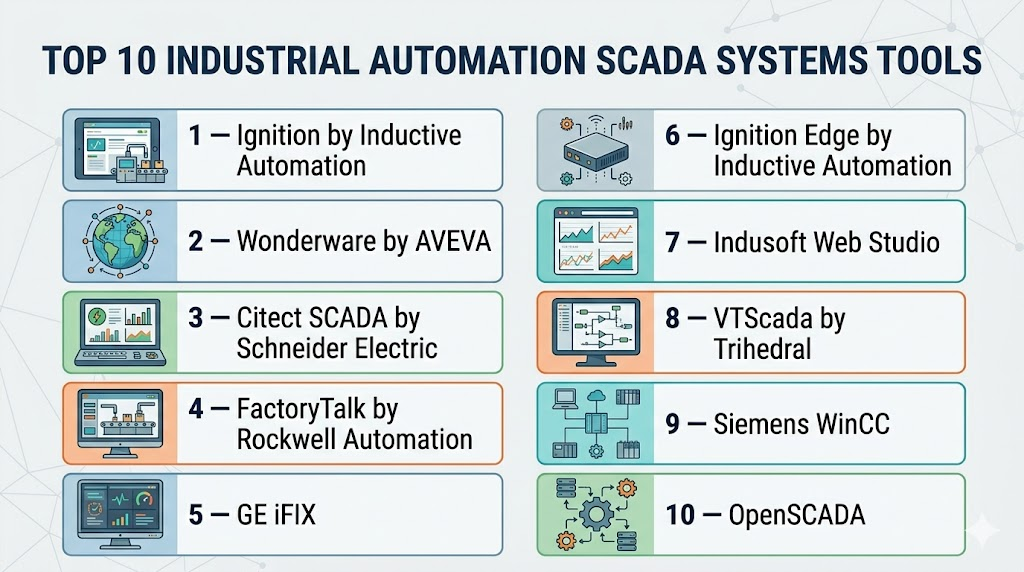
Top 10 Industrial Automation SCADA Systems Tools
#1 — Ignition by Inductive Automation
Short description: Ignition is a modular SCADA platform designed for industrial automation and IIoT integration. It allows companies to build real-time dashboards, connect to multiple data sources, and deploy applications across facilities. Suitable for both small operations and large enterprises.
Key Features
- Unlimited clients, tags, and connections.
- Web-based HMI and dashboard visualization.
- MQTT and OPC UA support for IIoT.
- Built-in alarming and event notifications.
- Python scripting for automation and customization.
- Modular architecture for flexible deployments.
- Database integration for historical data analytics.
Pros
- Scales easily from small plants to global operations.
- Strong developer and community support.
- Flexible licensing model for enterprise growth.
Cons
- Initial configuration can be complex for non-developers.
- Advanced features require scripting knowledge.
- On-premises deployment may need dedicated IT resources.
Platforms / Deployment
- Windows / Linux / Web
- Cloud / Self-hosted / Hybrid
Security & Compliance
- SSO/SAML support
- Role-based access control
- Encryption for data in transit and at rest
- SOC 2 and ISO 27001 Not publicly stated
Integrations & Ecosystem
Supports diverse PLCs, databases, and enterprise systems.
- OPC UA/MQTT connectors
- SQL database integration
- REST API support
- Third-party module ecosystem
- MES and ERP integration
Support & Community
- Extensive online documentation
- Training and certification programs
- Active user forum and developer community
#2 — Wonderware by AVEVA
Short description: Wonderware is a comprehensive SCADA platform for process automation, offering real-time monitoring, analytics, and integration with industrial devices. It serves large manufacturing, energy, and water utility environments.
Key Features
- Real-time process visualization.
- Historical data collection and trending.
- Alarm management and event logging.
- Device and PLC connectivity.
- Mobile monitoring applications.
- Analytics and reporting modules.
- Redundancy and high-availability options.
Pros
- Highly reliable for enterprise operations.
- Strong ecosystem of industrial connectors.
- Robust analytics and reporting tools.
Cons
- Licensing can be costly for small operations.
- Steep learning curve for new users.
- Some legacy modules require modernization.
Platforms / Deployment
- Windows / Web / Mobile
- Cloud / Self-hosted / Hybrid
Security & Compliance
- Not publicly stated
Integrations & Ecosystem
- PLC/RTU connectivity
- MES and ERP integration
- API for custom extensions
- IoT and sensor integration
Support & Community
- Dedicated support channels
- Professional training programs
- Active industrial user base
#3 — Citect SCADA by Schneider Electric
Short description: Citect SCADA provides industrial control and monitoring with high-performance visualization and data acquisition, ideal for manufacturing, infrastructure, and utilities.
Key Features
- High-speed data acquisition.
- Flexible HMI development tools.
- Redundant server configurations.
- Alarm and event management.
- Advanced reporting tools.
- Multi-language support.
- Integration with Schneider PLCs.
Pros
- Robust for critical infrastructure.
- Excellent redundancy and failover.
- Broad language and regional support.
Cons
- Limited web-based functionality.
- Less flexible outside Schneider ecosystem.
- Setup may require specialized engineers.
Platforms / Deployment
- Windows / Web
- Self-hosted / Hybrid
Security & Compliance
- Not publicly stated
Integrations & Ecosystem
- Schneider Electric devices
- OPC and Modbus integration
- Database connectivity
- API support for extensions
Support & Community
- Comprehensive documentation
- Regional support centers
- Training and certification
#4 — FactoryTalk by Rockwell Automation
Short description: FactoryTalk is a scalable SCADA suite for manufacturing and industrial operations, focusing on real-time insights, analytics, and process optimization.
Key Features
- HMI and visualization tools.
- Real-time data historian.
- Advanced analytics dashboards.
- Device and PLC integration.
- Alarm and notification system.
- Role-based user access.
- Mobile monitoring support.
Pros
- Strong integration with Rockwell PLCs.
- Comprehensive analytics and reporting.
- High reliability in industrial environments.
Cons
- Primarily tied to Rockwell ecosystem.
- Licensing complexity for multi-site deployment.
- Initial deployment requires expert configuration.
Platforms / Deployment
- Windows / Web / Mobile
- Self-hosted / Hybrid
Security & Compliance
- Role-based access control
- SSO Not publicly stated
- Data encryption Not publicly stated
Integrations & Ecosystem
- PLC/RTU integration
- MES/ERP connectivity
- API extensibility
- Database connections
Support & Community
- Dedicated support tiers
- Professional training programs
- Active industrial user community
#5 — GE iFIX
Short description: iFIX by GE Digital delivers real-time industrial visualization and SCADA control, suitable for manufacturing, energy, and water/wastewater operations.
Key Features
- High-speed data acquisition.
- Visualization dashboards.
- Alarm and event management.
- Historical data trending.
- Redundant server support.
- Integration with GE and third-party PLCs.
- Security features with user authentication.
Pros
- Reliable performance for industrial environments.
- Rich visualization capabilities.
- Proven in complex manufacturing setups.
Cons
- Interface may feel dated.
- Limited web/mobile functionality.
- Licensing costs can be high.
Platforms / Deployment
- Windows / Web
- Self-hosted / Hybrid
Security & Compliance
- Not publicly stated
Integrations & Ecosystem
- PLC and RTU integration
- Database connectivity
- MES/ERP support
- Custom APIs for extensions
Support & Community
- Strong documentation
- Technical support and training
- GE Digital user community
#6 — Ignition Edge by Inductive Automation
Short description: Ignition Edge extends Ignition SCADA capabilities to edge devices, offering lightweight deployment for IIoT and real-time local control.
Key Features
- Edge-level monitoring and control.
- OPC UA and MQTT connectivity.
- Local alarms and event handling.
- Lightweight footprint for devices.
- Data aggregation and forwarding.
- Python scripting for customization.
Pros
- Ideal for distributed operations.
- Low hardware requirements.
- Integrates seamlessly with central Ignition SCADA.
Cons
- Limited analytics compared to full SCADA.
- Advanced configuration requires scripting.
- Not a standalone enterprise SCADA solution.
Platforms / Deployment
- Windows / Linux
- Self-hosted / Edge / Hybrid
Security & Compliance
- Not publicly stated
Integrations & Ecosystem
- Connects to Ignition servers
- OPC UA/MQTT devices
- Local database support
- API for custom integration
Support & Community
- Varies / Not publicly stated
#7 — Indusoft Web Studio
Short description: Indusoft Web Studio provides SCADA and HMI software with web-enabled visualization, ideal for industrial and manufacturing automation.
Key Features
- Web-based dashboards and HMIs.
- Real-time data acquisition.
- Alarm and event management.
- Historical trending and reporting.
- Multi-platform runtime deployment.
- PLC and sensor connectivity.
- Security features for user access.
Pros
- Cross-platform web deployment.
- Flexible HMI development.
- Scales for both small and large installations.
Cons
- Learning curve for beginners.
- Advanced analytics require additional modules.
- Licensing may be complex.
Platforms / Deployment
- Windows / Web
- Cloud / Self-hosted / Hybrid
Security & Compliance
- Not publicly stated
Integrations & Ecosystem
- PLC and database integration
- MES connectivity
- REST API support
Support & Community
- Documentation and training available
- Community forums
#8 — VTScada by Trihedral
Short description: VTScada is an integrated SCADA system focused on water, wastewater, and industrial applications, offering intuitive visualization and process control.
Key Features
- Integrated historian and trending.
- Alarm management and notifications.
- Web and mobile visualization.
- Redundant server support.
- Device integration (PLC, RTU).
- Security via role-based access.
- Report generation and analytics.
Pros
- Reliable for critical infrastructure.
- Easy-to-use interface.
- Strong industry-specific features.
Cons
- Primarily suited for water/wastewater.
- May require customization for other industries.
- Limited third-party ecosystem.
Platforms / Deployment
- Windows / Web / Mobile
- Self-hosted / Hybrid
Security & Compliance
- Not publicly stated
Integrations & Ecosystem
- PLC/RTU integration
- Database connections
- API support
Support & Community
- Professional support available
- Documentation provided
#9 — Siemens WinCC
Short description: WinCC is Siemens’ SCADA offering, providing visualization, monitoring, and control of industrial processes, suitable for complex manufacturing and energy operations.
Key Features
- Real-time HMI and visualization.
- Alarm and event handling.
- Historical data and trend analysis.
- Redundant server options.
- Integration with Siemens PLCs.
- Web-based access and mobile monitoring.
- Analytics modules for operational insights.
Pros
- Strong industrial reliability.
- Tight integration with Siemens ecosystem.
- Scalable from small to large plants.
Cons
- Primarily Siemens-focused.
- Licensing complexity.
- Requires skilled operators for advanced configuration.
Platforms / Deployment
- Windows / Web / Mobile
- Self-hosted / Hybrid
Security & Compliance
- Not publicly stated
Integrations & Ecosystem
- Siemens PLCs
- Database integration
- MES connectivity
- API support
Support & Community
- Documentation and training
- Active Siemens industrial community
#10 — OpenSCADA
Short description: OpenSCADA is an open-source SCADA platform offering flexible, customizable automation and monitoring capabilities for industrial and educational environments.
Key Features
- Cross-platform support.
- Real-time monitoring dashboards.
- Alarm and event management.
- Modular architecture.
- Supports multiple industrial protocols.
- Scriptable automation features.
- Historical data logging.
Pros
- Open-source and highly customizable.
- Cost-effective for small-scale deployments.
- Community-driven development.
Cons
- Limited official support.
- Learning curve for non-technical users.
- Fewer enterprise-ready features.
Platforms / Deployment
- Windows / Linux / Web
- Self-hosted / Hybrid
Security & Compliance
- Not publicly stated
Integrations & Ecosystem
- PLC and RTU integration
- Database connectors
- API extensibility
Support & Community
- Community forums
- Online documentation
Comparison Table (Top 10)
| Tool Name | Best For | Platform(s) Supported | Deployment | Standout Feature | Public Rating |
|---|---|---|---|---|---|
| Ignition | SMB to Enterprise | Windows / Linux / Web | Cloud / Self-hosted / Hybrid | Modular, unlimited tags | N/A |
| Wonderware | Large Enterprises | Windows / Web / Mobile | Cloud / Self-hosted / Hybrid | Comprehensive process analytics | N/A |
| Citect SCADA | Critical Infrastructure | Windows / Web | Self-hosted / Hybrid | High-speed acquisition | N/A |
| FactoryTalk | Manufacturing | Windows / Web / Mobile | Self-hosted / Hybrid | Advanced analytics | N/A |
| GE iFIX | Manufacturing & Utilities | Windows / Web | Self-hosted / Hybrid | Visualization dashboards | N/A |
| Ignition Edge | Edge Monitoring | Windows / Linux | Self-hosted / Edge / Hybrid | Edge-level real-time control | N/A |
| Indusoft Web Studio | Industrial Automation | Windows / Web | Cloud / Self-hosted / Hybrid | Web-enabled HMI | N/A |
| VTScada | Water/Wastewater | Windows / Web / Mobile | Self-hosted / Hybrid | Industry-specific features | N/A |
| Siemens WinCC | Manufacturing & Energy | Windows / Web / Mobile | Self-hosted / Hybrid | Siemens integration | N/A |
| OpenSCADA | Open-source/Custom | Windows / Linux / Web | Self-hosted / Hybrid | Open-source flexibility | N/A |
Evaluation & Scoring of Industrial Automation SCADA Systems
| Tool Name | Core (25%) | Ease (15%) | Integrations (15%) | Security (10%) | Performance (10%) | Support (10%) | Value (15%) | Weighted Total (0–10) |
|---|---|---|---|---|---|---|---|---|
| Ignition | 9 | 8 | 9 | 8 | 9 | 8 | 9 | 8.85 |
| Wonderware | 9 | 7 | 8 | 7 | 9 | 8 | 7 | 8.0 |
| Citect SCADA | 8 | 7 | 7 | 7 | 8 | 7 | 7 | 7.6 |
| FactoryTalk | 8 | 7 | 7 | 7 | 8 | 7 | 7 | 7.6 |
| GE iFIX | 8 | 6 | 7 | 7 | 8 | 6 | 7 | 7.35 |
| Ignition Edge | 7 | 7 | 8 | 7 | 7 | 6 | 8 | 7.35 |
| Indusoft Web Studio | 7 | 7 | 7 | 7 | 7 | 6 | 7 | 7.0 |
| VTScada | 7 | 6 | 6 | 7 | 7 | 6 | 7 | 6.85 |
| Siemens WinCC | 8 | 6 | 7 | 7 | 8 | 7 | 7 | 7.5 |
| OpenSCADA | 6 | 6 | 6 | 6 | 6 | 5 | 8 | 6.5 |
Interpretation: Weighted scores help compare SCADA tools across features, usability, integration, security, performance, support, and value. Higher scores indicate stronger overall suitability for industrial operations, but context-specific factors may shift priorities.
Which Industrial Automation SCADA Systems Tool Is Right for You?
Solo / Freelancer
Lightweight or open-source options like OpenSCADA or Ignition Edge provide cost-effective monitoring and experimentation for small-scale projects or prototypes.
SMB
Tools such as Ignition or Indusoft Web Studio offer scalability, integration, and sufficient analytics without the complexity and cost of enterprise-focused solutions.
Mid-Market
FactoryTalk and GE iFIX provide advanced visualization, analytics, and integration capabilities suitable for plants expanding automation while managing cost.
Enterprise
Wonderware, Citect SCADA, and Siemens WinCC offer high reliability, redundancy, and extensive ecosystem support for large-scale industrial operations.
Budget vs Premium
Open-source tools are ideal for minimal cost and customization flexibility. Premium platforms provide advanced features, enterprise-grade support, and robust compliance, worth the investment for critical operations.
Feature Depth vs Ease of Use
Tools like Ignition balance depth and usability, whereas WinCC and Wonderware prioritize feature completeness and enterprise capabilities, sometimes requiring specialized training.
Integrations & Scalability
Choose platforms supporting OPC UA, MQTT, database connections, and ERP/MES integrations to ensure long-term scalability and seamless data exchange.
Security & Compliance Needs
Enterprises should prioritize RBAC, encryption, audit logs, and compliance-ready platforms, especially when managing critical infrastructure or sensitive industrial data.
Frequently Asked Questions (FAQs)
1. What is the typical pricing model for SCADA systems?
SCADA pricing varies from perpetual licenses, subscription models, to modular deployment costs. Enterprise-level solutions may require additional fees for clients, tags, or modules, while open-source alternatives are free but may incur support costs.
2. How long does SCADA implementation take?
Deployment duration depends on system complexity, facility size, and integration requirements. Simple setups can take weeks, while large-scale enterprise installations may span several months including configuration, testing, and training.
3. Can SCADA systems integrate with existing PLCs and IoT devices?
Yes, modern SCADA solutions support OPC UA, MQTT, Modbus, and other protocols, enabling integration with existing PLCs, RTUs, sensors, and IIoT devices for real-time data acquisition.
4. How is security handled in SCADA systems?
Security includes role-based access, encryption, SSO/SAML, and compliance with industrial standards. Users should verify features, audit logs, and vulnerability management to safeguard operations.
5. What are common mistakes when selecting SCADA software?
Common errors include underestimating scalability needs, ignoring integration compatibility, overlooking user training, and choosing solutions with insufficient support or outdated protocols.
6. Can SCADA systems be deployed in the cloud?
Many modern SCADA platforms support cloud, hybrid, or edge deployments. Cloud options facilitate remote monitoring, centralized management, and IIoT integration, while on-premises may be required for latency-sensitive or regulated environments.
7. How do SCADA systems handle redundancy and uptime?
Enterprise SCADA platforms provide redundant servers, failover configurations, and high-availability architectures to ensure continuous operations in critical industrial environments.
8. Are SCADA systems suitable for small manufacturers?
Yes, lightweight or modular SCADA systems like Ignition Edge or OpenSCADA can scale to small operations, providing real-time monitoring without excessive cost or complexity.
9. How do SCADA systems support analytics and optimization?
Many platforms include built-in analytics, dashboards, and historical trending. Advanced solutions integrate AI/ML for predictive maintenance, process optimization, and energy efficiency monitoring.
10. What alternatives exist to traditional SCADA systems?
Alternatives include HMI-only platforms, cloud IoT dashboards, or hybrid edge-based monitoring solutions. These may be sufficient for smaller operations without full SCADA requirements.
Conclusion
Industrial Automation SCADA systems are the backbone of modern industrial operations, providing real-time visibility, control, and optimization across complex processes. The right platform depends on your operational scale, integration requirements, and industry-specific needs. Enterprises benefit from robust, feature-rich solutions like Wonderware, FactoryTalk, and Siemens WinCC, while SMBs or edge-focused operations may prefer Ignition, Indusoft, or OpenSCADA. Evaluating core features, security, scalability, and support is critical before deployment. Companies are encouraged to shortlist tools, run pilot projects, and validate integrations to ensure the SCADA system aligns with operational goals and long-term digital transformation strategies.

Find Trusted Cardiac Hospitals
Compare heart hospitals by city and services — all in one place.
Explore Hospitals
A faulty sensor can send incorrect values while the SCADA system continues to display them as normal. Teams should have simple checks for unusual readings and a clear process for confirming sensor problems. This can help prevent wrong decisions and unnecessary production issues.