Introduction
Master Data Management (MDM) is a comprehensive method used by organizations to define and manage their critical data to provide a single point of reference. In a digital landscape where data is generated across hundreds of disconnected applications—from CRM and ERP systems to e-commerce platforms—MDM acts as the “glue” that binds these silos. It focuses on creating a “Golden Record,” which is a single, verified, and consistent version of a data entity, such as a customer, product, or supplier.
As we move through , MDM has evolved from a back-office data cleansing task into a strategic engine for AI and digital transformation. Without high-quality master data, AI models often hallucinate or provide skewed insights due to poor input quality. Modern MDM software uses advanced machine learning to automate the matching, merging, and cleansing of millions of records, ensuring that every department in a global enterprise is working from the same “source of truth.” This consistency is vital for regulatory compliance, personalized customer experiences, and operational agility.
Real-World Use Cases:
- Customer 360: Consolidating customer interactions across retail, mobile, and support to create a unified profile for personalized marketing.
- Supply Chain Optimization: Tracking suppliers and materials across global regions to identify redundancies and reduce procurement costs.
- Regulatory Compliance: Ensuring accurate reporting for GDPR, CCPA, and HIPAA by centralizing data consent and privacy controls.
- Product Information Management: Synchronizing product details across global marketplaces to ensure consistent descriptions and pricing.
- Mergers and Acquisitions: Rapidly integrating disparate data systems from two merging companies to achieve a unified operational view.
Evaluation Criteria for Buyers:
- Multi-Domain Support: Capability to manage various data types (Customer, Product, Location, Asset) within one platform.
- Data Quality and Cleansing: Sophistication of built-in tools for deduplication, normalization, and enrichment.
- Integration Flexibility: Ease of connecting with legacy systems, cloud apps, and modern data lakes via APIs.
- AI and Automation: Presence of machine learning for automated entity resolution and stewardship.
- User Experience: How easily business users and data stewards can navigate the interface and resolve conflicts.
- Scalability: Performance levels when handling hundreds of millions of records and high-frequency updates.
- Data Governance: Robustness of workflows, audit logs, and policy enforcement mechanisms.
- Deployment Models: Availability of cloud-native, on-premise, or hybrid options.
- Security Framework: Depth of encryption, role-based access controls, and compliance certifications.
- Time to Value: How quickly the software can be implemented and show measurable ROI.
Best for: Large-scale enterprises with fragmented data landscapes, highly regulated industries like BFSI and healthcare, and organizations scaling their AI and analytics initiatives.
Not ideal for: Small businesses with single-source data needs or companies looking for a basic spreadsheet replacement without technical data management requirements.
Key Trends in Master Data Management Tools
- AI-Native Entity Resolution: Modern MDM tools are replacing rigid rule-based matching with deep learning models that can identify duplicate records across languages and formats with 99% accuracy.
- Self-Healing Data Governance: Automation features are now capable of identifying and correcting data anomalies in real-time, reducing the manual workload of data stewards.
- Data Mesh and Fabric Integration: MDM is moving away from being a “siloed hub” toward becoming a foundational layer in decentralized data architectures like Data Mesh.
- Real-Time Data Activations: Instead of batch processing, 2026 MDM platforms offer millisecond synchronization, ensuring a “Golden Record” is updated across all systems the moment a change occurs.
- ESG Data Stewardship: New domains are emerging specifically to track Environmental, Social, and Governance (ESG) metrics for global sustainability reporting.
- Privacy-by-Design: Advanced data masking and differential privacy are becoming standard features to protect sensitive consumer information while still allowing for analytical utility.
- Graph-Based Relationship Discovery: Using graph databases to visualize complex hidden relationships between customers, family units, and corporate hierarchies.
- Low-Code/No-Code Stewardship: Empowering business users to define data rules and workflows without deep technical or programming knowledge.
How We Selected These Tools (Methodology)
The selection of the top 10 MDM tools for this guide followed a rigorous evaluation logic designed to represent the diverse needs of modern global enterprises. Our methodology includes:
- Market Adoption and Reliability: We prioritized platforms with a proven track record of handling massive, mission-critical datasets in the world’s largest organizations.
- Feature Completeness: Only tools that provide a comprehensive “end-to-end” experience—from data profiling and matching to governance and distribution—were considered.
- Technological Innovation: We favored vendors who have actively integrated AI, machine learning, and cloud-native architectures over the last 24 months.
- Security and Compliance Posture: Selection was influenced by the platform’s ability to satisfy rigorous global regulations like GDPR and SOC 2.
- Integration Ecosystem: We evaluated how well each tool connects with common enterprise applications like SAP, Salesforce, and Snowflake.
- Customer Satisfaction Signals: We analyzed performance feedback regarding ease of implementation, support quality, and actual ROI reported by professional users.
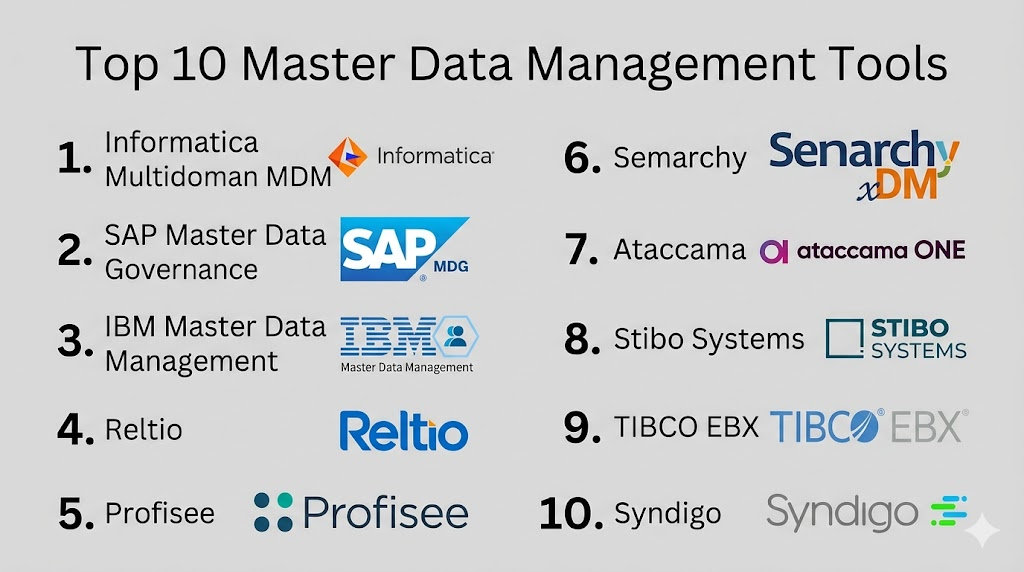
Top 10 Master Data Management Tools
#1 — Informatica Multidomain MDM
Short description: A modular, cloud-native MDM platform that provides a unified view of relationships between data domains. It is designed for large-scale digital transformations.
Key Features
- AI-Powered Claire Engine: Uses machine learning for automated data discovery, mapping, and entity resolution.
- 360-Degree Views: Pre-built “360” applications for Customer, Supplier, Product, and Employee domains.
- Microservices Architecture: Allows for flexible scaling and deployment within complex cloud environments.
- Data Quality Integration: Seamlessly integrated with Informatica’s industry-leading data cleansing and profiling tools.
- Relationship Discovery: Advanced capabilities to visualize complex hierarchies and social relationships within data.
- Multi-Cloud Support: Compatible with AWS, Azure, Google Cloud, and on-premise setups.
Pros
- Deeply mature feature set capable of solving the most complex enterprise data challenges.
- Extensive library of pre-built connectors and industry-specific data models.
Cons
- Higher total cost of ownership compared to entry-level competitors.
- Implementation can be complex, often requiring specialized consultants.
Platforms / Deployment
- Web / Windows / Linux
- Cloud / Hybrid
Security & Compliance
- SSO/SAML, MFA, RBAC, and data masking.
- SOC 2, ISO 27001, GDPR, and HIPAA compliant.
Integrations & Ecosystem
Informatica boasts one of the most robust integration hubs in the software world.
- SAP, Oracle, and Salesforce
- Snowflake, Databricks, and AWS Redshift
- Microsoft Dynamics 365
- ServiceNow
Support & Community
Industry-leading support tiers with 24/7 global availability. The Informatica Network provides a massive community forum and extensive training certifications.
#2 — SAP Master Data Governance (MDG)
Short description: A state-of-the-art governance platform that provides centralized ownership of master data across the SAP ecosystem and beyond.
Key Features
- Native S/4HANA Integration: Leverages the same business rules and data structures as SAP’s core ERP system.
- Consolidation and Central Governance: Supports both decentralized data consolidation and centralized data creation.
- Workflow Management: Robust, customizable approval workflows with role-based responsibilities.
- Mass Processing: Tools to handle bulk changes to millions of product or business partner records simultaneously.
- Data Quality Management: Integrated dashboards to monitor and remediate data health in real-time.
- Reuse Mode: Directly uses existing SAP data models, reducing the need for complex data mapping.
Pros
- Perfect for organizations already committed to an SAP-centric IT landscape.
- Strongest governance and audit trail capabilities in the enterprise market.
Cons
- User interface can feel “archaic” compared to modern SaaS-first platforms.
- Integration with non-SAP systems can be more challenging and time-consuming.
Platforms / Deployment
- Web / Windows
- Cloud / Self-hosted / Hybrid
Security & Compliance
- Standard SAP Security (SSO, MFA), detailed audit logs.
- Compliant with major financial and privacy regulations globally.
Integrations & Ecosystem
Tightly coupled with the SAP Business Technology Platform (BTP).
- SAP S/4HANA and Ariba
- SAP SuccessFactors
- Third-party systems via SAP Cloud Integration
- Open APIs for custom development
Support & Community
Backed by SAP’s massive global support infrastructure. Extensive documentation and a global network of SAP-certified implementation partners.
#3 — IBM Master Data Management
Short description: A high-performance MDM solution part of the IBM Cloud Pak for Data, focusing on intelligent matching and 360-degree views.
Key Features
- Intelligent Matching Engine: Combines probabilistic and deterministic matching powered by machine learning.
- Cloud Pak for Data Integration: Runs on a unified data and AI platform for seamless stewardship.
- Automapping Capabilities: Automatically generates data models and maps attributes during onboarding.
- Consent Management: Built-in tools to track and manage data privacy consents across multiple channels.
- Person/Organization Insights: Specialized algorithms for identifying household and corporate relationships.
- Hybrid Cloud Architecture: Built on Red Hat OpenShift for deployment flexibility across any cloud.
Pros
- World-class matching engine that handles messy, inconsistent data with high precision.
- Seamlessly transitions from data management to advanced AI/ML modeling within the same platform.
Cons
- Licensing structures can be complex and expensive for mid-sized organizations.
- Requires significant technical expertise to tune the matching algorithms for peak performance.
Platforms / Deployment
- Web / Linux
- Cloud / Hybrid
Security & Compliance
- SSO, RBAC, encryption at rest/transit via Cloud Pak for Data.
- ISO 27001, SOC 2, and GDPR ready.
Integrations & Ecosystem
Highly extensible via a rich set of REST APIs and integrated IBM services.
- Watson Studio and DataStage
- Salesforce and Workday
- Mainframe and Legacy systems
- Major cloud providers (AWS, Azure, IBM Cloud)
Support & Community
Professional support with various SLA tiers. IBM provides extensive technical documentation and developer advocacy programs.
#4 — Reltio
Short description: A cloud-native, AI-powered MDM platform designed for real-time data unification and context intelligence.
Key Features
- Intelligent Data Graph: Models data as a network of entities and relationships rather than simple tables.
- AgentFlow Layer: Uses AI agents to automate data stewardship and business process workflows.
- Velocity Packs: Industry-specific data models for Life Sciences, Healthcare, and Financial Services.
- Resolve-on-Read Patterns: Provides real-time data access with dynamic record resolution.
- Multitenant SaaS: Zero-maintenance infrastructure with automatic updates and scaling.
- Continuous Data Quality: Real-time profiling and cleansing as data enters the system.
Pros
- True cloud-native architecture that scales horizontally without manual intervention.
- Fastest time-to-value for modern SaaS-heavy organizations.
Cons
- Limited on-premise options, which may be a drawback for certain high-security sectors.
- The graph-based approach requires a shift in mindset from traditional relational MDM.
Platforms / Deployment
- Web
- Cloud (SaaS)
Security & Compliance
- SSO/SAML, MFA, RBAC, high-level encryption.
- SOC 2, HIPAA, ISO 27001, and GDPR compliant.
Integrations & Ecosystem
Reltio Integration Hub provides connectivity to over 1,000 enterprise applications.
- Salesforce, SAP, and Oracle
- Snowflake and Google BigQuery
- MuleSoft and Workato
- Adobe Experience Platform
Support & Community
Excellent 24/7 technical support and a growing “Reltio Community” platform for knowledge sharing and best practices.
#5 — Profisee
Short description: A highly flexible and fast-to-deploy MDM platform that emphasizes low total cost of ownership and deep Microsoft integration.
Key Features
- Fast Track Modeling: Allows for rapid creation of data domains without complex coding.
- Golden Record Management: Streamlined interface for stewards to review, match, and merge records.
- Microsoft Azure Native: Built to integrate perfectly with the Azure Data Factory and Microsoft Purview.
- Bidirectional Sync: Ensures data changes in MDM are reflected in source systems immediately.
- Address Verification: Native integration with global address and location validation services.
- Stewardship Dashboards: Real-time visibility into data health and workflow bottlenecks.
Pros
- Significantly lower TCO compared to “Big Tech” MDM solutions.
- The best choice for organizations already utilizing a Microsoft-heavy data stack.
Cons
- Not as robust as Informatica or IBM for extremely complex, high-volume VFX/scientific datasets.
- Smaller ecosystem of third-party plugins compared to market leaders.
Platforms / Deployment
- Web / Windows
- Cloud (SaaS) / Hybrid
Security & Compliance
- Active Directory integration, RBAC, SSO.
- SOC 2 Type 2 and GDPR compliant.
Integrations & Ecosystem
Deeply embedded in the Microsoft data ecosystem.
- Microsoft Dynamics 365
- Azure Synapse and Purview
- Salesforce
- Power BI
Support & Community
Highly rated customer support and “Profisee Academy” for structured user training and certification.
#6 — Semarchy xDM
Short description: An “Intelligent Data Hub” that unifies MDM, data quality, and governance into a single, user-friendly platform.
Key Features
- Unified UI: A modern, consumer-grade interface designed for both IT and business users.
- Agile Modeling: Supports iterative data modeling that evolves as business needs change.
- Built-in Data Quality: Includes data profiling, enrichment, and validation as core features.
- Zero Coding Environment: Allows for complex governance rule definition using visual tools.
- Hierarchy Management: Visual tools to manage complex corporate and product hierarchies.
- Data Lineage: Tracks the history of every change to the “Golden Record.”
Pros
- High user adoption due to its intuitive and responsive interface.
- Consolidates multiple data tools into one, reducing software bloat.
Cons
- Does not include a native ETL (Extract, Transform, Load) tool; requires external software for complex data movement.
- Advanced technical documentation could be more comprehensive.
Platforms / Deployment
- Web
- Cloud / Self-hosted / Hybrid
Security & Compliance
- RBAC, Data masking, MFA.
- Compliant with GDPR and standard security certifications.
Integrations & Ecosystem
Focuses on standard REST APIs for connectivity.
- Salesforce and ERP systems
- Snowflake and Databricks
- Informatica and Talend (via APIs)
- Business Intelligence tools like Tableau
Support & Community
Strong technical support and an active user community. Known for being highly responsive to customer feature requests.
#7 — Ataccama ONE
Short description: A unified AI-powered platform that automates data quality, MDM, and data governance for self-service users.
Key Features
- Self-Service Stewardship: Empowers non-technical business users to take ownership of their data.
- AI Data Matching: Uses predictive analytics to suggest record matches and quality fixes.
- Multi-Domain Architecture: Easily handles Customer, Product, Asset, and Location data.
- Automated Data Discovery: Catalogues and profiles data sources automatically upon connection.
- Data Masking: Dynamic masking features to protect sensitive PII during the management process.
- Cloud-Native Microservices: Designed for high performance and high availability.
Pros
- Highly automated approach reduces the manual effort of data governance.
- Excellent balance between advanced technical features and ease of use.
Cons
- The open-source version is limited and lacks professional support.
- Visualization tools for data relationships could be more dynamic.
Platforms / Deployment
- Web / Windows / macOS / Linux
- Cloud / Self-hosted
Security & Compliance
- Access controls, SSO, and MFA.
- GDPR and major security standards compliant.
Integrations & Ecosystem
Offers a wide range of native connectors for cloud environments.
- Snowflake and Google Cloud
- AWS and Azure Data Catalog
- Microsoft Dynamics
- Salesforce
Support & Community
High-quality customer support and a collaborative community forum. Training is provided through Ataccama’s educational platform.
#8 — Stibo Systems
Short description: A specialized MDM platform with a legendary focus on Product Information Management (PIM) and complex supply chain data.
Key Features
- STEP Platform: A unified platform for managing multidomain master data (Product, Location, Supplier).
- Omni-channel Capability: Ensures product data is consistent across physical stores, websites, and mobile apps.
- Advanced Data Modeling: Highly flexible data models tailored for retailers and manufacturers.
- Asset Management: Integrated tools to manage digital assets (images, videos) associated with master data.
- Sustainability Tracking: Features specifically designed to track ESG and supply chain transparency.
- Role-Based Workflows: Detailed approval and validation processes for data governance.
Pros
- The absolute leader for retail and manufacturing organizations with massive product catalogs.
- Highly customizable to fit very specific, rigid business operating models.
Cons
- User experience is primarily optimized for desktops; limited mobile support for stewards.
- Lags slightly behind Reltio and Ataccama in terms of rapid AI integration.
Platforms / Deployment
- Web / Windows / macOS
- Cloud / Hybrid
Security & Compliance
- RBAC, SSO, MFA.
- Not publicly stated.
Integrations & Ecosystem
Deeply integrated with retail and supply chain management systems.
- SAP and Oracle ERP
- Adobe Experience Manager
- E-commerce platforms (Magento, Shopify)
- Stock and warehouse management systems
Support & Community
Excellent professional services and a dedicated global community. Stibo is known for its strong implementation partner network.
#9 — TIBCO EBX
Short description: A unique multidomain MDM solution that manages all shared data assets, including master data, reference data, and metadata.
Key Features
- Unified Platform: Manages master, reference, and metadata within a single environment.
- Version Control: Unique “branching” and “merging” capabilities similar to software development.
- Collaborative Governance: Tools for distributed teams to collaborate on data definitions and workflows.
- Data Authoring: Allows for the manual creation and editing of data directly within the MDM hub.
- Data Modeling: Graphically-driven data modeling for complex business entities.
- Deduplication Suite: Robust engine for fuzzy matching and survivorship rules.
Pros
- Exceptional for managing “Reference Data” (e.g., country codes, currency lists) alongside master data.
- Highly flexible and can be adapted to almost any vertical industry.
Cons
- The “all-in-one” approach can lead to a steeper learning curve for new teams.
- The visual interface is functional but lacks the “modern” feel of SaaS competitors.
Platforms / Deployment
- Web / Windows / Linux
- Cloud / Self-hosted / Hybrid
Security & Compliance
- RBAC, SSO, audit logs.
- Standard enterprise security compliance.
Integrations & Ecosystem
Part of the TIBCO Connected Intelligence platform.
- TIBCO Spotfire and JasperReports
- SAP and Oracle
- Major cloud providers
- Standard enterprise APIs
Support & Community
Robust enterprise support and an active user forum. TIBCO provides a large library of self-paced training.
#10 — Syndigo (Riversand)
Short description: A cloud-native MDM and PIM solution focusing on the “Product Experience” across the global digital supply chain.
Key Features
- Cloud-Native SaaS: Built on a microservices architecture for unlimited scalability.
- 360-Degree Relationships: Visualizes the links between products, customers, and suppliers.
- Digital Asset Management: Built-in tools for managing the media associated with product master data.
- Data Transparency: Focuses on eliminating data silos across marketing, sales, and logistics.
- Retail Network Connectors: Pre-built pipes to send data to major retailers like Amazon and Walmart.
- Automated Enrichment: Uses external data sources to automatically enrich product information.
Pros
- The most innovative platform for modern e-commerce and retail “product experiences.”
- Fast and scalable deployment model that grows with the business.
Cons
- Can be expensive for smaller brands or SMBs.
- May require additional configuration for non-retail sectors like finance.
Platforms / Deployment
- Web
- Cloud (SaaS)
Security & Compliance
- Enterprise-grade security, RBAC, SSO.
- Not publicly stated.
Integrations & Ecosystem
Strongest in the digital retailing and marketing space.
- Shopify, Magento, and BigCommerce
- SAP and Oracle ERP
- Salesforce
- Amazon and Walmart Retailer APIs
Support & Community
Strong technical support and detailed product tours. Syndigo provides professional onboarding and ongoing strategic advice.
Comparison Table (Top 10)
| Tool Name | Best For | Platform(s) Supported | Deployment | Standout Feature | Public Rating |
| Informatica Multidomain MDM | Large Global Enterprises | Web, Win, Linux | Hybrid | Claire AI Engine | 4.5/5 |
| SAP Master Data Governance (MDG) | SAP-Centric Ecosystems | Web, Win | Hybrid | Native S/4HANA Sync | 4.3/5 |
| IBM Master Data Management | AI-First Organizations | Web, Linux | Hybrid | Intelligent Matching | 4.4/5 |
| Reltio | Real-Time SaaS Teams | Web | Cloud (SaaS) | Intelligent Data Graph | 4.7/5 |
| Profisee | Microsoft-Centric SMB/Ent | Web, Win | Hybrid | Azure Purview Sync | 4.6/5 |
| Semarchy xDM | User Adoption & Agile | Web | Hybrid | Integrated Data Hub | 4.8/5 |
| Ataccama ONE | Self-Service Stewardship | Web, Win, Mac, Linux | Hybrid | Automated Discovery | 4.7/5 |
| Stibo Systems | Retail & Manufacturing | Web, Win, Mac | Hybrid | STEP PIM Platform | 4.5/5 |
| TIBCO EBX | Reference & Meta Management | Web, Win, Linux | Hybrid | Versioning & Branching | 4.3/5 |
| Syndigo | E-commerce Experience | Web | Cloud (SaaS) | Retailer Connectors | N/A |
Evaluation & Scoring of Master Data Management Tools
The scoring below represents how each tool performs against the critical success factors of a modern data management initiative.
| Tool Name | Core (25%) | Ease (15%) | Integrations (15%) | Security (10%) | Performance (10%) | Support (10%) | Value (15%) | Weighted Total |
| Informatica Multidomain MDM | 10 | 4 | 10 | 9 | 10 | 9 | 5 | 8.15 |
| SAP Master Data Governance (MDG) | 9 | 4 | 7 | 9 | 9 | 9 | 6 | 7.50 |
| IBM Master Data Management | 10 | 4 | 9 | 9 | 10 | 9 | 6 | 8.05 |
| Reltio | 9 | 7 | 10 | 9 | 10 | 9 | 8 | 8.80 |
| Profisee | 8 | 8 | 9 | 8 | 8 | 9 | 9 | 8.40 |
| Semarchy xDM | 8 | 10 | 8 | 8 | 9 | 8 | 9 | 8.55 |
| Ataccama ONE | 9 | 9 | 9 | 8 | 9 | 8 | 8 | 8.65 |
| Stibo Systems | 9 | 6 | 8 | 8 | 9 | 8 | 7 | 7.80 |
| TIBCO EBX | 9 | 5 | 8 | 8 | 9 | 8 | 8 | 7.60 |
| Syndigo | 8 | 8 | 9 | 8 | 9 | 8 | 7 | 8.10 |
How to interpret these scores:
The Weighted Total is a measure of overall enterprise readiness. Reltio and Ataccama ONE score highly because they combine advanced AI capabilities with modern cloud interfaces. Informatica remains the technical leader in “Core” features, though its complexity lowers its “Ease” score. Semarchy is the leader for organizations prioritizing user adoption and fast internal workflows.
Which Master Data Management Tool Is Right for You?
Solo / Freelancer
Generally, MDM is an enterprise-scale problem. However, if you are a consultant helping clients manage data, Blender (for 3D data) or small-scale specialized tools are common. For pure master data management at a solo level, using the open-source version of Ataccama or Semarchy‘s trial tiers can help you learn the framework without a massive financial commitment.
SMB
For small to medium businesses that need to scale, Profisee and Semarchy xDM are the top choices. They offer a lower entry price, faster implementation cycles, and intuitive interfaces that don’t require a dedicated team of 20 data engineers to maintain.
Mid-Market
Companies in the mid-market range often have enough complexity to require Reltio or Ataccama ONE. These cloud-native solutions allow you to scale your data management as you grow without the heavy infrastructure burden of traditional legacy MDM.
Enterprise
Global enterprises with hundreds of millions of records should prioritize Informatica Multidomain MDM, IBM, or SAP MDG (if they are an SAP shop). These platforms are designed for the “unlimited” complexity and high security requirements of the world’s largest corporations.
Budget vs Premium
- Budget Focused: Profisee, Semarchy xDM.
- Premium / High Performance: Informatica, IBM, Reltio.
Feature Depth vs Ease of Use
- Deepest Features: Informatica Multidomain MDM, SideFX Houdini (for 3D data), SAP MDG.
- Easiest to Use: Semarchy xDM, Profisee, Ataccama ONE.
Integrations & Scalability
- Best Integrations: Informatica, Reltio, Syndigo.
- Best Scalability: Reltio, IBM, Informatica.
Security & Compliance Needs
Organizations in banking or healthcare should look toward IBM, Reltio, and Informatica, as they provide the most documented compliance for HIPAA, GDPR, and financial data standards.
Frequently Asked Questions (FAQs)
1. What is the difference between MDM and PIM?
MDM is a broader strategy that manages multiple data domains (Customers, Employees, Locations). PIM (Product Information Management) is a subset of MDM specifically focused on product data for retail and e-commerce.
2. How long does a typical MDM implementation take?
A basic implementation of a single domain (e.g., Customer 360) usually takes 3 to 6 months. A full multidomain enterprise rollout can take 12 to 18 months to reach maturity.
3. Is cloud MDM better than on-premise?
Cloud MDM (SaaS) is generally better for most modern organizations due to faster deployment, automatic scaling, and lower maintenance. On-premise is usually reserved for sectors with extreme air-gapped security needs.
4. How does MDM support AI initiatives?
AI is only as good as the data it is fed. MDM ensures that the data used to train and prompt AI models is clean, consistent, and accurate, preventing “Garbage In, Garbage Out.”
5. What is a “Golden Record” in MDM?
A Golden Record is the single, authoritative version of a data entity that has been cleansed, deduplicated, and verified as the “source of truth” across the organization.
6. How does MDM handle GDPR compliance?
MDM centralizes data consent and individual records, making it easier for organizations to process “Right to be Forgotten” requests and ensure data is used only for permitted purposes.
7. Can MDM manage multiple data domains simultaneously?
Yes, modern Multidomain MDM platforms (like Informatica and Reltio) allow you to manage Customer, Product, Supplier, and Asset data within a single unified environment.
8. What is the role of a data steward in MDM?
A data steward is a human expert responsible for resolving data conflicts that the AI cannot handle automatically, ensuring high data quality and policy compliance.
9. How does MDM improve company ROI?
By reducing data duplication, automating manual cleansing, and enabling more accurate marketing and procurement, MDM often shows a return on investment within the first year of operation.
10. What is data matching and cleansing in MDM?
Data cleansing involves fixing formatting errors (e.g., typos), while matching involves identifying that “John Smith” and “J. Smith” are actually the same person to merge them into one record.
Conclusion
Master Data Management is the cornerstone of any modern data-driven organization. Choosing the right tool requires balancing technical power with user adoption. While Informatica and IBM lead in technical depth, Reltio and Ataccama ONE are redefining the market with AI-native, cloud-first approaches. For the best outcome, focus on a “pilot” domain like Customer 360 to demonstrate value before expanding to a full enterprise-wide rollout.

Find Trusted Cardiac Hospitals
Compare heart hospitals by city and services — all in one place.
Explore Hospitals
Master Data Management (MDM) tools are most valuable when they help organizations create, maintain, and govern consistent and trusted master data across multiple business systems. By providing data consolidation, entity resolution, deduplication, data cleansing, standardization, golden record creation, data governance, hierarchy management, workflow automation, data quality monitoring, and integration with ERP, CRM, and other enterprise systems, these platforms enable organizations to improve data consistency, reduce duplicate records, strengthen data governance, streamline business processes, and make more reliable data-driven decisions.