Introduction
3D Printing Workflow Software refers to tools that manage the entire lifecycle of additive manufacturing—from file preparation and slicing to printer management, job scheduling, monitoring, and post-processing coordination. These platforms act as the operational backbone for individuals and organizations working with 3D printers.
As 3D printing adoption accelerates across industries in and beyond, managing complex workflows has become essential. Whether you’re running a print farm, prototyping products, or delivering on-demand manufacturing, manual processes no longer scale. Workflow software enables automation, efficiency, and consistency.
Common Use Cases
- Managing large-scale print farms
- Industrial rapid prototyping
- On-demand manufacturing services
- Educational and research lab coordination
- Healthcare applications like custom prosthetics
What Buyers Should Evaluate
- File preparation and slicing capabilities
- Multi-printer management
- Automation and scheduling features
- Cloud vs on-premise deployment
- Integration with CAD and ERP systems
- Monitoring and remote control
- Security and user access control
- Scalability for growing operations
- Cost and licensing model
Best for: Manufacturers, engineering teams, service bureaus, educational institutions, and startups working with multiple printers or complex workflows.
Not ideal for: Hobbyists using a single printer or users who only need basic slicing tools without workflow orchestration.
Key Trends in 3D Printing Workflow Software
- AI-powered print optimization for reducing failures and material waste
- Cloud-native platforms enabling remote access and distributed manufacturing
- End-to-end automation from file upload to print completion
- Integration with Industry 4.0 systems like ERP, MES, and PLM
- Real-time monitoring with IoT sensors and cameras
- Digital inventory and part libraries for reuse and version control
- Security-first architecture with role-based access and audit logs
- Subscription-based pricing models replacing perpetual licenses
- Multi-material and multi-technology support (FDM, SLA, SLS, etc.)
- Sustainability tracking (material usage, energy efficiency)
How We Selected These Tools (Methodology)
- Evaluated market adoption and industry recognition
- Assessed feature completeness across the workflow lifecycle
- Reviewed performance and reliability indicators
- Considered security posture and enterprise readiness
- Analyzed integration capabilities and ecosystem strength
- Ensured coverage across SMB to enterprise use cases
- Included both cloud-native and desktop-based solutions
- Prioritized tools with active development and innovation
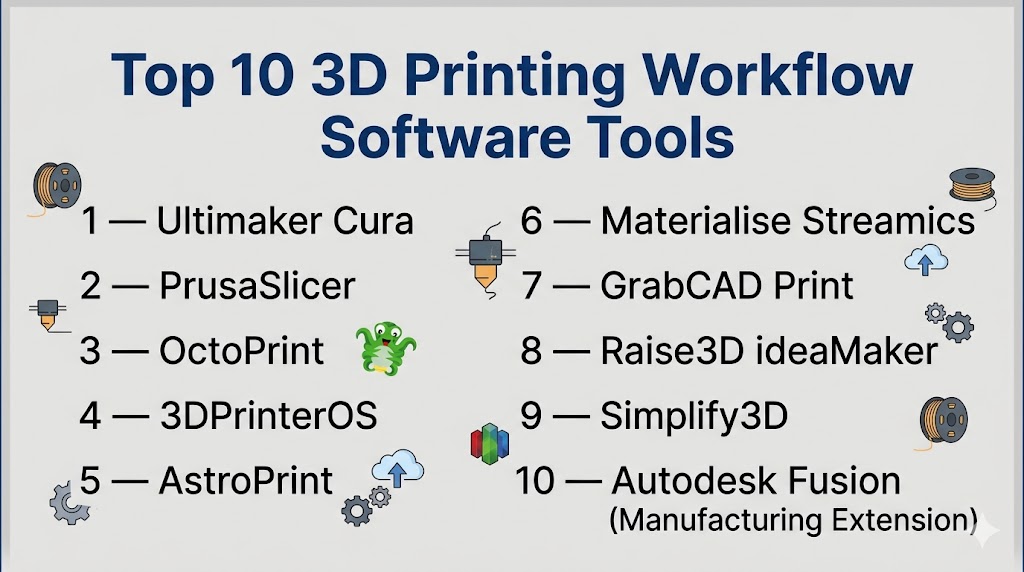
Top 10 3D Printing Workflow Software Tools
#1 — Ultimaker Cura
Short description: A widely used slicing software with strong workflow capabilities, ideal for individuals and teams using Ultimaker and compatible printers.
Key Features
- Advanced slicing engine
- Custom print profiles
- Plugin marketplace
- Multi-printer support
- Material optimization
- Open-source extensibility
Pros
- Free and widely supported
- Strong community ecosystem
Cons
- Limited enterprise workflow features
- Not ideal for large-scale automation
Platforms / Deployment
Windows / macOS / Linux
Security & Compliance
Not publicly stated
Integrations & Ecosystem
Supports plugins and integrates with CAD tools.
- SolidWorks
- Autodesk tools
- Cloud libraries
Support & Community
Large open-source community, extensive documentation.
#2 — PrusaSlicer
Short description: A powerful open-source slicer designed for precision and customization, popular among professionals and enthusiasts.
Key Features
- Advanced slicing controls
- Multi-material support
- Custom G-code editing
- Print simulation
- SLA and FDM support
Pros
- Highly customizable
- Frequent updates
Cons
- UI can be complex for beginners
- Limited workflow automation
Platforms / Deployment
Windows / macOS / Linux
Security & Compliance
Not publicly stated
Integrations & Ecosystem
Works with multiple printer ecosystems.
- OctoPrint
- Custom firmware
Support & Community
Strong community support and forums.
#3 — OctoPrint
Short description: A web-based printer management tool for remote monitoring and control.
Key Features
- Remote printer control
- Webcam monitoring
- Plugin ecosystem
- G-code streaming
- Print job management
Pros
- Highly extensible
- Great for remote operations
Cons
- Requires setup and maintenance
- Not enterprise-grade
Platforms / Deployment
Web / Self-hosted
Security & Compliance
Basic authentication, plugins for security
Integrations & Ecosystem
Extensive plugin ecosystem.
- Cura
- PrusaSlicer
- Home automation tools
Support & Community
Large open-source community.
#4 — 3DPrinterOS
Short description: A cloud-based platform for managing 3D printing workflows across multiple printers and users.
Key Features
- Cloud slicing
- Multi-user management
- File storage and sharing
- Print queue management
- Analytics dashboard
Pros
- Scalable for institutions
- Easy remote access
Cons
- Subscription required
- Limited offline functionality
Platforms / Deployment
Cloud
Security & Compliance
SSO, encryption (details not fully public)
Integrations & Ecosystem
- Google Drive
- Dropbox
- CAD tools
Support & Community
Commercial support with onboarding resources.
#5 — AstroPrint
Short description: A cloud platform for managing and monetizing 3D printing operations.
Key Features
- Remote printing
- Slicing engine
- App marketplace
- Usage analytics
- API access
Pros
- Easy setup
- Cloud convenience
Cons
- Limited advanced features
- Dependency on internet
Platforms / Deployment
Cloud
Security & Compliance
Not publicly stated
Integrations & Ecosystem
- Thingiverse
- Cloud storage
Support & Community
Moderate documentation and support.
#6 — Materialise Streamics
Short description: Enterprise-grade workflow automation software for industrial 3D printing.
Key Features
- End-to-end workflow automation
- MES integration
- Job tracking
- Production analytics
- Multi-machine coordination
Pros
- Enterprise-ready
- Highly scalable
Cons
- Complex setup
- Expensive
Platforms / Deployment
Windows / Cloud / Hybrid
Security & Compliance
Not publicly stated
Integrations & Ecosystem
- ERP systems
- MES platforms
- Industrial printers
Support & Community
Enterprise support and consulting.
#7 — GrabCAD Print
Short description: A streamlined workflow tool for Stratasys printers with CAD integration.
Key Features
- CAD file import
- Print preparation
- Job queue management
- Multi-printer control
- Simulation tools
Pros
- Easy CAD integration
- Optimized for Stratasys
Cons
- Limited to specific hardware
- Not fully open
Platforms / Deployment
Windows / Cloud
Security & Compliance
Not publicly stated
Integrations & Ecosystem
- SolidWorks
- Siemens NX
Support & Community
Backed by Stratasys support.
#8 — Raise3D ideaMaker
Short description: A slicing and workflow tool with cloud integration for Raise3D printers.
Key Features
- Custom slicing profiles
- Remote monitoring
- Print queue
- Cloud library
- Template sharing
Pros
- User-friendly
- Good cloud features
Cons
- Limited outside Raise3D ecosystem
- Fewer integrations
Platforms / Deployment
Windows / macOS / Cloud
Security & Compliance
Not publicly stated
Integrations & Ecosystem
- RaiseCloud
- CAD imports
Support & Community
Vendor-supported with growing community.
#9 — Simplify3D
Short description: A premium slicing software known for precision and control.
Key Features
- Advanced slicing
- Multi-process printing
- Preview simulation
- Custom supports
- Material profiles
Pros
- High-quality output
- Strong control
Cons
- Paid license
- Slower updates
Platforms / Deployment
Windows / macOS / Linux
Security & Compliance
Not publicly stated
Integrations & Ecosystem
- Works with most printers
- File import/export
Support & Community
Documentation available; smaller community.
#10 — Autodesk Fusion (Manufacturing Extension)
Short description: A comprehensive CAD/CAM tool with integrated additive manufacturing workflows.
Key Features
- Integrated CAD + slicing
- Simulation tools
- Generative design
- Toolpath planning
- Cloud collaboration
Pros
- All-in-one platform
- Strong design integration
Cons
- Learning curve
- Subscription cost
Platforms / Deployment
Web / Windows / macOS
Security & Compliance
Not publicly stated
Integrations & Ecosystem
- Autodesk ecosystem
- Cloud collaboration tools
Support & Community
Strong documentation and enterprise support.
Comparison Table (Top 10)
| Tool Name | Best For | Platform(s) | Deployment | Standout Feature | Public Rating |
|---|---|---|---|---|---|
| Ultimaker Cura | Beginners & pros | Win/macOS/Linux | Local | Plugin ecosystem | N/A |
| PrusaSlicer | Advanced users | Win/macOS/Linux | Local | Customization | N/A |
| OctoPrint | Remote control | Web | Self-hosted | Plugin system | N/A |
| 3DPrinterOS | Schools & teams | Web | Cloud | Multi-user mgmt | N/A |
| AstroPrint | Cloud users | Web | Cloud | Remote printing | N/A |
| Materialise Streamics | Enterprise | Win/Cloud | Hybrid | Workflow automation | N/A |
| GrabCAD Print | Stratasys users | Windows | Hybrid | CAD integration | N/A |
| ideaMaker | Raise3D users | Win/macOS | Hybrid | Cloud sync | N/A |
| Simplify3D | Professionals | Win/macOS/Linux | Local | Precision slicing | N/A |
| Autodesk Fusion | Designers | Web/Win/macOS | Cloud | CAD integration | N/A |
Evaluation & Scoring of 3D Printing Workflow Software
| Tool | Core | Ease | Integrations | Security | Performance | Support | Value | Total |
|---|---|---|---|---|---|---|---|---|
| Cura | 8 | 9 | 7 | 5 | 8 | 9 | 9 | 8.1 |
| PrusaSlicer | 9 | 7 | 7 | 5 | 9 | 8 | 9 | 8.0 |
| OctoPrint | 7 | 6 | 9 | 6 | 7 | 8 | 8 | 7.5 |
| 3DPrinterOS | 8 | 8 | 8 | 7 | 8 | 7 | 7 | 7.8 |
| AstroPrint | 7 | 8 | 7 | 6 | 7 | 7 | 7 | 7.2 |
| Streamics | 10 | 6 | 9 | 8 | 9 | 9 | 6 | 8.5 |
| GrabCAD | 8 | 8 | 7 | 6 | 8 | 8 | 7 | 7.8 |
| ideaMaker | 7 | 8 | 6 | 5 | 7 | 7 | 8 | 7.2 |
| Simplify3D | 8 | 7 | 6 | 5 | 9 | 6 | 6 | 7.3 |
| Fusion | 9 | 7 | 9 | 7 | 9 | 9 | 6 | 8.4 |
Interpretation:
Scores are comparative and reflect relative strengths across key criteria. Enterprise tools score higher in features and integrations, while open-source tools excel in value and community. Choose based on your workflow complexity and scale.
Which 3D Printing Workflow Software Tool Is Right for You?
Solo / Freelancer
- Cura, PrusaSlicer → free and powerful
- Simplify3D → premium precision
SMB
- 3DPrinterOS, AstroPrint → cloud-based ease
- ideaMaker → simple workflows
Mid-Market
- GrabCAD Print → CAD-focused teams
- Fusion → integrated design + print
Enterprise
- Materialise Streamics → full automation
- Fusion → scalable ecosystem
Budget vs Premium
- Budget: Cura, PrusaSlicer
- Premium: Streamics, Fusion
Feature Depth vs Ease of Use
- Deep features: Streamics, Fusion
- Ease: AstroPrint, ideaMaker
Integrations & Scalability
- Best: Fusion, Streamics
- Moderate: GrabCAD, 3DPrinterOS
Security & Compliance Needs
- Enterprise: Streamics
- Basic: open-source tools
Frequently Asked Questions (FAQs)
What is 3D printing workflow software?
It manages the entire process from design to printing and monitoring, improving efficiency and consistency.
Do I need workflow software for one printer?
Not necessarily. Basic slicers may be enough for single-printer setups.
Is cloud-based software better?
It depends. Cloud offers remote access, but local tools give more control.
Are these tools expensive?
Some are free (Cura), while enterprise tools can be costly.
Can I integrate with CAD tools?
Yes, many tools support CAD integration.
Is security important?
Yes, especially for enterprise and IP-sensitive workflows.
What is the best tool for beginners?
Cura is widely recommended for beginners.
Can I switch tools later?
Yes, but file compatibility and workflows should be considered.
Do these tools support all printers?
Most support multiple printers, but some are hardware-specific.
What are common mistakes?
Ignoring scalability and integration needs early on.
Conclusion
3D printing workflow software has evolved from simple slicing tools into full-scale production management platforms, reflecting the growing maturity of additive manufacturing. The right solution depends heavily on your scale, technical requirements, and integration needs rather than a single “best” tool. Individuals and small teams may benefit from flexible, cost-effective options like Cura or PrusaSlicer, while enterprises require robust automation platforms like Streamics or Fusion. As workflows become more complex, prioritizing automation, monitoring, and system integration becomes critical. Before committing, shortlist two or three tools, test them in real scenarios, and validate how well they integrate with your existing processes and security expectations.

Find Trusted Cardiac Hospitals
Compare heart hospitals by city and services — all in one place.
Explore Hospitals