Introduction
3D modeling tools are software applications used to create digital representations of objects in three dimensions. These tools are essential across industries—from game development and film production to architecture, product design, and 3D printing. They allow users to design, sculpt, and refine objects before bringing them into animation, simulation, or manufacturing pipelines.
With rapid advancements in AI, real-time rendering, and cloud collaboration, modern 3D modeling tools are more powerful and accessible than ever. Today’s platforms support everything from procedural modeling to generative AI workflows, enabling faster design cycles and higher-quality outputs.
Common Use Cases
- Game asset creation and environment design
- Film, VFX, and character modeling
- Product prototyping and industrial design
- Architectural visualization
- 3D printing and digital fabrication
What Buyers Should Evaluate
- Modeling approach (polygonal, sculpting, parametric, procedural)
- Ease of learning and UI design
- Rendering and visualization capabilities
- Performance with complex models
- Integration with animation/game engines
- Plugin and ecosystem support
- Collaboration and version control
- Hardware requirements
- Pricing and licensing flexibility
Best for: Designers, 3D artists, game developers, engineers, and architects working on visual or physical product creation.
Not ideal for: Users needing only simple graphics or 2D design—lighter tools are more efficient for those use cases.
Key Trends in 3D Modeling Tools
- AI-assisted modeling (text-to-3D, auto-retopology, smart sculpting)
- Procedural and node-based workflows gaining popularity
- Real-time rendering engines replacing traditional pipelines
- Cloud-based modeling platforms enabling collaboration
- Integration with AR/VR environments
- Cross-platform workflows improving accessibility
- Open-source tools gaining traction like Blender
- GPU acceleration improvements for faster modeling
- Generative design tools for optimized structures
- Interoperability across CAD, animation, and game engines
How We Selected These Tools (Methodology)
- Assessed industry adoption and usage across sectors
- Evaluated modeling capabilities (sculpting, parametric, polygonal)
- Reviewed performance and stability with large projects
- Analyzed integration ecosystems (engines, plugins, pipelines)
- Considered ease of use across beginner to expert levels
- Evaluated community, tutorials, and documentation
- Assessed deployment flexibility (desktop/cloud)
- Considered pricing accessibility and scalability
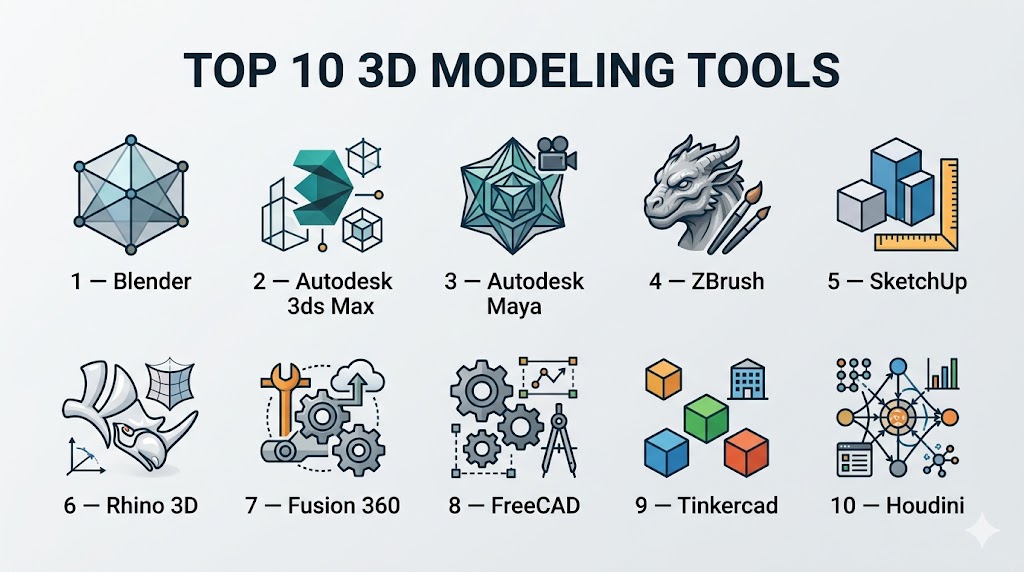
Top 10 3D Modeling Tools
#1 — Blender
Short description: A powerful open-source 3D modeling suite supporting everything from modeling to rendering and animation.
Key Features
- Polygonal and sculpting tools
- Real-time rendering (Eevee)
- Node-based workflows
- Simulation tools
- UV mapping and texturing
- Animation and rigging
- Add-on ecosystem
Pros
- Completely free
- Extremely versatile
Cons
- Steep learning curve
- Complex interface
Platforms / Deployment
Windows / macOS / Linux
Security & Compliance
Not publicly stated
Integrations & Ecosystem
Integrates with major engines and pipelines.
- Unity
- Unreal Engine
- Python API
- Add-ons marketplace
Support & Community
Very large community with extensive tutorials.
#2 — Autodesk 3ds Max
Short description: Industry-standard modeling tool for architecture, product design, and visualization.
Key Features
- Advanced polygon modeling
- Rendering tools
- Animation support
- Simulation features
- Material editor
- Plugin ecosystem
Pros
- Industry-standard
- Powerful modeling capabilities
Cons
- Windows-only
- Expensive
Platforms / Deployment
Windows
Security & Compliance
Not publicly stated
Integrations & Ecosystem
- V-Ray renderer
- Unreal Engine
- CAD tools
Support & Community
Strong professional support.
#3 — Autodesk Maya
Short description: High-end modeling and animation tool used in film and VFX production.
Key Features
- Polygon and NURBS modeling
- Advanced animation tools
- Sculpting tools
- Simulation systems
- Rendering engine
- Rigging tools
Pros
- Industry-standard for VFX
- Highly customizable
Cons
- Expensive
- Complex interface
Platforms / Deployment
Windows / macOS / Linux
Security & Compliance
Not publicly stated
Integrations & Ecosystem
- Arnold renderer
- Game engines
- Plugin ecosystem
Support & Community
Strong enterprise support.
#4 — ZBrush
Short description: Digital sculpting tool for high-detail organic models.
Key Features
- High-resolution sculpting
- Custom brushes
- Texture painting
- Mesh optimization
- Real-time preview
Pros
- Best for sculpting
- Extremely detailed output
Cons
- Unique interface
- Limited general modeling
Platforms / Deployment
Windows / macOS
Security & Compliance
Not publicly stated
Integrations & Ecosystem
- Maya
- Blender
- Export pipelines
Support & Community
Strong artist community.
#5 — SketchUp
Short description: Easy-to-use modeling tool ideal for architecture and design.
Key Features
- Simple interface
- 3D modeling
- Plugin ecosystem
- Web version
- Fast rendering
Pros
- Beginner-friendly
- Quick learning curve
Cons
- Limited advanced tools
- Not ideal for complex engineering
Platforms / Deployment
Web / Windows / macOS
Security & Compliance
Not publicly stated
Integrations & Ecosystem
- Extensions marketplace
- Rendering plugins
- Export formats
Support & Community
Large community.
#6 — Rhino 3D
Short description: Precision modeling software focused on NURBS and industrial design.
Key Features
- NURBS modeling
- Precision design
- Plugin ecosystem
- Scripting support
- Complex surface modeling
Pros
- Highly precise
- Flexible modeling
Cons
- Steep learning curve
- Limited built-in rendering
Platforms / Deployment
Windows / macOS
Security & Compliance
Not publicly stated
Integrations & Ecosystem
- Grasshopper
- CAD tools
- Rendering engines
Support & Community
Strong professional base.
#7 — Fusion 360
Short description: Cloud-based modeling platform combining CAD, CAM, and simulation.
Key Features
- Parametric modeling
- Cloud collaboration
- Simulation tools
- CAM integration
- Version control
Pros
- All-in-one solution
- Strong collaboration
Cons
- Internet dependency
- Subscription model
Platforms / Deployment
Windows / macOS / Cloud
Security & Compliance
Not publicly stated
Integrations & Ecosystem
- Autodesk ecosystem
- APIs
- Cloud storage
Support & Community
Strong documentation.
#8 — FreeCAD
Short description: Open-source parametric modeling tool for engineers and hobbyists.
Key Features
- Parametric modeling
- Modular design
- Python scripting
- Custom extensions
- CAD workflows
Pros
- Free
- Flexible
Cons
- Limited UI
- Smaller ecosystem
Platforms / Deployment
Windows / macOS / Linux
Security & Compliance
Not publicly stated
Integrations & Ecosystem
- Plugins
- Scripting
- Extensions
Support & Community
Moderate support.
#9 — Tinkercad
Short description: Beginner-friendly web-based modeling tool for simple designs.
Key Features
- Drag-and-drop modeling
- Browser-based
- 3D printing support
- Easy interface
- Educational tools
Pros
- Very easy
- Free
Cons
- Limited functionality
- Not for professionals
Platforms / Deployment
Web
Security & Compliance
Not publicly stated
Integrations & Ecosystem
- Export tools
- 3D printing
Support & Community
Good for beginners.
#10 — Houdini
Short description: Procedural modeling tool for advanced VFX and simulations.
Key Features
- Node-based workflows
- Procedural modeling
- Simulation tools
- VFX capabilities
- Custom scripting
Pros
- Extremely powerful
- Highly flexible
Cons
- Very complex
- Not beginner-friendly
Platforms / Deployment
Windows / macOS / Linux
Security & Compliance
Not publicly stated
Integrations & Ecosystem
- Game engines
- Rendering tools
- Pipelines
Support & Community
Strong professional support.
Comparison Table (Top 10)
| Tool | Best For | Platforms | Deployment | Feature | Rating |
|---|---|---|---|---|---|
| Blender | All users | Win/Mac/Linux | Local | Free full pipeline | N/A |
| 3ds Max | Architecture | Windows | Local | Modeling power | N/A |
| Maya | VFX | Win/Mac/Linux | Local | Animation tools | N/A |
| ZBrush | Sculpting | Win/Mac | Local | High detail | N/A |
| SketchUp | Beginners | Win/Mac/Web | Hybrid | Ease of use | N/A |
| Rhino | Industrial design | Win/Mac | Local | Precision | N/A |
| Fusion 360 | SMB | Win/Mac/Cloud | Hybrid | All-in-one | N/A |
| FreeCAD | Hobbyists | All | Local | Open-source | N/A |
| Tinkercad | Beginners | Web | Cloud | Simplicity | N/A |
| Houdini | VFX | Win/Mac/Linux | Local | Procedural | N/A |
Evaluation & Scoring of 3D Modeling Tools
| Tool | Core | Ease | Integrations | Security | Performance | Support | Value | Total |
|---|---|---|---|---|---|---|---|---|
| Blender | 9 | 7 | 8 | 6 | 8 | 9 | 10 | 8.5 |
| 3ds Max | 9 | 7 | 8 | 7 | 8 | 8 | 6 | 7.9 |
| Maya | 10 | 6 | 9 | 7 | 9 | 9 | 6 | 8.3 |
| ZBrush | 8 | 6 | 7 | 6 | 8 | 8 | 7 | 7.5 |
| SketchUp | 7 | 9 | 7 | 6 | 7 | 8 | 8 | 7.8 |
| Rhino | 8 | 7 | 8 | 6 | 8 | 8 | 7 | 7.9 |
| Fusion 360 | 9 | 8 | 9 | 7 | 8 | 8 | 8 | 8.5 |
| FreeCAD | 7 | 6 | 6 | 6 | 7 | 6 | 10 | 7.2 |
| Tinkercad | 5 | 10 | 5 | 5 | 6 | 7 | 10 | 6.9 |
| Houdini | 10 | 5 | 8 | 7 | 9 | 8 | 6 | 8.1 |
Scores are comparative and help identify trade-offs between capability, usability, and cost.
Which 3D Modeling Tool Is Right for You?
Solo / Freelancer
Blender, FreeCAD, or SketchUp
SMB
Fusion 360 or Rhino
Mid-Market
3ds Max or Blender
Enterprise
Maya or Houdini
Budget vs Premium
- Budget: Blender, FreeCAD
- Premium: Maya, Houdini
Feature Depth vs Ease of Use
- Depth: Houdini, Maya
- Easy: SketchUp, Tinkercad
Integrations & Scalability
- Best integrations: Blender, Fusion 360
- Scalable: Maya, Houdini
Security & Compliance Needs
Enterprise tools provide better internal controls; cloud tools depend on provider security.
Frequently Asked Questions (FAQs)
1. What is 3D modeling software used for?
It is used to create digital 3D objects for games, films, design, and manufacturing.
2. Which tool is best for beginners?
Tinkercad and SketchUp are great starting points.
3. Is Blender enough for professionals?
Yes, many professionals use Blender for production work.
4. What is the most powerful modeling tool?
Maya and Houdini are considered top-tier.
5. Do I need a powerful PC?
Yes, especially for large or detailed models.
6. Can I use these tools for 3D printing?
Yes, many tools support export for 3D printing workflows.
7. Are there free options?
Yes, Blender and FreeCAD are popular free tools.
8. How long does learning take?
It varies from weeks to months depending on complexity.
9. Can I switch tools later?
Yes, but file compatibility and retraining are factors.
10. What are common mistakes?
Choosing overly complex tools without proper training.
Conclusion
3D modeling tools are essential across industries, enabling creators to design, simulate, and visualize complex ideas before execution. From beginner-friendly tools like Tinkercad to advanced platforms like Maya and Houdini, each solution serves a specific purpose. The right choice depends on your skill level, project requirements, and integration needs. Open-source tools like Blender provide incredible value, while enterprise tools deliver unmatched performance for complex workflows. Instead of chasing a single “best” tool, focus on aligning features with your use case. Shortlist a few tools, test them in real scenarios, and evaluate how well they integrate into your workflow before making a final decision.

Find Trusted Cardiac Hospitals
Compare heart hospitals by city and services — all in one place.
Explore Hospitals