Introduction
Academic Credentialing Platforms help educational institutions issue, manage, verify, and distribute digital diplomas, transcripts, certificates, badges, and academic credentials securely. These platforms modernize credential management by replacing paper-based systems with verifiable digital credentials that can be shared instantly and authenticated globally. Academic credentialing has become increasingly important because universities, online learning providers, workforce training organizations, and governments are moving toward digital-first education ecosystems. Traditional paper diplomas and static PDF certificates are vulnerable to fraud, difficult to verify internationally, and inefficient for modern student mobility and workforce verification workflows. Modern academic credentialing platforms now combine blockchain verification, decentralized identity standards, AI-assisted fraud detection, mobile credential wallets, and automated verification systems to improve trust, scalability, and learner experience.
Real-World Use Cases Include:
- Issuing digital diplomas and transcripts
- Managing student achievement badges
- Supporting international credential verification
- Verifying workforce and professional certifications
- Enabling lifelong learning credential ecosystems
Evaluation Criteria for Buyers:
- Digital credential issuance capabilities
- Verification and fraud prevention workflows
- Blockchain and decentralized identity support
- LMS and SIS integration flexibility
- Credential revocation management
- Mobile wallet compatibility
- Security and encryption standards
- Scalability for large student populations
- User experience and accessibility
- Reporting and analytics support
Best for: universities, colleges, online learning providers, certification bodies, government education departments, workforce development organizations, and enterprise training institutions.
Not ideal for: institutions that only require basic PDF certificate generation without digital verification or modern credential-sharing capabilities.
Key Trends in Academic Credentialing Platforms
- Blockchain-backed credential verification is becoming more common across universities and certification bodies.
- Digital learner wallets are replacing paper transcripts and static certificates.
- AI-assisted fraud detection is improving credential authenticity validation.
- Verifiable credentials and decentralized identity standards are expanding globally.
- Skills-based credential ecosystems are becoming increasingly important for workforce development.
- Cross-border academic credential interoperability is gaining momentum.
- Automated transcript and diploma workflows are improving operational efficiency.
- Mobile-first credential sharing is improving accessibility for learners.
- Micro-credential and badge ecosystems are growing rapidly.
- Cloud-native academic infrastructure is replacing legacy student credential systems.
How We Selected These Tools
The tools below were selected using a practical academic credentialing evaluation framework:
- Market adoption across educational ecosystems
- Breadth of credential issuance capabilities
- Security and verification maturity
- Blockchain and decentralized identity support
- LMS and SIS integration ecosystem strength
- Scalability for academic institutions
- User experience and credential-sharing simplicity
- Vendor reputation within education technology markets
- Deployment flexibility across institutional environments
- Long-term relevance for evolving digital education ecosystems
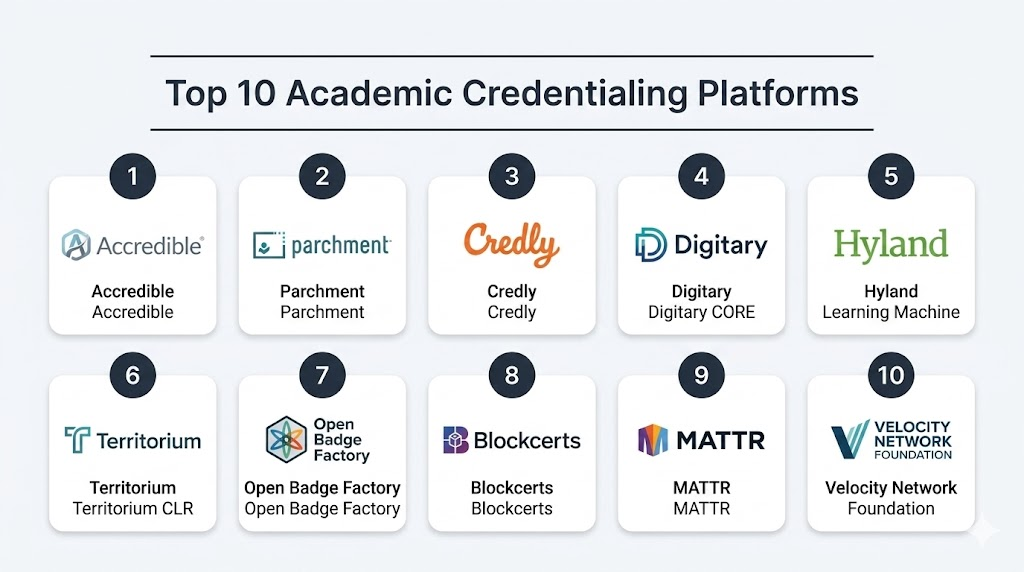
Top 10 Academic Credentialing Platforms
1- Accredible
Short description: Accredible provides digital diploma, certificate, and badge management workflows for universities, online learning providers, and enterprise training organizations.
Key Features
- Digital diploma issuance
- Blockchain-backed verification
- Credential analytics
- Automated badge generation
- Mobile credential sharing
- Credential revocation workflows
- LMS integrations
Pros
- Strong education ecosystem adoption
- Easy verification workflows
- Good automation capabilities
Cons
- Enterprise customization varies
- Advanced workflows may require planning
- Public pricing transparency limited
Platforms / Deployment
Cloud
Security & Compliance
Security controls available.
Integrations & Ecosystem
Accredible integrates credential workflows with education, HR, and learning management ecosystems.
- Learning management systems
- Student information systems
- HR platforms
- Enterprise training systems
- API integrations
Support & Community
Strong onboarding and education-sector support ecosystem.
2- Parchment
Short description: Parchment provides academic transcript, diploma, and credential management workflows for schools, universities, and education networks.
Key Features
- Transcript management
- Digital diploma issuance
- Credential verification workflows
- Automated document delivery
- Student credential access
- Institutional reporting
- API integration support
Pros
- Strong academic transcript ecosystem
- Broad institutional adoption
- Good student access workflows
Cons
- Enterprise customization varies
- Advanced blockchain support limited
- Public pricing details limited
Platforms / Deployment
Cloud
Security & Compliance
Security controls available.
Integrations & Ecosystem
Parchment integrates credential management with academic administration and student information systems.
- Student information systems
- Academic records systems
- Verification workflows
- Education platforms
- API integrations
Support & Community
Strong education administration support ecosystem.
3- Credly
Short description: Credly provides digital badges and workforce-oriented academic credentialing workflows for universities and certification providers.
Key Features
- Digital badge issuance
- Workforce skills verification
- Credential analytics
- Automated certification workflows
- Credential sharing support
- Verification APIs
- Skills tracking workflows
Pros
- Strong workforce credential ecosystem
- Good badge-sharing workflows
- Broad learning ecosystem support
Cons
- Primarily workforce-focused
- Advanced governance workflows may require customization
- Public pricing details limited
Platforms / Deployment
Cloud
Security & Compliance
Security controls available.
Integrations & Ecosystem
Credly integrates academic credentials with workforce development and enterprise learning systems.
- Learning management systems
- HR platforms
- Certification systems
- Workforce analytics
- API workflows
Support & Community
Strong training and workforce onboarding support.
4- Digitary CORE
Short description: Digitary CORE provides secure academic credential management and blockchain-based verification workflows for universities and governments.
Key Features
- Academic credential issuance
- Blockchain verification support
- Secure transcript sharing
- Student credential wallets
- Credential verification APIs
- Fraud-resistant workflows
- Digital diploma management
Pros
- Strong international academic verification support
- Good fraud prevention capabilities
- Useful student credential portability
Cons
- Enterprise deployment planning required
- Smaller commercial ecosystem
- Public pricing details limited
Platforms / Deployment
Cloud
Security & Compliance
Security controls available.
Integrations & Ecosystem
Digitary integrates academic credential workflows with institutional verification systems.
- Student information systems
- Identity verification
- Credential wallets
- Academic administration
- API integrations
Support & Community
Strong higher-education onboarding support.
5- Hyland Learning Machine
Short description: Learning Machine provides blockchain-based credential issuance and digital diploma workflows for educational institutions.
Key Features
- Blockchain credential verification
- Digital diploma issuance
- Credential lifecycle management
- Mobile credential storage
- Verification APIs
- Fraud-resistant certificates
- Decentralized identity compatibility
Pros
- Strong academic credential support
- Good blockchain verification capabilities
- Useful fraud prevention workflows
Cons
- Enterprise customization varies
- Smaller commercial ecosystem
- Public pricing details limited
Platforms / Deployment
Cloud
Security & Compliance
Security controls available.
Integrations & Ecosystem
Learning Machine integrates credential issuance with academic and identity verification ecosystems.
- Student information systems
- Credential wallets
- Identity verification
- Educational platforms
- API workflows
Support & Community
Strong education-sector implementation support.
6- Territorium CLR
Short description: Territorium CLR provides comprehensive learner records and skills-based credentialing workflows for universities and workforce ecosystems.
Key Features
- Comprehensive learner records
- Skills-based credentialing
- Competency mapping
- Credential analytics
- AI-assisted skills tracking
- Workforce alignment workflows
- Mobile credential support
Pros
- Strong lifelong learning support
- Good competency-based workflows
- Useful workforce alignment capabilities
Cons
- Enterprise deployment planning required
- Smaller institutional ecosystem
- Public pricing details limited
Platforms / Deployment
Cloud
Security & Compliance
Security controls available.
Integrations & Ecosystem
Territorium integrates learner records with workforce and education ecosystems.
- LMS platforms
- Workforce analytics
- Student systems
- Skills frameworks
- API integrations
Support & Community
Strong lifelong learning and education support ecosystem.
7- Open Badge Factory
Short description: Open Badge Factory provides digital badge and academic credential workflows for schools, universities, and training organizations.
Key Features
- Open badge issuance
- Credential verification
- Learning pathway management
- Badge analytics
- Mobile credential sharing
- LMS integrations
- Credential portability
Pros
- Strong education-focused workflows
- Good badge interoperability
- Easy onboarding and usability
Cons
- Less enterprise IAM functionality
- Limited advanced governance workflows
- Public pricing transparency limited
Platforms / Deployment
Cloud
Security & Compliance
Security controls available.
Integrations & Ecosystem
Open Badge Factory integrates academic credential workflows with LMS and workforce learning systems.
- LMS platforms
- Academic systems
- Workforce training
- Credential verification
- API integrations
Support & Community
Strong academic and training community support.
8- Blockcerts
Short description: Blockcerts provides open-standard blockchain credentialing frameworks for educational and professional verification ecosystems.
Key Features
- Open blockchain credentials
- Decentralized identity support
- Credential verification APIs
- Mobile credential wallets
- Fraud-resistant verification
- Open interoperability standards
- Credential portability
Pros
- Strong open-standard architecture
- Good decentralized identity compatibility
- Useful interoperability support
Cons
- Requires technical expertise
- Enterprise deployment complexity
- Commercial support varies
Platforms / Deployment
Cloud / Self-hosted
Security & Compliance
Varies / N/A
Integrations & Ecosystem
Blockcerts integrates decentralized academic credential workflows across open ecosystems.
- Blockchain frameworks
- Credential wallets
- Verification APIs
- Educational systems
- Identity providers
Support & Community
Strong open-source credentialing community support.
9- MATTR
Short description: MATTR provides verifiable credential infrastructure and decentralized academic identity workflows for institutions and governments.
Key Features
- Verifiable credentials
- Decentralized identity support
- Mobile credential workflows
- API-first architecture
- Identity verification support
- Credential revocation
- Privacy-preserving verification
Pros
- Strong decentralized identity capabilities
- Flexible developer-focused APIs
- Good interoperability support
Cons
- Enterprise implementation planning required
- Smaller traditional academic footprint
- Public pricing details limited
Platforms / Deployment
Cloud
Security & Compliance
Security controls available.
Integrations & Ecosystem
MATTR integrates academic credential workflows with identity verification and onboarding systems.
- Identity providers
- Academic systems
- Mobile wallets
- Verification systems
- API ecosystems
Support & Community
Strong decentralized identity implementation support.
10- Velocity Network Foundation
Short description: Velocity Network Foundation provides workforce-oriented academic credential infrastructure for professional identity ecosystems.
Key Features
- Workforce credential issuance
- Employment verification
- Blockchain credential validation
- Interoperability workflows
- Credential portability
- Identity verification APIs
- Decentralized identity support
Pros
- Strong workforce credential focus
- Good interoperability architecture
- Useful employment verification support
Cons
- Academic adoption still evolving
- Complex ecosystem coordination
- Public pricing details limited
Platforms / Deployment
Cloud / Hybrid
Security & Compliance
Security controls available.
Integrations & Ecosystem
Velocity Network integrates workforce credentials with academic and employment ecosystems.
- HR systems
- Academic records systems
- Identity providers
- API integrations
- Credential wallets
Support & Community
Growing workforce credential ecosystem support.
Comparison Table
| Tool Name | Best For | Platform Supported | Deployment | Standout Feature | Public Rating |
|---|---|---|---|---|---|
| Accredible | Digital certificates and diplomas | Web / Cloud | Cloud | Blockchain verification | N/A |
| Parchment | Academic transcript workflows | Web / Cloud | Cloud | Transcript management | N/A |
| Credly | Workforce-focused credentials | Web / Cloud | Cloud | Skills-based badges | N/A |
| Digitary CORE | International academic verification | Web / Cloud | Cloud | Student credential wallets | N/A |
| Hyland Learning Machine | Blockchain academic credentials | Web / Cloud | Cloud | Fraud-resistant diplomas | N/A |
| Territorium CLR | Comprehensive learner records | Web / Cloud | Cloud | Competency-based learning | N/A |
| Open Badge Factory | Open badge ecosystems | Web / Cloud | Cloud | Badge interoperability | N/A |
| Blockcerts | Open-source credential verification | Web / Cloud | Hybrid | Open blockchain standards | N/A |
| MATTR | Decentralized identity credentials | Web / Cloud | Cloud | API-first credentialing | N/A |
| Velocity Network Foundation | Workforce credential portability | Web / Cloud | Hybrid | Employment verification workflows | N/A |
Evaluation & Scoring of Academic Credentialing Platforms
| Tool Name | Core 25% | Ease 15% | Integrations 15% | Security 10% | Performance 10% | Support 10% | Value 15% | Weighted Total |
|---|---|---|---|---|---|---|---|---|
| Accredible | 8 | 9 | 8 | 8 | 8 | 8 | 8 | 8.10 |
| Parchment | 8 | 8 | 8 | 8 | 8 | 8 | 7 | 7.90 |
| Credly | 8 | 9 | 8 | 8 | 8 | 8 | 8 | 8.10 |
| Digitary CORE | 8 | 7 | 7 | 8 | 7 | 7 | 7 | 7.35 |
| Hyland Learning Machine | 8 | 7 | 7 | 8 | 7 | 7 | 7 | 7.35 |
| Territorium CLR | 8 | 8 | 7 | 7 | 7 | 7 | 8 | 7.60 |
| Open Badge Factory | 7 | 9 | 7 | 7 | 7 | 7 | 8 | 7.45 |
| Blockcerts | 8 | 6 | 8 | 7 | 8 | 7 | 8 | 7.45 |
| MATTR | 8 | 7 | 8 | 8 | 7 | 7 | 8 | 7.70 |
| Velocity Network Foundation | 8 | 7 | 8 | 7 | 7 | 7 | 7 | 7.35 |
Which Academic Credentialing Platform Is Right for You?
Solo / Freelancer
Independent educators and small training providers may benefit from lightweight credential issuance platforms focused on digital badges and certificate generation without requiring complex decentralized identity infrastructure.
SMB
Online learning providers, training companies, and smaller educational institutions should prioritize usability, onboarding simplicity, mobile compatibility, and LMS integrations. Accredible, Open Badge Factory, and Credly are often practical options.
Mid-Market
Mid-sized universities and workforce training ecosystems typically require stronger governance, transcript workflows, and verification capabilities. Digitary CORE, Territorium CLR, and MATTR can provide balanced functionality.
Enterprise
Large universities, government education systems, and multinational credential ecosystems should evaluate Parchment, Microsoft-compatible identity ecosystems, and blockchain-oriented platforms like Blockcerts or Velocity Network Foundation for scalability and interoperability.
Budget vs Premium
Premium academic credentialing platforms provide broader governance, advanced verification workflows, decentralized identity support, and enterprise integrations. Smaller institutions should focus first on verification simplicity and learner usability.
Feature Depth vs Ease of Use
Enterprise-grade credential systems deliver advanced governance and interoperability but often require experienced IT and identity-management teams. Cloud-native credential platforms generally simplify onboarding and student access experiences.
Integrations & Scalability
Integration quality is critical because academic credentialing platforms commonly connect with LMS platforms, SIS environments, HR systems, identity providers, mobile wallets, and verification ecosystems.
Security & Compliance Needs
Strong encryption, credential revocation workflows, audit logging, identity verification, privacy-preserving sharing, and fraud-resistant verification mechanisms are essential because academic credentialing platforms manage highly sensitive educational records and learner identities.
Frequently Asked Questions FAQs
1. What are Academic Credentialing Platforms?
Academic Credentialing Platforms help institutions issue, verify, and manage digital diplomas, transcripts, certificates, and learning badges securely. These platforms replace traditional paper-based academic records with digitally verifiable credentials. Modern systems also support blockchain verification and decentralized identity standards. They are increasingly important for modern education ecosystems.
2. Who typically uses academic credentialing platforms?
Universities, colleges, online learning providers, certification bodies, workforce development organizations, and government education agencies commonly use these platforms. Academic administrators, registrar offices, IT teams, and workforce training providers often manage deployments. Digital learning ecosystems are also major adopters. Credential verification needs usually drive implementation complexity.
3. Why are digital academic credentials important today?
Traditional paper diplomas and static PDF certificates are difficult to verify and vulnerable to fraud. Digital credentials improve trust verification, simplify global sharing, and reduce forgery risks. They also support remote education ecosystems and workforce mobility. Adoption continues expanding rapidly across academic and professional environments.
4. What types of credentials can these platforms issue?
Most academic credentialing platforms support diplomas, transcripts, badges, certificates, competency records, workforce credentials, and verifiable digital identities. Some advanced systems also support decentralized identity frameworks and blockchain-backed verification. Enterprise-grade platforms may combine credential management with identity verification workflows. Supported credential types vary by vendor.
5. Are blockchain and decentralized identity important in academic credentialing?
Yes, blockchain and decentralized identity frameworks improve credential authenticity, portability, and interoperability. Traditional centralized credential systems can create verification delays and trust limitations. Decentralized identity workflows allow learners to securely manage and share verified credentials independently. However, institutional adoption maturity still varies significantly.
6. Can academic credentialing platforms support workforce verification?
Yes, many modern platforms support workforce certification, skills verification, employment readiness badges, and professional identity workflows. This capability is becoming increasingly important for lifelong learning ecosystems and global hiring workflows. Buyers should verify exact workforce integration support before deployment. Functionality varies across vendors.
7. What integrations matter most for academic credentialing systems?
Important integrations include LMS platforms, student information systems, HR systems, identity providers, credential wallets, APIs, and workforce verification platforms. API flexibility is especially important for enterprise-scale deployments. Poor integrations can create fragmented credential ecosystems and operational inefficiencies. Integration planning should be prioritized early.
8. Are cloud-based credentialing platforms secure?
Most enterprise credentialing vendors provide encryption, audit logging, access controls, and verification security workflows. However, institutions should independently review vendor security documentation and operational controls carefully. Security expectations vary depending on regulatory exposure and student data sensitivity. Education institutions should involve IT and security teams during procurement.
9. What mistakes should institutions avoid during implementation?
Common mistakes include underestimating interoperability complexity, ignoring credential revocation workflows, focusing only on issuance instead of verification, and failing to involve IT teams early. Some institutions also overlook mobile usability and learner access requirements. Poor planning can create fragmented credential ecosystems. Pilot deployments are highly recommended.
10. How long does academic credentialing platform implementation usually take?
Implementation timelines vary depending on credential complexity, integration requirements, governance workflows, and institutional scale. Smaller cloud-native deployments may move relatively quickly, while university-wide rollouts can take several months. Verification workflows, SIS integrations, and interoperability testing often require significant planning. Institutions should use phased deployment strategies whenever possible.
Conclusion
Academic Credentialing Platforms are becoming foundational infrastructure for modern education ecosystems, workforce verification, and digital identity management. As universities, governments, online learning providers, and workforce development organizations continue replacing paper-based credentials with secure digital verification workflows, institutions need scalable systems capable of delivering trusted issuance, fraud-resistant verification, credential portability, and interoperability. The right platform depends on institutional size, governance requirements, integration complexity, and decentralized identity priorities. Large universities and enterprise education ecosystems may prioritize Parchment, Accredible, and blockchain-oriented verification platforms for scalability and governance, while workforce-focused ecosystems may prefer Credly, Territorium CLR, or Velocity Network Foundation for skills verification and lifelong learning workflows. Before selecting an academic credentialing platform, institutions should shortlist a few vendors, validate integrations carefully, test verification workflows, review governance and privacy controls, and run pilot deployments using realistic academic credential scenarios.

Find Trusted Cardiac Hospitals
Compare heart hospitals by city and services — all in one place.
Explore Hospitals
Good comparison! I didn’t know there were so many features involved in academic credentialing beyond just issuing certificates.