Introduction
Student Information Systems SIS platforms help schools, colleges, universities, and educational institutions manage student data, admissions, attendance, grades, scheduling, communication, billing, transcripts, compliance reporting, and academic workflows from a centralized platform. These systems act as the operational backbone of modern education environments by connecting administrators, teachers, students, parents, finance teams, and academic departments into a unified digital ecosystem. SIS platforms are becoming increasingly important because educational institutions are handling larger student populations, hybrid learning environments, digital credential ecosystems, compliance reporting requirements, and data-driven academic operations. Traditional spreadsheets and disconnected databases create inefficiencies, data inconsistencies, security risks, and poor student experiences. Modern SIS platforms now combine automation, AI-assisted analytics, cloud-native architecture, mobile accessibility, integrations with learning management systems, and real-time reporting to improve operational efficiency and institutional decision-making.
Real-World Use Cases Include:
- Managing student admissions and enrollment
- Tracking attendance, grades, and academic performance
- Automating transcript and reporting workflows
- Supporting parent, student, and faculty communication
- Managing tuition, billing, and financial records
Evaluation Criteria for Buyers:
- Student lifecycle management capabilities
- Ease of use for staff and students
- LMS and third-party integration support
- Reporting and analytics functionality
- Mobile accessibility and portals
- Security and data privacy controls
- Scalability for institutional growth
- Compliance and audit support
- Automation and workflow management
- Cloud deployment and infrastructure flexibility
Best for: K-12 schools, colleges, universities, online education providers, vocational institutes, and enterprise learning organizations requiring centralized academic and student administration systems.
Not ideal for: very small institutions that only require basic attendance or grading software without full academic administration workflows.
Key Trends in Student Information Systems SIS
- AI-assisted student analytics are helping institutions identify retention and performance risks earlier.
- Cloud-native SIS deployments are replacing legacy on-premise education systems.
- Mobile-first student portals are becoming standard expectations.
- Integrated LMS and SIS ecosystems are improving academic workflow automation.
- Digital credentialing and transcript integration are expanding rapidly.
- Self-service enrollment and registration workflows are reducing administrative workloads.
- Data interoperability standards are improving educational data exchange.
- Real-time institutional reporting and dashboards are supporting faster decision-making.
- Automation of compliance and audit reporting is becoming increasingly important.
- Student engagement analytics and communication tools are becoming core platform capabilities.
How We Selected These Tools
The tools below were selected using a practical academic operations and institutional management evaluation framework:
- Market adoption across K-12 and higher education
- Breadth of academic administration features
- Reporting and analytics maturity
- Integration ecosystem strength
- Scalability for institutional deployments
- User experience for students and administrators
- Cloud infrastructure and deployment flexibility
- Vendor reputation within education technology markets
- Security and compliance readiness
- Long-term relevance for evolving digital education ecosystems
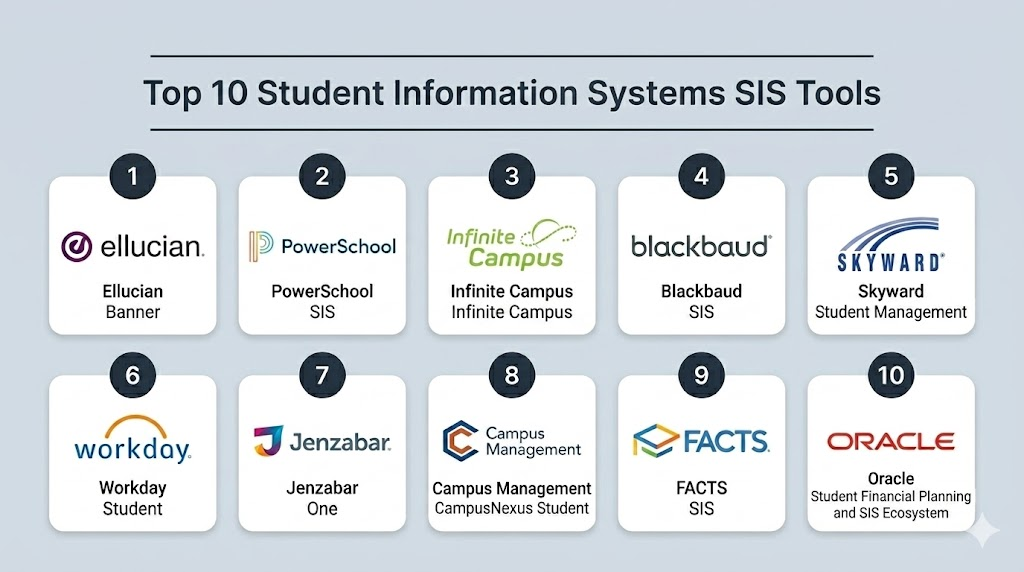
Top 10 Student Information Systems SIS Tools
1- Ellucian Banner
Short description: Ellucian Banner provides enterprise-grade SIS workflows for colleges and universities managing complex academic, financial, and administrative operations.
Key Features
- Student lifecycle management
- Academic records management
- Financial aid workflows
- Scheduling and enrollment tools
- Reporting and analytics
- Compliance management
- Self-service student portals
Pros
- Strong higher education ecosystem
- Broad administrative functionality
- Scalable enterprise architecture
Cons
- Complex implementation workflows
- Requires dedicated IT planning
- Public pricing transparency limited
Platforms / Deployment
Cloud / Hybrid
Security & Compliance
Enterprise-grade controls available.
Integrations & Ecosystem
Ellucian integrates SIS workflows with academic, financial, and learning ecosystems.
- Learning management systems
- Financial systems
- HR platforms
- Student portals
- API integrations
Support & Community
Strong higher education implementation and support ecosystem.
2- PowerSchool SIS
Short description: PowerSchool SIS provides K-12 student administration workflows for schools and school districts managing student records and communication.
Key Features
- Attendance tracking
- Gradebook management
- Parent and student portals
- Scheduling workflows
- Enrollment management
- Reporting and analytics
- Communication tools
Pros
- Strong K-12 adoption
- Good parent communication features
- Easy-to-use administrative workflows
Cons
- Higher education functionality limited
- Advanced customization varies
- Public pricing details limited
Platforms / Deployment
Cloud
Security & Compliance
Security controls available.
Integrations & Ecosystem
PowerSchool integrates student administration with K-12 education ecosystems.
- Learning platforms
- Parent communication tools
- Academic reporting
- District systems
- API integrations
Support & Community
Strong K-12 education support ecosystem.
3- Infinite Campus
Short description: Infinite Campus provides cloud-based student administration and district-wide SIS workflows for K-12 education environments.
Key Features
- Student information management
- Scheduling workflows
- Attendance monitoring
- Parent communication portals
- State reporting support
- Learning analytics
- Mobile accessibility
Pros
- Strong district-level functionality
- Good state reporting support
- Unified K-12 workflows
Cons
- Higher education support limited
- Enterprise customization varies
- Public pricing details limited
Platforms / Deployment
Cloud
Security & Compliance
Security controls available.
Integrations & Ecosystem
Infinite Campus integrates student workflows with district reporting and learning systems.
- Learning management systems
- State reporting tools
- Parent portals
- Analytics systems
- API integrations
Support & Community
Strong district implementation support ecosystem.
4- Blackbaud SIS
Short description: Blackbaud SIS provides student administration workflows for private schools and independent educational institutions.
Key Features
- Admissions management
- Student records management
- Academic scheduling
- Tuition billing
- Parent communication
- Reporting dashboards
- Mobile access support
Pros
- Strong private school workflows
- Good fundraising ecosystem compatibility
- Useful financial management features
Cons
- Large university support limited
- Enterprise customization varies
- Public pricing transparency limited
Platforms / Deployment
Cloud
Security & Compliance
Security controls available.
Integrations & Ecosystem
Blackbaud integrates SIS workflows with financial and institutional management ecosystems.
- Tuition systems
- Communication platforms
- Learning tools
- Development systems
- API integrations
Support & Community
Strong private education onboarding support.
5- Skyward Student Management
Short description: Skyward provides student administration and district management workflows for K-12 schools and educational institutions.
Key Features
- Attendance management
- Student records workflows
- Gradebook functionality
- Parent communication
- Reporting tools
- Scheduling support
- Financial management
Pros
- Strong usability for K-12 staff
- Good district management workflows
- Reliable reporting capabilities
Cons
- Advanced analytics vary
- Large university support limited
- Public pricing details limited
Platforms / Deployment
Cloud / Hybrid
Security & Compliance
Security controls available.
Integrations & Ecosystem
Skyward integrates student management workflows with district and academic ecosystems.
- Learning platforms
- Reporting systems
- Parent portals
- Financial tools
- API integrations
Support & Community
Strong K-12 administrative support ecosystem.
6- Workday Student
Short description: Workday Student provides cloud-native student lifecycle management and academic administration workflows for higher education institutions.
Key Features
- Student lifecycle management
- Enrollment and admissions workflows
- Academic planning
- Financial integration
- Reporting dashboards
- Mobile student access
- Enterprise analytics
Pros
- Strong cloud-native architecture
- Unified enterprise workflows
- Good analytics capabilities
Cons
- Enterprise implementation complexity
- Premium pricing positioning
- Requires institutional planning
Platforms / Deployment
Cloud
Security & Compliance
Enterprise-grade controls available.
Integrations & Ecosystem
Workday integrates student workflows with enterprise HR and financial systems.
- Financial systems
- HR platforms
- Learning management systems
- Analytics platforms
- API ecosystems
Support & Community
Strong enterprise higher education support ecosystem.
7- Jenzabar One
Short description: Jenzabar One provides integrated SIS and campus management workflows for colleges and universities.
Key Features
- Student lifecycle management
- Academic scheduling
- Enrollment workflows
- Financial management
- Reporting dashboards
- Mobile accessibility
- Campus communication tools
Pros
- Strong higher education workflows
- Good campus-wide integration
- Unified academic administration
Cons
- Smaller ecosystem than some competitors
- Enterprise customization may require planning
- Public pricing details limited
Platforms / Deployment
Cloud / Hybrid
Security & Compliance
Security controls available.
Integrations & Ecosystem
Jenzabar integrates SIS workflows with academic and administrative systems.
- Learning management systems
- Financial tools
- Student portals
- Reporting systems
- API integrations
Support & Community
Strong higher education implementation support.
8- CampusNexus Student
Short description: CampusNexus Student provides enterprise student administration workflows for higher education institutions and online learning ecosystems.
Key Features
- Enrollment management
- Student records workflows
- Academic administration
- Compliance reporting
- Financial aid support
- Analytics dashboards
- Mobile student portals
Pros
- Strong higher education focus
- Good compliance workflows
- Useful online learning support
Cons
- Implementation planning required
- Smaller ecosystem visibility
- Public pricing transparency limited
Platforms / Deployment
Cloud
Security & Compliance
Security controls available.
Integrations & Ecosystem
CampusNexus integrates academic workflows with student services and analytics systems.
- LMS platforms
- Financial systems
- Student portals
- Reporting tools
- API integrations
Support & Community
Strong higher education onboarding support.
9- FACTS SIS
Short description: FACTS SIS provides student administration and communication workflows for private schools and faith-based educational institutions.
Key Features
- Attendance tracking
- Grade management
- Tuition billing
- Parent communication
- Scheduling workflows
- Student records management
- Reporting support
Pros
- Strong private school workflows
- Good parent communication tools
- Easy administrative usability
Cons
- Large university support limited
- Advanced analytics capabilities vary
- Public pricing details limited
Platforms / Deployment
Cloud
Security & Compliance
Security controls available.
Integrations & Ecosystem
FACTS integrates student workflows with tuition and parent communication systems.
- Tuition systems
- Parent portals
- Academic records
- Learning tools
- API integrations
Support & Community
Strong private education support ecosystem.
10- Oracle Student Financial Planning and SIS Ecosystem
Short description: Oracle provides enterprise student administration and financial planning workflows for universities and large academic institutions.
Key Features
- Enterprise student administration
- Financial planning workflows
- Academic records management
- Reporting dashboards
- Enrollment support
- Enterprise analytics
- Cloud infrastructure support
Pros
- Strong enterprise scalability
- Broad analytics capabilities
- Good financial ecosystem integration
Cons
- Complex implementation planning
- Enterprise pricing positioning
- Requires dedicated administration expertise
Platforms / Deployment
Cloud / Hybrid
Security & Compliance
Enterprise-grade controls available.
Integrations & Ecosystem
Oracle integrates SIS workflows with enterprise financial and academic systems.
- Financial systems
- HR platforms
- Analytics tools
- Learning management systems
- API integrations
Support & Community
Strong enterprise implementation and support ecosystem.
Comparison Table
| Tool Name | Best For | Platform Supported | Deployment | Standout Feature | Public Rating |
|---|---|---|---|---|---|
| Ellucian Banner | Universities | Web / Cloud | Hybrid | Enterprise academic administration | N/A |
| PowerSchool SIS | K-12 schools | Web / Mobile | Cloud | Parent communication workflows | N/A |
| Infinite Campus | School districts | Web / Mobile | Cloud | State reporting support | N/A |
| Blackbaud SIS | Private schools | Web / Cloud | Cloud | Tuition and fundraising workflows | N/A |
| Skyward Student Management | K-12 administration | Web / Mobile | Hybrid | District management usability | N/A |
| Workday Student | Enterprise higher education | Web / Mobile | Cloud | Unified enterprise workflows | N/A |
| Jenzabar One | Colleges and universities | Web / Cloud | Hybrid | Campus-wide integration | N/A |
| CampusNexus Student | Online and higher education | Web / Mobile | Cloud | Compliance reporting support | N/A |
| FACTS SIS | Private and faith-based schools | Web / Mobile | Cloud | Tuition management integration | N/A |
| Oracle SIS Ecosystem | Large universities | Web / Cloud | Hybrid | Enterprise analytics and finance | N/A |
Evaluation & Scoring of Student Information Systems SIS
| Tool Name | Core 25% | Ease 15% | Integrations 15% | Security 10% | Performance 10% | Support 10% | Value 15% | Weighted Total |
|---|---|---|---|---|---|---|---|---|
| Ellucian Banner | 9 | 7 | 9 | 9 | 8 | 8 | 7 | 8.20 |
| PowerSchool SIS | 8 | 9 | 8 | 8 | 8 | 8 | 8 | 8.10 |
| Infinite Campus | 8 | 8 | 8 | 8 | 8 | 8 | 8 | 8.00 |
| Blackbaud SIS | 7 | 8 | 7 | 8 | 7 | 7 | 7 | 7.25 |
| Skyward Student Management | 8 | 8 | 7 | 7 | 8 | 8 | 8 | 7.75 |
| Workday Student | 9 | 7 | 9 | 9 | 8 | 8 | 7 | 8.20 |
| Jenzabar One | 8 | 7 | 8 | 8 | 7 | 7 | 7 | 7.55 |
| CampusNexus Student | 8 | 7 | 8 | 8 | 7 | 7 | 7 | 7.55 |
| FACTS SIS | 7 | 8 | 7 | 7 | 7 | 7 | 8 | 7.30 |
| Oracle SIS Ecosystem | 9 | 6 | 9 | 9 | 8 | 8 | 6 | 8.00 |
Which Student Information Systems SIS Tool Is Right for You?
Solo / Freelancer
Independent educators and very small institutions may not require full enterprise SIS functionality. Lightweight academic management platforms may be sufficient for attendance and grading workflows.
SMB
Small schools and private educational institutions should prioritize usability, parent communication, mobile access, and affordable administration workflows. PowerSchool SIS, FACTS SIS, and Blackbaud SIS are often practical options.
Mid-Market
Mid-sized colleges and districts typically require stronger reporting, academic administration, and integration capabilities. Infinite Campus, Jenzabar One, and CampusNexus Student can provide balanced functionality.
Enterprise
Large universities, government education systems, and enterprise learning ecosystems should evaluate Ellucian Banner, Workday Student, and Oracle SIS solutions for scalability and governance capabilities.
Budget vs Premium
Premium SIS platforms provide broader analytics, automation, enterprise governance, and financial integration capabilities. Smaller institutions should focus first on usability, communication workflows, and operational simplicity.
Feature Depth vs Ease of Use
Enterprise-grade SIS platforms deliver advanced governance and reporting capabilities but often require experienced IT and administrative teams. Cloud-native SIS platforms generally simplify onboarding and daily academic workflows.
Integrations & Scalability
Integration quality is critical because SIS platforms commonly connect with LMS platforms, HR systems, financial software, identity providers, reporting tools, and communication systems.
Security & Compliance Needs
Strong encryption, access controls, audit logging, student data privacy protections, role-based permissions, and compliance reporting workflows are essential because SIS platforms manage highly sensitive educational and financial data.
Frequently Asked Questions FAQs
1. What is a Student Information System SIS?
A Student Information System SIS is a centralized platform used by educational institutions to manage student records, enrollment, grades, attendance, billing, scheduling, and academic administration workflows. These systems help schools streamline operations and improve communication between administrators, students, parents, and faculty. Modern SIS platforms also support analytics and mobile access.
2. Who typically uses SIS platforms?
K-12 schools, colleges, universities, online learning providers, vocational institutes, and training organizations commonly use SIS platforms. Administrators, registrar offices, teachers, finance departments, students, and parents may all interact with the system. Larger institutions often use SIS platforms as the operational backbone of academic management. Adoption is widespread across education sectors.
3. Why are cloud-based SIS platforms becoming more popular?
Cloud-based SIS platforms simplify deployment, improve scalability, reduce infrastructure maintenance, and enable remote access for administrators, students, and parents. Institutions also benefit from automatic updates and better integration flexibility. Mobile-first access has become increasingly important for modern education ecosystems. Cloud adoption continues accelerating globally.
4. What features are most important in an SIS platform?
Important features include enrollment management, grade tracking, attendance workflows, scheduling, reporting dashboards, financial administration, parent communication, mobile access, and integration support. Institutions should also evaluate analytics capabilities and scalability carefully. Security and compliance controls are equally important because SIS platforms manage sensitive student data.
5. Can SIS platforms integrate with Learning Management Systems LMS?
Yes, most modern SIS platforms support integrations with LMS platforms to synchronize student data, grades, attendance, assignments, and academic records. Strong LMS integration reduces administrative duplication and improves data consistency. Buyers should verify exact integration capabilities before deployment. Integration maturity varies across vendors.
6. Are SIS platforms suitable for online learning institutions?
Yes, many SIS vendors now support online and hybrid learning environments with mobile access, digital workflows, self-service enrollment, and cloud-native infrastructure. Online learning institutions often prioritize scalability and integration flexibility. Student engagement analytics are also becoming increasingly important. Cloud deployments are especially useful for remote education ecosystems.
7. What integrations matter most for SIS platforms?
Important integrations include LMS platforms, HR systems, financial software, communication tools, analytics systems, identity providers, reporting platforms, and digital credentialing solutions. API flexibility is critical for large institutions managing multiple academic systems. Poor integrations can create fragmented operational workflows. Integration planning should be prioritized early.
8. Are SIS platforms secure enough for student data?
Most enterprise SIS vendors provide encryption, role-based access controls, audit logging, authentication workflows, and compliance-focused security features. However, institutions should independently review vendor security documentation carefully. Student records contain highly sensitive personal and financial information. IT and compliance teams should participate during vendor evaluation.
9. What mistakes should institutions avoid during SIS implementation?
Common mistakes include underestimating data migration complexity, ignoring integration planning, failing to train staff adequately, and selecting systems based only on pricing. Some institutions also overlook scalability and reporting requirements. Poor implementation planning can create operational inefficiencies and adoption challenges. Pilot testing is strongly recommended.
10. How long does SIS implementation usually take?
Implementation timelines vary depending on institutional size, data migration complexity, integrations, and governance requirements. Smaller deployments may move relatively quickly, while university-wide enterprise rollouts can take several months. Training, workflow customization, and data validation often require significant planning. Institutions should use phased implementation strategies whenever possible.
Conclusion
Student Information Systems SIS platforms have become foundational infrastructure for modern education management, student engagement, institutional reporting, and academic operations. As educational institutions continue moving toward digital-first administration and hybrid learning environments, schools and universities need scalable systems capable of supporting enrollment, attendance, communication, financial workflows, reporting, and analytics from a centralized platform. The best SIS platform depends on institutional size, operational complexity, reporting requirements, integration needs, and budget priorities. Large universities and enterprise education ecosystems may prioritize Ellucian Banner, Workday Student, and Oracle SIS solutions for scalability and governance, while K-12 schools and smaller institutions may prefer PowerSchool SIS, Infinite Campus, or FACTS SIS for usability and communication workflows. Before selecting an SIS platform, institutions should shortlist a few vendors, validate integrations carefully, test reporting workflows, review security and compliance controls, and run pilot deployments using realistic academic administration scenarios.

Find Trusted Cardiac Hospitals
Compare heart hospitals by city and services — all in one place.
Explore Hospitals
Interesting overview! I learned that a good SIS can simplify everything from student records and attendance tracking to academic reporting.