Introduction
Airline Crew Scheduling Tools help airlines plan, assign, optimize, monitor, and recover pilot and cabin crew schedules across flight operations. These systems manage crew pairing, rostering, duty limits, rest rules, qualifications, training, leave, standby crew, disruptions, and regulatory compliance. They help operations teams ensure that the right crew members are assigned to the right flights at the right time while respecting safety, labor, and operational constraints. This category matters because airline operations are becoming more complex, disruption-heavy, and compliance-sensitive. Airlines need better tools to balance cost, crew wellbeing, fatigue risk, legal duty rules, operational recovery, and passenger service continuity.
Real World Use Cases:
- Creating crew pairings and monthly rosters
- Tracking crew availability, qualifications, and legality
- Managing fatigue risk and duty-time compliance
- Reassigning crew during delays, cancellations, and aircraft swaps
- Supporting crew communication, bidding, leave, and schedule changes
Evaluation Criteria for Buyers:
- Crew pairing and rostering optimization
- Flight time limitation and rest rule compliance
- Fatigue risk management support
- Disruption recovery and crew tracking
- Training, qualification, and license management
- Crew self-service and mobile access
- Integration with flight operations and HR systems
- Reporting, auditability, and scenario planning
- Scalability for fleet, bases, and network complexity
- Security, role permissions, and data governance
Best for: Airlines, regional carriers, low-cost carriers, charter operators, airline operations control centers, crew planning teams, rostering departments, flight operations leaders, cabin crew management teams, and aviation IT teams that need reliable crew legality, cost control, fatigue awareness, and operational recovery.
Not ideal for: Very small aviation businesses with simple rosters, low crew count, and limited route complexity may not need enterprise airline crew scheduling software. Basic scheduling tools, spreadsheets, or lightweight aviation operations tools may work until duty compliance, crew availability, fatigue risk, or disruption handling becomes difficult to manage manually.
Key Trends in Airline Crew Scheduling Tools
- AI-assisted crew optimization is becoming more practical: Airlines increasingly want tools that can suggest better pairings, reduce deadheading, improve reserve use, and identify schedule risks before they affect operations.
- Fatigue risk management is a core requirement: Crew scheduling is no longer only about legal limits. Airlines also need systems that help identify fatigue exposure, rest risk, time-zone impact, night duties, and roster intensity.
- Real-time disruption recovery is critical: Weather, ATC constraints, aircraft issues, airport delays, and crew sickness require fast re-optimization and clear communication to crew members.
- Crew self-service is becoming standard: Mobile access, roster viewing, bid management, leave requests, notifications, swap requests, and acknowledgement workflows improve crew satisfaction and reduce admin workload.
- Integrated operations platforms are gaining value: Airlines increasingly prefer crew scheduling tools that connect with flight operations, aircraft scheduling, crew tracking, training, HR, payroll, and disruption systems.
- Regulatory complexity is increasing: Airlines need to manage multiple duty rules, union agreements, local labor laws, fatigue rules, qualification checks, and audit requirements across regions.
- Scenario planning is becoming more important: Crew planners need to test operational options before publishing schedules, such as new routes, fleet changes, seasonal demand, and crew shortages.
- Cloud and hybrid deployment are growing: Airlines want faster upgrades, remote collaboration, API connectivity, and resilience, while some still need hybrid architecture for operational continuity.
- Crew wellbeing is now a business priority: Better rosters, fair bidding, fatigue-aware scheduling, and transparent communication can improve retention in a competitive aviation labor market.
- Data-driven planning is replacing manual roster repair: Analytics around legality, utilization, hotel costs, reserve use, sickness, overtime, delays, and disruptions help airlines improve future schedules.
How We Selected These Tools
The tools below were selected using practical airline crew planning and operations evaluation logic:
- Market recognition among airlines, aviation operations teams, and crew management professionals
- Strength of crew pairing, rostering, tracking, legality checking, and disruption recovery workflows
- Fit across full-service carriers, low-cost carriers, regional airlines, charter operators, and airline groups
- Support for pilots, cabin crew, reserve crew, training assignments, leave, bidding, and qualifications
- Ability to support regulatory rules, labor agreements, flight time limitations, and fatigue management workflows
- Integration potential with flight operations, aircraft scheduling, PSS, HR, payroll, training, and reporting systems
- Ease of use for crew planners, operations controllers, crew schedulers, and crew members
- Reporting depth for legality, utilization, crew cost, schedule stability, duty risk, and operational recovery
- Security posture signals such as user roles, audit logs, access controls, and data protection
- Practical value for improving reliability, reducing manual effort, supporting compliance, and improving crew satisfaction
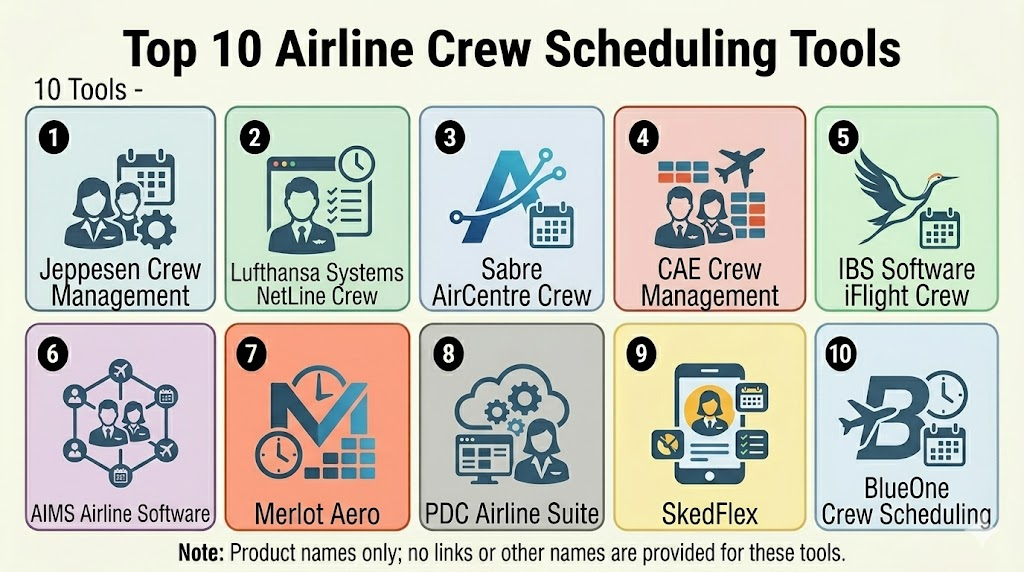
Top 10 Airline Crew Scheduling Tools
1- Jeppesen Crew Management
Short description: Jeppesen Crew Management, part of Boeing Digital Solutions, supports airline crew planning, pairing, rostering, tracking, and disruption recovery. It is best for airlines that need mature optimization, regulatory compliance, and operational recovery across complex crew networks.
Key Features
- Crew pairing and crew rostering optimization
- Crew tracking and disruption recovery workflows
- Flight time limitation and crew legality checks
- Scenario planning for schedule changes
- Crew cost and utilization visibility
- Integration with airline operations systems
- Support for complex airline rules and constraints
Pros
- Strong fit for large and complex airline operations
- Mature optimization and crew recovery capabilities
- Useful for airlines with multi-base and multi-fleet complexity
Cons
- Implementation can be complex and resource-intensive
- Smaller airlines may not need the full platform depth
- Configuration requires strong business rule mapping
Platforms / Deployment
Web / Windows / Airline operational interfaces vary
Cloud / Hosted / Hybrid options vary
Security & Compliance
Varies / N/A. Buyers should validate SSO, MFA, RBAC, audit logs, encryption, data retention, regulatory auditability, and operational access controls directly.
Integrations & Ecosystem
Jeppesen Crew Management is useful when crew planning must connect with airline operations, aircraft planning, recovery workflows, and operational control systems.
- Flight operations systems
- Aircraft scheduling tools
- Crew tracking and control systems
- Training and qualification systems
- Payroll and HR workflows
- Reporting and analytics platforms
Support & Community
Jeppesen provides airline technology support, implementation expertise, product documentation, and domain-specific consulting. Support depth depends on airline size, contract scope, modules, and migration complexity.
2- Lufthansa Systems NetLine Crew
Short description: Lufthansa Systems NetLine Crew supports crew pairing, rostering, planning, tracking, training, qualifications, and compliance workflows. It is suitable for airlines that want an integrated crew planning environment connected with broader airline operations.
Key Features
- Crew pairing and rostering optimization
- Crew planning and crew tracking workflows
- Training and qualification management
- Fatigue and duty compliance support
- Scenario handling and planning automation
- Integration with airline operations tools
- Reporting for crew cost, utilization, and legality
Pros
- Strong airline domain expertise
- Good fit for carriers needing integrated crew planning
- Useful scenario planning and optimization capabilities
Cons
- Enterprise setup requires detailed process alignment
- Smaller airlines may find the suite broader than needed
- Integration work should be scoped carefully
Platforms / Deployment
Web / Airline operational interfaces vary
Cloud / Hosted / Hybrid options vary
Security & Compliance
Varies / N/A. Buyers should validate role controls, encryption, audit logs, SSO, regulatory reports, crew data privacy, and access governance directly.
Integrations & Ecosystem
NetLine Crew is valuable when crew scheduling needs to operate with broader airline planning, control, and operational decision systems.
- NetLine airline operations ecosystem
- Flight operations planning
- Crew qualification systems
- Training planning workflows
- Crew communication tools
- Analytics and scenario reporting
Support & Community
Lufthansa Systems provides airline implementation, domain consulting, training, support, and product resources. Support depth may vary by airline size, modules, and deployment region.
3- Sabre AirCentre Crew
Short description: Sabre AirCentre Crew supports crew planning, crew management, scheduling, tracking, and disruption response as part of Sabre’s airline operations technology ecosystem. It is useful for airlines that need crew workflows connected with network operations and operational control.
Key Features
- Crew scheduling and crew planning workflows
- Crew tracking and daily operations support
- Legality and duty-rule monitoring
- Disruption management and recovery support
- Crew communication and operational visibility
- Integration with broader airline operations systems
- Reporting for schedule quality and crew utilization
Pros
- Strong fit for airline operations control environments
- Useful integration with broader Sabre airline systems
- Supports crew recovery during operational disruptions
Cons
- Implementation requires airline-specific configuration
- Smaller carriers may need lighter alternatives
- Buyers should validate roadmap and module fit carefully
Platforms / Deployment
Web / Airline operational interfaces vary
Cloud / Hosted / Hybrid options vary
Security & Compliance
Varies / N/A. Buyers should validate SSO, MFA, RBAC, encryption, audit logs, regulatory reporting, API access, and crew data privacy directly.
Integrations & Ecosystem
Sabre AirCentre Crew works well when crew scheduling must connect with airline operations, disruption control, flight planning, and commercial systems.
- Airline operations control systems
- Flight planning and aircraft scheduling
- Crew communication channels
- HR and training systems
- Payroll workflows
- Reporting and analytics tools
Support & Community
Sabre provides airline technology support, implementation services, documentation, consulting, and account management. Support experience may vary by airline size, contract, and region.
4- CAE Crew Management
Short description: CAE Crew Management supports airlines with crew planning, rostering, tracking, training, qualifications, and operational crew workflows. It is useful for carriers that want crew scheduling connected with aviation training and operational readiness.
Key Features
- Crew scheduling and roster management
- Crew tracking and operational monitoring
- Training and qualification visibility
- Duty-time and legality support
- Crew communication workflows
- Integration with aviation training systems
- Reporting for operations and crew readiness
Pros
- Strong aviation training and operations alignment
- Useful for crew qualification and training visibility
- Good fit for airlines focused on operational readiness
Cons
- Buyers should validate detailed optimization depth
- Integration with existing operations systems may require planning
- Pricing and module structure should be reviewed directly
Platforms / Deployment
Web / Mobile access varies / Airline operational interfaces vary
Cloud / Hosted / Hybrid options vary
Security & Compliance
Varies / N/A. Buyers should validate role permissions, SSO, audit logs, encryption, training record security, crew data privacy, and compliance workflows directly.
Integrations & Ecosystem
CAE Crew Management is useful when crew scheduling must connect with training, qualification, readiness, and operations workflows.
- Training management systems
- Crew qualification records
- Airline operations tools
- Crew tracking workflows
- HR and payroll systems
- Reporting dashboards
Support & Community
CAE provides aviation-focused support, training resources, implementation guidance, and customer assistance. Support scope may vary by product mix, contract, and airline requirements.
5- IBS Software iFlight Crew
Short description: IBS Software iFlight Crew is part of the broader iFlight airline operations platform, supporting crew optimization, tracking, compliance, and operational workflows. It is suitable for airlines seeking a connected operations environment across crew, flight, and disruption management.
Key Features
- Crew planning and optimization workflows
- Crew tracking and real-time operations visibility
- Compliance and legality monitoring
- Training and qualification support
- Disruption management workflows
- Integration with airline operations modules
- Reporting and decision-support dashboards
Pros
- Strong fit for airlines seeking connected operations technology
- Useful for disruption visibility and process automation
- Supports multiple airline models and operational needs
Cons
- Implementation scope can be significant
- Buyers should validate feature depth for their crew rules
- Integration planning is important for legacy environments
Platforms / Deployment
Web / Airline operational interfaces vary
Cloud / Hosted / Hybrid options vary
Security & Compliance
Varies / N/A. Buyers should validate SSO, MFA, RBAC, encryption, audit logs, regulatory compliance, data retention, and crew data protection directly.
Integrations & Ecosystem
iFlight Crew works well when crew scheduling must connect with broader airline operations, disruption handling, and digital transformation workflows.
- iFlight airline operations modules
- Flight operations systems
- Training and qualification workflows
- Crew tracking and recovery tools
- HR and payroll systems
- Analytics platforms
Support & Community
IBS Software provides airline implementation support, product documentation, customer success resources, and aviation consulting. Support depth depends on deployment size and airline complexity.
6- AIMS Airline Software
Short description: AIMS Airline Software provides crew management, operations control, scheduling, rostering, flight operations, and airline management workflows. It is widely known among airlines that need practical crew scheduling and operational control tools.
Key Features
- Crew scheduling and roster management
- Flight operations and operations control workflows
- Crew legality and duty-time checks
- Training and qualification management
- Crew communication and notifications
- Payroll and allowance support where configured
- Reporting for crew and flight operations
Pros
- Practical fit for regional, charter, and growing airlines
- Covers both crew and operational workflows
- Useful for airlines needing a broad aviation operations platform
Cons
- Interface and workflow fit should be tested by airline teams
- Advanced optimization depth should be validated for large carriers
- Integration with existing enterprise systems may require planning
Platforms / Deployment
Web / Windows / Mobile access varies
Cloud / Hosted / Self-hosted / Hybrid options vary
Security & Compliance
Varies / N/A. Buyers should validate user roles, audit logs, encryption, data backups, crew record access, duty compliance reporting, and system security directly.
Integrations & Ecosystem
AIMS works well for airlines that need crew scheduling connected with flight operations, training, payroll, and reporting.
- Flight operations systems
- Crew payroll and allowances
- Training records
- Operations control workflows
- Reporting dashboards
- Airline administrative tools
Support & Community
AIMS provides airline-focused support, implementation help, training, and product resources. Support experience may vary by airline size, modules, and deployment model.
7- Merlot Aero
Short description: Merlot Aero is an airline operations management platform that supports crew management, crew tracking, operations control, disruption handling, and communication. It is useful for airlines that need integrated crew and operations workflows with practical usability.
Key Features
- Crew scheduling and crew tracking support
- Operations control workflows
- Disruption and recovery management
- Crew communication and notifications
- Crew qualification and availability visibility
- Integration with airline systems
- Operational reporting and performance visibility
Pros
- Good fit for operationally focused airlines
- Useful for connecting crew and daily operations control
- Practical workflows for disruption response
Cons
- Buyers should validate optimization depth for complex networks
- Enterprise integrations may require careful scoping
- Availability and support model should be confirmed directly
Platforms / Deployment
Web / Mobile access varies
Cloud / Hosted options vary
Security & Compliance
Varies / N/A. Buyers should validate access roles, audit logs, encryption, crew data privacy, compliance reporting, and operational security directly.
Integrations & Ecosystem
Merlot Aero is useful when crew workflows need to connect with operations control, flight following, and disruption management.
- Operations control systems
- Crew communication tools
- Flight operations workflows
- Qualification records
- Reporting systems
- Airline data integrations
Support & Community
Merlot Aero provides aviation support, implementation assistance, and product resources. Support depth depends on airline size, modules, and contract scope.
8- PDC Airline Suite
Short description: PDC Airline Suite supports airline operations, crew planning, crew control, flight watch, and disruption management workflows. It is suitable for airlines that need operations-focused tools with crew coordination and operational awareness.
Key Features
- Crew planning and crew control workflows
- Flight watch and operational monitoring
- Disruption handling support
- Crew communication and schedule updates
- Operational data visibility
- Scenario and recovery support
- Reporting for crew and operations teams
Pros
- Strong focus on airline operations coordination
- Useful for crew control and disruption workflows
- Practical fit for airlines needing integrated operational awareness
Cons
- Buyers should validate detailed crew optimization capabilities
- May need integration with separate HR or training tools
- Product fit should be tested against airline-specific workflows
Platforms / Deployment
Web / Airline operational interfaces vary
Cloud / Hosted / Varies
Security & Compliance
Varies / N/A. Buyers should validate user permissions, auditability, data retention, encryption, crew data access, and compliance workflows directly.
Integrations & Ecosystem
PDC Airline Suite fits airlines that need crew and operations visibility across control center workflows.
- Flight watch tools
- Operations control systems
- Crew control workflows
- Communication systems
- Reporting dashboards
- Airline operational data feeds
Support & Community
PDC provides implementation resources, airline support, and operational product guidance. Support scope may vary by modules, airline size, and deployment region.
9- SkedFlex
Short description: SkedFlex is an airline crew management and scheduling tool focused on crew planning, rostering, compliance, and operational flexibility. It is relevant for airlines that need a lighter or more focused crew scheduling solution.
Key Features
- Crew roster and schedule management
- Crew availability and assignment workflows
- Duty and rest compliance checks
- Crew communication support
- Leave and availability visibility
- Reporting for crew utilization
- Operational schedule adjustment support
Pros
- Practical for airlines needing focused crew scheduling
- May be easier to adopt than large enterprise suites
- Useful for smaller and mid-sized aviation operations
Cons
- Enterprise optimization depth should be validated
- Integration ecosystem may be narrower than major vendors
- Buyers should confirm regulatory and regional rule support
Platforms / Deployment
Web / Mobile access varies
Cloud / Varies
Security & Compliance
Varies / N/A. Buyers should validate access roles, data security, audit logs, compliance reports, crew data privacy, and authentication options directly.
Integrations & Ecosystem
SkedFlex works well for aviation teams that need practical roster control and compliance visibility.
- Crew records
- Schedule workflows
- Availability tracking
- Communication tools
- Reporting dashboards
- Operational planning systems
Support & Community
SkedFlex support and onboarding should be validated directly based on airline size, deployment model, and regional support expectations.
10- BlueOne Crew Scheduling
Short description: BlueOne Crew Scheduling is a crew planning and scheduling solution for aviation operators that need roster management, crew availability, legality checks, and operational crew coordination. It is suitable for smaller airlines, charter operators, and aviation businesses that need structured crew scheduling.
Key Features
- Crew schedule and roster creation
- Crew availability and assignment management
- Duty-time and rest-rule support
- Leave and standby management
- Crew communication workflows
- Reporting for operational planning
- Support for smaller aviation operations
Pros
- Good fit for smaller aviation teams
- Useful for moving away from manual roster processes
- Supports core crew scheduling and availability workflows
Cons
- Large airline optimization depth should be validated
- Integration and automation capabilities may be limited
- Buyers should confirm support for local aviation rules
Platforms / Deployment
Web / Mobile access varies
Cloud / Varies
Security & Compliance
Varies / N/A. Buyers should validate user permissions, crew data privacy, authentication, audit logs, encryption, and regulatory reporting directly.
Integrations & Ecosystem
BlueOne Crew Scheduling is useful when aviation operators need simple but structured crew planning and schedule coordination.
- Crew availability records
- Roster workflows
- Communication tools
- Leave management
- Reporting dashboards
- Operational scheduling tools
Support & Community
BlueOne support depth should be validated directly. Buyers should review onboarding help, training resources, rule configuration support, and product roadmap before selection.
Comparison Table
| Tool Name | Best For | Platform Supported | Deployment | Standout Feature | Public Rating |
|---|---|---|---|---|---|
| Jeppesen Crew Management | Large and complex airline crew operations | Web, Windows, operational interfaces vary | Cloud / Hosted / Hybrid varies | Mature crew optimization and recovery workflows | N/A |
| Lufthansa Systems NetLine Crew | Integrated airline crew planning | Web, operational interfaces vary | Cloud / Hosted / Hybrid varies | Pairing, rostering, training, and compliance planning | N/A |
| Sabre AirCentre Crew | Airline operations control environments | Web, operational interfaces vary | Cloud / Hosted / Hybrid varies | Crew scheduling connected with operational control | N/A |
| CAE Crew Management | Crew scheduling and training alignment | Web, mobile varies | Cloud / Hosted / Hybrid varies | Crew readiness and qualification visibility | N/A |
| IBS Software iFlight Crew | Connected airline operations transformation | Web, operational interfaces vary | Cloud / Hosted / Hybrid varies | Crew optimization within a broader operations platform | N/A |
| AIMS Airline Software | Regional, charter, and growing airlines | Web, Windows, mobile varies | Cloud / Hosted / Self-hosted / Hybrid varies | Practical crew and flight operations suite | N/A |
| Merlot Aero | Crew tracking and operations control | Web, mobile varies | Cloud / Hosted varies | Crew and operations control integration | N/A |
| PDC Airline Suite | Crew control and operational awareness | Web, operational interfaces vary | Cloud / Hosted / Varies | Flight watch and crew control workflows | N/A |
| SkedFlex | Focused crew scheduling for smaller teams | Web, mobile varies | Cloud / Varies | Lightweight roster and compliance workflows | N/A |
| BlueOne Crew Scheduling | Smaller aviation crew scheduling | Web, mobile varies | Cloud / Varies | Simple crew roster and availability control | N/A |
Evaluation & Scoring of Airline Crew Scheduling Tools
| Tool Name | Core 25% | Ease 15% | Integrations 15% | Security 10% | Performance 10% | Support 10% | Value 15% | Weighted Total |
|---|---|---|---|---|---|---|---|---|
| Jeppesen Crew Management | 9.6 | 7.5 | 9.3 | 8.7 | 9.3 | 8.9 | 7.5 | 8.8 |
| Lufthansa Systems NetLine Crew | 9.4 | 7.8 | 9.1 | 8.5 | 9.0 | 8.8 | 7.7 | 8.7 |
| Sabre AirCentre Crew | 9.2 | 7.6 | 9.0 | 8.5 | 8.9 | 8.7 | 7.5 | 8.6 |
| CAE Crew Management | 8.8 | 8.0 | 8.5 | 8.2 | 8.6 | 8.5 | 7.8 | 8.4 |
| IBS Software iFlight Crew | 9.0 | 8.0 | 8.8 | 8.3 | 8.7 | 8.4 | 7.9 | 8.5 |
| AIMS Airline Software | 8.6 | 8.1 | 8.2 | 8.0 | 8.5 | 8.3 | 8.2 | 8.4 |
| Merlot Aero | 8.4 | 8.2 | 8.2 | 7.9 | 8.4 | 8.1 | 8.0 | 8.2 |
| PDC Airline Suite | 8.3 | 8.0 | 8.1 | 7.9 | 8.4 | 8.0 | 8.0 | 8.1 |
| SkedFlex | 7.8 | 8.4 | 7.5 | 7.5 | 7.9 | 7.7 | 8.4 | 7.9 |
| BlueOne Crew Scheduling | 7.6 | 8.3 | 7.3 | 7.4 | 7.8 | 7.6 | 8.3 | 7.8 |
Which Airline Crew Scheduling Tools Tool Is Right for You?
Solo / Freelancer
Solo aviation consultants, independent crew coordinators, and very small operators usually do not need full airline crew scheduling suites. A lightweight aviation scheduling tool, compliance checklist, or operational planning system may be enough for very small crew teams.
If the organization operates flights and must manage duty limits, crew legality, and standby coverage, a structured crew scheduling platform becomes more important.
SMB
Small airlines, charter operators, regional carriers, and aviation startups should focus on crew legality, simple rostering, availability tracking, crew communication, and basic reporting. AIMS Airline Software, SkedFlex, BlueOne Crew Scheduling, Merlot Aero, and PDC Airline Suite may be practical starting points.
SMBs should avoid overbuying complex optimization suites unless growth, multi-base operations, or disruption recovery demands justify the investment.
Mid-Market
Mid-market airlines often need stronger pairing optimization, crew bidding, leave planning, training visibility, legality automation, and disruption handling. AIMS, Merlot Aero, IBS Software iFlight Crew, CAE Crew Management, PDC Airline Suite, Lufthansa Systems NetLine Crew, and Sabre AirCentre Crew can fit different mid-market needs.
This segment should validate rule configuration, union agreement support, mobile crew communication, and integration with flight operations systems.
Enterprise
Large airlines need high-scale optimization, multi-base and multi-fleet scheduling, complex labor rules, reserve management, training planning, fatigue risk visibility, and fast disruption recovery. Jeppesen Crew Management, Lufthansa Systems NetLine Crew, Sabre AirCentre Crew, IBS Software iFlight Crew, and CAE Crew Management are strong enterprise candidates.
Enterprise buyers should involve crew planning, crew control, flight operations, HR, training, payroll, unions, safety, IT, cybersecurity, and finance before selecting a platform.
Budget vs Premium
Budget-conscious airlines should evaluate SkedFlex, BlueOne Crew Scheduling, AIMS Airline Software, Merlot Aero, and focused crew tools that support core rostering and legality without heavy enterprise complexity.
Premium buyers should evaluate Jeppesen, Lufthansa Systems, Sabre, IBS Software, and CAE when large-scale optimization, operational integration, fatigue management, and disruption recovery matter more than lowest cost.
Feature Depth vs Ease of Use
If ease of use matters most, AIMS, Merlot Aero, SkedFlex, BlueOne Crew Scheduling, and PDC Airline Suite may be easier starting points. If feature depth matters more, Jeppesen, Lufthansa Systems, Sabre, IBS Software, and CAE should be reviewed closely.
The best system should match airline operational complexity rather than forcing planners to work around unnecessary platform complexity.
Integrations & Scalability
Airline crew scheduling tools should integrate with flight operations, aircraft scheduling, crew tracking, training systems, qualification records, HR, payroll, fatigue risk systems, mobile communication tools, hotel logistics, and reporting platforms. Jeppesen, Lufthansa Systems, Sabre, IBS Software, CAE, and AIMS are strong candidates for integration-heavy environments.
For scaling, test multi-base rules, roster publication, disruption recovery, crew notifications, and reporting under real operational conditions.
Security & Compliance Needs
Crew scheduling tools may store personal data, license details, medical status indicators, training records, passport information, work history, location-related operational data, and labor agreement rules. Buyers should review SSO, MFA, RBAC, encryption, audit logs, access segregation, retention rules, and compliance reporting.
Airlines should also validate duty-time rule configuration, fatigue risk workflows, crew acknowledgement records, audit trails, and disaster recovery before rollout.
Frequently Asked Questions
1. What are Airline Crew Scheduling Tools?
Airline Crew Scheduling Tools help airlines plan and manage pilot and cabin crew assignments.
They support pairing, rostering, tracking, legality checks, rest rules, training, leave, and disruptions.
These tools help ensure that every flight has qualified and legal crew coverage.
They are mission-critical because crew issues can delay flights and affect safety.
2. Who needs Airline Crew Scheduling Tools?
Airlines, regional carriers, low-cost carriers, charter operators, cargo airlines, and airline operations centers need these tools.
They are especially useful when crew count, bases, duty rules, and route networks become complex.
Crew planning teams use them to create rosters, while crew control teams use them during daily operations.
Very small operators may start with simpler scheduling systems.
3. How much do Airline Crew Scheduling Tools cost?
Pricing varies by vendor, airline size, crew count, modules, optimization depth, deployment model, support level, and integration needs.
Enterprise systems often involve custom pricing, implementation services, rule configuration, and migration costs.
Smaller tools may have simpler commercial models but may not support complex airline rules.
Buyers should compare total cost over several years.
4. What features should buyers look for?
Buyers should look for crew pairing, rostering, legality checks, fatigue risk support, training records, leave planning, and disruption recovery.
Mobile crew communication, crew self-service, bidding, reporting, and audit logs are also important.
Larger airlines need integration with operations, HR, payroll, and training systems.
The right tool should match airline size and rule complexity.
5. Can crew scheduling tools reduce delays?
Yes, crew scheduling tools can reduce delays by improving legality checks, reserve planning, disruption recovery, and crew communication.
They help planners identify crew risks before flights are affected.
During disruptions, crew tracking tools can help reassign legal and qualified crew faster.
The results depend on accurate data, good processes, and trained users.
6. Which tool is best for large airlines?
Jeppesen Crew Management, Lufthansa Systems NetLine Crew, Sabre AirCentre Crew, IBS Software iFlight Crew, and CAE Crew Management are strong enterprise candidates.
They support complex crew rules, integration needs, recovery workflows, and large-scale optimization.
Large airlines should validate performance under real operational scenarios.
A deep proof of concept is essential before migration.
7. Which tool is best for smaller airlines?
AIMS Airline Software, Merlot Aero, PDC Airline Suite, SkedFlex, and BlueOne Crew Scheduling may fit smaller or mid-sized aviation operations.
They can support core rostering, crew visibility, compliance, and operations workflows without enterprise-level complexity.
The best choice depends on crew size, fleet type, route complexity, and local duty rules.
Smaller airlines should prioritize ease of setup and support.
8. What are common mistakes when choosing crew scheduling software?
Common mistakes include underestimating rule configuration, ignoring crew feedback, and not testing disruption recovery workflows.
Airlines also forget to involve payroll, training, HR, and operations teams early enough.
Another mistake is focusing only on roster generation while ignoring daily crew control.
A pilot with real crew data helps reveal gaps before rollout.
9. Can crew scheduling tools support fatigue risk management?
Yes, many modern crew scheduling tools support fatigue-aware planning, duty limits, rest rules, and fatigue risk visibility.
However, fatigue management depends on policy, data quality, safety culture, and operational decisions, not software alone.
Airlines should validate how each tool models fatigue risk and regulatory requirements.
Safety teams should be involved in evaluation and implementation.
10. What are alternatives to Airline Crew Scheduling Tools?
Alternatives include spreadsheets, manual rosters, generic workforce scheduling tools, and basic aviation operations software.
These may work for very small operators with simple crew patterns.
As airline operations grow, manual methods become risky, slow, and hard to audit.
Dedicated crew scheduling tools are better for legality, safety, recovery, and operational reliability.
Conclusion
Airline Crew Scheduling Tools help airlines manage one of the most complex parts of aviation operations: assigning qualified, rested, legal, and available crew to flights while controlling costs and maintaining schedule reliability. The best platform depends on airline size, fleet complexity, route network, labor agreements, fatigue policy, disruption frequency, mobile communication needs, and integration architecture. Jeppesen, Lufthansa Systems, Sabre, IBS Software, and CAE are strong options for large and complex airlines, while AIMS, Merlot Aero, PDC Airline Suite, SkedFlex, and BlueOne can support smaller or more focused crew operations. The smartest next step is to shortlist two or three tools, map crew planning and crew control workflows, test legality and recovery scenarios, validate integrations and security controls, and run a structured pilot before full deployment.

Find Trusted Cardiac Hospitals
Compare heart hospitals by city and services — all in one place.
Explore Hospitals
Airline crew scheduling tools are most valuable when they help airlines efficiently plan, assign, and manage pilots, cabin crew, and other flight personnel while ensuring compliance with aviation regulations and labor agreements. By providing automated crew rostering, duty and rest time compliance, qualification tracking, disruption management, shift optimization, leave management, real-time schedule adjustments, analytics, and integration with flight operations and HR systems, these platforms enable airlines to improve operational efficiency, reduce scheduling conflicts, ensure regulatory compliance, optimize crew utilization, and maintain reliable flight operations.