Introduction
Business Intelligence (BI) Tools are software solutions designed to transform raw data into actionable insights. They help organizations visualize trends, analyze performance, and make data-driven decisions efficiently. BI tools integrate data from various sources, providing interactive dashboards, reports, and analytics to business users and decision-makers.
Organizations leverage BI tools to optimize operations, improve customer experiences, track KPIs, and forecast growth. Common use cases include sales and revenue analytics, financial reporting, operational monitoring, customer behavior analysis, and marketing campaign performance tracking.
When evaluating BI tools, buyers should consider:
- Dashboard customization and interactivity
- Real-time reporting and analytics
- Integration capabilities with data sources
- AI/ML-powered insights and predictions
- Scalability for enterprise-grade datasets
- Security, compliance, and access controls
- Ease of use for non-technical users
- Collaboration features across teams
- Deployment flexibility (cloud, on-premise, hybrid)
- Vendor support and training
Best for: Data analysts, business executives, operations managers, and marketing teams across SMBs to large enterprises.
Not ideal for: Companies with minimal data complexity or limited analytics needs, where spreadsheets and basic reporting suffice.
Key Trends in Business Intelligence (BI) Tools
- AI-driven analytics for predictive insights and anomaly detection
- Real-time data processing and visualization
- Cloud-native BI platforms for scalability and flexibility
- Integration with modern data warehouses, lakes, and data pipelines
- Enhanced collaboration tools for team-based analytics
- Low-code/no-code environments for faster adoption
- Data storytelling and narrative visualization features
- Mobile-friendly BI dashboards for remote access
- Subscription or usage-based pricing models
- Focus on governance, security, and compliance
How We Selected These Tools (Methodology)
- Evaluated market adoption and popularity
- Reviewed feature completeness including dashboards, reporting, and analytics
- Assessed performance, reliability, and scalability
- Analyzed security and compliance capabilities
- Checked integrations with cloud and on-prem data sources
- Assessed customer fit across enterprise, mid-market, and SMB
- Reviewed ease of use, onboarding, and training options
- Evaluated vendor innovation and AI/automation capabilities
- Considered total cost of ownership
- Reviewed support, documentation, and community engagement
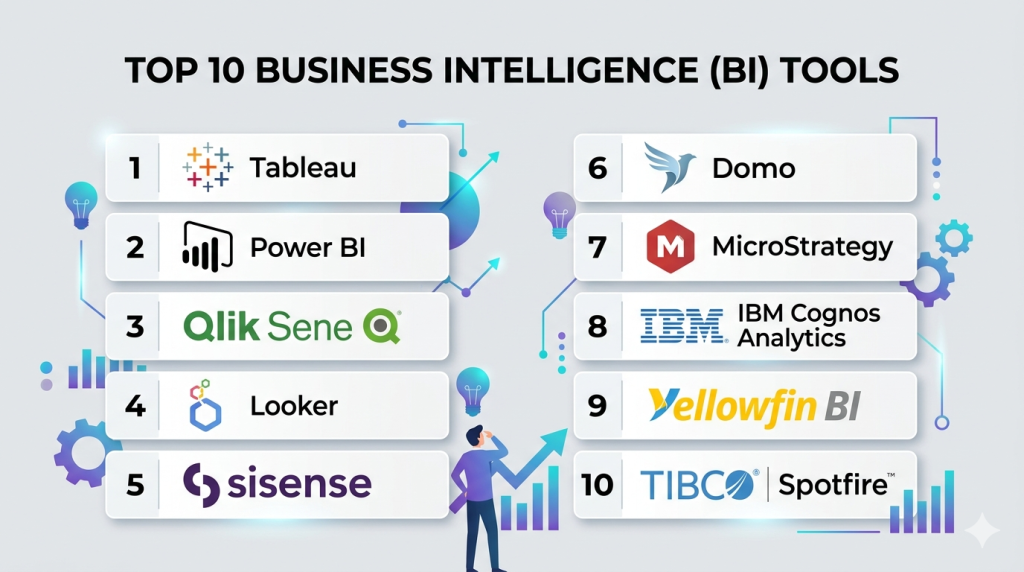
Top 10 Business Intelligence (BI) Tools
#1 — Tableau
Short description: Tableau is a leading BI platform that provides interactive dashboards, visual analytics, and real-time reporting. It enables organizations to explore data intuitively and communicate insights across teams.
Key Features
- Drag-and-drop data visualization
- Real-time analytics and dashboards
- AI-powered insights
- Mobile-friendly interface
- Extensive integration ecosystem
- Pre-built templates and reports
Pros
- Highly interactive and intuitive dashboards
- Strong analytics capabilities for various data types
Cons
- Steeper learning curve for beginners
- Higher cost for enterprise deployments
Platforms / Deployment
- Windows, macOS, Web
- Cloud / On-premise
Security & Compliance
- SSO, MFA, encryption
- SOC 2, GDPR
Integrations & Ecosystem
- Salesforce, Snowflake, Redshift
- REST API support
- Third-party connectors
Support & Community
- Extensive documentation and active user community
- Professional onboarding and support tiers
#2 — Power BI
Short description: Power BI by Microsoft offers robust business analytics and interactive visualizations. It connects seamlessly with Microsoft products and other data sources for comprehensive reporting.
Key Features
- Real-time dashboards
- AI-driven insights
- Integration with Excel and Azure
- Custom visualizations
- Data alerts and sharing
- Mobile access
Pros
- Seamless integration with Microsoft ecosystem
- Affordable and scalable for SMBs
Cons
- Limited non-Microsoft integration capabilities
- Requires data modeling expertise for advanced analytics
Platforms / Deployment
- Windows, Web, iOS, Android
- Cloud / On-premise
Security & Compliance
- RBAC, SSO, encryption
- SOC 2, GDPR, ISO 27001
Integrations & Ecosystem
- Azure, SQL Server, Excel
- API and connectors for external apps
- Third-party visualization tools
Support & Community
- Microsoft support tiers and active community forums
#3 — Qlik Sense
Short description: Qlik Sense is a self-service BI platform offering associative analytics, AI-assisted insights, and guided analytics. It empowers users to explore data freely across sources.
Key Features
- Associative data model
- Smart visualizations
- Guided analytics
- AI-assisted insights
- Cloud and on-prem deployment
Pros
- Flexible data exploration
- Strong data integration capabilities
Cons
- Complex setup for new users
- Pricing can be high for small teams
Platforms / Deployment
- Web, Windows
- Cloud / On-premise
Security & Compliance
- RBAC, encryption
- SOC 2, GDPR
Integrations & Ecosystem
- ETL tools, databases, SaaS apps
- API support and marketplace extensions
Support & Community
- Documentation, professional support, active community
#4 — Looker
Short description: Looker provides a modern BI platform for embedded analytics and real-time dashboards. Its model-based approach simplifies data exploration and reporting for business users.
Key Features
- Real-time dashboards
- Embedded analytics
- LookML modeling
- Collaboration tools
- API-driven integrations
Pros
- Strong integration with cloud data warehouses
- Flexible embedded analytics
Cons
- Learning LookML requires training
- Limited offline capabilities
Platforms / Deployment
- Web
- Cloud
Security & Compliance
- SSO, MFA, encryption
- SOC 2, GDPR
Integrations & Ecosystem
- BigQuery, Snowflake, Redshift
- API access for BI embedding
- Third-party visualization tools
Support & Community
- Vendor support and community forums
#5 — Sisense
Short description: Sisense enables complex data analysis and visualization with an AI-driven analytics engine. It is ideal for embedding BI into applications and scaling insights across organizations.
Key Features
- In-chip data processing
- AI-powered analytics
- Interactive dashboards
- Data modeling
- Embedded BI
Pros
- High-performance analytics
- Embeddable dashboards for SaaS apps
Cons
- Setup complexity for beginners
- Requires technical expertise for advanced features
Platforms / Deployment
- Web
- Cloud / On-premise
Security & Compliance
- SSO, RBAC, encryption
- SOC 2, GDPR
Integrations & Ecosystem
- ETL tools, databases, SaaS apps
- API and SDK for embedding
Support & Community
- Documentation, onboarding, enterprise support
#6 — Domo
Short description: Domo is a cloud-native BI platform delivering interactive dashboards, alerts, and mobile analytics. It enables business users to gain insights without heavy IT involvement.
Key Features
- Cloud-native dashboards
- Mobile analytics
- Data alerts and notifications
- Pre-built connectors
- Collaboration features
Pros
- Easy-to-use, cloud-based interface
- Strong mobile BI capabilities
Cons
- Higher cost for large organizations
- Limited on-prem options
Platforms / Deployment
- Web, iOS, Android
- Cloud
Security & Compliance
- RBAC, SSO, encryption
- SOC 2, GDPR
Integrations & Ecosystem
- Salesforce, Snowflake, SQL databases
- API and pre-built connectors
Support & Community
- Vendor support, training, active community
#7 — MicroStrategy
Short description: MicroStrategy provides enterprise BI with advanced analytics, mobile dashboards, and embedded analytics. It caters to large-scale organizations requiring high governance and security.
Key Features
- Advanced analytics
- Mobile and embedded dashboards
- Self-service reporting
- Data discovery
- Governance and security controls
Pros
- Enterprise-grade security
- Highly scalable analytics
Cons
- Steep learning curve
- High total cost of ownership
Platforms / Deployment
- Web, Windows, iOS, Android
- Cloud / On-premise
Security & Compliance
- SSO, RBAC, encryption
- SOC 2, ISO 27001, GDPR
Integrations & Ecosystem
- Databases, ETL tools, SaaS apps
- APIs for embedding
Support & Community
- Enterprise support, professional services
#8 — IBM Cognos Analytics
Short description: IBM Cognos Analytics offers AI-assisted reporting, dashboards, and governance for enterprise BI. It combines self-service and governed analytics for complex organizations.
Key Features
- AI-driven insights
- Report automation
- Dashboard creation
- Data modeling
- Governance and security
Pros
- Strong AI and automation capabilities
- Enterprise-grade analytics
Cons
- Complex deployment
- User interface less intuitive
Platforms / Deployment
- Web
- Cloud / On-premise
Security & Compliance
- SSO, RBAC, encryption
- SOC 2, GDPR, ISO 27001
Integrations & Ecosystem
- ETL tools, databases, cloud apps
- API and connectors
Support & Community
- Documentation, vendor support
#9 — Yellowfin BI
Short description: Yellowfin provides collaborative dashboards, reporting, and storyboards. Its focus is on user-friendly BI with embedded analytics and automated insights.
Key Features
- Collaborative dashboards
- Storyboards and reports
- Automated insights
- Embedded analytics
- Mobile BI
Pros
- Intuitive interface
- Strong collaboration tools
Cons
- Limited advanced analytics features
- Some integration limitations
Platforms / Deployment
- Web, iOS, Android
- Cloud / On-premise
Security & Compliance
- SSO, RBAC, encryption
- SOC 2, GDPR
Integrations & Ecosystem
- Databases, ETL tools, BI apps
- API support
Support & Community
- Vendor support and community forums
#10 — TIBCO Spotfire
Short description: Spotfire delivers data visualization, dashboards, and advanced analytics for enterprises. It emphasizes interactive exploration and predictive insights.
Key Features
- Interactive dashboards
- Predictive analytics
- Data visualization
- Real-time monitoring
- Mobile access
Pros
- Strong visualization capabilities
- Advanced analytics options
Cons
- Requires technical expertise
- Higher cost for full feature set
Platforms / Deployment
- Windows, Web
- Cloud / On-premise
Security & Compliance
- SSO, RBAC, encryption
- SOC 2, GDPR
Integrations & Ecosystem
- Databases, ETL tools, SaaS apps
- API and SDKs
Support & Community
- Documentation, professional support
Comparison Table (Top 10)
| Tool Name | Best For | Platform(s) Supported | Deployment | Standout Feature | Public Rating |
|---|---|---|---|---|---|
| Tableau | Interactive dashboards | Windows, macOS, Web | Cloud / On-premise | AI-powered visualization | N/A |
| Power BI | Microsoft ecosystem | Windows, Web, iOS, Android | Cloud / On-premise | Excel & Azure integration | N/A |
| Qlik Sense | Self-service analytics | Web, Windows | Cloud / On-premise | Associative data model | N/A |
| Looker | Embedded analytics | Web | Cloud | Model-based reporting | N/A |
| Sisense | Embedded & AI analytics | Web | Cloud / On-premise | High-performance in-chip processing | N/A |
| Domo | Cloud-native BI | Web, iOS, Android | Cloud | Mobile dashboards | N/A |
| MicroStrategy | Enterprise analytics | Web, Windows, iOS, Android | Cloud / On-premise | Governance & security | N/A |
| IBM Cognos Analytics | AI-driven reporting | Web | Cloud / On-premise | Automated insights | N/A |
| Yellowfin BI | Collaborative dashboards | Web, iOS, Android | Cloud / On-premise | Storyboards & collaboration | N/A |
| TIBCO Spotfire | Data visualization & analytics | Windows, Web | Cloud / On-premise | Predictive analytics | N/A |
Evaluation & Scoring of Business Intelligence (BI) Tools
| Tool Name | Core (25%) | Ease (15%) | Integrations (15%) | Security (10%) | Performance (10%) | Support (10%) | Value (15%) | Weighted Total (0–10) |
|---|---|---|---|---|---|---|---|---|
| Tableau | 9 | 8 | 9 | 8 | 9 | 8 | 7.5 | 8.3 |
| Power BI | 8.5 | 9 | 8 | 8 | 8 | 7.5 | 8 | 8.2 |
| Qlik Sense | 8 | 7.5 | 8 | 8 | 8 | 7.5 | 7.5 | 7.8 |
| Looker | 8 | 7 | 7.5 | 8 | 7.5 | 7 | 7.5 | 7.5 |
| Sisense | 8 | 7 | 7.5 | 7.5 | 7.5 | 7 | 7.5 | 7.55 |
| Domo | 7.5 | 8 | 7 | 7.5 | 7 | 7 | 7.5 | 7.45 |
| MicroStrategy | 9 | 7 | 8 | 8.5 | 8.5 | 8 | 7 | 8.25 |
| IBM Cognos Analytics | 8 | 7 | 7.5 | 8 | 7.5 | 7 | 7 | 7.45 |
| Yellowfin BI | 7.5 | 8 | 7 | 7.5 | 7 | 7 | 7 | 7.3 |
| TIBCO Spotfire | 8 | 7 | 7 | 7.5 | 7.5 | 7 | 7 | 7.35 |
Scores are comparative; higher weighted totals indicate stronger overall performance considering feature set, ease, integrations, security, reliability, support, and value.
Which Business Intelligence (BI) Tools Tool Is Right for You?
Solo / Freelancer
Power BI or Yellowfin BI offer easy adoption and affordability for small teams.
SMB
Domo or Sisense provide collaborative and cloud-based solutions for mid-sized businesses.
Mid-Market
Looker and Qlik Sense deliver more advanced analytics and integration capabilities for growing teams.
Enterprise
Tableau, MicroStrategy, IBM Cognos, and TIBCO Spotfire offer scalable, governed BI solutions for large organizations.
Budget vs Premium
Budget-conscious teams may choose Power BI or Yellowfin; premium users benefit from Tableau, MicroStrategy, or IBM Cognos.
Feature Depth vs Ease of Use
Tableau and MicroStrategy offer depth; Domo and Power BI emphasize usability.
Integrations & Scalability
Enterprises should focus on BI tools with broad connectors to cloud data warehouses, ETL pipelines, and analytics ecosystems.
Security & Compliance Needs
Select tools with SOC 2, ISO 27001, GDPR compliance, RBAC, and encryption for regulated industries.
Frequently Asked Questions (FAQs)
1. What is a Business Intelligence (BI) Tool?
Software that converts raw data into interactive dashboards, reports, and visual analytics to help decision-making.
2. Are BI tools suitable for small businesses?
Yes, options like Power BI and Yellowfin BI offer accessible, cost-effective solutions for smaller teams.
3. Can BI tools integrate with multiple data sources?
Yes, most modern BI platforms connect to databases, cloud warehouses, ETL pipelines, and SaaS applications.
4. Do these tools offer AI-driven insights?
Many provide AI/ML capabilities for predictive analytics, anomaly detection, and automated insights.
5. How steep is the learning curve?
Depends on the platform; Power BI and Domo are beginner-friendly, whereas Tableau, MicroStrategy, and Cognos may require training.
6. Can BI tools support mobile access?
Yes, platforms like Domo, Tableau, Power BI, and Yellowfin provide mobile dashboards and reporting.
7. What security features are included?
Most offer RBAC, SSO, encryption, audit logs, and compliance with SOC 2, ISO 27001, or GDPR.
8. Can BI tools handle real-time analytics?
Yes, many platforms support streaming data, real-time dashboards, and alerts.
9. How do I choose between self-service and enterprise BI?
Consider data complexity, governance requirements, and team capabilities.
10. What are common mistakes when implementing BI?
Ignoring data quality, lacking governance, underestimating integration complexity, and insufficient user training.
Conclusion
Business Intelligence tools are critical for transforming data into actionable insights. Platforms like Tableau, Power BI, and Qlik Sense excel in visualization and analytics, while Domo, Looker, and Sisense offer cloud-native and embedded solutions. Selecting the right BI tool requires evaluating team size, data complexity, integration needs, security requirements, and ease of use. Pilots and trials help determine suitability, ensuring your organization can leverage insights for strategic decisions, operational efficiency, and competitive advantage.

Find Trusted Cardiac Hospitals
Compare heart hospitals by city and services — all in one place.
Explore Hospitals
If sales, finance, and operations use different definitions for the same KPI, the BI dashboard can create confusion even when the data is correct. Teams should agree on common metric definitions and maintain them centrally. This helps everyone work from the same numbers when making decisions.