Introduction
Business Process Management (BPM) Suites are software platforms that help organizations design, execute, monitor, and optimize business processes. These suites provide a structured approach to automating workflows, ensuring efficiency, reducing errors, and enabling compliance across departments.
BPM Suites have become essential for enterprises looking to modernize operations, integrate disparate systems, and deliver consistent services. By providing visibility into processes and performance, BPM tools support data-driven decisions and continuous process improvement.
Real-world use cases include:
- Automating order-to-cash or procure-to-pay workflows
- Streamlining HR onboarding and approval processes
- Compliance monitoring and audit tracking
- Customer service and ticketing workflow automation
- IT service management and change request handling
Key evaluation criteria for buyers:
- Process modeling and design capabilities
- Workflow automation (manual, semi-automated, fully automated)
- Integration with ERP, CRM, and other enterprise systems
- Analytics, reporting, and process monitoring
- AI and rule-based decision engine support
- Low-code/no-code workflow customization
- Security and compliance features
- Deployment flexibility (cloud, on-premises, hybrid)
- Scalability across departments or geographies
- Support, documentation, and community resources
Best for: Enterprises, operations managers, IT departments, and process improvement teams seeking efficiency and governance.
Not ideal for: Organizations with simple workflows, low volumes, or minimal automation needs.
Key Trends in Business Process Management (BPM) Suites
- Integration of AI and machine learning for predictive process optimization
- Low-code/no-code tools for rapid process modeling
- Cloud-first BPM platforms enabling scalability and accessibility
- Real-time process monitoring with dashboards and alerts
- Enhanced collaboration and workflow orchestration features
- API-first design for seamless system interoperability
- Process mining and analytics for continuous improvement
- Automation of both structured and unstructured processes
- Subscription-based or consumption-based pricing models
- Compliance-driven BPM with audit trails and security policies
How We Selected These Tools (Methodology)
- Evaluated market adoption, enterprise presence, and customer feedback
- Assessed feature completeness, including workflow automation and AI capabilities
- Examined reliability, uptime, and performance under enterprise loads
- Reviewed security standards and compliance certifications
- Checked integration flexibility with ERP, CRM, and cloud apps
- Considered low-code/no-code usability and developer support
- Analyzed community engagement and vendor support options
- Evaluated deployment options and flexibility (cloud, on-prem, hybrid)
- Considered scalability and process orchestration capabilities
- Reviewed pricing models and total cost of ownership
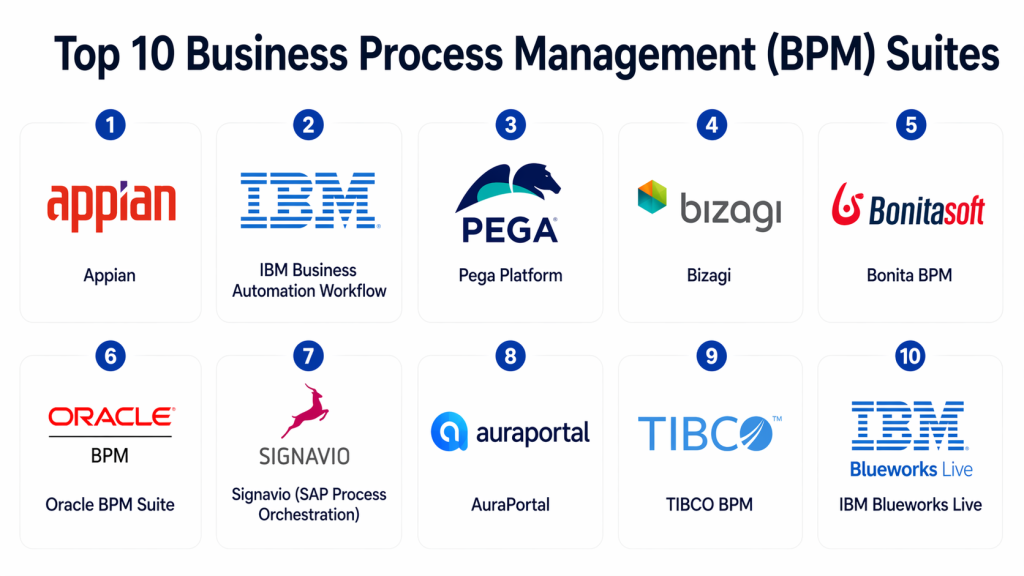
Top 10 Business Process Management (BPM) Suites
#1 — Appian
Short description: Appian is a low-code BPM platform enabling rapid application development, workflow automation, and process optimization for enterprises.
Key Features
- Low-code process modeling
- Case management and workflow automation
- AI-driven decision support
- Mobile and web accessibility
- Integration with ERP, CRM, and legacy systems
- Process monitoring and analytics
Pros
- Rapid deployment of business apps
- Strong integration ecosystem
Cons
- Licensing costs can be high
- Steep learning curve for complex processes
Platforms / Deployment
- Web / Windows / macOS / Cloud / Hybrid
Security & Compliance
- SSO, MFA, encryption, RBAC
- SOC 2, ISO 27001, GDPR
Integrations & Ecosystem
- ERP, CRM, databases, cloud services
- APIs for extensibility
- Pre-built connectors for common enterprise apps
Support & Community
- Enterprise support, training programs, active community
#2 — IBM Business Automation Workflow
Short description: IBM BA Workflow combines BPM and case management, enabling enterprises to automate complex processes and integrate AI insights.
Key Features
- Workflow and case management
- AI and decision automation
- Real-time monitoring dashboards
- Integration with IBM Cloud and on-prem systems
- Process analytics and reporting
Pros
- Enterprise-grade scalability
- Robust analytics and AI support
Cons
- Complexity in implementation
- Requires IBM ecosystem familiarity
Platforms / Deployment
- Web / Windows / Linux / Cloud / On-prem
Security & Compliance
- MFA, RBAC, encryption
- SOC 2, ISO 27001, HIPAA
Integrations & Ecosystem
- IBM Cloud apps, ERP, CRM
- APIs and connectors
- Integration with AI and analytics tools
Support & Community
- Enterprise support, documentation, IBM developer network
#3 — Pega Platform
Short description: Pega BPM enables process automation with case management and AI-driven insights to optimize enterprise workflows.
Key Features
- Low-code workflow design
- Case management
- AI-based decision engine
- Process orchestration
- Analytics and reporting dashboards
Pros
- Strong automation and AI capabilities
- Scalable for large enterprises
Cons
- Higher implementation cost
- Complexity for smaller teams
Platforms / Deployment
- Web / Cloud / Hybrid
Security & Compliance
- RBAC, encryption, audit logs
- SOC 2, ISO 27001
Integrations & Ecosystem
- ERP, CRM, cloud apps
- APIs for custom integrations
- Pre-built connectors
Support & Community
- Enterprise support, partner network, active forums
#4 — Bizagi
Short description: Bizagi provides a low-code BPM platform focused on process automation, collaboration, and analytics for business users.
Key Features
- Visual process modeling
- Workflow automation
- Case management
- Process analytics and monitoring
- Cloud and on-prem deployment
Pros
- User-friendly low-code environment
- Strong process modeling and documentation
Cons
- Limited AI capabilities
- Advanced features require training
Platforms / Deployment
- Web / Cloud / Windows / Hybrid
Security & Compliance
- RBAC, encryption
- ISO 27001, GDPR
Integrations & Ecosystem
- ERP, CRM, databases
- APIs and connectors
- Collaboration tools
Support & Community
- Enterprise support, documentation, online community
#5 — Bonita BPM
Short description: Bonita BPM is an open-source BPM suite with strong process modeling, automation, and integration features.
Key Features
- Open-source workflow modeling
- Process automation
- Integration with APIs and databases
- User task management
- Reporting and monitoring
Pros
- Open-source flexibility
- Strong integration options
Cons
- Requires technical expertise for setup
- Limited enterprise support compared to commercial platforms
Platforms / Deployment
- Web / Windows / Linux / Cloud / On-prem
Security & Compliance
- Not publicly stated
Integrations & Ecosystem
- APIs, databases, third-party apps
- Extensible with Java and scripts
Support & Community
- Community-driven, optional enterprise support
#6 — Oracle BPM Suite
Short description: Oracle BPM Suite provides enterprise-grade process automation with integration to Oracle applications and cloud services.
Key Features
- Workflow automation
- Business rules management
- Process monitoring and analytics
- Oracle Cloud and ERP integration
- Scalable enterprise deployments
Pros
- Strong integration with Oracle ecosystem
- Enterprise scalability
Cons
- Complexity and cost
- Requires Oracle platform familiarity
Platforms / Deployment
- Web / Windows / Linux / Cloud / On-prem
Security & Compliance
- RBAC, encryption
- SOC 2, ISO 27001
Integrations & Ecosystem
- ERP, CRM, Oracle Cloud
- APIs for custom workflows
- Pre-built connectors
Support & Community
- Enterprise support, Oracle community forums
#7 — Signavio (SAP Process Orchestration)
Short description: Signavio BPM focuses on process modeling, orchestration, and optimization with analytics for large enterprises.
Key Features
- Process modeling and simulation
- Workflow automation
- Analytics dashboards
- Integration with SAP and third-party apps
- Collaboration tools
Pros
- Strong analytics and process improvement
- SAP ecosystem integration
Cons
- Higher pricing
- Requires SAP knowledge for full integration
Platforms / Deployment
- Web / Cloud / Hybrid
Security & Compliance
- MFA, encryption
- SOC 2, ISO 27001
Integrations & Ecosystem
- SAP apps, ERP, CRM
- APIs and pre-built connectors
Support & Community
- Enterprise support, training programs
#8 — AuraPortal
Short description: AuraPortal provides a no-code BPM suite with workflow automation, document management, and process analytics.
Key Features
- No-code workflow designer
- Document and content management
- Process automation
- Analytics and reporting
- Cloud and on-prem deployment
Pros
- User-friendly no-code platform
- Fast deployment for business users
Cons
- Limited AI capabilities
- Less known globally
Platforms / Deployment
- Web / Cloud / Hybrid
Security & Compliance
- Not publicly stated
Integrations & Ecosystem
- ERP, CRM, cloud apps
- APIs for custom integrations
Support & Community
- Enterprise support, documentation
#9 — TIBCO BPM
Short description: TIBCO BPM provides process automation, orchestration, and real-time analytics for enterprise workflows.
Key Features
- Workflow automation
- Process orchestration
- Analytics dashboards
- Integration with TIBCO ecosystem
- Cloud and on-prem deployment
Pros
- Strong analytics and orchestration
- Scalable for large enterprises
Cons
- Requires technical expertise
- Licensing costs
Platforms / Deployment
- Web / Cloud / Hybrid
Security & Compliance
- RBAC, encryption
- ISO 27001, GDPR
Integrations & Ecosystem
- ERP, CRM, cloud apps
- APIs and connectors
Support & Community
- Enterprise support, partner network
#10 — IBM Blueworks Live
Short description: Blueworks Live is a cloud-based BPM platform for process discovery, modeling, and collaboration.
Key Features
- Cloud-based process modeling
- Collaboration and workflow design
- Process documentation
- Analytics and monitoring
- Integration with IBM ecosystem
Pros
- Cloud-based ease of use
- Collaboration-focused
Cons
- Limited advanced automation
- Requires IBM familiarity
Platforms / Deployment
- Web / Cloud
Security & Compliance
- MFA, encryption
- SOC 2, ISO 27001
Integrations & Ecosystem
- ERP, CRM, cloud apps
- APIs for process extensions
Support & Community
- Enterprise support, IBM forums
Comparison Table (Top 10)
| Tool Name | Best For | Platform(s) Supported | Deployment | Standout Feature | Public Rating |
|---|---|---|---|---|---|
| Appian | Enterprise workflows | Web / Windows / Cloud / Hybrid | Cloud / Hybrid | Low-code automation | N/A |
| IBM BA Workflow | Enterprise BPM | Web / Windows / Linux / Cloud | Cloud / On-prem | AI-based decision support | N/A |
| Pega Platform | Case management | Web / Cloud / Hybrid | Cloud / Hybrid | AI-powered process automation | N/A |
| Bizagi | Process modeling | Web / Cloud / Windows / Hybrid | Cloud / Hybrid | Visual workflow design | N/A |
| Bonita BPM | Open-source flexibility | Web / Windows / Linux / Cloud | Cloud / On-prem | Open-source extensibility | N/A |
| Oracle BPM Suite | Oracle ERP integration | Web / Windows / Linux / Cloud | Cloud / On-prem | Enterprise-grade ERP integration | N/A |
| Signavio | Process optimization | Web / Cloud / Hybrid | Cloud / Hybrid | SAP integration | N/A |
| AuraPortal | No-code automation | Web / Cloud / Hybrid | Cloud / Hybrid | No-code platform | N/A |
| TIBCO BPM | Real-time orchestration | Web / Cloud / Hybrid | Cloud / Hybrid | Analytics and orchestration | N/A |
| IBM Blueworks Live | Cloud process modeling | Web / Cloud | Cloud | Collaboration-focused modeling | N/A |
Evaluation & Scoring of Business Process Management (BPM) Suites
| Tool Name | Core (25%) | Ease (15%) | Integrations (15%) | Security (10%) | Performance (10%) | Support (10%) | Value (15%) | Weighted Total |
|---|---|---|---|---|---|---|---|---|
| Appian | 9 | 8 | 9 | 9 | 9 | 8 | 7 | 8.55 |
| IBM BA Workflow | 8 | 7 | 8 | 9 | 8 | 8 | 7 | 8.05 |
| Pega Platform | 9 | 7 | 8 | 8 | 8 | 7 | 7 | 8.05 |
| Bizagi | 8 | 8 | 8 | 8 | 7 | 7 | 7 | 7.85 |
| Bonita BPM | 7 | 7 | 7 | 7 | 7 | 6 | 7 | 7.0 |
| Oracle BPM Suite | 8 | 7 | 8 | 8 | 8 | 7 | 7 | 7.85 |
| Signavio | 8 | 8 | 7 | 8 | 8 | 7 | 7 | 7.85 |
| AuraPortal | 7 | 8 | 7 | 7 | 7 | 6 | 7 | 7.05 |
| TIBCO BPM | 8 | 7 | 8 | 8 | 8 | 7 | 7 | 7.85 |
| IBM Blueworks Live | 7 | 8 | 7 | 7 | 7 | 6 | 7 | 7.0 |
Interpretation: Weighted totals indicate overall suitability. Higher scores favor large, complex enterprise deployments; mid-tier scores suit SMBs or specific process needs.
Which Business Process Management (BPM) Suites Tool Is Right for You?
Solo / Freelancer
- Bizagi or AuraPortal for low-code/no-code process modeling
SMB
- Appian, Bonita BPM, Blueworks Live for scalable yet cost-effective automation
Mid-Market
- Pega, IBM BA Workflow, Signavio for complex workflow orchestration
Enterprise
- Appian, Oracle BPM Suite, TIBCO BPM for large-scale, integrated deployments
Budget vs Premium
- Budget: Bonita BPM, AuraPortal
- Premium: Appian, Oracle BPM Suite, Pega
Feature Depth vs Ease of Use
- Feature-rich: Appian, Oracle BPM Suite, Pega
- Ease-of-use: Bizagi, AuraPortal, Blueworks Live
Integrations & Scalability
- Enterprise-ready: Appian, Oracle BPM Suite, TIBCO BPM
- Moderate: Bizagi, AuraPortal
Security & Compliance Needs
- Enterprise-grade: Appian, IBM BA Workflow, Oracle BPM Suite
- Standard compliance: Bizagi, AuraPortal
Frequently Asked Questions (FAQs)
1. What is a BPM Suite?
A BPM Suite is software designed to automate, monitor, and optimize business processes, often providing workflow modeling, orchestration, and analytics.
2. How long does implementation take?
Implementation depends on complexity; simple workflows can be deployed in weeks, enterprise-scale processes may take months.
3. Do BPM suites support cloud deployment?
Yes, most modern BPM suites support cloud, on-premises, or hybrid deployments.
4. Can BPM suites integrate with ERP and CRM?
Yes, they often provide pre-built connectors and API support for enterprise systems.
5. Are BPM suites secure for enterprise use?
Yes. Enterprise platforms offer RBAC, encryption, MFA, audit logs, and compliance certifications like ISO 27001.
6. Can non-technical users design workflows?
Low-code/no-code BPM suites like Bizagi and AuraPortal allow business users to design workflows without coding.
7. What are common mistakes in BPM adoption?
- Overly complex process modeling
- Ignoring integration requirements
- Lack of governance and monitoring
8. Are BPM suites expensive?
Pricing varies by vendor and deployment size; enterprise-grade solutions tend to have higher costs.
9. Can BPM suites handle AI-powered decisions?
Yes, many platforms incorporate AI/ML for predictive analytics and intelligent routing.
10. What are alternatives to BPM suites?
iPaaS, workflow automation tools, and RPA platforms can serve as alternatives for specific automation needs.
Conclusion
Business Process Management (BPM) Suites empower organizations to streamline workflows, enhance process visibility, and enable automation across departments. Choosing the right BPM suite depends on company size, process complexity, integration needs, and compliance requirements. SMBs may benefit from Bizagi or AuraPortal, while enterprises gain value from Appian, Oracle BPM Suite, or Pega. Piloting 2–3 platforms helps validate features, scalability, and integration compatibility, ensuring long-term process efficiency and governance.

Find Trusted Cardiac Hospitals
Compare heart hospitals by city and services — all in one place.
Explore Hospitals
This explains how BPM suites help organizations automate and control entire business processes from start to finish in a structured way.