Introduction
Business Rules & Decision Management Systems (BRDMS) are platforms that enable organizations to define, deploy, and automate business rules and decision logic across systems. They provide a structured framework for consistent, auditable decision-making, allowing enterprises to quickly adapt to changes in regulations, policies, or business strategies.
These systems are critical for organizations managing high volumes of transactional decisions, compliance rules, or customer-specific logic. By centralizing decision logic, BRDMS reduce redundancy, increase consistency, and enable faster operational changes without extensive coding.
Real-world use cases include:
- Automating loan approvals and credit scoring in financial institutions
- Dynamic pricing and discounting rules in e-commerce
- Fraud detection and risk management in banking and insurance
- Compliance monitoring and regulatory reporting
- Customer service routing based on predefined rules
Key evaluation criteria for buyers:
- Rule authoring and management capabilities
- Decision automation and execution
- AI and predictive decision support
- Integration with BPM, ERP, and CRM systems
- Auditability, reporting, and governance
- Low-code/no-code rule creation
- Security and compliance features
- Deployment options (cloud, on-premises, hybrid)
- Scalability and performance under load
- Support, training, and community resources
Best for: Enterprises, IT and operations teams, risk and compliance departments, and organizations requiring automated decision-making.
Not ideal for: Small businesses with minimal decision logic, or those that require only manual rule execution.
Key Trends in Business Rules & Decision Management Systems
- Integration of AI and machine learning for predictive and adaptive decisions
- Low-code/no-code rule authoring environments for business users
- Cloud-first deployment for scalability and accessibility
- Real-time decision engines for immediate response to events
- Enhanced audit trails and governance for compliance
- API-first platforms for seamless integration with enterprise systems
- Decision analytics and dashboards for performance monitoring
- Automation of both structured and unstructured decision processes
- Modular, subscription-based pricing models
- Interoperability with BPM, RPA, and iPaaS platforms
How We Selected These Tools (Methodology)
- Evaluated market adoption, enterprise presence, and customer feedback
- Assessed feature completeness, including rule authoring, decision automation, and AI support
- Examined reliability, uptime, and performance signals
- Reviewed security posture, compliance, and governance capabilities
- Checked integration flexibility with ERP, CRM, BPM, and other enterprise systems
- Considered low-code/no-code usability for business users
- Analyzed community engagement and vendor support
- Evaluated deployment options and flexibility
- Considered scalability for enterprise workloads
- Assessed pricing models and total cost of ownership
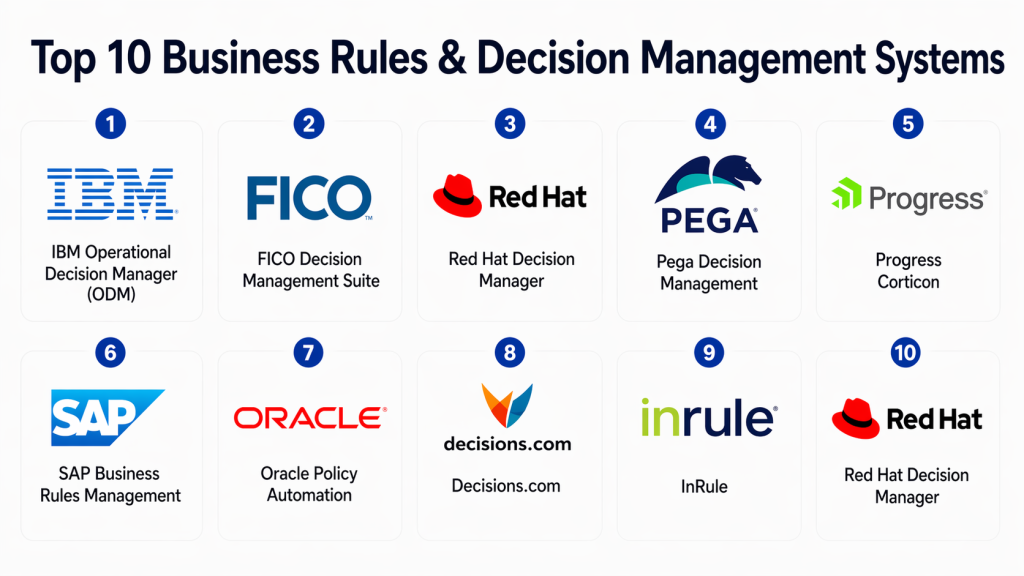
Top 10 Business Rules & Decision Management Systems
#1 — IBM Operational Decision Manager (ODM)
Short description: IBM ODM enables enterprises to automate, govern, and monitor business rules and operational decisions at scale.
Key Features
- Centralized rule repository
- AI-based decision support
- Real-time decision execution
- Integration with BPM, RPA, and enterprise apps
- Decision analytics and reporting
- Version control and audit capabilities
Pros
- Enterprise-grade scalability
- Strong integration ecosystem
Cons
- Complex configuration
- Higher cost for SMBs
Platforms / Deployment
- Web / Windows / Linux / Cloud / On-prem
Security & Compliance
- RBAC, encryption, audit logs
- SOC 2, ISO 27001, GDPR
Integrations & Ecosystem
- ERP, CRM, BPM, RPA
- APIs for custom connectors
- Pre-built integration modules
Support & Community
- Enterprise support, IBM developer network
#2 — FICO Decision Management Suite
Short description: FICO Decision Management Suite focuses on predictive and rules-based decisions, widely used in banking and insurance.
Key Features
- Rule modeling and deployment
- Predictive analytics integration
- Fraud detection and risk scoring
- Workflow orchestration
- Real-time decision monitoring
Pros
- Strong analytics and AI capabilities
- Industry-specific decision templates
Cons
- Complexity for non-financial use cases
- Licensing costs
Platforms / Deployment
- Web / Cloud / On-prem
Security & Compliance
- Encryption, MFA
- ISO 27001, GDPR
Integrations & Ecosystem
- ERP, CRM, BPM systems
- API connectors
- Integration with fraud and risk analytics
Support & Community
- Enterprise support, documentation
#3 — Red Hat Decision Manager
Short description: Red Hat Decision Manager is a low-code, open-source rules engine enabling automation and intelligent decision-making.
Key Features
- Rule authoring and execution
- Decision tables and scorecards
- Integration with BPM and RPA
- AI/ML decision support
- Real-time analytics and monitoring
Pros
- Open-source flexibility
- Low-code environment for business users
Cons
- Enterprise support limited compared to commercial vendors
- Learning curve for advanced features
Platforms / Deployment
- Web / Linux / Cloud / Hybrid
Security & Compliance
- Not publicly stated
Integrations & Ecosystem
- ERP, BPM, RPA
- APIs and custom connectors
- Cloud and on-prem integration
Support & Community
- Community-driven, optional enterprise support
#4 — Pega Decision Management
Short description: Pega Decision Management provides AI-powered decision automation and predictive analytics for enterprise workflows.
Key Features
- Predictive analytics and scoring
- Real-time decision engine
- Rule authoring and management
- Case management integration
- Decision monitoring and optimization
Pros
- Strong AI integration
- Scalable for enterprise workloads
Cons
- Higher implementation cost
- Complexity for small teams
Platforms / Deployment
- Web / Cloud / Hybrid
Security & Compliance
- RBAC, encryption
- SOC 2, ISO 27001
Integrations & Ecosystem
- BPM, CRM, ERP systems
- APIs for custom logic
- Pre-built connectors
Support & Community
- Enterprise support, Pega forums
#5 — Progress Corticon
Short description: Corticon provides a no-code rules engine for automating business decisions across processes and applications.
Key Features
- Visual rule modeling
- Decision simulation
- Integration with BPM and RPA
- Predictive analytics support
- Rule versioning and auditing
Pros
- User-friendly, no-code approach
- Fast rule deployment
Cons
- Limited AI capabilities
- Advanced analytics require additional modules
Platforms / Deployment
- Web / Windows / Cloud / On-prem
Security & Compliance
- Not publicly stated
Integrations & Ecosystem
- ERP, BPM, RPA systems
- APIs and SDKs
- Extensible via scripts
Support & Community
- Enterprise support, documentation
#6 — SAP Business Rules Management
Short description: SAP BRM enables decision automation and policy management integrated with SAP ERP and cloud applications.
Key Features
- Rule authoring and deployment
- Integration with SAP Cloud Platform
- Decision simulation
- Reporting and audit trails
- Business policy management
Pros
- Tight integration with SAP ecosystem
- Enterprise-grade governance
Cons
- Best suited for SAP environments
- Licensing complexity
Platforms / Deployment
- Web / Cloud / On-prem
Security & Compliance
- RBAC, encryption, audit logs
- ISO 27001, GDPR
Integrations & Ecosystem
- SAP ERP, CRM, cloud apps
- API connectors
- Workflow integration
Support & Community
- Enterprise support, SAP community
#7 — Oracle Policy Automation
Short description: Oracle Policy Automation provides declarative rule management with natural language processing and integration capabilities.
Key Features
- Natural language rule authoring
- Decision simulation
- Integration with BPM and ERP
- Reporting and analytics
- Automated decision execution
Pros
- Natural language approach for business users
- Scalable for large organizations
Cons
- Complex integration setup
- Licensing costs
Platforms / Deployment
- Web / Cloud / On-prem
Security & Compliance
- RBAC, encryption
- ISO 27001, SOC 2
Integrations & Ecosystem
- ERP, CRM, BPM
- API connectors
- Extensible via Oracle Cloud
Support & Community
- Enterprise support, Oracle community
#8 — Decisions.com
Short description: Decisions.com is a low-code platform for rule-based workflow automation and decision management.
Key Features
- Rule and workflow modeling
- Case management integration
- Low-code decision design
- Analytics and reporting
- Automation across processes
Pros
- Easy to use for business users
- Rapid deployment
Cons
- Limited advanced analytics
- Smaller community than major vendors
Platforms / Deployment
- Web / Cloud / Hybrid
Security & Compliance
- Not publicly stated
Integrations & Ecosystem
- ERP, CRM, BPM
- APIs for extensibility
Support & Community
- Enterprise support, online documentation
#9 — InRule
Short description: InRule provides a business rules management platform enabling dynamic decisions with integration to enterprise systems.
Key Features
- Rule authoring and simulation
- Decision automation
- Integration with BPM, CRM, ERP
- Version control and audit logs
- Analytics dashboards
Pros
- Fast deployment of rules
- Flexible integration options
Cons
- Limited AI/ML support
- Advanced customization requires technical expertise
Platforms / Deployment
- Web / Windows / Cloud / On-prem
Security & Compliance
- Not publicly stated
Integrations & Ecosystem
- ERP, CRM, BPM
- APIs and connectors
Support & Community
- Enterprise support, documentation
#10 — Red Hat Decision Manager
Short description: Red Hat Decision Manager offers a rules engine with low-code decision automation and AI integration for enterprise environments.
Key Features
- Rule and decision modeling
- Integration with BPM and RPA
- Predictive analytics support
- Execution monitoring
- Version control and audit
Pros
- Open-source flexibility
- Low-code rule creation
Cons
- Technical expertise needed for advanced features
- Limited out-of-the-box AI capabilities
Platforms / Deployment
- Web / Linux / Cloud / Hybrid
Security & Compliance
- Not publicly stated
Integrations & Ecosystem
- ERP, BPM, RPA
- APIs for custom integration
Support & Community
- Community-driven, optional enterprise support
Comparison Table (Top 10)
| Tool Name | Best For | Platform(s) Supported | Deployment | Standout Feature | Public Rating |
|---|---|---|---|---|---|
| IBM ODM | Enterprise decisions | Web / Windows / Linux / Cloud | Cloud / On-prem | Real-time decision automation | N/A |
| FICO Decision Management | Banking & Insurance | Web / Cloud / On-prem | Cloud / On-prem | Predictive analytics integration | N/A |
| Red Hat Decision Manager | Enterprise low-code | Web / Linux / Cloud / Hybrid | Cloud / Hybrid | Open-source flexibility | N/A |
| Pega Decision Management | AI-driven decisions | Web / Cloud / Hybrid | Cloud / Hybrid | Predictive and AI-powered | N/A |
| Progress Corticon | No-code rules | Web / Windows / Cloud / On-prem | Cloud / On-prem | Visual rule modeling | N/A |
| SAP BRM | SAP ERP environments | Web / Cloud / On-prem | Cloud / On-prem | SAP ecosystem integration | N/A |
| Oracle Policy Automation | Natural language rules | Web / Cloud / On-prem | Cloud / On-prem | Natural language authoring | N/A |
| Decisions.com | Low-code automation | Web / Cloud / Hybrid | Cloud / Hybrid | Workflow and decision modeling | N/A |
| InRule | Dynamic rule execution | Web / Windows / Cloud / On-prem | Cloud / On-prem | Flexible integration | N/A |
| Red Hat Decision Manager | Open-source low-code | Web / Linux / Cloud / Hybrid | Cloud / Hybrid | Decision modeling & execution | N/A |
Evaluation & Scoring of Business Rules & Decision Management Systems
| Tool Name | Core (25%) | Ease (15%) | Integrations (15%) | Security (10%) | Performance (10%) | Support (10%) | Value (15%) | Weighted Total |
|---|---|---|---|---|---|---|---|---|
| IBM ODM | 9 | 8 | 9 | 9 | 9 | 8 | 7 | 8.55 |
| FICO Decision Management | 8 | 7 | 8 | 8 | 8 | 7 | 7 | 7.85 |
| Red Hat Decision Manager | 8 | 8 | 7 | 7 | 7 | 6 | 7 | 7.45 |
| Pega Decision Management | 9 | 7 | 8 | 8 | 8 | 7 | 7 | 8.05 |
| Progress Corticon | 7 | 8 | 7 | 7 | 7 | 6 | 7 | 7.0 |
| SAP BRM | 8 | 7 | 8 | 8 | 8 | 7 | 7 | 7.85 |
| Oracle Policy Automation | 8 | 7 | 8 | 8 | 8 | 7 | 7 | 7.85 |
| Decisions.com | 7 | 8 | 7 | 7 | 7 | 6 | 7 | 7.05 |
| InRule | 8 | 7 | 8 | 7 | 7 | 6 | 7 | 7.35 |
| Red Hat Decision Manager | 8 | 8 | 7 | 7 | 7 | 6 | 7 | 7.45 |
Interpretation: Weighted totals reflect comparative suitability for enterprise vs SMB environments. Higher scores favor complex decision automation and integration scenarios.
Which Business Rules & Decision Management Systems Tool Is Right for You?
Solo / Freelancer
- Progress Corticon or Decisions.com for simple, low-code rule automation
SMB
- InRule or Red Hat Decision Manager for affordable, scalable decision management
Mid-Market
- Pega, Oracle Policy Automation for advanced decision automation
Enterprise
- IBM ODM, FICO Decision Management, SAP BRM for high-volume, complex workflows
Budget vs Premium
- Budget: Progress Corticon, Decisions.com
- Premium: IBM ODM, Pega, FICO
Feature Depth vs Ease of Use
- Feature-rich: IBM ODM, Pega, Oracle Policy Automation
- Ease-of-use: Decisions.com, Progress Corticon
Integrations & Scalability
- Enterprise-ready: IBM ODM, SAP BRM, Pega
- Moderate: InRule, Decisions.com
Security & Compliance Needs
- Enterprise-grade: IBM ODM, FICO, SAP BRM
- Standard compliance: Decisions.com, Progress Corticon
Frequently Asked Questions (FAQs)
1. What is a Business Rules & Decision Management System?
A BRDMS is a platform for defining, automating, and managing business rules to ensure consistent and auditable decision-making.
2. Can non-technical users manage rules?
Yes, low-code/no-code platforms like Decisions.com allow business users to author rules without programming.
3. How do BRDMS integrate with other systems?
They provide APIs, pre-built connectors, and integrations with ERP, CRM, BPM, and RPA tools.
4. Are these platforms secure for enterprise use?
Yes, enterprise platforms include RBAC, MFA, encryption, audit logs, and compliance certifications.
5. What industries benefit most from BRDMS?
Financial services, insurance, healthcare, retail, and large enterprises with complex decision logic.
6. How long does deployment take?
It varies from a few weeks for SMBs to several months for enterprise-grade workflows.
7. Can BRDMS incorporate AI/ML for decisions?
Yes, many platforms integrate AI for predictive analytics and intelligent decision-making.
8. What are common mistakes when adopting BRDMS?
- Overcomplicating rules
- Ignoring integration and monitoring
- Lack of governance
9. Do these tools support cloud deployment?
Yes, most modern BRDMS offer cloud, on-premises, or hybrid deployments.
10. What are alternatives to BRDMS?
iPaaS, BPM suites, and RPA platforms can serve as alternatives for specific automation needs.
Conclusion
Business Rules & Decision Management Systems empower organizations to automate, govern, and optimize critical decisions while ensuring compliance and consistency. Choosing the right platform depends on organizational size, decision complexity, integration needs, and AI requirements. SMBs benefit from low-code tools like Progress Corticon or Decisions.com, while enterprises achieve scale with IBM ODM, Pega, or SAP BRM. Shortlisting 2–3 platforms and running a pilot helps validate capabilities, integration, and compliance, ensuring long-term decision automation success.

Find Trusted Cardiac Hospitals
Compare heart hospitals by city and services — all in one place.
Explore Hospitals
This explains how business rules and decision systems help automate complex decisions like approvals, pricing, and compliance in a structured way.