Introduction
Business Rules & Decision Management Systems (BRDMS) are platforms designed to automate, manage, and optimize decision-making across an organization. They allow businesses to encode policies, rules, and logic into a centralized system, ensuring consistent decisions, reducing errors, and increasing agility. with growing regulatory requirements, AI adoption, and the need for real-time decisioning, BRDMS have become vital for enterprise operations.
Common use cases include automating loan approvals in banking, routing insurance claims, enforcing compliance rules in healthcare, managing pricing decisions in retail, and orchestrating operational decisions in logistics. Organizations rely on these systems to standardize complex decision processes, enhance accuracy, and integrate AI-driven recommendations.
Evaluation Criteria for Buyers:
- Decision modeling and rule management capabilities
- AI and predictive analytics integration
- Real-time decision execution
- Integration with core systems (ERP, CRM, workflow)
- Compliance and audit features
- Ease of authoring and maintenance
- Deployment flexibility (cloud, on-prem, hybrid)
- Monitoring, analytics, and reporting
- Vendor support and ecosystem
- Cost and licensing options
Best for: Enterprises needing high-volume decision automation, compliance-driven industries, data-driven operations, and IT/business teams managing complex logic.
Not ideal for: Small businesses with minimal decision complexity, or teams satisfied with spreadsheet-based or workflow-driven rule management.
Key Trends in Business Rules & Decision Management Systems
- AI-assisted decisioning: Incorporating machine learning models for predictive and prescriptive decision support.
- Low-code rule authoring: Business users can define and modify rules without heavy IT involvement.
- Real-time execution: Decisions are made instantly in transactional and operational systems.
- Cloud and hybrid deployment: Organizations increasingly adopt flexible architectures to scale globally.
- Integration with BPM and workflow systems: Seamless alignment between decisions and processes.
- Enhanced governance and compliance: Audit trails, traceability, and regulatory alignment are mandatory.
- Decision analytics dashboards: Visualization of rule performance and business impact.
- Decision versioning and testing: Safe deployment of new rules with controlled rollback.
- API-first approach: Easier integration with microservices, RPA, and AI systems.
- Subscription and usage-based pricing: Shifting from perpetual licenses to consumption models.
How We Selected These Tools (Methodology)
- Reviewed market adoption and mindshare across enterprise and mid-market segments.
- Evaluated decision modeling, automation, and analytics capabilities.
- Assessed performance, reliability, and scalability signals.
- Checked security posture, auditability, and compliance features.
- Analyzed integration support for ERP, CRM, BPM, RPA, and AI tools.
- Considered ease of use for both business and IT stakeholders.
- Looked for AI/ML-enabled decisioning capabilities.
- Reviewed support offerings, documentation, and community strength.
- Considered industry-specific applicability (finance, insurance, healthcare).
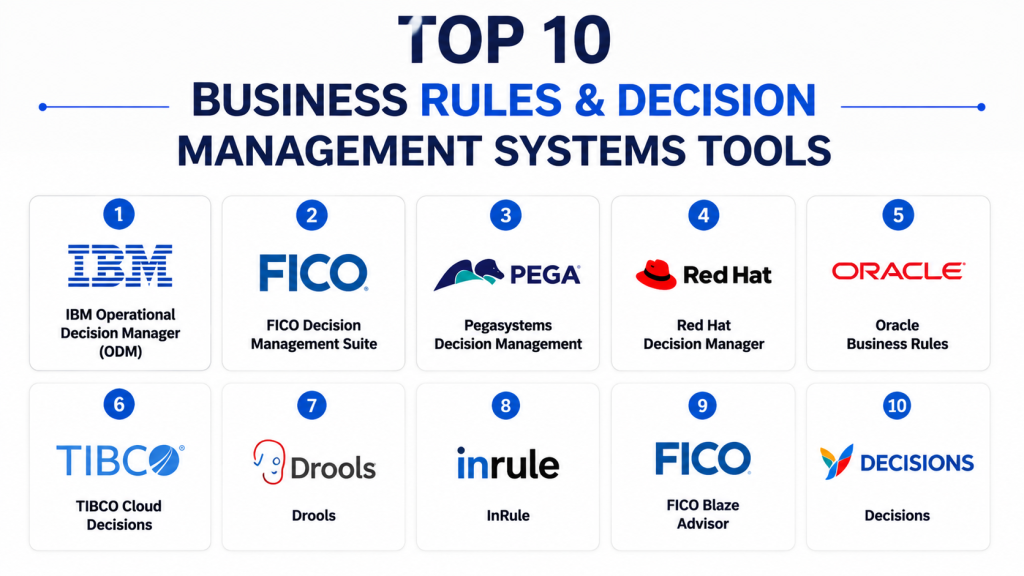
Top 10 Business Rules & Decision Management Systems Tools
1- IBM Operational Decision Manager (ODM)
Short description: IBM ODM provides a comprehensive platform to capture, automate, and govern business rules and decisions, suitable for large enterprises.
Key Features
- Rule authoring and versioning
- Decision analytics dashboards
- AI integration for predictive decisioning
- Workflow and BPM integration
- Real-time decision execution
- Compliance and audit trail features
Pros
- Enterprise-grade reliability and scalability
- Strong integration with IBM ecosystem
- Advanced analytics and decision monitoring
Cons
- Complexity may require skilled resources
- Higher cost for smaller deployments
- Steep learning curve for business users
Platforms / Deployment
- Web, Windows
- Cloud / On-prem / Hybrid
Security & Compliance
- SSO, MFA, encryption, audit logs
- SOC 2, ISO 27001, GDPR
Integrations & Ecosystem
IBM ODM integrates with BPM, ERP, CRM, and AI tools.
- IBM BPM, IBM Cloud Pak for Automation
- Salesforce, SAP, Oracle ERP connectors
- REST/SOAP APIs for custom integration
- AI/ML modules for predictive decisions
Support & Community
- Enterprise support tiers
- Documentation and training portals
- Active IBM community forums
2- FICO Decision Management Suite
Short description: FICO provides a rules and decision management system widely used in banking, insurance, and risk management.
Key Features
- Decision modeling and simulation
- Credit and fraud scoring rules
- Predictive analytics integration
- Compliance and audit reporting
- Rule repository and version control
Pros
- Strong domain expertise in finance
- Scalable and reliable decision execution
- Integrated predictive analytics
Cons
- Complex deployment for non-finance applications
- Requires expertise for rule modeling
- Cost may be high for smaller teams
Platforms / Deployment
- Web
- Cloud / On-prem / Hybrid
Security & Compliance
- SSO, encryption, RBAC
- SOC 2, GDPR
Integrations & Ecosystem
FICO integrates with enterprise systems and analytics platforms.
- ERP and core banking systems
- AI/ML and predictive modeling tools
- API-based connectors
Support & Community
- Vendor support and training
- Industry-focused user forums
- Documentation and best practices guides
3- Pegasystems Decision Management
Short description: Pega offers a rules and decision management engine integrated with its BPM suite for enterprise decision automation.
Key Features
- Real-time decisioning
- AI-powered recommendations
- Case and workflow integration
- Predictive and adaptive analytics
- Decision testing and versioning
Pros
- Strong AI decisioning and analytics
- Real-time operational decisions
- Seamless BPM integration
Cons
- Licensing can be expensive
- Technical complexity for custom rules
- Learning curve for non-technical users
Platforms / Deployment
- Web, iOS, Android
- Cloud / On-prem / Hybrid
Security & Compliance
- SSO, encryption, audit trails
- SOC 2, GDPR
Integrations & Ecosystem
- BPM integration with Pega Platform
- REST APIs and event-driven connectors
- CRM and ERP system connectors
Support & Community
- Vendor support and consulting
- Training and knowledge base
- Pega Community portal
4- Red Hat Decision Manager
Short description: Red Hat Decision Manager provides an open-source business rules engine for automating complex decisions across IT environments.
Key Features
- Open-source rule engine
- Decision tables and workflows
- Integration with RHPAM (Red Hat Process Automation Manager)
- Real-time decision execution
- Cloud-native deployment support
Pros
- Open-source flexibility
- Strong integration with Red Hat ecosystem
- Cost-effective for scalable deployment
Cons
- Requires developer expertise
- Limited built-in analytics
- Community support may be less structured than enterprise vendors
Platforms / Deployment
- Linux, Windows
- Cloud / On-prem / Hybrid
Security & Compliance
- RBAC, encryption, audit logs
- Not publicly stated
Integrations & Ecosystem
- Red Hat OpenShift, RHPAM
- REST APIs and custom connectors
- Integration with BPM and RPA platforms
Support & Community
- Vendor enterprise support options
- Open-source community forums
- Documentation and guides
5- Oracle Business Rules
Short description: Oracle Business Rules enables decision automation, policy enforcement, and integration with Oracle applications and ERP systems.
Key Features
- Rule modeling and execution
- Integration with BPM workflows
- Audit and compliance tracking
- Decision analytics dashboards
- Predictive decisioning support
Pros
- Deep integration with Oracle ecosystem
- Enterprise-grade scalability
- Strong governance and auditing
Cons
- Complex setup for non-Oracle environments
- Higher cost for smaller teams
- Advanced features may require specialist training
Platforms / Deployment
- Web, Windows
- Cloud / On-prem / Hybrid
Security & Compliance
- SSO, encryption, audit logs
- SOC 2, GDPR
Integrations & Ecosystem
- Oracle ERP and Cloud Apps
- REST/SOAP APIs
- Integration with AI and analytics tools
Support & Community
- Oracle support tiers
- Documentation and tutorials
- Active enterprise user community
6- TIBCO Cloud Decisions
Short description: TIBCO provides a cloud-based decision management system for real-time rule execution and process orchestration.
Key Features
- Cloud-native decision engine
- Rule authoring and versioning
- AI and analytics integration
- Decision simulation and testing
- Integration with BPM and event-driven workflows
Pros
- Real-time decision automation
- Cloud-native scalability
- Strong event-driven architecture support
Cons
- Limited on-premises support
- Requires technical expertise for complex rules
- Pricing may be prohibitive for SMBs
Platforms / Deployment
- Web
- Cloud
Security & Compliance
- SSO, encryption, audit logs
- SOC 2, GDPR (varies)
Integrations & Ecosystem
- BPM, RPA, and event stream platforms
- REST APIs
- Prebuilt connectors for ERP/CRM systems
Support & Community
- Vendor support tiers
- Online documentation and knowledge base
- Community forums
7- Drools
Short description: Drools is an open-source rule engine and decision management platform for developers and IT teams seeking flexible automation.
Key Features
- Open-source rule engine
- Complex event processing
- Decision tables and DRL rules
- Cloud and container deployment support
- Workflow orchestration
Pros
- Free and open-source
- Flexible and developer-friendly
- Cloud-native deployment options
Cons
- Requires coding expertise
- Limited business-user accessibility
- Community support may be inconsistent
Platforms / Deployment
- Linux, Windows, macOS
- Cloud / On-prem / Hybrid
Security & Compliance
- RBAC, encryption
- Not publicly stated
Integrations & Ecosystem
- REST APIs and custom integrations
- RPA and BPM integration support
- Java ecosystem compatibility
Support & Community
- Community-driven support
- Documentation and forums
- Paid enterprise support through Red Hat or partners
8- InRule
Short description: InRule provides decision management software with low-code authoring for business users and integration with operational systems.
Key Features
- Low-code decision modeling
- Decision simulation and testing
- Integration with ERP and CRM systems
- Real-time rule execution
- Reporting and analytics dashboards
Pros
- Business-user friendly
- Rapid rule deployment
- Good integration with operational systems
Cons
- Limited AI/ML support
- Advanced customization may require developers
- Cost can increase with scaling
Platforms / Deployment
- Web, Windows
- Cloud / On-prem / Hybrid
Security & Compliance
- SSO, encryption, audit logs
- Not publicly stated
Integrations & Ecosystem
- ERP/CRM systems
- REST APIs
- Prebuilt connectors
Support & Community
- Vendor support tiers
- Training and documentation
- Active user community
9- FICO Blaze Advisor
Short description: Blaze Advisor enables rule-based decision automation with predictive analytics, often used in financial services.
Key Features
- Predictive analytics integration
- Decision modeling and execution
- Compliance and audit tracking
- Integration with operational systems
- Scenario simulation
Pros
- Strong predictive analytics support
- Enterprise scalability
- Regulatory compliance features
Cons
- Costly for small deployments
- Technical setup may be complex
- Learning curve for non-technical users
Platforms / Deployment
- Web, Windows
- Cloud / On-prem / Hybrid
Security & Compliance
- SSO, encryption, audit logs
- SOC 2, GDPR
Integrations & Ecosystem
- Core banking and ERP systems
- REST/SOAP APIs
- AI/ML integration
Support & Community
- Vendor support plans
- Documentation and tutorials
- Community forums
10- Decisions
Short description: Decisions provides a low-code decision automation platform for workflow-driven rule execution and process integration.
Key Features
- Low-code rule authoring
- Workflow and process integration
- Decision simulation
- Real-time execution
- Reporting dashboards
Pros
- Easy for business users
- Rapid deployment
- Integration with BPM and operational systems
Cons
- Limited advanced analytics
- May require developers for complex rules
- Pricing can vary with modules
Platforms / Deployment
- Web
- Cloud / On-prem / Hybrid
Security & Compliance
- SSO, encryption, audit logs
- Not publicly stated
Integrations & Ecosystem
- BPM, ERP, CRM integration
- REST APIs
- Event-driven workflow support
Support & Community
- Vendor support tiers
- Documentation and tutorials
- Active online forums
Comparison Table (Top 10)
| Tool Name | Best For | Platform(s) Supported | Deployment | Standout Feature | Public Rating |
|---|---|---|---|---|---|
| IBM ODM | Enterprise decision automation | Web, Windows | Cloud / On-prem / Hybrid | Real-time decisioning | N/A |
| FICO Decision Management Suite | Financial services and risk | Web | Cloud / On-prem / Hybrid | Predictive analytics integration | N/A |
| Pegasystems Decision Management | Enterprise decision automation | Web, iOS, Android | Cloud / On-prem / Hybrid | AI-powered recommendations | N/A |
| Red Hat Decision Manager | Open-source developer-focused | Linux, Windows | Cloud / On-prem / Hybrid | Open-source flexibility | N/A |
| Oracle Business Rules | Oracle ecosystem integration | Web, Windows | Cloud / On-prem / Hybrid | ERP integration | N/A |
| TIBCO Cloud Decisions | Real-time cloud decisions | Web | Cloud | Cloud-native decision engine | N/A |
| Drools | Developer-oriented open-source | Linux, Windows, macOS | Cloud / On-prem / Hybrid | Open-source rule engine | N/A |
| InRule | Low-code business-friendly | Web, Windows | Cloud / On-prem / Hybrid | Low-code authoring | N/A |
| FICO Blaze Advisor | Predictive analytics in finance | Web, Windows | Cloud / On-prem / Hybrid | Predictive decision rules | N/A |
| Decisions | Workflow-driven low-code | Web | Cloud / On-prem / Hybrid | Low-code decision automation | N/A |
Evaluation & Scoring of Business Rules & Decision Management Systems
| Tool Name | Core (25%) | Ease (15%) | Integrations (15%) | Security (10%) | Performance (10%) | Support (10%) | Value (15%) | Weighted Total (0–10) |
|---|---|---|---|---|---|---|---|---|
| IBM ODM | 9 | 7 | 9 | 9 | 9 | 8 | 7 | 8.50 |
| FICO Decision Suite | 9 | 6 | 8 | 8 | 9 | 7 | 6 | 7.95 |
| Pegasystems | 9 | 7 | 8 | 8 | 9 | 8 | 6 | 8.15 |
| Red Hat Decision Manager | 7 | 6 | 7 | 7 | 7 | 6 | 9 | 7.15 |
| Oracle Business Rules | 8 | 6 | 8 | 8 | 8 | 7 | 6 | 7.70 |
| TIBCO Cloud Decisions | 8 | 7 | 7 | 7 | 8 | 7 | 7 | 7.60 |
| Drools | 7 | 6 | 7 | 7 | 7 | 6 | 9 | 7.10 |
| InRule | 7 | 8 | 7 | 7 | 7 | 7 | 7 | 7.50 |
| FICO Blaze Advisor | 9 | 6 | 8 | 8 | 9 | 7 | 6 | 7.95 |
| Decisions | 7 | 8 | 7 | 7 | 7 | 7 | 7 | 7.50 |
Interpretation: Weighted scores provide a comparative overview. Higher scores indicate better alignment with enterprise decision automation needs; lower scores are suitable for SMBs or targeted decision workflows.
Which Business Rules & Decision Management Tool Is Right for You?
Solo / Freelancer
- Tools like InRule or Decisions provide low-code, easy-to-use options suitable for individual developers or small teams.
SMB
- Red Hat Decision Manager, InRule, and Decisions offer scalable solutions with manageable cost and ease of deployment.
Mid-Market
- Pegasystems, TIBCO Cloud Decisions, and Oracle Business Rules provide enterprise-grade decisioning while remaining accessible for departmental use.
Enterprise
- IBM ODM, FICO Decision Suite, Pegasystems, and FICO Blaze Advisor excel for large-scale, regulated, high-volume decision environments.
Budget vs Premium
- Budget-conscious: Red Hat Decision Manager, Decisions, Drools
- Premium/Enterprise: IBM ODM, FICO, Pegasystems, Oracle
Feature Depth vs Ease of Use
- High feature depth: IBM ODM, Pegasystems, FICO
- Ease of use: InRule, Decisions, Red Hat
Integrations & Scalability
- Broad integrations: IBM, Oracle, Pegasystems
- Lightweight SMB integration: InRule, Red Hat, Decisions
Security & Compliance Needs
- Enterprises with strict regulatory requirements: IBM ODM, FICO, Pegasystems, Oracle
- SMBs with basic compliance: InRule, Decisions, Drools
Frequently Asked Questions
1. What are Business Rules & Decision Management Systems?
These systems help organizations automate decisions using predefined business rules and logic. They improve consistency, reduce manual work, and support faster operational decisions. Enterprises commonly use them in finance, insurance, healthcare, and logistics.
2. Why are these tools important for enterprises?
They help businesses standardize decision-making across departments and systems. Organizations can reduce errors, improve compliance, and respond faster to changing business conditions. They also support automation and digital transformation initiatives.
3. Can non-technical users manage business rules?
Many modern platforms include low-code or no-code interfaces that allow business users to create and update rules. This reduces dependency on developers and speeds up process improvements. However, advanced integrations may still require technical expertise.
4. Do these systems support AI and machine learning?
Yes, many modern platforms integrate AI and predictive analytics for smarter decision-making. They can recommend actions, analyze historical patterns, and improve operational efficiency. AI-driven automation is becoming a major trend in this category.
5. Are Business Rules systems secure?
Most enterprise-grade platforms include security features like SSO, encryption, RBAC, MFA, and audit logging. Some vendors also support compliance standards such as GDPR and SOC 2. Security capabilities may vary depending on deployment type.
6. How difficult is implementation?
Implementation complexity depends on workflow size, integrations, and organizational requirements. SMB deployments may take a few weeks, while enterprise rollouts can take several months. Proper planning and testing are important for success.
7. Which industries benefit the most from these tools?
Banking, insurance, healthcare, retail, telecom, and logistics industries benefit heavily from automated decision management. These sectors handle high-volume transactions and complex compliance requirements. Decision automation improves accuracy and operational speed.
8. Can these tools integrate with ERP and CRM platforms?
Yes, most platforms support integrations through APIs, connectors, and middleware. Common integrations include SAP, Salesforce, Oracle, Microsoft Dynamics, and BPM systems. Strong integration capabilities are essential for enterprise automation.
9. What should buyers evaluate before choosing a platform?
Organizations should evaluate scalability, ease of use, AI capabilities, integration support, security, compliance, deployment flexibility, and vendor support. Cost and long-term maintainability should also be considered. A pilot deployment is usually recommended.
10. Are open-source decision management tools reliable?
Open-source platforms like Drools and Red Hat Decision Manager are widely used and highly flexible. They are suitable for organizations with strong technical teams and customization needs. However, enterprise support and advanced UI features may be limited compared to commercial tools.
Conclusion
Business Rules & Decision Management Systems have become essential for organizations that want faster, more accurate, and scalable decision-making. These platforms help automate complex workflows, improve compliance, and reduce operational bottlenecks across departments. Enterprise organizations may prefer advanced platforms like IBM ODM, Pegasystems, or FICO for large-scale automation, while SMBs can benefit from flexible and cost-effective tools like InRule or Decisions. The right choice depends on factors such as integration requirements, AI capabilities, security expectations, and deployment preferences. Businesses should carefully evaluate usability, scalability, and long-term maintenance before making a final decision. A practical next step is to shortlist 2–3 tools, run a pilot project, and validate integrations, governance, and workflow performance before full deployment.

Find Trusted Cardiac Hospitals
Compare heart hospitals by city and services — all in one place.
Explore Hospitals
I learned how business rules and decision management systems help automate decisions and make business processes more consistent and efficient. I’d like to understand more about how these systems are used in real companies.