Introduction
CAE Simulation Software refers to computer-aided engineering tools used to simulate real-world physical behaviors such as structural stress, fluid dynamics, thermal performance, and electromagnetic effects before building a physical product. These tools help engineers validate designs digitally, reduce costly prototyping, and accelerate innovation cycles across industries.
It matters now because modern product development is becoming more complex, faster, and highly competitive. Organizations are under pressure to deliver optimized designs with minimal failure risks while meeting strict compliance and sustainability goals. Advanced simulation, AI-assisted modeling, and cloud-based computation are transforming how engineers work, enabling faster and more accurate decision-making.
Real-world use cases include:
- Simulating stress and deformation in automotive parts before manufacturing
- Testing airflow and heat distribution in electronic devices
- Optimizing aerodynamics in aerospace components
- Validating structural integrity in civil engineering projects
- Evaluating material performance in product design
What buyers should evaluate:
- Simulation accuracy and solver capabilities
- Ease of modeling and meshing
- Performance and scalability
- Integration with CAD tools
- Cloud vs on-premise flexibility
- Automation and AI features
- Industry-specific modules
- Support and documentation quality
- Security and compliance features
- Cost and licensing flexibility
Best for: Engineering teams, R&D departments, product designers, aerospace, automotive, manufacturing, and energy industries that rely on simulation-driven development.
Not ideal for: Small teams with basic design needs or organizations that only require simple CAD modeling without advanced simulation.
Key Trends in CAE Simulation Software for 2026 and Beyond
- Increased use of AI-assisted simulation for faster design iterations
- Cloud-based simulation reducing dependency on high-end hardware
- Digital twin integration for real-time system monitoring
- Multi-physics simulation becoming standard
- Automation of meshing and modeling workflows
- Real-time simulation for rapid prototyping
- Integration with IoT and smart manufacturing systems
- Subscription-based and flexible pricing models
- Improved collaboration tools for distributed engineering teams
- Focus on sustainability and energy-efficient design simulation
How We Selected These Tools (Methodology)
- Evaluated market adoption and industry usage
- Assessed simulation capabilities across physics domains
- Considered performance and solver efficiency
- Reviewed integration with CAD and PLM systems
- Analyzed ease of use and learning curve
- Examined scalability and deployment flexibility
- Checked ecosystem and third-party integrations
- Evaluated vendor reputation and support quality
- Considered suitability for different business sizes
- Compared value for cost and licensing flexibility
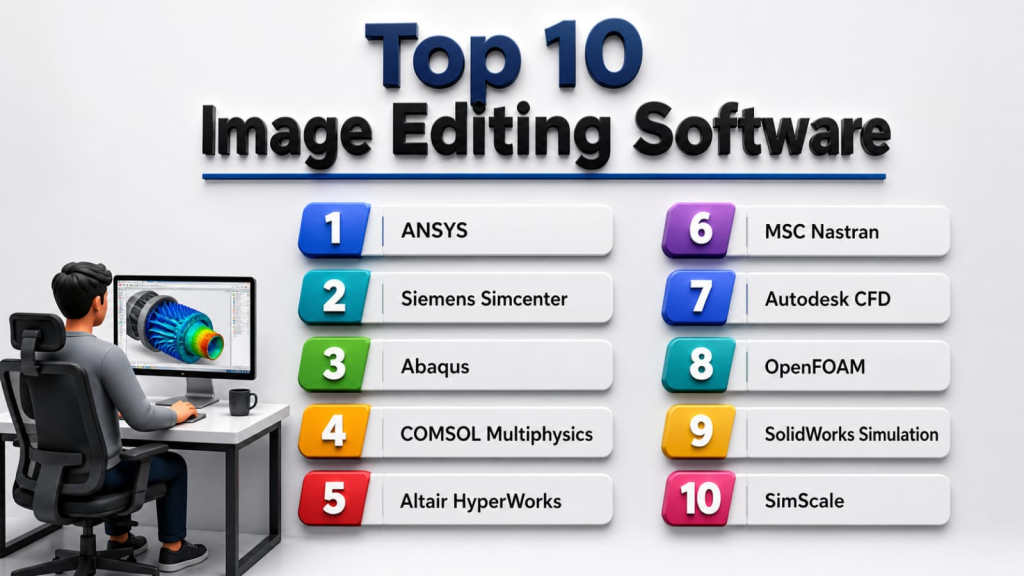
Top 10 CAE Simulation Software Tools
1 — ANSYS
Short description: A leading simulation platform offering comprehensive multi-physics capabilities for advanced engineering applications across industries.
Key Features
- Multi-physics simulation
- High-performance solvers
- Advanced meshing tools
- AI-assisted optimization
- Digital twin capabilities
Pros
- Industry-leading accuracy
- Strong scalability
Cons
- Steep learning curve
- High cost
Platforms / Deployment
Windows / Linux / Cloud / Hybrid
Security & Compliance
Not publicly stated
Integrations & Ecosystem
ANSYS integrates with major CAD tools and enterprise systems, enabling seamless engineering workflows.
- CAD platforms
- PLM systems
- APIs for customization
Support & Community
Strong global community with extensive documentation and enterprise support.
2 — Siemens Simcenter
Short description: A robust simulation suite designed for system-level engineering and multi-domain simulations.
Key Features
- System simulation
- Multi-domain analysis
- Real-time testing
- Digital twin integration
- Automation workflows
Pros
- Excellent system modeling
- Strong integration with Siemens tools
Cons
- Complex setup
- Expensive licensing
Platforms / Deployment
Windows / Cloud / Hybrid
Security & Compliance
Not publicly stated
Integrations & Ecosystem
Deep integration with Siemens ecosystem and engineering tools.
- NX CAD
- Teamcenter
- APIs
Support & Community
Enterprise-grade support with extensive resources.
3 — Abaqus
Short description: Advanced simulation software focused on structural and mechanical analysis with high precision.
Key Features
- Finite element analysis
- Nonlinear simulation
- Material modeling
- Contact analysis
- High accuracy solvers
Pros
- Excellent for structural simulation
- High precision
Cons
- Complex interface
- Resource intensive
Platforms / Deployment
Windows / Linux
Security & Compliance
Not publicly stated
Integrations & Ecosystem
Works well with Dassault systems and CAD tools.
- CATIA
- SIMULIA ecosystem
- APIs
Support & Community
Strong academic and enterprise support.
4 — COMSOL Multiphysics
Short description: A flexible simulation platform known for its multiphysics modeling capabilities.
Key Features
- Multi-physics modeling
- Custom simulation apps
- Interactive modeling
- Advanced visualization
- Add-on modules
Pros
- Highly customizable
- Broad physics coverage
Cons
- Expensive modules
- Learning curve
Platforms / Deployment
Windows / macOS / Linux
Security & Compliance
Not publicly stated
Integrations & Ecosystem
Supports integration with external tools and custom workflows.
- MATLAB integration
- APIs
- Custom scripting
Support & Community
Strong user community and documentation.
5 — Altair HyperWorks
Short description: A powerful CAE platform focused on simulation-driven design and optimization.
Key Features
- Structural analysis
- Optimization tools
- Multi-physics support
- AI-driven design
- Lightweight modeling
Pros
- Strong optimization tools
- Scalable platform
Cons
- Complex UI
- Requires training
Platforms / Deployment
Windows / Linux / Cloud
Security & Compliance
Not publicly stated
Integrations & Ecosystem
Integrates with multiple CAD and simulation tools.
- CAD platforms
- Data analytics tools
- APIs
Support & Community
Active community and enterprise support.
6 — MSC Nastran
Short description: A widely used structural analysis tool for aerospace and automotive industries.
Key Features
- Finite element analysis
- Structural simulation
- High-performance computing
- Advanced solvers
- Fatigue analysis
Pros
- Proven reliability
- High accuracy
Cons
- Legacy interface
- Limited UI modernization
Platforms / Deployment
Windows / Linux
Security & Compliance
Not publicly stated
Integrations & Ecosystem
Works with various engineering tools and workflows.
- CAD tools
- Simulation platforms
- APIs
Support & Community
Strong enterprise support.
7 — Autodesk CFD
Short description: A fluid dynamics simulation tool focused on airflow and thermal analysis.
Key Features
- CFD simulation
- Thermal analysis
- Flow visualization
- Design optimization
- Cloud simulation
Pros
- Easy to use
- Good for beginners
Cons
- Limited advanced features
- Not ideal for complex simulations
Platforms / Deployment
Windows / Cloud
Security & Compliance
Not publicly stated
Integrations & Ecosystem
Integrated with Autodesk ecosystem.
- Fusion
- Inventor
- Cloud tools
Support & Community
Good documentation and support.
8 — OpenFOAM
Short description: An open-source CFD platform for advanced fluid simulations.
Key Features
- Open-source flexibility
- Custom solvers
- CFD simulation
- Parallel computing
- Scripting capabilities
Pros
- Free and customizable
- Highly flexible
Cons
- Requires expertise
- Limited UI
Platforms / Deployment
Linux / Cloud
Security & Compliance
Varies / N/A
Integrations & Ecosystem
Supports custom integrations and workflows.
- APIs
- Custom scripts
- Community tools
Support & Community
Strong open-source community.
9 — SolidWorks Simulation
Short description: A user-friendly simulation tool integrated with SolidWorks CAD.
Key Features
- Structural simulation
- Motion analysis
- Thermal simulation
- CAD integration
- Design validation
Pros
- Easy to learn
- Seamless CAD integration
Cons
- Limited advanced capabilities
- Performance constraints
Platforms / Deployment
Windows
Security & Compliance
Not publicly stated
Integrations & Ecosystem
Works within SolidWorks ecosystem.
- CAD tools
- PLM systems
- APIs
Support & Community
Large user base and support.
10 — SimScale
Short description: A cloud-native simulation platform enabling browser-based engineering simulations.
Key Features
- Cloud simulation
- CFD and FEA
- Collaboration tools
- Scalable computing
- Real-time results
Pros
- No hardware needed
- Easy collaboration
Cons
- Internet dependency
- Subscription cost
Platforms / Deployment
Web / Cloud
Security & Compliance
Not publicly stated
Integrations & Ecosystem
Supports integrations with cloud and CAD tools.
- Browser-based workflows
- APIs
- CAD integrations
Support & Community
Growing community with online support.
Comparison Table (Top 10)
| Tool Name | Best For | Platform(s) Supported | Deployment | Standout Feature | Public Rating |
|---|---|---|---|---|---|
| ANSYS | Enterprise simulation | Windows/Linux | Hybrid | Multi-physics | N/A |
| Siemens Simcenter | System simulation | Windows | Hybrid | Digital twin | N/A |
| Abaqus | Structural analysis | Windows/Linux | On-premise | High accuracy | N/A |
| COMSOL | Multi-physics | All major OS | On-premise | Custom modeling | N/A |
| Altair HyperWorks | Optimization | Windows/Linux | Hybrid | AI-driven design | N/A |
| MSC Nastran | Structural engineering | Windows/Linux | On-premise | Proven solvers | N/A |
| Autodesk CFD | Fluid analysis | Windows | Cloud | Ease of use | N/A |
| OpenFOAM | CFD experts | Linux | Self-hosted | Open-source | N/A |
| SolidWorks Simulation | CAD users | Windows | On-premise | CAD integration | N/A |
| SimScale | Cloud simulation | Web | Cloud | Browser-based | N/A |
Evaluation & Scoring of CAE Simulation Software
| Tool | Core | Ease | Integrations | Security | Performance | Support | Value | Weighted Total |
|---|---|---|---|---|---|---|---|---|
| ANSYS | 9 | 6 | 8 | 7 | 9 | 8 | 6 | 7.9 |
| Simcenter | 9 | 6 | 9 | 7 | 8 | 8 | 6 | 7.8 |
| Abaqus | 9 | 5 | 7 | 7 | 9 | 8 | 6 | 7.6 |
| COMSOL | 8 | 7 | 7 | 7 | 8 | 7 | 6 | 7.3 |
| Altair | 8 | 6 | 8 | 7 | 8 | 7 | 7 | 7.5 |
| MSC Nastran | 8 | 5 | 7 | 7 | 9 | 7 | 6 | 7.2 |
| Autodesk CFD | 7 | 8 | 7 | 6 | 7 | 7 | 7 | 7.1 |
| OpenFOAM | 8 | 4 | 6 | 6 | 8 | 6 | 9 | 7.0 |
| SolidWorks | 7 | 8 | 8 | 6 | 7 | 8 | 7 | 7.3 |
| SimScale | 7 | 8 | 7 | 6 | 7 | 7 | 8 | 7.2 |
How to interpret scores:
- Scores are comparative, not absolute.
- Higher core and performance scores indicate strong simulation capabilities.
- Ease and value highlight usability and cost-effectiveness.
- Choose based on your specific needs rather than highest score alone.
Which CAE Simulation Tool Is Right for You?
Solo / Freelancer
Choose SimScale or Autodesk CFD for ease of use and affordability.
SMB
SolidWorks Simulation or COMSOL provide a balance of usability and capability.
Mid-Market
Altair HyperWorks or COMSOL offer strong optimization and multi-physics features.
Enterprise
ANSYS and Siemens Simcenter are best for large-scale, complex simulations.
Budget vs Premium
- Budget: OpenFOAM
- Premium: ANSYS, Simcenter
Feature Depth vs Ease of Use
- Deep features: Abaqus, ANSYS
- Easy to use: Autodesk CFD, SolidWorks
Integrations & Scalability
- Best integrations: Siemens, ANSYS
- Scalable cloud: SimScale
Security & Compliance Needs
- Enterprise tools provide better security controls
- Open-source tools require manual configuration
Frequently Asked Questions (FAQs)
1. What is CAE simulation software used for?
CAE software is used to simulate real-world physical behavior of products digitally, helping engineers test designs before manufacturing.
2. Is CAE software only for large enterprises?
No, there are tools like SimScale and SolidWorks Simulation suitable for small and mid-sized teams.
3. What is the difference between CAD and CAE?
CAD focuses on design creation, while CAE focuses on analyzing and simulating those designs.
4. Are cloud-based CAE tools reliable?
Yes, modern cloud platforms provide scalable computing and reliable simulation environments.
5. Do I need high-end hardware for CAE tools?
Traditional tools require powerful systems, but cloud tools eliminate this need.
6. Is open-source CAE software a good option?
OpenFOAM is a strong option for experts, but it requires technical knowledge.
7. How long does it take to learn CAE tools?
Learning time varies; basic tools can be learned quickly, while advanced platforms take months.
8. Can CAE tools integrate with CAD software?
Yes, most CAE tools integrate with popular CAD platforms for seamless workflows.
9. What industries use CAE software?
Automotive, aerospace, manufacturing, energy, electronics, and civil engineering.
10. How do I choose the right CAE tool?
Evaluate based on simulation needs, budget, integration requirements, and team expertise.
Conclusion
CAE Simulation Software plays a critical role in modern engineering by enabling teams to validate designs, reduce risks, and accelerate product development. From advanced enterprise solutions like ANSYS and Simcenter to flexible cloud platforms like SimScale, the market offers a wide range of tools tailored to different needs and budgets.
The best choice depends on your specific use case, technical expertise, and infrastructure. Organizations should focus on scalability, integration capabilities, and ease of use while selecting a solution. A smart approach is to shortlist two or three tools, run pilot simulations, and validate performance before making a final decision.

Find Trusted Cardiac Hospitals
Compare heart hospitals by city and services — all in one place.
Explore Hospitals
CAE simulation tools are explained clearly, and the comparison helps in understanding how design testing, analysis, and optimization are done before actual production.