Introduction
Collections Automation Tools are specialized software solutions designed to streamline and optimize the process of managing receivables, overdue invoices, and debt recovery operations. They leverage automation, analytics, and sometimes AI to reduce manual effort, improve cash flow, and enhance collection effectiveness. By automating repetitive tasks, sending reminders, and providing actionable insights, these tools allow finance and accounts teams to focus on high-value activities rather than chasing overdue payments manually. the need for efficient collections solutions has grown due to increased digital transactions, subscription-based business models, and stricter compliance requirements. Companies of all sizes are looking to reduce Days Sales Outstanding (DSO), improve customer communication, and maintain regulatory compliance across regions.
Real-world use cases include:
- Automated invoice reminders and escalation workflows for overdue accounts.
- Predictive analytics to identify high-risk customers and prioritize collections efforts.
- Integrations with ERP, CRM, and payment gateways for seamless financial operations.
- Multi-channel communication including email, SMS, and calls for debt recovery.
- Compliance monitoring to meet global regulatory standards in accounts receivable.
Evaluation criteria buyers should consider:
- Core automation features and workflow flexibility
- Ease of use and onboarding
- Integrations with existing ERP/CRM/payment systems
- Security, compliance, and audit capabilities
- Performance and reliability
- Reporting and analytics sophistication
- Customer support and community presence
- Cost and pricing flexibility
- AI-assisted decision-making capabilities
- Scalability for growing businesses
Best for: Finance and accounts receivable teams, CFOs, mid-market to enterprise companies, subscription-based businesses, and organizations with high-volume invoicing needs.
Not ideal for: Small businesses with very low volume collections, companies using outsourced collection agencies exclusively, or organizations with simple billing that may be handled manually.
Key Trends in Collections Automation Tools
- Increased adoption of AI-powered predictive collections and risk scoring.
- Automated multi-channel communications (email, SMS, voice) with personalization.
- Integration with global payment gateways and ERP/CRM platforms.
- Embedded compliance checks for GDPR, SOC 2, and local regulations.
- Cloud-first deployment with hybrid options for legacy system integration.
- Real-time dashboards and analytics for receivable health and trends.
- Use of machine learning for optimal collection timing and messaging.
- Flexible pricing models including per-invoice, per-user, and subscription plans.
- Self-service portals for customers to manage payments and disputes.
- API-first ecosystems enabling extended automation and third-party integrations.
How We Selected These Tools (Methodology)
- Assessed market adoption and visibility among finance and AR teams.
- Evaluated feature completeness and depth of automation capabilities.
- Reviewed reliability signals, uptime, and performance benchmarks.
- Verified security posture including access control, encryption, and audit trails.
- Considered the breadth and quality of integrations with ERP, CRM, and payment platforms.
- Analyzed suitability for different customer segments: SMB, mid-market, and enterprise.
- Checked support structures, onboarding, and training resources.
- Prioritized tools offering AI-driven insights and predictive capabilities.
- Considered cost-to-value alignment for different organization sizes.
- Reviewed customer feedback and case studies where available.
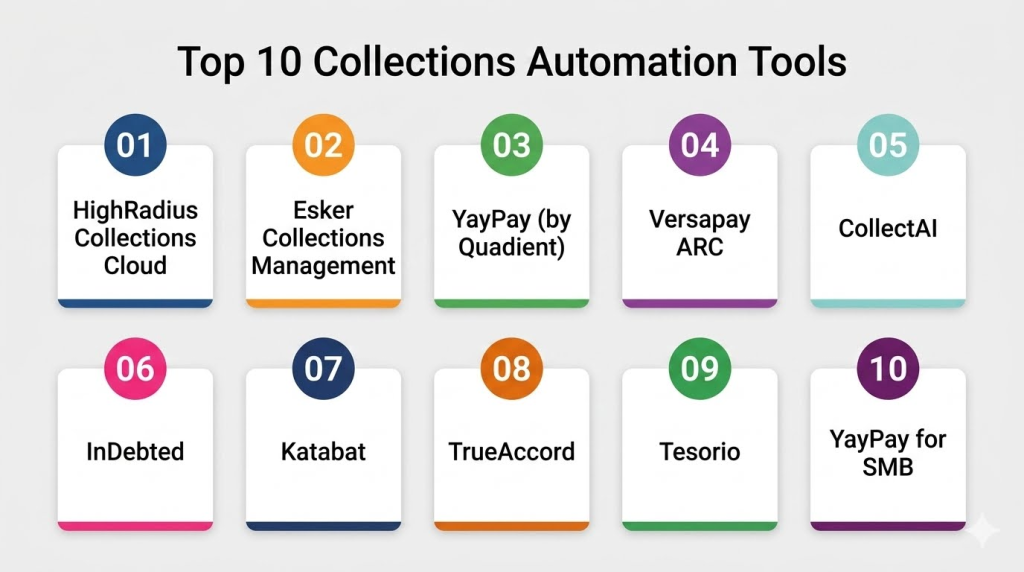
Top 10 Collections Automation Tools
1- HighRadius Collections Cloud
Short description: AI-powered collections management platform for enterprises aiming to reduce DSO and automate receivables.
Key Features
- Predictive analytics for prioritizing high-risk accounts
- Automated payment reminders and follow-ups
- Workflow automation for escalation processes
- Integration with ERP systems like SAP and Oracle
- Reporting dashboards with actionable insights
- Multi-channel communication support
Pros
- Reduces manual collection effort significantly
- Advanced AI prioritization improves efficiency
Cons
- May require ERP integration expertise
- Enterprise pricing may be high for smaller companies
Platforms / Deployment
- Web / Cloud
Security & Compliance
- SOC 2, GDPR
- SSO and MFA support
Integrations & Ecosystem
Supports ERP and accounting platforms; offers REST APIs and connectors:
- SAP, Oracle, NetSuite
- Payment gateways
- CRM systems
- Custom API integrations
Support & Community
Varies / Not publicly stated
2- Esker Collections Management
Short description: Cloud-based AR automation platform designed to optimize collections and cash flow for mid-to-large enterprises.
Key Features
- Automated invoice follow-ups and dispute management
- Centralized AR dashboard
- AI-driven customer segmentation
- Workflow automation and task routing
- Multi-channel communication
- Advanced analytics and reporting
Pros
- Strong automation reducing manual AR work
- Good visibility into receivables
Cons
- Initial configuration may be complex
- Smaller businesses may find features overkill
Platforms / Deployment
- Web / Cloud
Security & Compliance
- Not publicly stated
Integrations & Ecosystem
- ERP systems
- Email and communication platforms
- Payment gateways
- APIs for custom integration
Support & Community
- Vendor support with onboarding services
- Documentation available
3- YayPay (by Quadient)
Short description: Intelligent collections solution automating communications and cash application with AI insights.
Key Features
- Predictive customer scoring
- Automated reminders and follow-ups
- Cash application automation
- Multi-channel AR communication
- Detailed reporting dashboards
- Workflow automation for escalations
Pros
- AI insights for better collections prioritization
- Easy-to-use dashboards
Cons
- Limited self-service configuration
- Enterprise feature set may overwhelm SMBs
Platforms / Deployment
- Web / Cloud
Security & Compliance
- Not publicly stated
Integrations & Ecosystem
- ERP platforms
- Payment gateways
- APIs for third-party integrations
- CRM integration
Support & Community
- Online support
- Knowledge base
4- Versapay ARC
Short description: Cloud-native AR platform automating invoice-to-cash and collections workflows.
Key Features
- Automated invoice delivery and reminders
- Workflow management and escalations
- Customer self-service portal
- Reporting and analytics
- Integration with ERP systems
- Payment tracking
Pros
- User-friendly interface
- Strong AR automation for mid-market
Cons
- Advanced analytics may require additional modules
- Limited AI prioritization
Platforms / Deployment
- Web / Cloud
Security & Compliance
- Not publicly stated
Integrations & Ecosystem
- ERP connectors
- Payment gateways
- APIs for integration
Support & Community
- Vendor support
- Knowledge base and community resources
5- CollectAI
Short description: AI-driven collections tool focusing on automated communication and payment reminders to enhance cash flow.
Key Features
- Automated SMS, email, and digital reminders
- AI-based payment likelihood prediction
- Customer segmentation for targeting
- Dispute management
- Analytics and reporting
- Integration APIs
Pros
- Strong AI-driven communication
- Reduces DSO effectively
Cons
- Limited ERP-native integration
- Focused primarily on digital communication
Platforms / Deployment
- Web / Cloud
Security & Compliance
- Not publicly stated
Integrations & Ecosystem
- Payment gateways
- ERP connectors
- API access for custom workflows
Support & Community
- Online support
- Documentation provided
6- InDebted
Short description: Automated collections platform leveraging AI and customer-friendly workflows to improve recovery rates.
Key Features
- Customer-friendly automated messaging
- AI payment prediction
- Multi-channel communication
- Reporting dashboards
- API for ERP/CRM integration
- Escalation workflows
Pros
- Customer-centric approach increases recovery
- Easy to set up
Cons
- Less suitable for complex enterprise workflows
- Limited native ERP connectors
Platforms / Deployment
- Web / Cloud
Security & Compliance
- Not publicly stated
Integrations & Ecosystem
- Payment gateways
- CRM integrations
- APIs for ERP systems
Support & Community
- Vendor onboarding and support
- Knowledge resources available
7- Katabat
Short description: Enterprise collections automation platform with AI-assisted prioritization and workflow management.
Key Features
- AI-based risk scoring
- Multi-channel collection automation
- Payment plan management
- Reporting and insights dashboards
- Workflow automation
- Integration with ERP and CRM
Pros
- Scalable for enterprise collections
- Comprehensive reporting and insights
Cons
- May require technical support for implementation
- Cost may be high for smaller organizations
Platforms / Deployment
- Web / Cloud
Security & Compliance
- Not publicly stated
Integrations & Ecosystem
- ERP connectors
- Payment gateways
- CRM integrations
- APIs
Support & Community
- Dedicated support
- Documentation provided
8- TrueAccord
Short description: Digital-first collections platform using AI and behavioral analytics to drive payment recovery.
Key Features
- AI-based communication optimization
- Personalized messaging
- Multi-channel collections
- Customer self-service portal
- Analytics dashboards
- Integration APIs
Pros
- Focus on digital-native workflows
- Customer-friendly approach
Cons
- Limited ERP automation
- May be better suited for B2C than B2B
Platforms / Deployment
- Web / Cloud
Security & Compliance
- Not publicly stated
Integrations & Ecosystem
- Payment gateways
- API integration
- CRM connectors
Support & Community
- Online support
- Knowledge base
9- Tesorio
Short description: Cash flow performance and AR automation platform with predictive collections and reporting capabilities.
Key Features
- Predictive cash flow insights
- Automated reminders
- Collections prioritization
- Reporting and analytics
- ERP integration
- Workflow management
Pros
- Strong predictive analytics
- Improves cash flow planning
Cons
- Enterprise integration may be required for full value
- Smaller teams may underutilize features
Platforms / Deployment
- Web / Cloud
Security & Compliance
- Not publicly stated
Integrations & Ecosystem
- ERP platforms
- Payment gateways
- API support
Support & Community
- Vendor support
- Knowledge base
10- YayPay for SMB
Short description: Tailored version of YayPay focused on small to mid-market businesses seeking automated collections.
Key Features
- Automated reminders and follow-ups
- Simple dashboards
- ERP/Accounting integration
- Customer segmentation
- Payment tracking
- Analytics reports
Pros
- Simplified setup for SMBs
- Affordable compared to enterprise edition
Cons
- Limited AI sophistication
- Fewer advanced features than enterprise
Platforms / Deployment
- Web / Cloud
Security & Compliance
- Not publicly stated
Integrations & Ecosystem
- Accounting platforms
- Payment gateways
- API support
Support & Community
- Vendor support
- Documentation
Comparison Table (Top 10)
| Tool Name | Best For | Platform(s) Supported | Deployment | Standout Feature | Public Rating |
|---|---|---|---|---|---|
| HighRadius Collections Cloud | Enterprise AR teams | Web | Cloud | AI prioritization of accounts | N/A |
| Esker Collections Management | Mid-to-large enterprises | Web | Cloud | Workflow automation | N/A |
| YayPay (Quadient) | Enterprises & mid-market | Web | Cloud | Predictive customer scoring | N/A |
| Versapay ARC | Mid-market AR teams | Web | Cloud | Invoice-to-cash automation | N/A |
| CollectAI | B2C-focused digital collections | Web | Cloud | AI-driven communications | N/A |
| InDebted | Mid-market & B2C collections | Web | Cloud | Customer-friendly automation | N/A |
| Katabat | Enterprise AR teams | Web | Cloud | AI-assisted prioritization | N/A |
| TrueAccord | B2C digital collections | Web | Cloud | Behavioral AI messaging | N/A |
| Tesorio | Enterprise & SMB AR teams | Web | Cloud | Predictive cash flow analytics | N/A |
| YayPay for SMB | SMBs | Web | Cloud | Simplified collections setup | N/A |
Evaluation & Scoring of Collections Automation Tools
| Tool Name | Core (25%) | Ease (15%) | Integrations (15%) | Security (10%) | Performance (10%) | Support (10%) | Value (15%) | Weighted Total |
|---|---|---|---|---|---|---|---|---|
| HighRadius Collections Cloud | 9 | 8 | 8 | 9 | 9 | 8 | 7 | 8.6 |
| Esker Collections Management | 8 | 7 | 8 | 8 | 8 | 8 | 8 | 8.0 |
| YayPay (Quadient) | 8 | 8 | 8 | 8 | 8 | 7 | 7 | 7.9 |
| Versapay ARC | 7 | 8 | 7 | 8 | 8 | 7 | 7 | 7.5 |
| CollectAI | 7 | 8 | 7 | 7 | 7 | 7 | 8 | 7.4 |
| InDebted | 7 | 8 | 7 | 7 | 7 | 7 | 8 | 7.4 |
| Katabat | 9 | 7 | 8 | 8 | 9 | 7 | 6 | 7.9 |
| TrueAccord | 8 | 8 | 7 | 7 | 8 | 7 | 7 | 7.5 |
| Tesorio | 8 | 8 | 8 | 8 | 8 | 7 | 7 | 7.9 |
| YayPay for SMB | 7 | 9 | 7 | 7 | 7 | 7 | 8 | 7.5 |
Which Collections Automation Tool Is Right for You?
Solo / Freelancer
Simpler tools like YayPay for SMB or InDebted provide affordable, automated reminders without ERP complexity.
SMB
Versapay ARC, CollectAI, and YayPay SMB editions offer easy onboarding, multi-channel communication, and analytics for growing teams.
Mid-Market
Esker, Tesorio, and YayPay Enterprise provide robust ERP integration, AI prioritization, and workflow automation for mid-sized AR departments.
Enterprise
HighRadius, Katabat, and TrueAccord scale for large volumes, enterprise security, AI-assisted insights, and multi-channel collections.
Budget vs Premium
- Budget: YayPay SMB, InDebted
- Premium: HighRadius, Katabat, Esker, TrueAccord
Select based on automation depth vs cost constraints.
Feature Depth vs Ease of Use
- Feature depth: HighRadius, Katabat
- Ease of use: Versapay ARC, YayPay SMB, InDebted
Balance needed based on team capabilities.
Integrations & Scalability
- ERP-heavy: HighRadius, Esker
- API-friendly: Tesorio, CollectAI
Choose tools that match current and future integration needs.
Security & Compliance Needs
- Enterprises with strict compliance: HighRadius, Katabat
- SMBs with moderate requirements: YayPay SMB, Versapay ARC
Prioritize tools supporting SOC 2, GDPR, and secure authentication.
Frequently Asked Questions (FAQs)
1- What pricing models exist for collections automation tools?
Most vendors offer subscription-based pricing, often per user, per invoice, or as tiered packages based on volume. Some provide enterprise custom pricing.
2- How long does onboarding typically take?
Small businesses can deploy within days, while enterprise ERP integrations may require several weeks to configure workflows and automate rules.
3- Can these tools handle multi-currency collections?
Yes, most platforms support global payments, multi-currency invoicing, and cross-border collection workflows, though some require additional configuration.
4- How do AI features help in collections?
AI predicts payment likelihood, prioritizes accounts, and automates messaging to maximize recovery while reducing manual effort.
5- Are these tools secure for sensitive financial data?
Security measures vary; enterprises should look for SOC 2, GDPR compliance, MFA, SSO, and audit logging when selecting a platform.
6- Can I integrate these tools with my ERP or CRM?
Yes, most top platforms provide native integrations or APIs for popular ERP/CRM systems like SAP, Oracle, NetSuite, or Salesforce.
7- How scalable are these tools for growing businesses?
Enterprise-grade platforms like HighRadius, Katabat, and Esker scale easily for hundreds of thousands of invoices per month.
8- What common mistakes should I avoid when adopting?
Avoid skipping workflow configuration, underestimating ERP integration complexity, and neglecting staff training on automated communications.
9- How easy is it to switch tools?
Switching requires careful migration of customer data, invoice histories, and automated rules; APIs and export capabilities help simplify the process.
10- Are there alternatives to full automation?
Yes, some companies use semi-automated approaches or outsource to collections agencies; tools can often complement these workflows.
Conclusion
Collections automation tools have become essential for organizations aiming to improve cash flow, reduce DSO, and streamline accounts receivable operations. The right tool depends on company size, workflow complexity, compliance needs, and integration requirements. Smaller businesses benefit from simplified SaaS solutions, while enterprises require robust AI-driven, ERP-integrated platforms. To begin, organizations should shortlist 2–3 tools, run a pilot on their accounts workflows, and validate integration and security compliance before full deployment. By carefully selecting a platform, businesses can achieve efficiency, reduce risk, and maintain healthy financial operations.

Find Trusted Cardiac Hospitals
Compare heart hospitals by city and services — all in one place.
Explore Hospitals
Collections automation works best when it balances efficiency with customer relationships. Flexible payment reminders, personalized communication, and intelligent prioritization can improve recovery rates while helping maintain a positive customer experience.