Introduction
Court Docket Management Tools help law firms, courts, legal departments, litigation teams, and legal operations professionals track court filings, hearing schedules, case updates, deadlines, motions, orders, and litigation activity. In simple terms, these platforms organize court-related activity and ensure legal teams do not miss important dates, filings, or procedural updates. These tools matter more than ever because litigation timelines are becoming more complex, courts increasingly operate digitally, and legal teams must manage cases across multiple jurisdictions and systems. Manual docket tracking through spreadsheets, emails, and calendar reminders often creates missed deadlines, compliance risks, and operational inefficiencies. Modern docket management platforms combine court monitoring, calendaring, notifications, AI-assisted workflows, document tracking, and litigation analytics into centralized systems.
Real-world use cases include:
- Tracking court deadlines and litigation schedules
- Monitoring filings, motions, and case updates
- Managing multi-jurisdiction litigation calendars
- Automating docket alerts and reminders
- Coordinating litigation teams and outside counsel workflows
What buyers should evaluate:
- Court coverage and jurisdiction support
- Automated docket updates and alerts
- Litigation calendar accuracy
- AI-assisted deadline extraction and summarization
- Integrations with legal practice management tools
- Reporting and litigation analytics
- User permissions and audit controls
- Ease of use for attorneys and paralegals
- Mobile access and notification workflows
- Security and confidentiality protections
Best for: Litigation law firms, in-house litigation teams, courts, legal operations teams, compliance groups, insurance defense teams, government legal departments, and organizations managing large volumes of court activity and deadlines.
Not ideal for: Organizations with little or no litigation activity, teams managing only a few local matters manually, or firms that only need basic calendaring without litigation workflow automation.
Key Trends in Court Docket Management Tools
- AI-assisted docket summarization is expanding: Platforms increasingly summarize filings, motions, hearings, and court activity automatically.
- Court integration automation is improving: More systems directly sync with electronic court filing systems and online court records.
- Litigation analytics is becoming mainstream: Firms want judge analytics, motion trends, docket timelines, and court behavior insights.
- Multi-jurisdiction litigation support is critical: Large firms increasingly need centralized visibility across state, federal, and international matters.
- Automated calendaring reduces deadline risk: Rules-based calendaring and procedural deadline automation continue to grow.
- Mobile litigation workflows are increasing: Lawyers expect real-time docket alerts and court updates on mobile devices.
- Cybersecurity and confidentiality requirements are stricter: Litigation data contains sensitive client and case information requiring strong access controls.
- Integration with legal ecosystems is accelerating: Docket management tools increasingly connect with practice management, e-discovery, document management, and billing systems.
- Cloud-first adoption continues: Cloud platforms support distributed legal teams and faster deployment.
- AI governance matters more: Legal teams are evaluating how AI-generated summaries and alerts are produced and validated.
How We Selected These Tools
The Top 10 Court Docket Management Tools were selected using a practical legal operations and litigation-focused methodology. The goal is not to identify one universal winner, but to compare recognized platforms for different litigation, calendaring, and docket tracking needs.
Selection criteria included:
- Market recognition in litigation support and docket management
- Court coverage across jurisdictions
- Automated calendaring and deadline management
- Litigation workflow and collaboration capabilities
- Docket monitoring reliability and update speed
- Integration ecosystem with legal software and document systems
- Security posture and access control signals
- Suitability for solo firms, litigation boutiques, and enterprise legal departments
- Reporting, analytics, and matter visibility capabilities
- Support, onboarding, and operational scalability
Top 10 Court Docket Management Tools
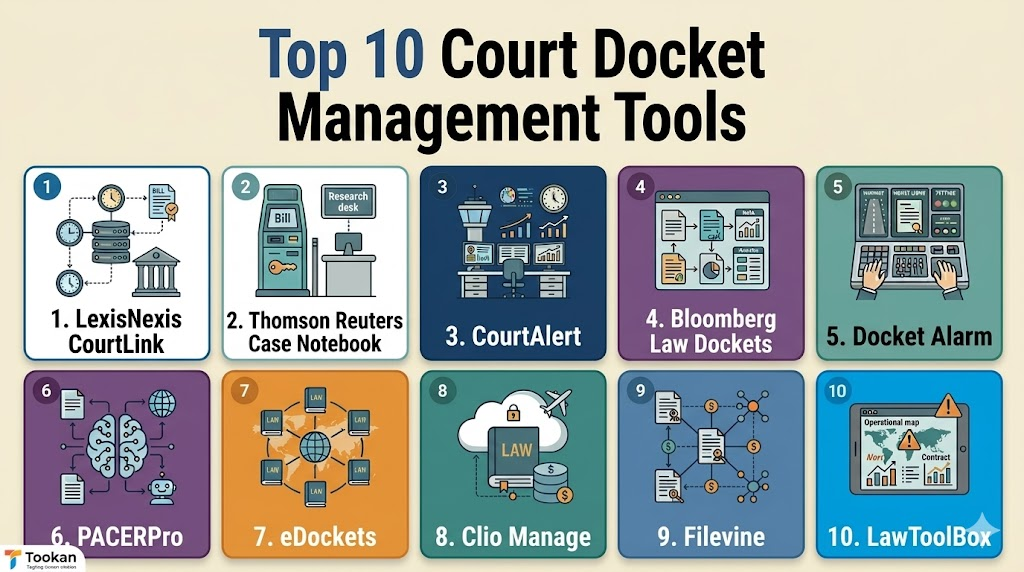
1- LexisNexis CourtLink
Short description: LexisNexis CourtLink is a litigation intelligence and docket tracking platform that provides access to federal and state court dockets, litigation analytics, alerts, and case monitoring workflows. It is best for litigation-focused law firms and enterprise legal teams.
Key Features
- Federal and state docket tracking
- Litigation analytics and court insights
- Automated case alerts and monitoring
- Court filing and motion visibility
- Advanced search across court records
- Judge and litigation analytics
- Integration with LexisNexis legal ecosystem
Pros
- Strong litigation monitoring capabilities
- Broad court coverage and analytics
- Useful for complex litigation environments
Cons
- Premium pricing may not fit smaller firms
- Analytics depth may require training
- Coverage can vary by jurisdiction
Platforms / Deployment
Web / Cloud
Security & Compliance
Not publicly stated in full detail for all buyer requirements. Buyers should validate MFA, RBAC, encryption, audit logs, confidentiality protections, data retention, and litigation data governance controls.
Integrations & Ecosystem
CourtLink works best inside broader LexisNexis legal research and litigation workflows.
- LexisNexis legal ecosystem
- Litigation analytics tools
- Legal research platforms
- Matter management systems
- Alerts and notification workflows
- APIs and reporting integrations
Support & Community
LexisNexis provides onboarding, customer support, training, and enterprise support resources. Buyers should confirm jurisdiction coverage and analytics onboarding assistance.
2- Thomson Reuters Case Notebook
Short description: Thomson Reuters Case Notebook is litigation case management and docket organization software designed for trial preparation, litigation collaboration, and case tracking. It is best for litigation teams managing large document-heavy cases.
Key Features
- Litigation case organization
- Docket and evidence tracking
- Timeline and fact management
- Trial preparation workflows
- Witness and exhibit management
- Collaboration support for litigation teams
- Integration with Thomson Reuters ecosystem
Pros
- Useful for trial-focused litigation workflows
- Strong evidence and matter organization support
- Good fit for litigation-heavy firms
Cons
- May require training for full adoption
- Best suited for structured litigation teams
- Some workflows may feel specialized for smaller firms
Platforms / Deployment
Windows / Web varies
Deployment: Cloud / Hybrid varies
Security & Compliance
Not publicly stated in full detail for all buyer needs. Buyers should validate encryption, RBAC, audit logs, MFA, confidentiality protections, and litigation document controls.
Integrations & Ecosystem
Case Notebook connects with litigation support, legal research, and document workflows.
- Thomson Reuters legal ecosystem
- Litigation document systems
- Trial preparation workflows
- Research and citation tools
- Matter management systems
- Reporting and evidence workflows
Support & Community
Thomson Reuters provides documentation, onboarding, support, and training resources. Buyers should confirm migration and litigation workflow setup support.
3- CourtAlert
Short description: CourtAlert is a litigation docketing and calendaring platform focused on court updates, deadline monitoring, litigation tracking, and automated alerts. It is best for law firms and litigation teams needing centralized docket visibility.
Key Features
- Automated docket tracking
- Court rule-based calendaring
- Litigation alerts and notifications
- Deadline monitoring
- Multi-jurisdiction support
- Reporting and docket visibility
- Matter and case tracking workflows
Pros
- Strong automated calendaring support
- Helpful for reducing missed litigation deadlines
- Practical for firms handling active litigation portfolios
Cons
- Coverage should be validated by jurisdiction
- Advanced analytics may vary by plan
- Workflow customization needs testing
Platforms / Deployment
Web / Cloud
Security & Compliance
Not publicly stated in full detail. Buyers should validate MFA, RBAC, encryption, audit logs, and confidentiality protections for litigation workflows.
Integrations & Ecosystem
CourtAlert fits litigation teams needing docket tracking connected with legal calendaring and case workflows.
- Calendar integrations
- Litigation workflows
- Matter management systems
- Email notifications
- Reporting dashboards
- Legal operations workflows
Support & Community
CourtAlert provides customer support, onboarding, and litigation workflow guidance. Buyers should validate support coverage and jurisdiction-specific onboarding.
4- Bloomberg Law Dockets
Short description: Bloomberg Law Dockets combines court docket tracking with legal research, litigation analytics, legal news, and business intelligence. It is best for corporate litigation teams and firms wanting litigation context beyond filings alone.
Key Features
- Court docket tracking
- Litigation monitoring and alerts
- Legal news and intelligence
- Docket analytics
- Business and regulatory insights
- Advanced search workflows
- Litigation trend analysis
Pros
- Strong combination of litigation and business intelligence
- Good for enterprise legal departments
- Useful docket visibility across multiple workflows
Cons
- Premium pricing structure
- Some firms may not need broader business intelligence features
- Coverage and workflows should be tested by jurisdiction
Platforms / Deployment
Web / Cloud
Security & Compliance
Not publicly stated in full detail for all requirements. Buyers should validate MFA, RBAC, encryption, audit logs, and litigation confidentiality controls.
Integrations & Ecosystem
Bloomberg Law Dockets works best when litigation monitoring needs to connect with legal intelligence and business context.
- Bloomberg Law ecosystem
- Legal research workflows
- Litigation analytics
- Alerts and monitoring
- Regulatory intelligence
- Reporting tools
Support & Community
Bloomberg Law provides onboarding, enterprise support, and documentation resources. Buyers should validate training and workflow configuration support.
5- Docket Alarm
Short description: Docket Alarm is a litigation tracking and docket analytics platform providing court monitoring, alerts, analytics, and legal research support. It is best for litigation teams needing searchable docket intelligence and tracking.
Key Features
- Court docket search and tracking
- Litigation alerts and notifications
- Analytics and reporting
- API and developer support
- Court filing monitoring
- Searchable litigation databases
- Workflow integrations
Pros
- Strong docket search capabilities
- Useful APIs for legal operations workflows
- Good litigation tracking visibility
Cons
- Analytics needs vary by jurisdiction
- Some advanced workflows require setup
- Teams should validate court coverage depth
Platforms / Deployment
Web / Cloud
Security & Compliance
Not publicly stated in full detail. Buyers should validate MFA, RBAC, encryption, audit logging, and confidentiality protections.
Integrations & Ecosystem
Docket Alarm works well for litigation monitoring and searchable legal data workflows.
- Legal research tools
- Litigation analytics
- APIs and reporting systems
- Alerts and monitoring workflows
- Case tracking systems
- Workflow automation tools
Support & Community
Docket Alarm provides onboarding resources, support, APIs, and documentation. Buyers should confirm support responsiveness and integration assistance.
6- PACERPro
Short description: PACERPro is a federal court docket management and workflow platform designed to simplify PACER access, filing review, docket tracking, and litigation collaboration. It is best for firms heavily involved in U.S. federal litigation.
Key Features
- PACER workflow optimization
- Federal court docket tracking
- Document organization and sharing
- Litigation alerts and monitoring
- Collaborative litigation workflows
- Searchable federal court data
- Billing and usage visibility
Pros
- Strong fit for federal litigation workflows
- Simplifies PACER access and organization
- Useful collaboration capabilities for litigation teams
Cons
- Focused heavily on federal court workflows
- International or non-federal needs may require additional tools
- Buyers should validate integration depth
Platforms / Deployment
Web / Cloud
Security & Compliance
Not publicly stated in full detail. Buyers should validate encryption, RBAC, MFA, audit logging, and litigation data protections.
Integrations & Ecosystem
PACERPro is useful where firms need centralized federal litigation document and docket management.
- PACER workflows
- Litigation document systems
- Alerts and calendaring
- Legal research workflows
- Matter management integrations
- Collaboration workflows
Support & Community
PACERPro provides onboarding, support, training, and litigation workflow assistance. Buyers should validate migration support and federal court coverage workflows.
7- eDockets
Short description: eDockets is a court docketing and litigation calendaring platform that helps legal teams manage deadlines, filing schedules, reminders, and procedural timelines. It is best for litigation practices needing centralized docket calendars.
Key Features
- Court docket calendaring
- Deadline and reminder automation
- Litigation workflow tracking
- Multi-user collaboration
- Matter-based scheduling
- Reporting and notifications
- Court rule workflows
Pros
- Helps reduce missed litigation deadlines
- Useful centralized docket visibility
- Practical for collaborative litigation teams
Cons
- Advanced analytics may be limited
- Coverage and workflow flexibility should be validated
- User experience depends on workflow setup
Platforms / Deployment
Web / Cloud
Security & Compliance
Not publicly stated in full detail. Buyers should validate MFA, encryption, RBAC, audit logs, and confidentiality controls.
Integrations & Ecosystem
eDockets supports litigation calendaring and scheduling workflows.
- Calendar integrations
- Litigation matter systems
- Email reminders
- Reporting workflows
- Team collaboration tools
- Notification systems
Support & Community
eDockets provides onboarding, support, and calendaring assistance. Buyers should confirm jurisdiction-specific rule support and onboarding resources.
8- Clio Manage
Short description: Clio Manage is a legal practice management platform with calendaring, litigation workflow, matter tracking, task management, and court deadline organization. It is best for smaller firms wanting docket-related workflows integrated with practice management.
Key Features
- Matter and litigation tracking
- Calendar and deadline workflows
- Task and reminder management
- Document and client organization
- Mobile access and notifications
- Billing and matter workflows
- Legal app integrations
Pros
- Strong all-in-one practice management experience
- Useful for smaller litigation firms
- Easier adoption compared with many enterprise litigation systems
Cons
- Not a dedicated enterprise docket analytics platform
- Large litigation teams may need specialized tools
- Advanced court analytics should be validated separately
Platforms / Deployment
Web / Cloud
iOS / Android availability: Varies by plan
Security & Compliance
Not publicly stated in full detail for every requirement. Buyers should validate MFA, RBAC, encryption, audit logs, confidentiality protections, and legal data governance.
Integrations & Ecosystem
Clio works well when litigation calendars need to connect with practice management and legal workflows.
- Document management tools
- Billing systems
- Legal workflow integrations
- Calendar and communication tools
- Client management systems
- Legal productivity ecosystem
Support & Community
Clio provides customer support, onboarding, training resources, and migration assistance. Buyers should validate litigation-specific workflow support.
9- Filevine
Short description: Filevine is a legal operations and case management platform supporting litigation workflows, document management, calendaring, collaboration, and legal automation. It is best for litigation-focused firms wanting workflow-driven matter management.
Key Features
- Litigation and case workflows
- Task and deadline management
- Document and communication tracking
- Workflow automation
- Reporting and analytics
- Team collaboration support
- Integration with legal operations workflows
Pros
- Strong workflow automation support
- Useful for litigation-heavy practices
- Good operational visibility across cases and deadlines
Cons
- Implementation may require configuration effort
- Advanced litigation analytics should be validated
- Smaller firms may not use all workflow capabilities
Platforms / Deployment
Web / Cloud
Security & Compliance
Not publicly stated in full detail. Buyers should validate MFA, RBAC, encryption, audit logging, and confidentiality protections.
Integrations & Ecosystem
Filevine works well for litigation operations connected with case workflows and collaboration.
- Document systems
- Communication tools
- Workflow automation
- Reporting dashboards
- Practice management workflows
- APIs and integrations
Support & Community
Filevine provides onboarding, implementation guidance, documentation, and customer support. Buyers should confirm workflow configuration assistance.
10- LawToolBox
Short description: LawToolBox is a rules-based legal calendaring and deadline management platform that automates court deadlines and integrates with productivity systems. It is best for firms focused on litigation calendaring accuracy.
Key Features
- Rules-based calendaring
- Court deadline automation
- Litigation reminders and notifications
- Outlook and productivity integrations
- Multi-jurisdiction calendar support
- Team collaboration workflows
- Deadline tracking and reporting
Pros
- Strong automated deadline calculation support
- Useful for reducing calendaring errors
- Good integration with productivity workflows
Cons
- Focused primarily on calendaring rather than full litigation analytics
- Buyers should validate court rule coverage
- Workflow depth may vary by use case
Platforms / Deployment
Web / Cloud
Security & Compliance
Not publicly stated in full detail. Buyers should validate MFA, RBAC, encryption, audit logs, and confidentiality protections.
Integrations & Ecosystem
LawToolBox is strongest when litigation calendaring must connect with productivity and legal workflow systems.
- Microsoft Outlook integrations
- Calendar workflows
- Litigation task management
- Matter management systems
- Notifications and reminders
- Legal productivity tools
Support & Community
LawToolBox provides onboarding, training, support, and rules-based calendaring guidance. Buyers should confirm jurisdiction support and onboarding assistance.
Comparison Table
| Tool Name | Best For | Platform Supported | Deployment | Standout Feature | Public Rating |
|---|---|---|---|---|---|
| LexisNexis CourtLink | Enterprise litigation tracking | Web | Cloud | Litigation analytics and docket intelligence | N/A |
| Thomson Reuters Case Notebook | Trial preparation and litigation organization | Windows / Web varies | Cloud / Hybrid varies | Trial-focused litigation workflows | N/A |
| CourtAlert | Automated docket alerts and calendaring | Web | Cloud | Rules-based litigation deadline tracking | N/A |
| Bloomberg Law Dockets | Litigation plus legal intelligence | Web | Cloud | Docket tracking with business intelligence | N/A |
| Docket Alarm | Searchable litigation analytics | Web | Cloud | Docket search and APIs | N/A |
| PACERPro | Federal litigation workflows | Web | Cloud | PACER optimization and collaboration | N/A |
| eDockets | Litigation calendaring | Web | Cloud | Centralized docket scheduling | N/A |
| Clio Manage | Smaller litigation firms | Web / Mobile varies | Cloud | Practice management plus litigation workflows | N/A |
| Filevine | Workflow-driven litigation operations | Web | Cloud | Litigation automation workflows | N/A |
| LawToolBox | Rules-based legal calendaring | Web | Cloud | Automated court deadline calculation | N/A |
Evaluation & Scoring of Court Docket Management Tools
| Tool Name | Core 25% | Ease 15% | Integrations 15% | Security 10% | Performance 10% | Support 10% | Value 15% | Weighted Total |
|---|---|---|---|---|---|---|---|---|
| LexisNexis CourtLink | 9 | 8 | 9 | 8 | 9 | 8 | 7 | 8.35 |
| Thomson Reuters Case Notebook | 8 | 7 | 8 | 8 | 8 | 8 | 7 | 7.75 |
| CourtAlert | 8 | 8 | 8 | 7 | 8 | 8 | 8 | 8.00 |
| Bloomberg Law Dockets | 9 | 8 | 8 | 8 | 9 | 8 | 7 | 8.20 |
| Docket Alarm | 8 | 8 | 9 | 7 | 8 | 8 | 8 | 8.05 |
| PACERPro | 8 | 8 | 8 | 7 | 8 | 8 | 8 | 8.00 |
| eDockets | 7 | 8 | 7 | 7 | 7 | 7 | 8 | 7.40 |
| Clio Manage | 8 | 9 | 9 | 8 | 8 | 9 | 8 | 8.45 |
| Filevine | 8 | 8 | 8 | 8 | 8 | 8 | 8 | 8.00 |
| LawToolBox | 8 | 9 | 8 | 7 | 8 | 8 | 8 | 8.05 |
Which Court Docket Management Tool Is Right for You?
Solo / Freelancer
Solo litigators and smaller firms often need simple deadline tracking, docket alerts, calendaring, and reminders without enterprise complexity. Clio Manage, LawToolBox, CourtAlert, and eDockets are practical choices depending on workflow needs and litigation volume.
SMB
Small and mid-sized litigation firms usually need stronger collaboration, matter tracking, document organization, and automated court workflows. Filevine, Clio Manage, CourtAlert, Docket Alarm, and LawToolBox can be strong fits.
Mid-Market
Mid-market firms managing multiple litigators and jurisdictions should prioritize integrations, centralized docket visibility, reporting, and litigation workflows. PACERPro, Filevine, Docket Alarm, Bloomberg Law Dockets, and CourtLink are strong candidates.
Enterprise
Large firms and enterprise legal departments need advanced litigation analytics, court coverage, workflow automation, integrations, auditability, and security controls. LexisNexis CourtLink, Bloomberg Law Dockets, Thomson Reuters Case Notebook, and Filevine are strong enterprise-oriented choices.
Budget vs Premium
Budget-focused buyers may prioritize calendaring and alerts first, while premium platforms add litigation analytics, court intelligence, and advanced integrations. Buyers should evaluate whether advanced analytics justify higher pricing.
Feature Depth vs Ease of Use
Dedicated litigation analytics platforms often provide deep functionality but may require training. Simpler calendaring-focused systems are easier to adopt but may not support complex litigation intelligence needs.
Integrations & Scalability
Court docket workflows increasingly need connections with practice management, legal research, billing, document management, and collaboration systems. Buyers should validate API support, notification workflows, and scalability across practice groups.
Security & Compliance Needs
Court docket systems contain sensitive litigation strategy, client information, and procedural data. Buyers should validate MFA, RBAC, encryption, audit logs, retention controls, and confidentiality governance before deployment.
Frequently Asked Questions
1- What is a court docket management tool?
A court docket management tool helps legal teams track court deadlines, filings, hearings, case updates, and litigation workflows. These systems centralize litigation calendars and reduce missed deadlines.
2- Who uses docket management software?
Law firms, litigation boutiques, corporate legal departments, insurance defense teams, courts, government legal offices, and legal operations professionals commonly use docket management platforms.
3- How is docket management different from practice management?
Practice management platforms handle broader law firm operations like billing, clients, and documents, while docket management tools focus specifically on litigation deadlines, filings, court calendars, and procedural tracking.
4- Which tool is best for federal court litigation?
PACERPro, CourtLink, Docket Alarm, and Bloomberg Law Dockets are strong options for federal litigation workflows. Buyers should validate court coverage and workflow needs before choosing.
5- Can these tools automate court deadlines?
Yes. Many docket management systems use court rules and litigation calendars to automate deadline calculation, reminders, and scheduling workflows.
6- Do docket management tools use AI?
Some modern platforms use AI for docket summarization, filing analysis, litigation insights, and workflow automation. Buyers should validate accuracy and governance controls before relying heavily on AI-generated outputs.
7- How much do docket management tools cost?
Pricing varies by jurisdiction coverage, analytics features, number of users, integrations, and litigation volume. Enterprise litigation intelligence platforms typically cost more than basic calendaring tools.
8- Are these tools suitable for small law firms?
Yes. Smaller firms can benefit from automated calendaring, reminders, and centralized litigation visibility. Simpler tools may provide enough value without enterprise-level complexity.
9- What are common mistakes when choosing a docket management tool?
Common mistakes include ignoring jurisdiction coverage, failing to validate court rule accuracy, underestimating integration needs, and choosing a platform too complex for the actual litigation workflow.
10- What should buyers test during evaluation?
Buyers should test deadline calculations, court coverage, alert accuracy, integrations, reporting, mobile access, permissions, and real litigation workflows before deployment.
Conclusion
Court Docket Management Tools help litigation teams reduce deadline risk, centralize court activity, automate calendaring, and improve litigation visibility across matters and jurisdictions. The best platform depends on litigation volume, court coverage needs, workflow complexity, analytics requirements, and whether the organization needs enterprise litigation intelligence or lightweight calendaring automation. LexisNexis CourtLink and Bloomberg Law Dockets are strong for litigation intelligence and analytics, while CourtAlert and LawToolBox are practical for automated litigation calendaring. PACERPro is valuable for federal court workflows, Docket Alarm provides strong searchable docket analytics, and Filevine and Clio Manage connect litigation tracking with broader legal operations.

Find Trusted Cardiac Hospitals
Compare heart hospitals by city and services — all in one place.
Explore Hospitals
Court docket management tools are most valuable when they help courts, law firms, and legal professionals organize, track, and manage court cases, filings, hearings, deadlines, and judicial schedules. By providing automated docket tracking, case calendaring, document management, deadline reminders, workflow automation, court filing integration, reporting, and collaboration features, these platforms improve legal efficiency, reduce missed deadlines, enhance case visibility, support regulatory compliance, and streamline the administration of litigation and court proceedings.