Introduction
IP Address Management (IPAM) Tools are specialized software solutions that enable IT teams to plan, track, and manage IP addresses in a networked environment. These tools provide visibility over IP address allocations, facilitate automated provisioning, enforce policies, and help prevent conflicts that can cause network outages. IPAM is critical for organizations managing large-scale, dynamic networks, including data centers, cloud infrastructures, and hybrid environments.
As enterprises increasingly adopt cloud services, virtualization, and hybrid networks in IPAM tools have become essential to maintaining network reliability, security, and scalability. Real-world use cases include centralized IP address inventory management, automated subnet allocations, integration with DNS and DHCP services, monitoring network usage, and supporting compliance audits. Buyers should evaluate scalability, automation, integration capabilities, reporting, security, compliance, multi-cloud support, user roles and access control, and pricing.
Best for: Network administrators, IT operations teams, cloud architects, enterprises managing large or hybrid networks, service providers.
Not ideal for: Small businesses with a limited number of IP addresses, where manual tracking or native DNS/DHCP tools suffice.
Key Trends in IP Address Management (IPAM) Tools
- AI-driven IP allocation and conflict detection
- Automation for provisioning, tracking, and subnet planning
- Integration with DNS and DHCP for seamless DDI (DNS, DHCP, IPAM) management
- Multi-cloud and hybrid network support
- Role-based access and audit logging for compliance
- API-driven workflows for DevOps and ITSM integration
- Analytics and reporting for capacity planning and usage trends
- Support for IPv6 adoption and dual-stack environments
- Subscription-based and usage-based pricing models
- Compliance with SOC 2, ISO 27001, and GDPR
How We Selected These Tools (Methodology)
- Market adoption and industry mindshare
- Feature completeness, including automation, reporting, and integrations
- Reliability and performance under high network load
- Security posture, including encryption, access control, and audit logs
- Integration capabilities with DNS, DHCP, ITSM, and monitoring tools
- Customer fit across small, medium, and enterprise networks
- Scalability and support for IPv4 and IPv6 networks
- Ease of use and deployment flexibility
- Compliance and audit readiness
- Vendor support, documentation, and training resources
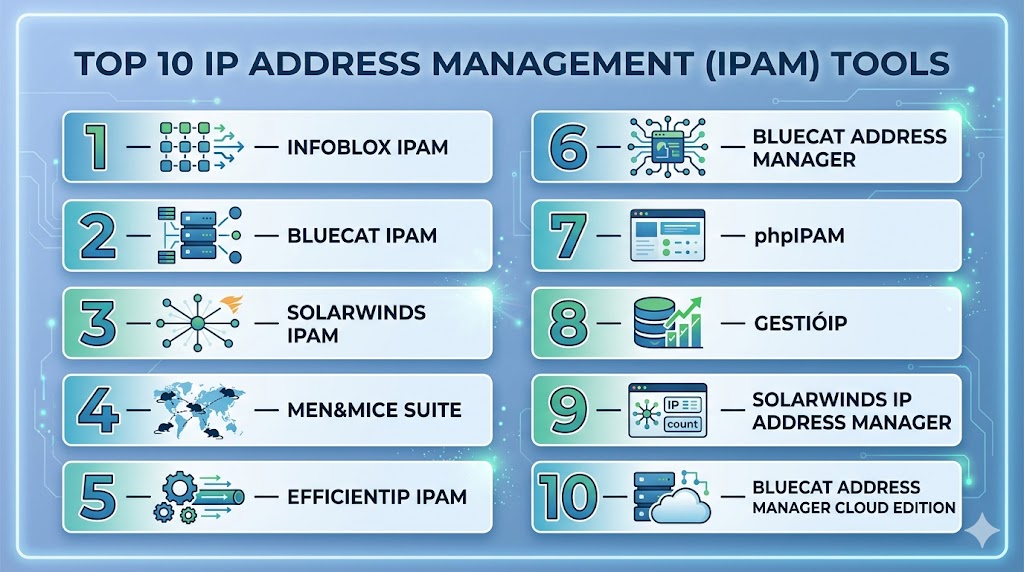
Top 10 IP Address Management (IPAM) Tools
#1 — Infoblox IPAM
Short description : Infoblox IPAM provides enterprise-grade IP address management, integrated with DNS and DHCP, offering automation, compliance, and analytics. It is designed for large-scale enterprise networks and service providers.
Key Features
- Centralized IP address inventory
- Automated subnet and address allocation
- DNS and DHCP integration
- Role-based access control and audit logging
- Analytics and reporting dashboards
- Multi-cloud and hybrid support
Pros
- Comprehensive enterprise functionality
- Strong automation and compliance features
- Scalable for large networks
Cons
- High enterprise pricing
- Complexity for smaller teams
Platforms / Deployment
- Web
- Cloud / Hybrid
Security & Compliance
- SOC 2, ISO 27001, GDPR
- Encryption, SSO, MFA
Integrations & Ecosystem
- ITSM: ServiceNow, Jira
- Cloud providers: AWS, Azure
- APIs for automation
Support & Community
Enterprise support, documentation, and professional services.
#2 — BlueCat IPAM
Short description : BlueCat IPAM delivers centralized management for IP, DHCP, and DNS, providing automation, policy enforcement, and visibility for enterprise networks.
Key Features
- Centralized IP address and subnet management
- Automation of provisioning tasks
- Policy-based configuration and compliance
- DHCP and DNS integration
- Reporting and analytics
- Multi-cloud support
Pros
- Strong automation capabilities
- Policy enforcement for compliance
- Scalable and reliable
Cons
- Premium pricing
- Requires training for advanced features
Platforms / Deployment
- Web
- Cloud / Hybrid
Security & Compliance
- SOC 2, ISO 27001, GDPR
- Encryption, SSO
Integrations & Ecosystem
- ITSM: ServiceNow
- Cloud platforms: AWS, Azure
- APIs and automation tools
Support & Community
Enterprise support, training, and documentation.
#3 — SolarWinds IPAM
Short description : SolarWinds IPAM simplifies IP address tracking, subnet management, and network automation for SMB and enterprise networks, with integrated monitoring capabilities.
Key Features
- IP address tracking and subnet management
- Automated scanning and reporting
- DNS and DHCP integration
- Alerts for conflicts and usage thresholds
- Role-based access
- API for automation
Pros
- Affordable for SMBs
- Easy to deploy
- Good monitoring and alerting features
Cons
- Limited multi-cloud support
- Advanced features may require separate modules
Platforms / Deployment
- Web
- On-premises / Cloud
Security & Compliance
- Not publicly stated
Integrations & Ecosystem
- ITSM tools: ServiceNow
- Network monitoring systems
- APIs for automation
Support & Community
Documentation, support tiers, and active user forums.
#4 — Men&Mice Suite
Short description : Men&Mice IPAM offers enterprise-level DDI (DNS, DHCP, IPAM) management with automation, centralized control, and multi-vendor support.
Key Features
- Centralized IP address and network management
- DNS and DHCP integration
- Automation and orchestration
- Multi-vendor network device support
- Analytics and reporting
- Role-based access
Pros
- Multi-vendor network compatibility
- Strong automation and policy enforcement
- Cloud and on-premises flexibility
Cons
- Complex configuration for smaller networks
- Premium pricing
Platforms / Deployment
- Web
- Cloud / Hybrid
Security & Compliance
- SOC 2, ISO 27001
- Encryption, SSO
Integrations & Ecosystem
- ITSM and monitoring platforms
- Cloud provider integrations
- APIs for DevOps automation
Support & Community
Enterprise support and training programs.
#5 — EfficientIP IPAM
Short description : EfficientIP provides scalable IPAM with network automation, DNS/DHCP integration, and advanced reporting, suitable for enterprises and managed services.
Key Features
- Centralized IP management
- Automation for provisioning
- DNS and DHCP integration
- Policy-based configuration
- Multi-cloud and hybrid network support
- Analytics and reporting
Pros
- Scalable for large networks
- Automation reduces manual errors
- Policy enforcement for compliance
Cons
- Enterprise pricing
- Learning curve for complex networks
Platforms / Deployment
- Web
- Cloud / Hybrid
Security & Compliance
- SOC 2, ISO 27001
- Encryption, SSO
Integrations & Ecosystem
- Cloud providers: AWS, Azure
- ITSM and network monitoring systems
- APIs for automation
Support & Community
Documentation, professional services, and support tiers.
#6 — BlueCat Address Manager
Short description : BlueCat Address Manager focuses on IPAM and DDI management, providing visibility, automation, and policy enforcement for enterprise networks.
Key Features
- IP and subnet management
- DNS and DHCP integration
- Automated provisioning
- Policy enforcement and compliance
- Analytics and reporting dashboards
- Multi-cloud support
Pros
- Enterprise-grade reliability
- Strong automation features
- Multi-domain management
Cons
- High cost
- Requires advanced training
Platforms / Deployment
- Web
- Cloud / Hybrid
Security & Compliance
- SOC 2, ISO 27001
- Encryption, SSO, MFA
Integrations & Ecosystem
- Cloud: AWS, Azure
- ITSM: ServiceNow
- APIs for automation
Support & Community
Professional support and training.
#7 — phpIPAM
Short description : phpIPAM is an open-source IP address management tool providing basic IPAM features suitable for SMBs and smaller enterprise networks.
Key Features
- IP address and subnet tracking
- VLAN management
- IPv4 and IPv6 support
- Role-based access
- Basic reporting and notifications
Pros
- Free and open-source
- Lightweight and easy to deploy
- Supports basic IPAM needs
Cons
- Limited automation
- Fewer integrations than enterprise tools
Platforms / Deployment
- Web
- Self-hosted
Security & Compliance
- Varies / N/A
Integrations & Ecosystem
- APIs for basic automation
- Limited third-party integrations
Support & Community
Community support and forums.
#8 — GestióIP
Short description : GestióIP is a web-based IPAM solution offering IP management, automated subnet scanning, and reporting for mid-sized networks.
Key Features
- IP address management
- Automated subnet discovery
- VLAN and VRF management
- IPv4 and IPv6 support
- Reporting and analytics
- Role-based access
Pros
- Free and open-source edition
- Supports automated scanning
- Lightweight and web-based
Cons
- Limited enterprise features
- Fewer integrations
Platforms / Deployment
- Web
- Self-hosted
Security & Compliance
- Varies / N/A
Integrations & Ecosystem
- API for automation
- Basic monitoring integration
Support & Community
Community support and online forums.
#9 — SolarWinds IP Address Manager
Short description : SolarWinds IP Address Manager provides automated IP tracking, DHCP and DNS integration, and conflict detection for SMBs and enterprises.
Key Features
- IP and subnet tracking
- Automated conflict detection
- DHCP and DNS integration
- Role-based access
- Reporting and alerts
- API for automation
Pros
- Easy to use and deploy
- Good for SMB and mid-market
- Integrated monitoring
Cons
- Limited advanced automation
- Pricing may be high for SMBs
Platforms / Deployment
- Web
- On-premises / Cloud
Security & Compliance
- Not publicly stated
Integrations & Ecosystem
- ITSM tools
- Cloud and monitoring integration
- APIs for automation
Support & Community
Documentation, support tiers, and active forums.
#10 — BlueCat Address Manager Cloud Edition
Short description : Cloud edition of BlueCat Address Manager provides IPAM with cloud-native deployment, automated workflows, and enterprise DDI integration.
Key Features
- Centralized IP management
- Cloud deployment and automation
- DNS and DHCP integration
- Analytics and monitoring
- Role-based access control
- Multi-cloud support
Pros
- Cloud-native and scalable
- Strong automation and security
- Multi-cloud integration
Cons
- Premium pricing
- Enterprise-focused complexity
Platforms / Deployment
- Web
- Cloud
Security & Compliance
- SOC 2, ISO 27001
- Encryption, SSO, MFA
Integrations & Ecosystem
- Cloud providers: AWS, Azure
- ITSM and monitoring systems
- APIs for automation
Support & Community
Enterprise support, training, and professional services.
Comparison Table (Top 10)
| Tool Name | Best For | Platform(s) Supported | Deployment | Standout Feature | Public Rating |
|---|---|---|---|---|---|
| Infoblox IPAM | Enterprise networks | Web | Cloud/Hybrid | DDI integration & automation | N/A |
| BlueCat IPAM | Enterprises | Web | Cloud/Hybrid | Policy enforcement & compliance | N/A |
| SolarWinds IPAM | SMB & enterprise | Web | On-prem/Cloud | Automated conflict detection | N/A |
| Men&Mice Suite | Enterprise & hybrid | Web | Cloud/Hybrid | Multi-vendor network support | N/A |
| EfficientIP IPAM | Enterprise | Web | Cloud/Hybrid | Policy-based automation | N/A |
| BlueCat Address Manager | Enterprise | Web | Cloud/Hybrid | Multi-domain management | N/A |
| phpIPAM | SMB & small enterprises | Web | Self-hosted | Open-source lightweight | N/A |
| GestióIP | Mid-sized networks | Web | Self-hosted | Automated subnet scanning | N/A |
| SolarWinds IP Address Manager | SMB & Mid-market | Web | On-prem/Cloud | DHCP & DNS integration | N/A |
| BlueCat Address Manager Cloud | Enterprise cloud networks | Web | Cloud | Cloud-native automation | N/A |
Evaluation & Scoring of IP Address Management (IPAM) Tools
| Tool Name | Core (25%) | Ease (15%) | Integrations (15%) | Security (10%) | Performance (10%) | Support (10%) | Value (15%) | Weighted Total (0–10) |
|---|---|---|---|---|---|---|---|---|
| Infoblox IPAM | 9 | 8 | 8 | 9 | 9 | 8 | 7 | 8.4 |
| BlueCat IPAM | 9 | 8 | 7 | 9 | 8 | 8 | 7 | 8.1 |
| SolarWinds IPAM | 8 | 8 | 7 | 8 | 8 | 7 | 7 | 7.8 |
| Men&Mice Suite | 8 | 7 | 8 | 8 | 8 | 7 | 7 | 7.8 |
| EfficientIP IPAM | 8 | 7 | 7 | 8 | 8 | 7 | 7 | 7.7 |
| BlueCat Address Manager | 9 | 7 | 7 | 9 | 8 | 8 | 7 | 7.9 |
| phpIPAM | 6 | 8 | 6 | 6 | 7 | 6 | 9 | 6.9 |
| GestióIP | 6 | 7 | 6 | 6 | 7 | 6 | 9 | 6.8 |
| SolarWinds IP Address Manager | 8 | 7 | 7 | 8 | 8 | 7 | 7 | 7.7 |
| BlueCat Address Manager Cloud | 9 | 7 | 8 | 9 | 8 | 8 | 7 | 8.1 |
Interpretation: Weighted totals provide a comparative evaluation of IPAM tools based on feature set, usability, integrations, security, performance, support, and value. Scores help organizations assess which solution aligns best with network scale and operational requirements.
Which IP Address Management (IPAM) Tools Tool Is Right for You?
Solo / Freelancer
phpIPAM or GestióIP provide lightweight, low-cost IPAM for small networks with minimal overhead.
SMB
SolarWinds IPAM or phpIPAM offer scalable yet affordable options with automated features and monitoring.
Mid-Market
EfficientIP IPAM, SolarWinds IP Address Manager, or Men&Mice Suite provide robust automation, multi-domain support, and reporting.
Enterprise
Infoblox IPAM, BlueCat IPAM, and BlueCat Address Manager Cloud offer enterprise-grade DDI integration, automation, and compliance features.
Budget vs Premium
Open-source tools reduce cost but require manual effort, whereas enterprise solutions provide automation, scalability, and security at higher price points.
Feature Depth vs Ease of Use
Enterprise IPAM tools offer advanced features and compliance controls, while open-source and SMB solutions prioritize simplicity and quick deployment.
Integrations & Scalability
Organizations with hybrid or multi-cloud environments should choose tools with API-driven automation and ITSM/DNS/DHCP integrations.
Security & Compliance Needs
Enterprises in regulated industries benefit from SOC 2, ISO 27001, and GDPR-compliant platforms like Infoblox and BlueCat.
Frequently Asked Questions (FAQs)
1. What pricing models exist?
IPAM platforms may use subscription, usage-based, or enterprise licensing. Open-source options are free but require manual management.
2. How long does deployment take?
Cloud-native solutions deploy quickly; enterprise multi-domain setups may require days to weeks for full configuration.
3. Can these tools handle IPv6?
Yes, most modern IPAM tools support both IPv4 and IPv6 addressing, including dual-stack environments.
4. Are AI or predictive features available?
Some platforms provide AI-driven anomaly detection, automated conflict resolution, and capacity forecasting.
5. How secure are these tools?
Enterprise IPAM tools implement encryption, SSO, MFA, and audit logging for regulatory compliance.
6. Do these tools integrate with ITSM?
Yes, integration with platforms like ServiceNow or Jira is common for automation and ticketing.
7. Are these suitable for small networks?
Open-source options like phpIPAM and GestióIP are ideal for smaller networks with minimal IPs.
8. Can IPAM automate provisioning?
Yes, enterprise tools automate IP assignment, subnet management, and DNS/DHCP updates.
9. How do these tools support multi-cloud?
Enterprise IPAM tools offer APIs and integrations to manage IPs across AWS, Azure, and GCP environments.
10. Are open-source alternatives viable?
Yes, for SMBs or non-critical networks, open-source IPAM can suffice, though with limited automation and security features.
Conclusion
IP Address Management (IPAM) Tools are critical for ensuring efficient, secure, and compliant IP allocation in modern network environments. Enterprises benefit from advanced automation, DDI integration, multi-cloud support, and compliance capabilities provided by Infoblox, BlueCat, and EfficientIP. SMBs can leverage SolarWinds IPAM or open-source solutions like phpIPAM for cost-effective management. Tool selection depends on network scale, integration needs, automation requirements, and budget. Piloting tools, validating integrations, and leveraging automation workflows are recommended to optimize IP management and network reliability.

Find Trusted Cardiac Hospitals
Compare heart hospitals by city and services — all in one place.
Explore Hospitals
IPAM data can become unreliable when network changes are made outside the IPAM system. A new subnet, reserved address, or device may be added manually and leave the records out of sync. Regular discovery checks against the real network can help catch these differences and keep the IPAM database accurate.