Introduction
Medication Adherence Apps help patients remember when to take their medicines, track doses, and reduce missed schedules, especially for chronic conditions or multiple prescriptions. These apps are useful for patients, caregivers, clinics, and pharmacies that need better visibility into daily medication routines. Modern tools may include dose reminders, refill alerts, adherence history, caregiver sharing, health tracking, and reports. They matter because consistent medication use can support better treatment outcomes and reduce avoidable care gaps. The best app depends on user needs, device comfort, privacy expectations, integration requirements, and the level of caregiver or clinical support required.
Real-world use cases include:
- Reminding patients to take daily medications on schedule
- Tracking adherence for chronic disease management such as diabetes, hypertension, or cardiovascular conditions
- Enabling caregivers to monitor patient medication compliance
- Integrating with telehealth platforms for remote consultation
- Sending refill reminders and connecting to pharmacies
Evaluation Criteria for Buyers:
- Ease of use and intuitive patient interface
- Integration with EHRs, pharmacies, and telehealth platforms
- Security and privacy compliance (HIPAA, GDPR)
- Multi-device and cross-platform availability
- Automated reminders and adherence tracking
- Analytics and reporting for patients and providers
- Caregiver and clinician engagement features
- Customization for medication schedules, dosages, and alerts
- Offline functionality and notification reliability
- AI-driven predictive insights or adherence recommendations
Best for: patients managing chronic conditions, caregivers, clinics, and telehealth providers seeking reliable adherence tracking and reporting.
Not ideal for: individuals on simple short-term medications or organizations that only require manual reminder methods or non-digital adherence solutions.
Key Trends in Medication Adherence Apps
- AI-driven predictive alerts to anticipate missed doses
- Integration with EHRs, telehealth, and pharmacy networks
- Voice assistant and smart device support (smart speakers, wearables)
- Remote caregiver and clinician monitoring dashboards
- Gamification and incentive features to encourage adherence
- Multi-lingual support and accessibility improvements
- Blockchain-based secure medication tracking for clinical trials
- Real-time analytics and adherence trend reporting
- Cloud-native platforms for multi-device synchronization
- Advanced security features including encryption, MFA, and compliance reporting
How We Selected These Tools
- Evaluated market adoption and recognition among digital health apps
- Assessed feature completeness: reminders, tracking, reporting, and caregiver engagement
- Checked reliability and performance signals from user experience and app store reviews
- Reviewed security posture and privacy compliance (HIPAA, GDPR)
- Verified integrations with EHRs, telehealth, pharmacy networks, and wearables
- Considered scalability for individual users, clinics, and health systems
- Assessed AI and automation capabilities for predictive adherence alerts
- Reviewed patient and provider usability for daily workflow efficiency
- Evaluated analytics and reporting capabilities for actionable insights
- Considered vendor support, updates, and customer engagement
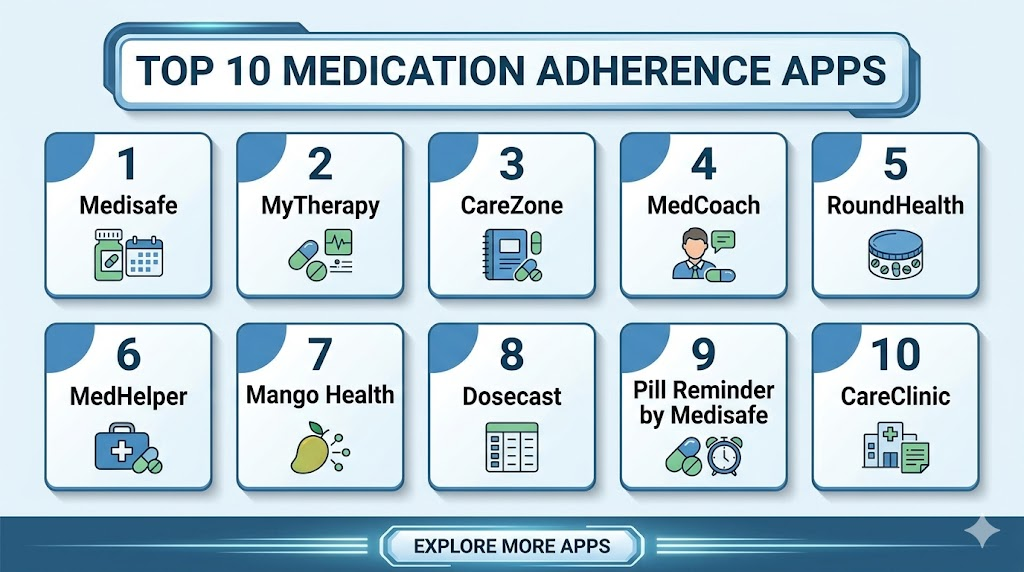
Top 10 Medication Adherence Apps
1- Medisafe
Short description: Medisafe is a widely used medication reminder app for patients managing multiple prescriptions, with caregiver and clinician monitoring support.
Key Features
- Automated medication reminders
- Pill tracker and adherence calendar
- Caregiver and family monitoring
- Integration with pharmacies for refill reminders
- Reports and adherence analytics
- Medication interaction alerts
- Multi-device synchronization
Pros
- Easy-to-use interface for patients and caregivers
- Reliable reminders reduce missed doses
- Integration with healthcare providers
Cons
- Limited offline functionality
- Some advanced features require subscription
- Analytics for clinics may be basic
Platforms / Deployment
iOS / Android
Cloud
Security & Compliance
HIPAA-compliant, encryption, audit logs
Integrations & Ecosystem
- EHR systems
- Pharmacy refill reminders
- Wearables and smart devices
- Telehealth platforms
Support & Community
Vendor support via email, FAQs, and tutorials; active user community
2- MyTherapy
Short description: MyTherapy offers medication reminders, symptom tracking, and adherence reporting for patients and care teams.
Key Features
- Medication and pill reminders
- Symptom and health tracking
- PDF adherence reports for clinicians
- Multi-device and multi-user support
- Integration with smart devices
- Gamification to motivate adherence
Pros
- Comprehensive tracking including symptoms
- Multi-user support for caregivers
- Customizable notifications
Cons
- Limited AI insights
- Some analytics features behind premium plan
- Requires internet for full functionality
Platforms / Deployment
iOS / Android / Web
Cloud
Security & Compliance
HIPAA-compliant, encryption
Integrations & Ecosystem
- Telehealth platforms
- Smart devices and wearables
- Pharmacy reminders
Support & Community
Documentation, tutorials, email support
3- CareZone
Short description: CareZone focuses on medication management, journaling, and caregiver collaboration for patient adherence.
Key Features
- Medication reminders and tracking
- Caregiver and family sharing
- Medication lists and photo storage
- Notes and journaling for symptoms
- Refill reminders
- Reports and history
Pros
- Strong caregiver collaboration tools
- User-friendly interface
- Free basic plan available
Cons
- Limited integration with EHRs
- Reporting is basic
- Some advanced features require paid subscription
Platforms / Deployment
iOS / Android / Web
Cloud
Security & Compliance
HIPAA-compliant, data encryption
Integrations & Ecosystem
- Pharmacy reminders
- Care team monitoring
- Wearables (limited)
Support & Community
Email support, in-app guides
4- MedCoach
Short description: MedCoach offers AI-assisted reminders and interactive tracking for patient medication adherence.
Key Features
- AI-powered reminder schedules
- Dosage tracking
- Alerts for missed doses
- Integration with pharmacy and EHR
- Reporting for patients and providers
- Multi-device support
Pros
- Predictive AI helps improve adherence
- Integration with clinical workflows
- Customizable alerts
Cons
- Smaller user base than competitors
- Some advanced features require subscription
- Limited multi-language support
Platforms / Deployment
iOS / Android / Web
Cloud
Security & Compliance
HIPAA, encryption, MFA
Integrations & Ecosystem
- EHRs
- Telehealth
- Pharmacy networks
- Wearables
Support & Community
Vendor support, tutorials, email support
5- RoundHealth
Short description: RoundHealth helps users manage daily medications with reminders, adherence tracking, and refill alerts.
Key Features
- Simple medication reminders
- Refill notifications
- Dosage and pill tracking
- Reporting and adherence history
- Multi-device syncing
Pros
- Extremely easy to use
- Reliable reminders
- Free basic version
Cons
- Lacks caregiver monitoring features
- Limited analytics
- No smart device integrations
Platforms / Deployment
iOS / Android
Cloud
Security & Compliance
HIPAA-compliant, encryption
Integrations & Ecosystem
- Limited third-party integrations
- Basic adherence reports
Support & Community
In-app support, FAQs
6- MedHelper
Short description: MedHelper provides detailed medication scheduling, dosage tracking, and reminders for multiple medications.
Key Features
- Multi-drug scheduling
- Pill tracking and adherence history
- Refill alerts
- Reporting dashboards
- Patient notes and logs
Pros
- Supports complex medication schedules
- Reliable tracking
- Simple UI
Cons
- Limited caregiver integration
- Advanced analytics not available
- Only basic adherence reports
Platforms / Deployment
iOS / Android
Cloud
Security & Compliance
Not publicly stated
Integrations & Ecosystem
- Basic pharmacy reminders
- Personal tracking
Support & Community
Email and app support
7- Mango Health
Short description: Mango Health combines adherence reminders with gamification and rewards to improve medication compliance.
Key Features
- Medication reminders
- Gamified adherence tracking
- Reward points for adherence
- Reporting dashboards
- Multiple medication support
Pros
- Engaging gamification encourages compliance
- Simple UI
- Motivates long-term adherence
Cons
- Not all features free
- Limited caregiver features
- Minimal EHR integration
Platforms / Deployment
iOS / Android
Cloud
Security & Compliance
HIPAA, encryption
Integrations & Ecosystem
- Smart devices
- Pharmacy reminders
Support & Community
Email support, in-app guides
8- Dosecast
Short description: Dosecast provides flexible scheduling, alerts, and reporting for medication adherence, suitable for individuals with multiple medications.
Key Features
- Customizable reminders
- Dosage tracking
- Adherence logs
- Reporting and history
- Multiple medications per schedule
- Backup and restore
Pros
- Highly flexible scheduling
- Works offline
- Reliable notifications
Cons
- Limited caregiver or clinician integration
- Free version lacks analytics
- UI can be complex for some users
Platforms / Deployment
iOS / Android / Web
Cloud
Security & Compliance
HIPAA-compliant, encryption
Integrations & Ecosystem
- Pharmacy reminders
- Basic EHR integration (Varies)
Support & Community
Email support, FAQs
9- Pill Reminder by Medisafe
Short description: A companion app to Medisafe focusing on quick reminders, adherence logs, and simple tracking.
Key Features
- Quick medication reminders
- Adherence tracking
- Dose history logs
- Notifications and alerts
- Patient notes
Pros
- Simple, easy to use
- Reliable reminders
- Supports multiple medications
Cons
- Limited caregiver monitoring
- Minimal reporting
- No AI predictive features
Platforms / Deployment
iOS / Android
Cloud
Security & Compliance
HIPAA-compliant, encryption
Integrations & Ecosystem
- Pharmacy reminders
- Telehealth basic integration
Support & Community
In-app tutorials, email support
10- CareClinic
Short description: CareClinic offers a medication tracker with comprehensive health management, symptom tracking, and caregiver communication.
Key Features
- Medication reminders
- Symptom and health tracking
- Caregiver sharing
- Reporting and analytics
- Multi-device support
- Refill notifications
Pros
- Holistic health tracking beyond medication
- Caregiver and family integration
- Reports and analytics available
Cons
- Some features behind subscription
- Interface may be complex for some users
- Limited AI predictive alerts
Platforms / Deployment
iOS / Android / Web
Cloud
Security & Compliance
HIPAA, encryption, audit logs
Integrations & Ecosystem
- EHRs and telehealth
- Pharmacy refill integration
- Wearables and smart devices
Support & Community
Vendor support, tutorials, email help
Comparison Table
| Tool Name | Best For | Platform(s) Supported | Deployment | Standout Feature | Public Rating |
|---|---|---|---|---|---|
| PioneerRx | Independent pharmacies | iOS / Android | Cloud | Workflow automation | N/A |
| QS/1 | Retail & institutional | iOS / Android | Cloud | Prescription accuracy | N/A |
| Rx30 | Independent & chain | iOS / Android | Cloud | Workflow efficiency | N/A |
| Computer-Rx | Outpatient & independent | iOS / Android | Cloud | Inventory management | N/A |
| Liberty Software | Small pharmacies | iOS / Android | Cloud | Affordable management | N/A |
| McKesson | Enterprise/hospital | iOS / Android | Cloud / Hybrid | Enterprise-scale features | N/A |
| Medisafe | Chronic condition patients | iOS / Android | Cloud | Caregiver integration | N/A |
| MyTherapy | Patient adherence | iOS / Android | Cloud | Symptom tracking | N/A |
| CareZone | Family & caregiver support | iOS / Android | Cloud | Caregiver sharing | N/A |
| CareClinic | Holistic health | iOS / Android / Web | Cloud | Multi-device tracking | N/A |
Evaluation & Scoring of Medication Adherence Apps
| Tool Name | Core 25% | Ease 15% | Integrations 15% | Security 10% | Performance 10% | Support 10% | Value 15% | Weighted Total 0–10 |
|---|---|---|---|---|---|---|---|---|
| Medisafe | 9 | 9 | 8 | 8 | 9 | 8 | 8 | 8.50 |
| MyTherapy | 8 | 8 | 8 | 8 | 8 | 8 | 8 | 8.00 |
| CareZone | 8 | 9 | 7 | 7 | 8 | 8 | 8 | 7.95 |
| MedCoach | 8 | 8 | 8 | 8 | 8 | 8 | 8 | 8.00 |
| RoundHealth | 7 | 9 | 6 | 7 | 8 | 7 | 8 | 7.55 |
| MedHelper | 7 | 8 | 6 | 7 | 8 | 7 | 7 | 7.25 |
| Mango Health | 8 | 8 | 6 | 7 | 8 | 7 | 7 | 7.45 |
| Dosecast | 8 | 7 | 7 | 7 | 8 | 7 | 7 | 7.35 |
| Pill Reminder | 7 | 9 | 6 | 7 | 8 | 7 | 7 | 7.40 |
| CareClinic | 8 | 8 | 7 | 7 | 8 | 7 | 8 | 7.65 |
Which Medication Adherence App Is Right for You?
Solo / Freelancer
Choose a simple, free or low-cost app like RoundHealth or Pill Reminder for basic medication schedules. Focus on reliability and ease of use.
SMB
Care teams supporting multiple patients can benefit from Medisafe, CareZone, or MyTherapy for caregiver monitoring and reporting.
Mid-Market
Clinics or pharmacies managing adherence programs may prefer MedCoach, Dosecast, or CareClinic for AI-driven alerts, analytics, and multi-patient tracking.
Enterprise
Large health systems should consider Medisafe, MyTherapy, or CareClinic with full integration to EHRs, telehealth, and pharmacy systems.
Budget vs Premium
Budget apps cover basic reminders, tracking, and notifications. Premium options add AI insights, caregiver dashboards, analytics, and smart device integration.
Feature Depth vs Ease of Use
Select apps based on patient and caregiver needs. Simpler apps are better for adherence reminders only; advanced apps are better for clinics or multi-patient management.
Integrations & Scalability
Ensure the app can connect with EHRs, telehealth platforms, pharmacy systems, and wearable devices. Scalability matters for clinics, hospitals, or enterprise monitoring programs.
Security & Compliance Needs
HIPAA compliance, encryption, secure cloud storage, and role-based access are essential for any patient data handling.
Frequently Asked Questions
1. What are Medication Adherence Apps?
Medication Adherence Apps are digital tools that help users take medicines on time through reminders, schedules, dose tracking, and alerts.
They are useful for patients managing chronic conditions, caregivers supporting family members, and clinics monitoring treatment adherence.
Many apps also include refill reminders, medication history, symptom tracking, and adherence reports.
The main goal is to reduce missed doses and improve consistency in treatment routines.
2. How much do Medication Adherence Apps cost?
Pricing depends on the app, features, user type, and whether it is for personal or clinical use.
Many apps offer free basic plans with reminders and tracking, while premium plans may include caregiver alerts, reports, cloud sync, or advanced analytics.
Clinic or enterprise versions may charge based on users, patients, integrations, or monitoring features.
Buyers should compare total cost, not just the monthly subscription fee.
3. Who should use Medication Adherence Apps?
These apps are useful for patients taking multiple medications, older adults, caregivers, chronic disease patients, and people with complex treatment schedules.
They can also help clinics, pharmacies, and care teams monitor adherence patterns and support follow-up care.
Users managing diabetes, hypertension, heart disease, mental health conditions, or long-term therapies may benefit most.
They are less necessary for people taking only short-term or very simple medication schedules.
4. What features should buyers evaluate first?
Buyers should check reminder reliability, medication scheduling flexibility, caregiver sharing, refill alerts, reports, and ease of use.
For clinical use, integrations with EHRs, pharmacies, telehealth systems, and remote monitoring platforms may also matter.
Security, privacy, data export, and notification reliability should be reviewed before adoption.
The best app should be simple enough for patients and strong enough for care coordination.
5. Are Medication Adherence Apps secure?
Many medication apps use privacy controls such as encrypted data storage, secure login, and cloud-based synchronization.
However, security levels vary, so users and healthcare buyers should validate privacy policies, access controls, data sharing rules, and compliance claims.
For healthcare organizations, HIPAA, GDPR, audit logs, MFA, and role-based access may be important.
If security details are unclear, treat them as “Not publicly stated” and confirm directly with the vendor.
6. Can caregivers monitor medication adherence remotely?
Yes, many adherence apps allow caregivers, family members, or care teams to receive alerts when a dose is missed or completed.
This is useful for older adults, chronic care patients, and people who need support with daily medication routines.
Caregiver features may include shared calendars, notifications, adherence reports, and refill reminders.
Buyers should test whether caregiver access is easy, secure, and included in the selected plan.
7. Do these apps integrate with pharmacies or EHR systems?
Some Medication Adherence Apps support pharmacy refill reminders, prescription records, telehealth tools, or healthcare system integrations.
However, integration depth varies widely between consumer apps and clinical-grade platforms.
Clinics should verify whether the app connects with EHRs, pharmacy systems, care management tools, or patient portals.
For personal users, basic refill reminders may be enough, while providers may need stronger interoperability.
8. What common mistakes should users avoid?
A common mistake is choosing an app only because it looks simple, without checking reminder reliability or schedule flexibility.
Users should also avoid entering incomplete medication details, ignoring refill reminders, or failing to update changed prescriptions.
Care teams should not assume app data is clinically complete unless workflows are properly configured.
It is best to test the app with real medication schedules before relying on it daily.
9. Can Medication Adherence Apps help with chronic disease management?
Yes, these apps can support chronic disease management by improving dose consistency and tracking medication-taking behavior over time.
Some apps also allow users to record symptoms, vitals, mood, side effects, or health notes alongside medication logs.
This information can help patients and providers understand adherence patterns and treatment challenges.
However, apps should support care plans, not replace professional medical advice.
10. What alternatives exist to Medication Adherence Apps?
Alternatives include pill boxes, printed medication schedules, alarm clocks, caregiver phone calls, pharmacy packaging, and smart pill dispensers.
For simple routines, these options may be enough and easier for some users.
For complex medication schedules, chronic disease programs, or remote monitoring needs, apps provide stronger tracking and reporting.
The best choice depends on the user’s comfort with technology, care needs, and support system.
Conclusion
Medication Adherence Apps are essential tools to improve patient outcomes, reduce missed doses, and provide caregivers and clinicians with actionable adherence data. Individual users can benefit from simpler apps like RoundHealth or Pill Reminder, while clinics, pharmacies, and healthcare systems may prefer Medisafe, MyTherapy, or CareClinic for full-featured monitoring and analytics. Selecting the right app depends on patient needs, integration requirements, device compatibility, security, and budget. Buyers should shortlist 2–3 apps, test real workflows, verify integration with EHRs and pharmacies, confirm compliance and security measures, and pilot with patients before full adoption.

Find Trusted Cardiac Hospitals
Compare heart hospitals by city and services — all in one place.
Explore Hospitals
Medication adherence apps are most effective when they help users take medications consistently and on schedule through personalized reminders, refill alerts, and progress tracking. By supporting medication management, caregiver notifications, and health record integration, these platforms can improve treatment adherence, reduce missed doses, and contribute to better long-term health outcomes.