Introduction
Model Risk Management Software refers to specialized systems designed to help organizations identify, assess, monitor, and mitigate risks associated with analytical, financial, statistical, and machine learning models. These tools provide structured frameworks to catalog models, validate performance, track changes, and ensure compliance with internal policies and external regulations. In industries where models drive critical decisions such as finance, insurance, healthcare, and supply chain unmanaged model risk can lead to significant financial loss, regulatory penalties, or operational breakdowns. the importance of model risk management (MRM) software continues to grow due to the rapid adoption of AI/ML models, increasing regulatory scrutiny (including expectations from regulators for explainability and validation), and the rising complexity of predictive systems used in decision-making. Organizations must proactively manage not only traditional risk models but also machine‑learning‑driven systems used for credit scoring, underwriting, pricing, forecasting, and fraud detection.
Real-world use cases include:
- Validating credit risk scoring models in banking and financial services.
- Monitoring machine learning models used in underwriting and pricing for insurance carriers.
- Ensuring regulatory compliance for models used in stress testing and capital adequacy.
- Tracking model performance over time to detect drift or deterioration.
- Standardizing model documentation and audit trails for internal and external reviews.
When evaluating model risk management tools, buyers should consider:
- Model inventory and categorization capabilities
- Validation and testing frameworks
- Automated performance monitoring and alerts
- Support for AI/ML explainability and fairness checks
- Audit trails and documentation management
- Workflow automation and approval processes
- Integration with data science, analytics, and governance tools
- Regulatory compliance support
- User roles and security controls
- Vendor support and scalability
Best for: Risk managers, quantitative analysts, data science teams, and compliance officers in financial services, insurance, and enterprises relying on predictive analytics and AI models.
Not ideal for: Small organizations with limited model usage or those using basic spreadsheet models without regulatory constraints.
Key Trends in Model Risk Management Software for 2026 and Beyond
- AI/ML‑centric validation frameworks that go beyond traditional statistical models to support explainability and fairness checks for machine learning.
- Automated performance monitoring with anomaly detection for model drift and degradation over time.
- Integration with data science platforms to streamline model cataloging, version control, and governance.
- Cloud‑native deployments for scalable and collaborative model risk management.
- Regulatory compliance built‑in for frameworks such as SR 11‑7, Basel standards, and emerging AI governance guidelines.
- Low‑code/no‑code model risk workflows to reduce reliance on custom development.
- Cross‑enterprise risk adoption linking model risk with broader risk management processes.
- Explainable AI (XAI) support to help business and compliance stakeholders understand model decisions.
- Enhanced audit trails and documentation stores for internal audits and external regulatory reviews.
- Subscription and usage‑based pricing models to align cost with model volumes and enterprise footprint.
How We Selected These Tools (Methodology)
- Identified software with significant market adoption and credible enterprise usage.
- Assessed feature completeness across core MRM needs: inventory, validation, monitoring, documentation, and governance.
- Evaluated reliability, performance signals, and deployment scalability.
- Reviewed support for security capabilities: RBAC, audit logs, encryption, and identity providers.
- Considered integrations with data science toolchains, model registries, and analytics platforms.
- Examined fit across enterprise, mid‑market, and data‑intensive industries.
- Prioritized tools offering predictive analytics and AI/ML risk oversight.
- Reviewed support for regulatory compliance and audit requirements.
- Weighted vendor support, onboarding, and professional services.
- Balanced ease of use with depth of risk governance functionality.
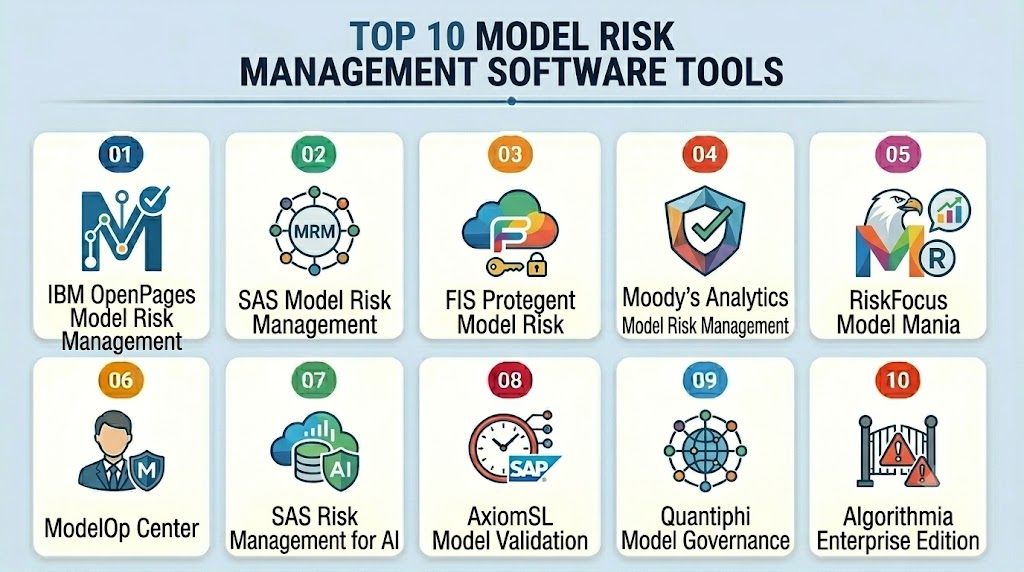
Top 10 Model Risk Management Software
1 — IBM OpenPages Model Risk Management
Short description :
IBM OpenPages Model Risk Management provides an enterprise‑class solution for tracking, validating, and governing analytical and AI models across large organizations. It is designed for financial services, insurance, and regulated industries requiring robust risk and compliance oversight.
Key Features
- Comprehensive model inventory and categorization
- Validation workflows and version control
- Performance monitoring dashboards
- Regulatory compliance support
- Automated documentation and audit trails
- Integration with governance and risk platforms
Pros
- Enterprise‑grade governance and audit capabilities
- Strong compliance support for financial regulations
- Scalable across global operations
Cons
- Higher cost and configuration complexity
- Requires training for advanced feature utilization
- Best tailored for large organizations
Platforms / Deployment
- Web / Cloud / Hybrid
Security & Compliance
Not publicly stated
Integrations & Ecosystem
Strong integration capabilities with enterprise systems, including data governance, business intelligence, and analytics tools.
- APIs for model registries and data science platforms
- Connectors for governance and risk frameworks
- Extensible alerting and reporting
Support & Community
Vendor onboarding, professional services, documentation, and support tiers. Active enterprise user base and professional community.
2 — SAS Model Risk Management
Short description:
SAS Model Risk Management helps organizations create, validate, and monitor models across their lifecycle, with a strong emphasis on statistical and machine learning models for financial risk, marketing, and predictive use cases.
Key Features
- Model inventory and lineage tracking
- Risk scoring and validation tests
- AI/ML monitoring and performance analytics
- Documentation and audit support
- Workflow automation for model review
- Stress testing and scenario analysis
Pros
- Deep analytics capabilities rooted in SAS platform
- Flexible support for quantitative and ML models
- Detailed validation workflows
Cons
- Steeper learning curve for new users
- Resource‑intensive for smaller teams
- Premium pricing for enterprise deployments
Platforms / Deployment
- Web / Cloud / Hybrid
Security & Compliance
Not publicly stated
Integrations & Ecosystem
Integrates with SAS analytics, data management, and reporting ecosystems.
- API support for external systems
- Connectors for model repositories
- Extensible modules for advanced validation
Support & Community
Vendor support and training available. Strong SAS user community with peer forums.
3 — FIS Protegent Model Risk
Short description:
FIS Protegent Model Risk Management offers robust tools for model validation, documentation, and monitoring tailored to banking and financial services institutions.
Key Features
- Model performance tracking
- Validation workflow support
- Version and change control
- Automated reporting and documentation
- Regulatory compliance alignment
- Model risk scorecards
Pros
- Designed for highly regulated financial environments
- Comprehensive model risk lifecycle coverage
- Audit‑ready documentation
Cons
- Focused on financial services use cases
- Implementation requires expertise
- Limited out‑of‑the‑box AI/ML explainability features
Platforms / Deployment
- Web / Cloud / Hybrid
Security & Compliance
Not publicly stated
Integrations & Ecosystem
Integrates with core banking systems, risk engines, and compliance tools.
- API interfaces for model repositories
- Connectors to audit and reporting platforms
- Extensible scorecard modules
Support & Community
Vendor professional services and support. Community engagement varies by region.
4 — Moody’s Analytics Model Risk Management
Short description:
Moody’s Analytics Model Risk Management delivers a comprehensive platform for managing quantitative risk models, focusing on financial risk, credit risk, and regulatory compliance.
Key Features
- Central model catalog and versioning
- Validation and benchmarking
- Performance dashboards
- Scenario analysis tools
- Documentation builder
- Regulatory compliance support
Pros
- Trusted tool for banks and insurers
- Extensive benchmarking capabilities
- Good support for stress testing and scenario planning
Cons
- Focused on financial institution needs
- Platform configuration may require specialists
- Less emphasis on ML explainability
Platforms / Deployment
- Web / Cloud
Security & Compliance
Not publicly stated
Integrations & Ecosystem
Integrates with risk data warehouses, credit systems, and BI platforms.
- APIs for external system connectivity
- Data connectors for risk feeds
- Extensible reporting modules
Support & Community
Vendor support and training. Professional user community focused on financial modeling.
5 — RiskFocus Model Mania
Short description:
RiskFocus Model Mania provides a model risk management framework emphasizing documentation, validation, and workflow automation for banks and insurers.
Key Features
- Model inventory and taxonomy
- Documentation and validation workflows
- Compliance checklist support
- Performance monitoring
- Version control
- Collaboration tools
Pros
- Workflow‑centric management focus
- Strong documentation support
- Well‑structured validation processes
Cons
- Limited advanced analytics compared to AI‑native tools
- Best suited for regulated finance firms
- Smaller ecosystem compared to large enterprise suites
Platforms / Deployment
- Web / Cloud
Security & Compliance
Not publicly stated
Integrations & Ecosystem
Connects to model repositories, regulatory reporting tools, and BI platforms.
- API access for data feeds
- Connectors for document management
- Extensible validation templates
Support & Community
Vendor onboarding and support. Varies / Not publicly stated for broader community.
6 — ModelOp Center
Short description:
ModelOp Center focuses on end‑to‑end model governance, from deployment through retirement, with support for ML and AI models in production.
Key Features
- Model inventory and lifecycle tracking
- Governance workflows
- Performance and drift monitoring
- Integration with CI/CD pipelines
- Audit trail and documentation
- AI/ML model support
Pros
- Strong support for models in production
- Governance tied to continuous delivery processes
- Good monitoring for model drift
Cons
- Complex for smaller teams
- Implementation and configuration overhead
- Requires integration with existing MLOps tools
Platforms / Deployment
- Web / Cloud / Hybrid
Security & Compliance
Not publicly stated
Integrations & Ecosystem
Focused on integration with model deployment pipelines and CI/CD tools.
- APIs for model registries
- Connectors for analytics platforms
- Extensible governance modules
Support & Community
Vendor support and professional services. Community presence varies.
7 — SAS Risk Management for AI
Short description:
SAS Risk Management for AI blends SAS analytics with tools to govern and validate AI models, focusing on explainability and compliance. It assists teams managing machine learning and advanced analytics models.
Key Features
- AI explainability modules
- Model validation and testing
- Performance dashboards
- Compliance reporting
- Automated documentation
- Scenario analysis
Pros
- Targeted for AI/ML model oversight
- Strong explainability support
- Good integration within SAS ecosystem
Cons
- Part of SAS broader platform (may require other components)
- Premium pricing
- Requires SAS expertise
Platforms / Deployment
- Web / Cloud / Hybrid
Security & Compliance
Not publicly stated
Integrations & Ecosystem
Integrates with SAS data management, analytics, and model repositories.
- API connectors
- Extensible explainability modules
- Connectors to compliance tools
Support & Community
Vendor onboarding, training, and strong SAS community.
8 — AxiomSL Model Validation
Short description:
AxiomSL’s Model Validation software supports rigorous model testing and validation for regulatory reporting and risk analysis, with strong lineage tracking.
Key Features
- Statistical and validation tests
- Model lineage and versioning
- Audit trails and documentation
- Regulatory reporting support
- Performance dashboards
Pros
- Strong lineage and audit capability
- Designed with regulatory reporting in mind
- Good for financial institutions
Cons
- Focused on validation rather than full governance
- Best suited for regulated banking use cases
- Limited ML explainability features
Platforms / Deployment
- Web / Cloud / Hybrid
Security & Compliance
Not publicly stated
Integrations & Ecosystem
Integrates with risk data warehouses, reporting engines, and BI tools.
- API access
- Connectors for audit systems
- Reporting extension modules
Support & Community
Vendor support and professional services. Community varies.
9 — Quantiphi Model Governance
Short description:
Quantiphi’s Model Governance platform focuses on supporting AI/ML lifecycle oversight with a strong emphasis on explainability and performance monitoring.
Key Features
- AI/ML model inventory
- Explainability dashboards
- Performance and drift monitoring
- Governance workflows
- Documentation repository
Pros
- Built for AI/ML governance
- Strong explainability features
- Intuitive dashboards
Cons
- Smaller ecosystem than enterprise suites
- May require integration with general governance tools
Platforms / Deployment
- Web / Cloud
Security & Compliance
Not publicly stated
Integrations & Ecosystem
Integrates with data science platforms and model registries.
- API access for model metadata
- Connectors for analytics tools
- Extensible governance dashboards
Support & Community
Vendor support and onboarding. Varies / Not publicly stated for community.
10 — Algorithmia Enterprise Edition
Short description:
Algorithmia offers an enterprise model management platform focused on securing, deploying, and monitoring machine learning models with governance features.
Key Features
- Model deployment and governance
- Performance and drift monitoring
- Version control
- Security and access controls
- Audit and documentation
- Integration with MLOps workflows
Pros
- Strong ML lifecycle support
- Built‑in governance and security
- Good integration with development workflows
Cons
- Focused on deployment and monitoring rather than full risk lifecycle
- Enterprise pricing
- May require separate validation tool
Platforms / Deployment
- Web / Linux / Cloud
Security & Compliance
Not publicly stated
Integrations & Ecosystem
Designed for MLOps toolchains and CI/CD platforms.
- APIs for model registries
- Connectors to analytics systems
- Extensible governance modules
Support & Community
Vendor support, documentation, and professional services.
Comparison Table (Top 10)
| Tool Name | Best For | Platform(s) Supported | Deployment | Standout Feature | Public Rating |
|---|---|---|---|---|---|
| IBM OpenPages Model Risk Management | Large enterprises | Web | Cloud/Hybrid | Enterprise governance & compliance | N/A |
| SAS Model Risk Management | Financial & analytics teams | Web | Cloud/Hybrid | Deep analytics & validation | N/A |
| FIS Protegent Model Risk | Regulated financial institutions | Web | Cloud/Hybrid | Financial model risk lifecycle | N/A |
| Moody’s Analytics Model Risk Management | Banks & insurers | Web | Cloud | Benchmarking & scenario analysis | N/A |
| RiskFocus Model Mania | Documentation & workflow teams | Web | Cloud | Workflow‑centric validation | N/A |
| ModelOp Center | Production model governance | Web | Cloud/Hybrid | Lifecycle governance & drift monitoring | N/A |
| SAS Risk Management for AI | AI/ML governance | Web | Cloud/Hybrid | Explainability tools | N/A |
| AxiomSL Model Validation | Regulatory reporting | Web | Cloud/Hybrid | Lineage & audit trails | N/A |
| Quantiphi Model Governance | AI/ML performance | Web | Cloud | Explainability dashboards | N/A |
| Algorithmia Enterprise Edition | ML deployment & governance | Web/Linux | Cloud | ML lifecycle support | N/A |
Evaluation & Scoring of Model Risk Management Software
| Tool Name | Core (25%) | Ease (15%) | Integrations (15%) | Security (10%) | Performance (10%) | Support (10%) | Value (15%) | Weighted Total |
|---|---|---|---|---|---|---|---|---|
| IBM OpenPages | 9 | 7 | 8 | 7 | 8 | 7 | 6 | 7.8 |
| SAS Model Risk | 9 | 7 | 8 | 7 | 8 | 7 | 6 | 7.7 |
| FIS Protegent | 8 | 7 | 7 | 7 | 7 | 6 | 6 | 7.0 |
| Moody’s Analytics | 8 | 7 | 7 | 7 | 8 | 6 | 6 | 7.1 |
| RiskFocus Model Mania | 7 | 8 | 7 | 7 | 7 | 6 | 6 | 7.0 |
| ModelOp Center | 8 | 7 | 7 | 7 | 7 | 6 | 6 | 7.1 |
| SAS Risk Mgmt for AI | 8 | 7 | 8 | 7 | 8 | 7 | 6 | 7.4 |
| AxiomSL Model Validation | 7 | 7 | 7 | 7 | 7 | 6 | 6 | 6.9 |
| Quantiphi Model Governance | 7 | 8 | 7 | 7 | 7 | 6 | 6 | 7.0 |
| Algorithmia Enterprise | 7 | 7 | 7 | 7 | 7 | 6 | 6 | 6.9 |
Which Model Risk Management Tool Is Right for You?
Solo / Freelancer
- Model risk tools are often overkill; focus on lightweight documentation and version control.
- Quantiphi or Algorithmia can suit small teams managing ML prototypes.
SMB
- Need structured validation and performance tracking without heavy enterprise overhead.
- RiskFocus Model Mania or SAS Risk Management for AI can balance capability and value.
Mid‑Market
- Require comprehensive validation, monitoring, and governance across models.
- ModelOp Center or SAS Model Risk Management offer strong mid‑tier enterprise support.
Enterprise
- Large, regulated players with extensive model portfolios demand broad governance and compliance.
- IBM OpenPages, SAS Model Risk, and Moody’s Analytics are ideal.
Budget vs Premium
- Budget‑conscious teams may prioritize ModelOp Center or Quantiphi.
- Premium enterprise risk buyers should consider IBM OpenPages or SAS Model Risk.
Feature Depth vs Ease of Use
- Enterprise tools offer depth but require training.
- Tools with strong UI and workflows reduce onboarding friction.
Integrations & Scalability
- Ensure native connectors to data science, analytics, and model registries.
- Cloud options enhance scalability for global operations.
Security & Compliance Needs
- Confirm RBAC, audit trails, and encryption.
- Support for regulatory standards is essential for finance and insurance.
Frequently Asked Questions (FAQs)
1- What is model risk management software?
Model risk management software helps organizations govern the lifecycle of predictive models — from inventory and validation to monitoring and compliance documentation.
2- Who needs model risk management tools?
Financial institutions, insurers, healthcare analytics teams, and enterprises deploying AI/ML models benefit most, especially where regulatory oversight is required.
3- How do these tools handle model drift?
Many include performance monitoring and alerts to flag degradation over time, allowing teams to retrain or adjust models proactively.
4- Do these tools support explainable AI?
Certain platforms — notably SAS Risk Management for AI and Quantiphi — include features for model explainability to help interpret AI decisions.
5- Are model risk tools only for regulated industries?
While most value is in regulated environments, any organization relying on mission‑critical models can benefit from structured risk oversight.
6- How long does deployment take?
Cloud deployments can be quick, but full enterprise implementations with workflows and compliance frameworks may take months.
7- Can model risk tools integrate with my data science stack?
Yes — top tools support APIs, connectors, and integrations with model registries, CI/CD pipelines, and analytics platforms.
8- What role does documentation play in model risk management?
Documentation and audit trails are essential for internal governance, audits, and regulatory reviews, providing traceability for decisions and changes.
9- How do I choose the right tool?
Assess how models are used, regulatory demands, existing tech stack, and budget. Then shortlist tools that align with validation needs, AI governance, and compliance.
10- Does model risk management replace data science platforms?
No — it complements them by providing governance, oversight, and risk controls over models developed and maintained in existing data science environments.
Conclusion
Model risk management software is essential for organizations relying on analytical and AI models for decision‑making. The right platform should balance governance requirements, ease of use, and integration with your existing data science and risk frameworks. As the complexity of models grows and regulatory expectations rise, investing in structured model risk oversight becomes a strategic priority. The best approach is to shortlist a few tools aligned with your risk priorities, pilot them in real scenarios, and validate integrations and security before full deployment.

Find Trusted Cardiac Hospitals
Compare heart hospitals by city and services — all in one place.
Explore Hospitals
As organizations rely more heavily on predictive models, maintaining trust in those models becomes just as important as building them. Strong model risk management platforms help ensure validation, documentation, and ongoing performance monitoring remain consistent throughout the model lifecycle.