Introduction
Renewable Asset Management Software refers to specialized platforms that help owners and operators of renewable energy assets such as solar farms, wind parks, battery storage facilities, and hybrid energy systems manage, monitor, and optimize the performance of these installations. In plain English, these systems centralize real‑time performance data, financial and operational metrics, maintenance schedules, and compliance reporting to ensure renewable assets operate reliably and profitably over their lifecycle. In the rapidly evolving energy landscape, renewable generation is growing faster than ever due to decarbonization mandates, corporate sustainability commitments, and cost declines in renewables. Operators need tools that provide real‑time insights into asset performance, integrate with grid and forecasting systems, support predictive maintenance, and automate complex workflows. Renewable Asset Management Software not only reduces downtime and operational costs but also improves return on investment for distributed and utility‑scale energy assets.
Real‑world use cases include:
- Performance monitoring: Live dashboards and alerts for solar and wind output deviations.
- Predictive maintenance: Using historical data and ML to predict failures before they occur.
- Revenue tracking: Aggregating energy production, PPA terms, incentives, and curtailment economics.
- Compliance reporting: Automated reports for regulators or investors.
- Grid integration: Facilitating dispatch signals, curtailment, and storage scheduling.
What buyers should evaluate:
- Real‑time monitoring and alerting capabilities
- Predictive analytics and AI/ML insights
- Integration with SCADA, IoT sensors, and weather/forecasting systems
- Custom reporting and compliance workflows
- Scalability and multi‑site support
- Cloud versus on‑premise deployment options
- Cybersecurity and access control
- Mobile access and field operations support
Best for: Renewable energy asset owners, independent power producers (IPPs), operations teams at utilities and energy service companies, solar and wind farm operators, and energy portfolio managers seeking centralized performance and financial visibility.
Not ideal for: Small residential systems owners, DIY installers, or organizations without multiple renewable installations where the overhead of a full asset management system may not be justified.
Key Trends in Renewable Asset Management Software
- AI‑Driven Predictive Insights: Machine learning for failure prediction, yield forecasting, and operational optimization.
- Edge‑to‑Cloud Connectivity: Hybrid models that balance low‑latency on‑site data with scalable cloud analytics.
- Integrated Weather Intelligence: Seamless ingestion of satellite, forecast, and irradiance data for accurate production forecasting.
- Multi‑Asset Portfolio Views: Unified dashboards for solar, wind, storage, and hybrid assets across geographies.
- Mobile‑First Field Tools: Native mobile apps for inspections, work orders, and maintenance tasks in the field.
- Open APIs and Ecosystem Integration: Standardized API connectivity to SCADA, ERP, GIS, and third‑party analytics.
- Cybersecurity by Design: Built‑in encryption, role‑based access control, and audit logs tailored for OT/IT convergence.
- Digital Twin Simulations: Virtual models of physical assets for scenario planning and what‑if analysis.
- Flexible Pricing Models: Subscription, usage‑based, and outcome‑oriented pricing aligned with asset size and production.
- Regulatory and ESG Reporting Automation: Tools that simplify sustainability disclosures and compliance obligations.
How We Selected These Tools (Methodology)
- Market adoption/mindshare: Consideration of platforms widely adopted by mid‑sized and large renewable operators.
- Feature completeness: Focus on core capabilities such as monitoring, analytics, maintenance, and reporting.
- Reliability/performance signals: Based on vendor maturity, uptime guarantees, and proven operational use.
- Security posture signals: Evaluation of security capabilities, access controls, and vendor transparency.
- Integrations/ecosystem: Availability of APIs, connectors to SCADA/IoT, forecasting, and financial systems.
- Customer fit across segments: Suitability for small, mid‑market, and enterprise renewable portfolios.
- Scalability: Ability to support portfolios with tens to thousands of assets.
- Ease of use and onboarding: Quality of user experience, documentation, and training.
- Support infrastructure: Availability of multi‑tier support, onboarding services, and professional services.
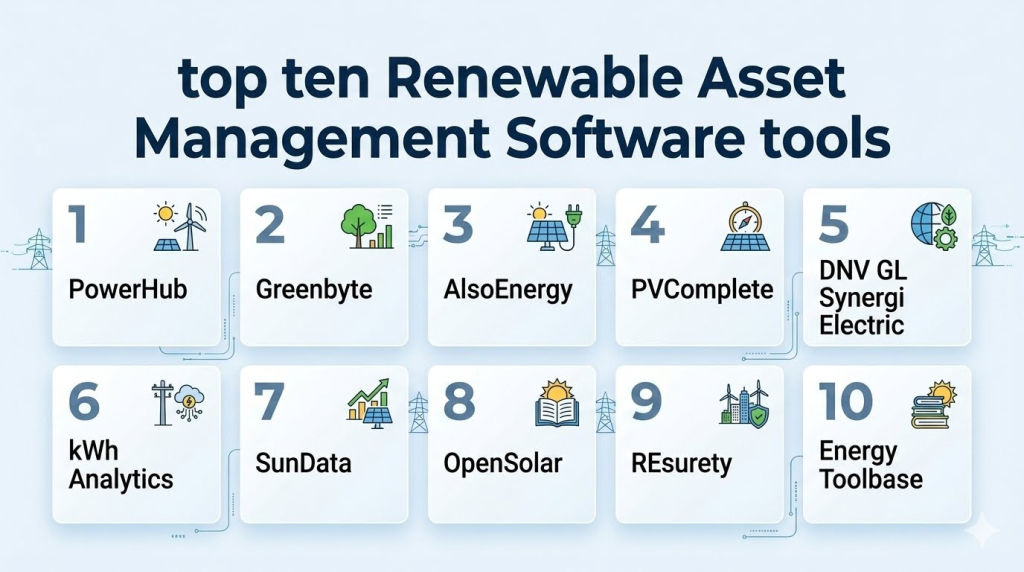
Top 10 Renewable Asset Management Software Tools
1- PowerHub
Short description: PowerHub is an asset management and operations platform for utility‑scale solar and wind portfolios, blending performance monitoring with financial and work order tracking.
Key Features
- Real‑time production monitoring
- Asset performance benchmarking
- Maintenance scheduling and work orders
- Financial performance tracking
- Custom dashboards and alerts
Pros
- Comprehensive performance + financial visibility
- Strong work order and maintenance tools
Cons
- Interface may feel complex for smaller portfolios
- Custom reporting setup can require professional services
Platforms / Deployment
- Web / iOS / Android
- Cloud
Security & Compliance
Not publicly stated
Integrations & Ecosystem
PowerHub integrates with SCADA/IoT sources and financial reporting tools:
- SCADA systems and IoT sensor feeds
- Weather and forecast data
- ERP and financial systems
- Custom API access
Support & Community
Professional support tiers, onboarding services, and documentation; user community engagement varies.
2- Greenbyte
Short description: Greenbyte offers a cloud‑native platform focused on renewable asset performance and risk management, particularly for solar and wind developers and operators.
Key Features
- Real‑time data monitoring
- Performance analytics and benchmarking
- Risk and KPI tracking
- Weather and forecast integration
- Reporting templates
Pros
- Strong analytics and benchmarking tools
- Simple onboarding for mid‑sized portfolios
Cons
- Less extendable for hybrid or storage assets
- Some advanced features require higher subscription tiers
Platforms / Deployment
- Web / iOS / Android
- Cloud
Security & Compliance
Not publicly stated
Integrations & Ecosystem
Integration support includes:
- Data acquisition from meters and sensors
- Forecast and weather sources
- Custom APIs and connectors
- Reporting exports
Support & Community
Vendor support available; documentation and training resources provided.
3- AlsoEnergy (now part of PowerFlex)
Short description: AlsoEnergy is a scalable platform for renewable asset performance monitoring, reporting, and alerting, serving utility, commercial, and industrial customers.
Key Features
- Live performance dashboards
- Custom alerts and notifications
- PPA and production reporting
- Work order coordination
- Multi‑site portfolio views
Pros
- User‑friendly dashboards
- Strong multi‑site and portfolio aggregation
Cons
- Advanced analytics are basic compared to specialized tools
- Custom integrations may require vendor support
Platforms / Deployment
- Web / Mobile
- Cloud
Security & Compliance
Not publicly stated
Integrations & Ecosystem
Ecosystem connectivity includes:
- SCADA and telemetry sources
- Forecast data
- ERP/work order systems
- API access
Support & Community
Tiered support and training; documentation moderate.
4- PVComplete
Short description: PVComplete is a design‑to‑operations platform that includes asset management features tailored for solar developers, integrators, and operators.
Key Features
- Site and system documentation
- Performance visualization
- Compliance documentation
- Change management tracking
- Inspection and maintenance tools
Pros
- Strong documentation and design integration
- Detailed asset visualization tools
Cons
- Less focused on traditional DMS metrics
- May be overkill for small portfolios
Platforms / Deployment
- Web
- Cloud
Security & Compliance
Not publicly stated
Integrations & Ecosystem
Supports:
- Design and BIM tools
- Sensor and telemetry feeds
- Report exports
- API extensions
Support & Community
Vendor support with on‑boarding; documentation is robust.
5- DNV GL Synergi Electric
Short description: Synergi Electric offers operations and performance tools designed for large renewable portfolios, emphasizing reliability and integrated safety workflows.
Key Features
- Performance monitoring
- Safety and compliance modules
- Risk and issue tracking
- Production forecasting
- Outage and downtime analytics
Pros
- Strong safety and risk focus
- Enterprise‑grade performance analytics
Cons
- More complex than necessary for smaller operators
- Configuration requires dedicated resources
Platforms / Deployment
- Web / Desktop
- Cloud / On‑premise
Security & Compliance
Not publicly stated
Integrations & Ecosystem
Includes:
- SCADA and telemetry systems
- Forecast data sources
- Field service systems
- Reporting workflows
Support & Community
Professional services and training; documentation good.
6- kWh Analytics
Short description: A data‑centric platform that combines performance intelligence with risk analytics for solar and storage portfolios.
Key Features
- Performance benchmarking
- Risk‑adjusted forecasting
- Production guarantee tracking
- Asset scorecards
- Weather and irradiance correlation
Pros
- Financial and risk insights
- Useful for portfolio valuation
Cons
- Less focused on work order or maintenance workflows
- Production forecasting accuracy depends on data quality
Platforms / Deployment
- Web
- Cloud
Security & Compliance
Not publicly stated
Integrations & Ecosystem
Integrations include:
- Meter and SCADA data sources
- Weather and forecast services
- Financial modeling tools
Support & Community
Professional support and documentation; community presence moderate.
7- SunData
Short description: SunData offers renewable asset monitoring and performance tools for solar and energy storage operators, with a focus on simple, customizable dashboards.
Key Features
- Real‑time monitoring
- Customizable KPI dashboards
- Alerts and anomaly detection
- Production reports
- Asset comparison tools
Pros
- Easy to set up and use
- Good visibility across assets
Cons
- Advanced analytics limited
- Feature depth may not suffice for large portfolios
Platforms / Deployment
- Web / Mobile
- Cloud
Security & Compliance
Not publicly stated
Integrations & Ecosystem
Supports:
- SCADA and sensor feeds
- Forecast and weather inputs
- Email/SMS notifications
- Exportable reports
Support & Community
Vendor support available; documentation basic but sufficient.
8- OpenSolar
Short description: A platform for solar project management that includes asset performance monitoring and operational reporting.
Key Features
- Dashboard and alerts
- Production analytics
- PPA and compliance reporting
- Inspection and maintenance tracking
- Multi‑site management
Pros
- Strong project and portfolio visibility
- Useful for mid‑sized operators
Cons
- Performance analytics are introductory
- Not as deep on predictive insights
Platforms / Deployment
- Web
- Cloud
Security & Compliance
Not publicly stated
Integrations & Ecosystem
Ecosystem support includes:
- Telemetry connections
- Reporting exports
- Field service inputs
- API access
Support & Community
Vendor support and documentation; community interest growing.
9- REsurety
Short description: A risk and valuation analytics platform focused on renewable energy production, price exposure, and hedge assessment.
Key Features
- Production vs market price analytics
- Risk exposure dashboards
- Contract performance tracking
- Forward valuation models
- Weather and generation correlation
Pros
- Deep financial insight
- Useful for PPA and hedge evaluation
Cons
- Not focused on day‑to‑day operations or maintenance
- Best for analysts and finance teams
Platforms / Deployment
- Web
- Cloud
Security & Compliance
Not publicly stated
Integrations & Ecosystem
Integrates with:
- Market and price feeds
- Production telemetry
- Financial models
- Report exports
Support & Community
Professional customer support; documentation available.
10- Energy Toolbase
Short description: A platform combining performance analytics with financial modeling and proposal generation for solar, storage, and DER assets.
Key Features
- Energy production analytics
- Financial modeling and proposal tools
- Utility rate and tariff scenarios
- PPA and incentive tracking
- Portfolio dashboards
Pros
- Combines technical and financial insights
- Useful for sales and asset performance teams
Cons
- Financial modeling focus may dilute operational depth
- Learning curve for advanced tools
Platforms / Deployment
- Web
- Cloud
Security & Compliance
Not publicly stated
Integrations & Ecosystem
Includes:
- Telemetry and sensor data
- Rate and tariff databases
- Reporting tools
- API extensions
Support & Community
Comprehensive documentation; tiered support available.
Comparison Table (Top 10)
| Tool Name | Best For | Platform(s) Supported | Deployment | Standout Feature | Public Rating |
|---|---|---|---|---|---|
| PowerHub | Utility portfolios | Web/iOS/Android | Cloud | Performance + Ops | N/A |
| Greenbyte | Mid‑sized operators | Web/iOS/Android | Cloud | Benchmarking | N/A |
| AlsoEnergy | Multi‑site aggregation | Web/Mobile | Cloud | Portfolio views | N/A |
| PVComplete | Design‑operations integration | Web | Cloud | Asset documentation | N/A |
| DNV GL Synergi Electric | Enterprise reliability | Web/Desktop | Cloud/On‑prem | Safety & risk | N/A |
| kWh Analytics | Risk & valuation | Web | Cloud | Risk analytics | N/A |
| SunData | Simple dashboards | Web/Mobile | Cloud | Custom KPIs | N/A |
| OpenSolar | Project + ops | Web | Cloud | PPA & reporting | N/A |
| REsurety | Financial risk | Web | Cloud | Price/production analytics | N/A |
| Energy Toolbase | Financial + ops | Web | Cloud | Combined modeling | N/A |
Evaluation & Scoring of Renewable Asset Management Software
| Tool Name | Core (25%) | Ease (15%) | Integrations (15%) | Security (10%) | Performance (10%) | Support (10%) | Value (15%) | Weighted Total |
|---|---|---|---|---|---|---|---|---|
| PowerHub | 9 | 7 | 8 | 7 | 8 | 8 | 7 | 8.0 |
| Greenbyte | 8 | 8 | 7 | 7 | 7 | 7 | 7 | 7.6 |
| AlsoEnergy | 7 | 8 | 8 | 7 | 7 | 7 | 7 | 7.4 |
| PVComplete | 7 | 7 | 7 | 7 | 6 | 7 | 7 | 7.0 |
| DNV GL Synergi Electric | 8 | 6 | 8 | 7 | 8 | 7 | 6 | 7.4 |
| kWh Analytics | 7 | 7 | 7 | 7 | 7 | 7 | 7 | 7.2 |
| SunData | 6 | 8 | 6 | 7 | 6 | 7 | 7 | 6.8 |
| OpenSolar | 7 | 7 | 7 | 7 | 7 | 7 | 7 | 7.0 |
| REsurety | 7 | 7 | 6 | 7 | 6 | 7 | 7 | 6.8 |
| Energy Toolbase | 8 | 7 | 7 | 7 | 7 | 7 | 8 | 7.6 |
Which Renewable Asset Management Tool Is Right for You?
Solo / Freelancer
Standalone consultants or small installers may prefer SunData or OpenSolar for lightweight monitoring and simple reporting without heavy operational overhead.
SMB
Mid‑sized asset owners with multiple installations may benefit from Greenbyte or AlsoEnergy, which balance ease of use with useful performance monitoring.
Mid‑Market
Portfolio owners with a mix of solar, storage, and hybrid assets should consider PowerHub or Energy Toolbase for robust dashboards, alerts, and financial insights.
Enterprise
Large operators and IPPs requiring comprehensive analytics, safety and risk tools may lean toward DNV GL Synergi Electric or PowerHub, which support advanced workflows.
Budget vs Premium
Cost‑sensitive buyers might begin with SunData or OpenSolar, while premium users with complex requirements may justify the expense of PowerHub or DNV GL Synergi Electric.
Feature Depth vs Ease of Use
Tools like kWh Analytics and Energy Toolbase balance analytical depth with relatively accessible interfaces, while platforms with advanced configuration may require training.
Integrations & Scalability
Prioritize platforms with open APIs, SCADA/IoT support, and weather/forecast integrations if future expansion to larger portfolios is anticipated.
Security & Compliance Needs
Ensure the selected platform offers encryption, role‑based access controls (RBAC), and audit logging if dealing with sensitive operational or financial data.
Frequently Asked Questions (FAQs)
1- What pricing models are common for renewable asset management tools?
Most tools use subscription‑based pricing tied to asset count or data ingestion volume. Some offer tiered feature bundles, and enterprise deployments may involve custom contracts.
2- How long does implementation typically take?
Implementation timelines vary based on data sources, telemetry complexity, and customization needs. Simple setups can take a few weeks, while enterprise configurations may span months.
3- Can these tools integrate with existing SCADA/IoT systems?
Yes, most platforms support SCADA or IoT data ingestion, enabling real‑time performance monitoring from existing sensors and telemetry layers.
4- Do these systems support predictive maintenance?
Many modern tools include predictive or anomaly detection capabilities, but the depth of ML‑based forecasting varies across platforms.
5- Are mobile apps available?
Several options provide mobile dashboards or field tools to track performance, receive alerts, and update work orders while onsite.
6- What operational data is most critical?
Real‑time production, inverter metrics, weather inputs, and downtime logs are fundamental data types for effective renewable asset management.
7- Can these tools handle hybrid assets?
Many platforms increasingly support solar + storage or wind + storage combinations, but hybrid optimization depth varies widely.
8- What integrations should I consider?
Key integrations include SCADA, ERP/financial systems, weather/forecast feeds, OMS/work order platforms, and GIS systems.
9- How do these tools support compliance reporting?
Platforms often provide customizable templates and scheduled reports for regulatory requirements, incentive programs, and investor dashboards.
10- How do I measure ROI?
ROI can be gauged through improved uptime, reduced maintenance costs, better forecasting, decreased curtailment losses, and enhanced financial visibility.
Conclusion
Renewable Asset Management Software solutions play a crucial role in helping operators monitor performance, improve reliability, and optimize financial returns across solar, wind, storage, and hybrid portfolios. The ideal platform depends on portfolio size, integration complexity, and operational priorities. Mid‑sized operators may value ease of use and rapid deployment, while enterprise owners often seek deep analytics, risk management, and extensive integration support. To make an informed choice, shortlist 2–3 tools aligned with your asset base, run pilots to validate data flows and forecasting accuracy, and confirm that integration and security capabilities meet your operational standards before committing to full deployment.

Find Trusted Cardiac Hospitals
Compare heart hospitals by city and services — all in one place.
Explore Hospitals
Renewable asset management platforms are most effective when they provide a unified view of performance across diverse energy assets such as solar, wind, and storage systems. Centralized monitoring, predictive maintenance, and financial performance tracking help operators maximize asset availability, improve operational efficiency, and optimize long-term returns.