Introduction
Sleep Tracking Apps are digital tools designed to monitor sleep patterns, track duration, assess quality, and provide actionable insights for improving rest. They often use wearable devices, smartphone sensors, or non-contact monitoring to analyze sleep cycles, heart rate, and environmental factors. sleep health has become a central component of overall wellness, productivity, and mental health. These apps are essential for individuals, health enthusiasts, athletes, and corporate wellness programs seeking to optimize rest and performance.
Real-world use cases include:
- Individuals monitoring sleep to improve energy and productivity.
- Athletes and fitness enthusiasts tracking recovery and rest cycles.
- Patients managing insomnia, sleep apnea, or other disorders.
- Corporate wellness programs monitoring employee sleep for better health initiatives.
- Integration with smart home devices for optimal sleep environment control.
Evaluation criteria for buyers:
- Accuracy of sleep tracking and analysis.
- Integration with wearables and smart devices.
- AI-based sleep coaching and personalized recommendations.
- Data privacy and HIPAA/GDPR compliance.
- Ease of use and user interface quality.
- Multi-device synchronization and cloud storage.
- Offline access and data export capabilities.
- Subscription plans and overall value.
- Customization for sleep goals and routines.
- Detailed reporting and trends analysis.
Best for: Individuals focused on health and wellness, athletes, sleep coaches, and corporate wellness programs.
Not ideal for: Users who do not prioritize sleep optimization or rely solely on built-in device sleep data.
Why It Matters Now
- Rising Sleep Awareness: Sleep is critical for health, mental clarity, and productivity.
- Wearable Device Integration: Provides more accurate insights using smartwatches and sensors.
- AI-Powered Coaching: Personalized guidance helps users improve sleep quality efficiently.
- Health Condition Management: Useful for tracking insomnia, apnea, and other sleep disorders.
- Lifestyle Convenience: Mobile logging and smart alarms support consistent routines.
Key Trends in Sleep Tracking Apps
- AI-driven sleep analysis and personalized coaching.
- Integration with wearables, IoT devices, and smart beds.
- Real-time sleep stage and environmental tracking.
- Personalized sleep schedule recommendations.
- Cloud-first apps with offline logging capability.
- Gamification and habit-forming features.
- Multi-language support for global adoption.
- Integration with wellness and productivity platforms.
- Enhanced security and privacy compliance (GDPR/HIPAA).
- Freemium and subscription models with premium analytics.
How We Selected These Tools (Methodology)
- Evaluated market adoption and mindshare.
- Assessed feature completeness and sleep tracking accuracy.
- Checked reliability, performance, and offline functionality.
- Examined privacy and security posture (HIPAA/GDPR).
- Considered integration ecosystem with wearables and health apps.
- Verified suitability for solo users, SMBs, and enterprise wellness programs.
- Reviewed user interface and onboarding experience.
- Analyzed community support, tutorials, and guides.
- Evaluated AI features for personalization and coaching.
- Compared pricing and overall value.
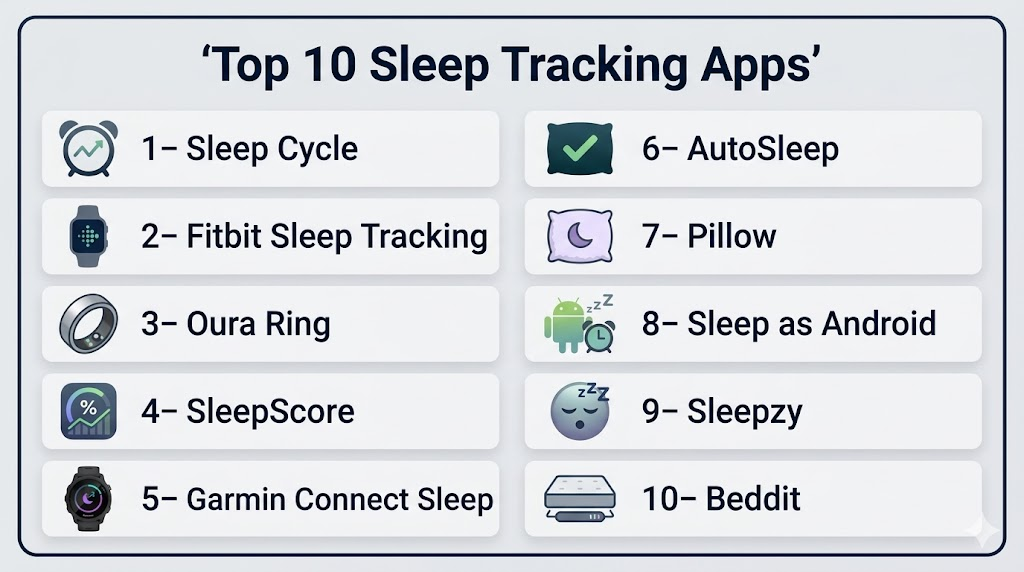
Top 10 Sleep Tracking Apps
1- Sleep Cycle
Short description: Monitors sleep phases using smartphone sensors, offering smart alarms and insights for improved rest.
Key Features
- Sleep phase tracking
- Smart alarm for gentle wake-up
- Sleep quality analysis
- Historical trends and stats
- Integrates with health apps
Pros
- Intuitive interface
- Detailed sleep data
Cons
- Premium subscription for full features
- Sensor accuracy depends on phone placement
Platforms / Deployment
- iOS / Android
- Cloud
Security & Compliance
- Not publicly stated
Integrations & Ecosystem
- Apple Health, Google Fit
- Smart home integrations
Support & Community
- FAQs, tutorials, email support
2- Fitbit Sleep Tracking
Short description: Leverages Fitbit devices to track sleep stages, duration, and quality with comprehensive analytics.
Key Features
- Sleep stage detection
- Heart rate monitoring
- Smart wake feature
- Weekly sleep reports
- Activity integration
Pros
- Accurate wearable-based tracking
- Integrates with fitness data
Cons
- Requires Fitbit device
- Limited manual logging
Platforms / Deployment
- iOS / Android / Fitbit devices
- Cloud
Security & Compliance
- Not publicly stated
Integrations & Ecosystem
- Fitbit ecosystem, Apple Health, Google Fit
Support & Community
- Fitbit help center, community forums
3- Oura Ring
Short description: Wearable ring offering detailed sleep, readiness, and HRV tracking with personalized insights.
Key Features
- Sleep staging and quality
- Heart rate variability tracking
- Readiness scoring
- Smart alarms
- Trends and wellness reports
Pros
- Highly accurate sleep tracking
- Advanced wellness metrics
Cons
- High initial cost
- Requires Oura hardware
Platforms / Deployment
- iOS / Android / Oura
- Cloud
Security & Compliance
- Not publicly stated
Integrations & Ecosystem
- Apple Health, Google Fit
- Fitness and wellness apps
Support & Community
- Tutorials, email support
4- SleepScore
Short description: Non-contact sleep monitoring using sonar technology, providing personalized recommendations.
Key Features
- Sleep tracking without wearable
- Sleep score and trend analysis
- Personalized tips
- Bedtime reminders
- Health platform integration
Pros
- Non-invasive
- Actionable insights
Cons
- Premium features require subscription
- Smartphone placement required
Platforms / Deployment
- iOS / Android
- Cloud
Security & Compliance
- Not publicly stated
Integrations & Ecosystem
- Apple Health, Google Fit
- Smart alarm apps
Support & Community
- Email support, online guides
5- Garmin Connect Sleep
Short description: Tracks sleep stages and wellness metrics using Garmin wearables.
Key Features
- Sleep staging
- Heart rate and stress monitoring
- Trend reports
- Smart notifications
- Integration with Garmin ecosystem
Pros
- Detailed wearable insights
- Combines fitness and sleep data
Cons
- Requires Garmin device
- Advanced features may require premium
Platforms / Deployment
- iOS / Android / Garmin devices
- Cloud
Security & Compliance
- Not publicly stated
Integrations & Ecosystem
- Garmin devices, Apple Health, Google Fit
Support & Community
- Forums, tutorials
6- AutoSleep
Short description: Automatically tracks sleep using Apple Watch, providing detailed sleep analysis.
Key Features
- Automatic sleep detection
- Sleep quality scoring
- Deep sleep & REM tracking
- Trend analytics
- Smart notifications
Pros
- Fully automatic
- Detailed metrics for Apple users
Cons
- Requires Apple Watch
- Data interpretation can be complex
Platforms / Deployment
- iOS / Apple Watch
- Cloud
Security & Compliance
- Not publicly stated
Integrations & Ecosystem
- Apple Health
- Fitness apps
Support & Community
- Tutorials, help center
7- Pillow
Short description: Apple-focused sleep tracking app with detailed reports and smart alarms.
Key Features
- Sleep stage tracking
- Heart rate and respiration monitoring
- Trend analysis
- Smart alarms
- Sleep recommendations
Pros
- Accurate reports
- Easy Apple Health integration
Cons
- iOS only
- Premium subscription needed
Platforms / Deployment
- iOS / Apple Watch
- Cloud
Security & Compliance
- Not publicly stated
Integrations & Ecosystem
- Apple Health
- Fitness & wellness apps
Support & Community
- Email, tutorials
8- Sleep as Android
Short description: Android app for sleep tracking, smart alarms, and wearable integration.
Key Features
- Sleep cycle analysis
- Smart alarms
- Snore detection
- Wearable device support
- Trend graphs
Pros
- Android-friendly
- Integrates with smart devices
Cons
- Premium needed for full features
- Accuracy varies with sensors
Platforms / Deployment
- Android / Wearables
- Cloud
Security & Compliance
- Not publicly stated
Integrations & Ecosystem
- Google Fit, smartwatches
- Alarm apps
Support & Community
- Tutorials, email support
9- Sleepzy
Short description: Simple sleep tracker with smart alarm and trend monitoring.
Key Features
- Sleep cycle tracking
- Smart alarm
- Sleep history charts
- Personalized suggestions
- Health app integration
Pros
- Simple and intuitive
- Affordable premium
Cons
- Limited wearable support
- Accuracy varies
Platforms / Deployment
- iOS / Android
- Cloud
Security & Compliance
- Not publicly stated
Integrations & Ecosystem
- Apple Health, Google Fit
- Smart alarm apps
Support & Community
- Email, tutorials
10- Beddit
Short description: Sensor-based Apple sleep monitor providing detailed sleep insights.
Key Features
- Sleep stage analysis
- Heart rate tracking
- Smart alarms
- Trend analytics
- Recommendations
Pros
- Accurate sensor-based tracking
- Apple Health integration
Cons
- Requires Beddit hardware
- Premium features require subscription
Platforms / Deployment
- iOS / Apple devices
- Cloud
Security & Compliance
- Not publicly stated
Integrations & Ecosystem
- Apple Health
- Fitness apps
Support & Community
- Tutorials, guides
Comparison Table (Top 10)
| Tool Name | Best For | Platform(s) Supported | Deployment | Standout Feature | Public Rating |
|---|---|---|---|---|---|
| Sleep Cycle | Smartphone sleep tracking | iOS / Android | Cloud | Smart alarm & sleep insights | N/A |
| Fitbit Sleep | Wearable integration | iOS / Android / Fitbit | Cloud | Sleep stage tracking | N/A |
| Oura Ring | In-depth wearable analysis | iOS / Android / Oura | Cloud | Readiness & HRV tracking | N/A |
| SleepScore | Non-contact tracking | iOS / Android | Cloud | Sonar-based sleep tracking | N/A |
| Garmin Connect | Wearable & wellness tracking | iOS / Android / Garmin | Cloud | Integrated wellness insights | N/A |
| AutoSleep | Automatic Apple Watch logging | iOS / Apple Watch | Cloud | Fully automatic sleep analysis | N/A |
| Pillow | Apple device sleep tracking | iOS / Apple Watch | Cloud | Detailed sleep reports | N/A |
| Sleep as Android | Android smart tracking | Android / Wearables | Cloud | Smart alarm & snore detection | N/A |
| Sleepzy | Routine & alarm focused | iOS / Android | Cloud | Smart alarm & trends | N/A |
| Beddit | Sensor-based Apple tracking | iOS / Apple Devices | Cloud | Accurate sleep stage insights | N/A |
Evaluation & Scoring of Sleep Tracking Apps
| Tool Name | Core (25%) | Ease (15%) | Integrations (15%) | Security (10%) | Performance (10%) | Support (10%) | Value (15%) | Weighted Total (0–10) |
|---|---|---|---|---|---|---|---|---|
| Sleep Cycle | 9 | 9 | 8 | 7 | 8 | 8 | 8 | 8.30 |
| Fitbit Sleep | 9 | 8 | 8 | 7 | 9 | 8 | 8 | 8.35 |
| Oura Ring | 10 | 8 | 8 | 8 | 9 | 8 | 8 | 8.60 |
| SleepScore | 8 | 9 | 7 | 7 | 8 | 7 | 8 | 7.95 |
| Garmin Connect | 9 | 8 | 8 | 8 | 8 | 8 | 8 | 8.30 |
| AutoSleep | 9 | 9 | 7 | 7 | 8 | 7 | 8 | 8.05 |
| Pillow | 8 | 8 | 7 | 7 | 8 | 7 | 8 | 7.85 |
| Sleep as Android | 8 | 8 | 7 | 7 | 8 | 7 | 8 | 7.85 |
| Sleepzy | 7 | 8 | 7 | 7 | 7 | 7 | 7 | 7.35 |
| Beddit | 9 | 8 | 7 | 7 | 8 | 7 | 8 | 8.05 |
Which Sleep Tracking App Is Right for You?
Solo / Freelancer
Sleep Cycle, Pillow, or AutoSleep are ideal for individuals seeking personal insights. They provide smart alarms, trend analysis, and AI-driven recommendations. Freemium and premium options allow flexibility based on budget. Mobile and wearable support ensures consistent logging.
SMB
Fitbit Sleep, SleepScore, and Garmin Connect are well-suited for small teams or wellness programs. Features include multi-user tracking, analytics dashboards, and AI suggestions. Integration with employee wellness initiatives supports health monitoring. Cloud access ensures remote visibility.
Mid-Market
Oura Ring, Sleep as Android, or Beddit Enterprise offer mid-sized organizations advanced analytics, trend reports, and multi-device monitoring. Smart alarms and wearable integration help optimize sleep for employees or clients. Scalable solutions fit organizational needs.
Enterprise
Garmin Connect Enterprise and Oura Ring Enterprise cater to large organizations. Multi-user dashboards, data privacy, and analytics support corporate wellness programs. AI-driven sleep insights, integration with HR systems, and wearable sync ensure adoption at scale.
Budget vs Premium
Free tiers: Sleep Cycle, Pillow, Sleep as Android (basic features). Premium unlocks AI coaching, trend analytics, and multi-device integration. Enterprise plans offer multi-user dashboards and advanced reporting. Choose based on usage intensity and feature depth.
Feature Depth vs Ease of Use
Depth-focused: Oura Ring, Fitbit Sleep, Garmin Connect. Easy-to-use: Sleep Cycle, Sleepzy, Pillow. Balance advanced metrics with intuitive interfaces. Complex apps provide detailed reporting and health metrics. Simpler apps ensure fast adoption.
Integrations & Scalability
Apps integrate with Fitbit, Garmin, Apple Health, Google Fit, and smart devices. Enterprise options allow multi-user scalability. API access supports corporate wellness programs. Cloud sync ensures consistent data. Scalable apps accommodate large teams.
Security & Compliance Needs
Enterprise apps provide encryption, access control, and HIPAA/GDPR compliance. Free and freemium apps rely on standard cloud security. Verify privacy policies before adoption. Security is critical for corporate or health-focused use.
Frequently Asked Questions (FAQs)
1. What pricing models are available?
Free, subscription, and enterprise tiers; free for individuals, premium for advanced analytics, enterprise for multi-user programs.
2. Can these apps work offline?
Some offer offline logging; cloud features need internet. Offline entries sync automatically when online.
3. Are AI-powered recommendations included?
Oura Ring, Sleep Cycle, and Fitbit Sleep provide AI insights; premium may unlock advanced analysis.
4. Can teams collaborate on sleep data?
Enterprise apps allow dashboards for multi-user tracking and wellness program monitoring.
5. How accurate is the sleep tracking?
Wearable-based apps provide high accuracy; phone-only tracking is less precise. Database and sensor quality affect results.
6. Do apps integrate with smart home devices?
Many support lights, thermostats, and alarm systems to optimize sleep environment.
7. Can sleep cycles and stages be analyzed?
Most apps provide REM, deep, and light sleep stages; detailed analytics require premium or wearable integration.
8. Are wearable devices required?
Apps like AutoSleep, Oura Ring, and Garmin Connect need compatible devices; others use phone sensors.
9. How secure is the user data?
Enterprise apps use encryption and cloud security; free apps follow standard protocols. Check privacy policies.
10. Can corporate wellness programs use these apps?
Yes, enterprise and SMB plans provide dashboards, multi-user management, and integration with wellness initiatives.
Conclusion
Selecting the right Sleep Tracking App depends on your goals, device ecosystem, and usage context. Solo users may prefer Sleep Cycle, Pillow, or AutoSleep for personal insights. SMBs and small wellness programs benefit from Fitbit Sleep, SleepScore, or Garmin Connect for team monitoring and analytics. Mid-sized organizations can leverage Oura Ring, Sleep as Android, or Beddit for trend reporting and wearable integration. Enterprises require Garmin Connect Enterprise or Oura Ring Enterprise for scalable dashboards, multi-user management, and privacy compliance. Evaluate AI-driven insights, integration with devices, and trend analytics. Offline access and cloud sync ensure usability anywhere. Pilot 2–3 apps to assess workflow fit and usability. Ultimately, the best app balances ease of use, feature depth, and personalization to optimize sleep and wellness outcomes.

Find Trusted Cardiac Hospitals
Compare heart hospitals by city and services — all in one place.
Explore Hospitals
Sleep tracking apps are most valuable when they provide meaningful insights into sleep patterns rather than simply recording sleep duration. By analyzing sleep quality, tracking trends, and offering personalized recommendations, these tools help users develop healthier sleep habits, improve recovery, and support overall well-being.