Introduction
Competitive Intelligence Platforms (CI Platforms) are specialized tools designed to help businesses monitor, analyze, and interpret the activities of competitors, industry trends, and market dynamics. These platforms consolidate data from multiple sources including websites, social media, product listings, news outlets, and financial reports into actionable insights, enabling organizations to make informed strategic decisions. In the landscape, CI platforms increasingly integrate AI-powered analytics, predictive forecasting, and automated reporting, making them indispensable for companies seeking to maintain a competitive edge.
Real-world use cases include:
- Tracking competitor pricing and product launches to inform sales and marketing strategies.
- Monitoring brand reputation and customer sentiment across digital channels.
- Analyzing market trends to guide product development and innovation.
- Conducting benchmarking studies against industry peers.
- Identifying potential threats and opportunities in new markets.
Evaluation criteria buyers should consider include:
- Data coverage and sources: breadth and depth of competitor and market data.
- AI and analytics capabilities: predictive insights, trend analysis, and anomaly detection.
- Ease of use: intuitive dashboards and visualization options.
- Integration capabilities: compatibility with CRMs, BI tools, and reporting platforms.
- Security & compliance: data protection, GDPR/SOC 2, and access controls.
- Customization: flexibility for alerts, reporting, and analysis workflows.
- Scalability: ability to handle growing data and user base.
- Support & community: onboarding, documentation, and vendor responsiveness.
- Cost/value ratio: subscription tiers versus feature set.
Best for: Marketing teams, product managers, business strategists, and competitive intelligence analysts in SMBs, mid-market, or enterprise organizations across technology, retail, finance, and healthcare sectors.
Not ideal for: Organizations with minimal competition, low market volatility, or those who rely solely on internal analytics without the need for external market intelligence. Alternatives may include standalone analytics, CRM insights, or simpler market research tools.
Key Trends in Competitive Intelligence Platforms
- AI-driven predictive analytics for competitor moves and market shifts.
- Automated sentiment and social listening dashboards with real-time alerts.
- Integration with enterprise CRMs, marketing platforms, and BI software.
- Enhanced natural language processing (NLP) for unstructured data analysis.
- Cloud-first deployment models with SaaS scalability.
- Increased regulatory and compliance focus on data sourcing.
- Advanced visualization and customizable reporting for executive stakeholders.
- Automation of repetitive competitive tracking tasks using bots.
- Multi-language intelligence capabilities for global market coverage.
- Subscription models offering modular, pay-for-what-you-use pricing.
How We Selected These Tools (Methodology)
- Market adoption and mindshare across SMB and enterprise segments.
- Depth and completeness of core competitive intelligence features.
- Reliability and system performance across large datasets.
- Security posture including encryption, access control, and compliance standards.
- Ecosystem integrations with BI, CRM, and data visualization platforms.
- Usability for both analysts and non-technical business users.
- Customer support quality, onboarding processes, and documentation.
- Cost-value alignment for organizations of different sizes.
- Innovation in AI and automation capabilities.
- Ability to scale with growing data and team size.
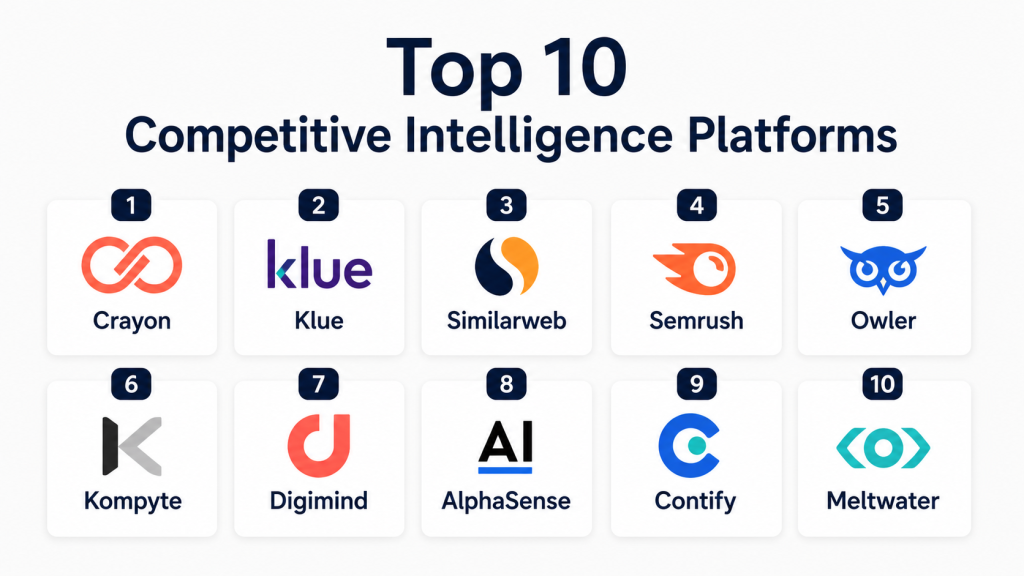
Top 10 Competitive Intelligence Platforms
1- Crayon
Short description: Crayon enables businesses to track competitors’ digital footprints and market activities in real time, offering actionable insights for sales, marketing, and strategy teams.
Key Features
- Real-time competitive tracking across websites, social media, and digital ads.
- Automated alerts for product, pricing, and content changes.
- Market trend analysis dashboards.
- Centralized intelligence repository for cross-team collaboration.
- AI-driven analytics for strategic decision-making.
- Integration with CRM and marketing platforms.
Pros
- Comprehensive data coverage and visual dashboards.
- Easy-to-use interface suitable for multiple teams.
Cons
- May require training for advanced analytics.
- Higher pricing for full-feature tiers.
Platforms / Deployment
- Web
- Cloud
Security & Compliance
- SSO/SAML, MFA, encryption
- SOC 2 compliant
Integrations & Ecosystem
Crayon offers flexible integrations allowing seamless workflow automation.
- Salesforce, HubSpot, Microsoft Dynamics
- Slack, Teams
- Google Workspace
- API access for custom integrations
Support & Community
- Comprehensive onboarding and documentation.
- Tiered support plans.
- Active community webinars and forums.
2- Klue
Short description: Klue centralizes competitive data and intelligence workflows, helping teams analyze market trends, track competitors, and improve product and sales strategy.
Key Features
- Competitive battlecards for sales teams.
- Centralized content library for intelligence.
- Alerts on competitor activity and market updates.
- Analytics and reporting dashboards.
- AI-driven insight extraction.
- Collaborative notes and workflows.
Pros
- Streamlines competitive intelligence for sales enablement.
- Supports collaboration across departments.
Cons
- Limited historical data without premium plans.
- Requires consistent data input for maximum value.
Platforms / Deployment
- Web / iOS / Android
- Cloud
Security & Compliance
- SSO/SAML, RBAC
- Not publicly stated for certifications
Integrations & Ecosystem
- Salesforce, HubSpot, MS Teams
- Slack
- API for custom integrations
Support & Community
- Guided onboarding
- Documentation and knowledge base
- Responsive support teams
3- SimilarWeb
Short description: SimilarWeb provides website and digital market intelligence, offering deep insights into traffic, engagement, and competitive landscape for online businesses.
Key Features
- Website traffic and engagement analytics.
- Industry and competitor benchmarking.
- Market trend analysis and reports.
- Audience segmentation and demographics.
- Exportable dashboards and alerts.
Pros
- Strong digital footprint insights.
- Easy to benchmark against competitors.
Cons
- Focused on digital metrics, less on offline activity.
- Data granularity may vary by region.
Platforms / Deployment
- Web
- Cloud
Security & Compliance
- Not publicly stated
Integrations & Ecosystem
- BI tool exports (CSV, Excel)
- API access for custom dashboards
- Integrates with Google Analytics
Support & Community
- Online documentation and tutorials
- Email support
- Community knowledge base
4- SEMrush
Short description: SEMrush combines SEO, PPC, and digital marketing intelligence with competitive insights, enabling businesses to monitor rivals’ online performance.
Key Features
- Competitor website audit and keyword tracking.
- Backlink and ad strategy analysis.
- Market share and traffic analytics.
- Reporting dashboards for SEO/marketing campaigns.
- Alerts for competitor activity.
- Social media monitoring.
Pros
- All-in-one digital marketing competitive tool.
- Strong for SEO and paid ad insights.
Cons
- Limited offline or non-digital competitor intelligence.
- Can be overwhelming for small teams.
Platforms / Deployment
- Web / iOS / Android
- Cloud
Security & Compliance
- Not publicly stated
Integrations & Ecosystem
- Google Analytics, Google Ads
- HubSpot
- API for custom integrations
Support & Community
- Knowledge base and webinars
- Email support
- Community forums
5- Owler
Short description: Owler provides crowdsourced and automated competitive intelligence, including company news, funding, and market updates.
Key Features
- Company profiles and news alerts.
- Funding and acquisition tracking.
- Peer benchmarking and industry analysis.
- Customizable dashboards.
- Community-driven insights.
Pros
- Quick access to broad market intelligence.
- Simple interface for executives.
Cons
- Crowdsourced data may vary in accuracy.
- Limited deep analytics for enterprise use.
Platforms / Deployment
- Web / iOS / Android
- Cloud
Security & Compliance
- Not publicly stated
Integrations & Ecosystem
- Email alerts
- CRM notifications
- API access limited
Support & Community
- Email support
- Online guides
- Community forum participation
6- Kompyte
Short description: Kompyte automates competitor tracking, alerting teams to changes in website content, product offerings, and marketing campaigns.
Key Features
- Automated competitor monitoring.
- Alerts on website and social media changes.
- Analytics dashboards for strategy teams.
- AI-assisted insights.
- Workflow collaboration features.
Pros
- Reduces manual tracking effort.
- AI highlights relevant competitive changes.
Cons
- Learning curve for complex workflows.
- Smaller integrations ecosystem.
Platforms / Deployment
- Web
- Cloud
Security & Compliance
- Not publicly stated
Integrations & Ecosystem
- Slack
- CRM alerts
- API support for custom dashboards
Support & Community
- Online documentation
- Email support
- User onboarding resources
7- Crux Intelligence
Short description: Crux Intelligence focuses on providing actionable market and competitor insights for enterprise strategy, combining analytics and data aggregation.
Key Features
- Market trend analytics.
- Competitor intelligence dashboards.
- Custom reporting and alerts.
- Collaborative notes and workflows.
- API access for enterprise systems.
Pros
- Enterprise-focused intelligence.
- Flexible reporting and alerting.
Cons
- Primarily suited for larger organizations.
- Less intuitive for small teams.
Platforms / Deployment
- Web
- Cloud
Security & Compliance
- Not publicly stated
Integrations & Ecosystem
- API for custom analytics
- BI platform connectors
- Collaboration tools
Support & Community
- Dedicated account support
- Documentation
- Enterprise onboarding
8- TrackMaven (Acquired/Integrated into larger platforms)
Short description: TrackMaven offered marketing and competitive intelligence with visual analytics and benchmarking tools for content performance.
Key Features
- Content marketing analytics.
- Benchmarking against competitors.
- Reporting dashboards.
- Trend analysis.
Pros
- Strong for content-focused intelligence.
- Visual dashboards simplify interpretation.
Cons
- Limited to marketing intelligence.
- May be part of larger platforms now.
Platforms / Deployment
- Web
- Cloud
Security & Compliance
- Not publicly stated
Integrations & Ecosystem
- Marketing platforms
- CRM notifications
- API access Varies / N/A
Support & Community
- Documentation
- Email support
- Knowledge resources
9- Digimind
Short description: Digimind provides social and market intelligence, monitoring competitors and brand mentions while generating AI-powered insights.
Key Features
- Social listening and monitoring.
- Market trend analysis.
- Competitor tracking dashboards.
- Alerts and AI-driven insights.
- Collaboration tools.
Pros
- Strong social intelligence integration.
- AI insights help with proactive strategy.
Cons
- Less focus on offline or financial data.
- Enterprise-focused, higher cost for SMBs.
Platforms / Deployment
- Web / iOS / Android
- Cloud
Security & Compliance
- SOC 2
- Not publicly stated
Integrations & Ecosystem
- CRM connectors
- Slack/Teams
- API access
Support & Community
- Onboarding support
- Documentation
- Training webinars
10- AlphaSense
Short description: AlphaSense leverages AI to analyze financial, news, and regulatory data for competitive and market intelligence, primarily for enterprise users.
Key Features
- AI-driven document and news analysis.
- Regulatory and financial intelligence.
- Market trend alerts.
- Searchable insight repository.
- Collaboration and workflow integration.
Pros
- High-value AI insights.
- Strong coverage of financial and regulatory data.
Cons
- Enterprise pricing limits SMB adoption.
- Learning curve for full AI functionality.
Platforms / Deployment
- Web
- Cloud
Security & Compliance
- SSO, encryption
- Not publicly stated
Integrations & Ecosystem
- CRM integration
- API support
- Collaboration platforms
Support & Community
- Dedicated support
- Documentation
- User training resources
Comparison Table (Top 10)
| Tool Name | Best For | Platform(s) Supported | Deployment | Standout Feature | Public Rating |
|---|---|---|---|---|---|
| Crayon | Marketing & strategy teams | Web | Cloud | Real-time competitive tracking | N/A |
| Klue | Sales & intelligence teams | Web, iOS, Android | Cloud | Sales battlecards & collaboration | N/A |
| SimilarWeb | Digital market analysis | Web | Cloud | Website traffic insights | N/A |
| SEMrush | SEO & marketing analytics | Web, iOS, Android | Cloud | SEO & paid ad insights | N/A |
| Owler | Executives & benchmarking | Web, iOS, Android | Cloud | Crowdsourced company insights | N/A |
| Kompyte | Marketing & strategy | Web | Cloud | Automated competitor monitoring | N/A |
| Crux Intelligence | Enterprise strategy | Web | Cloud | Custom analytics & alerts | N/A |
| TrackMaven | Content marketing | Web | Cloud | Benchmarking & dashboards | N/A |
| Digimind | Social & market intelligence | Web, iOS, Android | Cloud | Social listening & AI insights | N/A |
| AlphaSense | Enterprise financial/market | Web | Cloud | AI-powered document analysis | N/A |
Evaluation & Scoring of Competitive Intelligence Platforms
| Tool Name | Core (25%) | Ease (15%) | Integrations (15%) | Security (10%) | Performance (10%) | Support (10%) | Value (15%) | Weighted Total |
|---|---|---|---|---|---|---|---|---|
| Crayon | 9 | 8 | 8 | 9 | 9 | 8 | 7 | 8.5 |
| Klue | 8 | 8 | 7 | 8 | 8 | 8 | 7 | 8.0 |
| SimilarWeb | 8 | 9 | 7 | 7 | 8 | 7 | 8 | 8.0 |
| SEMrush | 9 | 7 | 8 | 7 | 8 | 7 | 7 | 7.9 |
| Owler | 7 | 9 | 6 | 6 | 7 | 6 | 8 | 7.2 |
| Kompyte | 8 | 7 | 7 | 7 | 7 | 7 | 7 | 7.4 |
| Crux Intelligence | 8 | 7 | 7 | 8 | 8 | 8 | 7 | 7.8 |
| TrackMaven | 7 | 8 | 6 | 6 | 7 | 6 | 7 | 7.0 |
| Digimind | 8 | 7 | 7 | 8 | 8 | 8 | 7 | 7.8 |
| AlphaSense | 9 | 7 | 7 | 8 | 8 | 8 | 7 | 8.0 |
Which Competitive Intelligence Platform Is Right for You?
Solo / Freelancer
Focus on tools with easy onboarding and minimal setup like Owler or SimilarWeb. Cost-effective, intuitive dashboards suffice for single-user research.
SMB
Crayon or Klue provide structured intelligence workflows, combining dashboards, alerts, and collaboration for small teams without enterprise overhead.
Mid-Market
Platforms like Digimind or Kompyte offer AI-assisted insights, scalable dashboards, and integration with CRM and marketing systems to support multi-team coordination.
Enterprise
AlphaSense, Crux Intelligence, and Klue deliver comprehensive data coverage, AI-driven analysis, and regulatory insights suitable for complex multi-geography operations.
Budget vs Premium
Budget options focus on digital and social intelligence with limited analytics. Premium platforms offer AI, predictive forecasting, and broader market coverage at higher cost.
Feature Depth vs Ease of Use
Simpler tools prioritize intuitive dashboards, while deeper platforms provide advanced analytics, AI capabilities, and extensive customization for strategic teams.
Integrations & Scalability
Ensure the platform connects with CRM, BI tools, and reporting systems. Cloud deployments scale easily with growing user counts and datasets.
Security & Compliance Needs
Enterprise buyers should prioritize SOC 2, SSO, encryption, and RBAC. SMBs may opt for cloud solutions with standard encryption and MFA.
Frequently Asked Questions (FAQs)
1- What is the typical pricing model for CI platforms?
Most use subscription-based pricing, often tiered by user count, data coverage, or feature access. Some offer freemium models for basic tracking.
2- How long does onboarding take?
Onboarding ranges from a few days for simple dashboards to several weeks for enterprise setups with integrations and training.
3- Can these tools replace market research teams?
They complement, rather than replace, analysts. CI platforms accelerate data collection and insights but require interpretation.
4- How is data accuracy ensured?
Platforms source from verified digital, social, and public datasets, but manual validation may be needed for critical decisions.
5- Are these tools suitable for global markets?
Many offer multi-language support and international data coverage, though coverage depth varies by region.
6- How easy is it to switch platforms?
Switching may require migrating data, configuring integrations, and retraining teams. Evaluate integration capabilities upfront.
7- What integrations are most common?
CRM systems, BI tools, Slack/Teams, email alerts, and custom APIs are commonly supported to streamline workflows.
8- Do these platforms handle social listening?
Yes, many platforms (Digimind, Crayon) monitor social channels and forums to analyze sentiment and competitor engagement.
9- How secure is the data?
Enterprise platforms typically support SSO, MFA, encryption, and SOC 2 or ISO 27001 compliance, ensuring business data remains protected.
10- Can small businesses benefit from these tools?
Yes, scaled-down versions of Crayon, Klue, or SimilarWeb are suitable for SMBs looking to gain competitive visibility without heavy investment.
Conclusion
Competitive intelligence platforms have evolved into indispensable tools for businesses seeking actionable market insights. By combining AI analytics, real-time monitoring, and collaborative dashboards, these platforms allow organizations to stay ahead of competitors, anticipate market changes, and optimize decision-making. Selecting the right platform depends on team size, budget, integration needs, and strategic priorities. For optimal results, shortlist 2–3 tools, run pilot implementations, and validate their insights against your workflows and compliance requirements. A thoughtful approach ensures your organization gains measurable value and a sustained competitive advantage.

Find Trusted Cardiac Hospitals
Compare heart hospitals by city and services — all in one place.
Explore Hospitals
Competitive intelligence platforms are most valuable when they continuously monitor market developments instead of relying on occasional research. By tracking competitors, pricing, product updates, and industry trends, these solutions help organizations make faster strategic decisions, identify emerging opportunities, and respond more effectively to changing market conditions.