Introduction
Environmental Monitoring Platforms are software systems designed to collect, analyze, and report data on environmental conditions. These platforms integrate sensors, IoT devices, and cloud-based analytics to track air quality, water quality, emissions, weather conditions, and other ecological parameters. Organizations rely on these platforms to ensure regulatory compliance, optimize operations, and make data-driven sustainability decisions. with increasing regulatory pressure, heightened focus on ESG (Environmental, Social, and Governance), and the proliferation of smart sensors, Environmental Monitoring Platforms have become critical tools for businesses, governments, and research institutions. Leveraging AI and real-time analytics, these platforms now enable predictive insights and automated alerts, helping organizations mitigate environmental risks proactively.
Real-world use cases include:
- Industrial Emissions Monitoring: Track pollutants in real-time to meet regulatory standards.
- Water Quality Management: Monitor pH, turbidity, and chemical levels in municipal and industrial water systems.
- Air Quality Analysis: Deploy IoT sensors across urban areas to provide actionable air pollution data.
- Agricultural Sustainability: Track soil moisture, nutrient levels, and local climate conditions for optimized crop management.
- Climate Research & Reporting: Collect longitudinal environmental data to study climate trends and inform policy decisions.
Evaluation Criteria for Buyers:
- Data accuracy and sensor compatibility
- Real-time monitoring and alerting
- Scalability across sites and geographies
- Regulatory compliance reporting
- AI/ML analytics and predictive capabilities
- Integration with existing systems and IoT devices
- Ease of deployment and use
- Security and data governance
- Cost efficiency and subscription flexibility
Best for: Environmental engineers, sustainability teams, regulatory compliance officers, large enterprises, municipalities, and research institutions.
Not ideal for: Small businesses with minimal environmental footprint or organizations that only require occasional, manual monitoring without real-time insights.
Key Trends in Environmental Monitoring Platforms
- AI-driven predictive analytics for proactive environmental risk management.
- Real-time sensor networks integrated with cloud platforms for live monitoring dashboards.
- IoT-enabled remote monitoring reducing manual inspection costs.
- Regulatory compliance automation across regions (EPA, EU-ETS, ISO 14001).
- Adoption of hybrid cloud and edge computing for low-latency, distributed data processing.
- Enhanced interoperability with ERP, MES, and GIS systems.
- Use of blockchain for immutable environmental data reporting and auditing.
- Subscription-based and usage-based pricing models to support flexible deployment.
- Integration of satellite imagery and geospatial analytics for large-scale environmental assessments.
- Increased focus on data security, encryption, and role-based access controls.
How We Selected These Tools (Methodology)
- Market adoption and enterprise mindshare.
- Depth and completeness of environmental monitoring features.
- Reliability and performance metrics under continuous operation.
- Security posture including SSO, encryption, and compliance standards.
- Ecosystem integrations with sensors, IoT devices, and enterprise systems.
- Applicability across solo users, SMBs, mid-market, and enterprise environments.
- Vendor responsiveness and support quality.
- Innovation in AI-driven analytics and predictive insights.
- Ease of deployment and user interface intuitiveness.
- Flexibility of reporting and compliance capabilities.
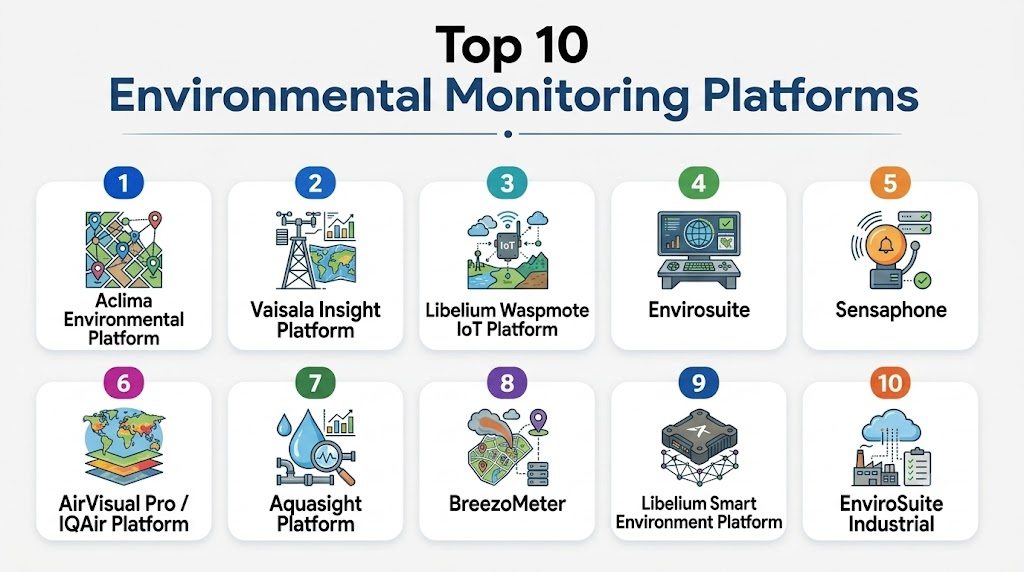
Top 10 Environmental Monitoring Platforms
1- Aclima Environmental Platform
Short description: Aclima provides real-time air quality and environmental analytics for cities and enterprises, combining sensor networks with cloud-based dashboards.
Key Features
- Distributed IoT sensor networks
- AI-driven pollution analytics
- Mobile and web dashboards
- Real-time air quality alerts
- Historical trend analysis
- GIS and mapping integrations
- Regulatory reporting templates
Pros
- High-resolution environmental data
- Predictive air quality modeling
- Strong urban and municipal use cases
Cons
- Requires investment in sensor deployment
- Primarily focused on air, limited water or soil metrics
- Some advanced analytics may require specialized training
Platforms / Deployment
- Web / iOS / Android
- Cloud
Security & Compliance
- Not publicly stated
Integrations & Ecosystem
Aclima integrates with GIS platforms, municipal data systems, and third-party analytics.
- GIS mapping tools
- Environmental databases
- Smart city dashboards
Support & Community
- Documentation available
- Professional onboarding
- Limited community forums
2- Vaisala Insight Platform
Short description: Vaisala delivers multi-parameter environmental monitoring solutions, focusing on industrial, meteorological, and safety-critical applications.
Key Features
- Multi-parameter sensor monitoring
- Cloud analytics and visualization
- Predictive maintenance alerts
- Historical trend reports
- Compliance dashboards
- Remote sensor calibration
- API access for custom integrations
Pros
- Broad industrial applicability
- Strong meteorological capabilities
- Reliable sensor hardware ecosystem
Cons
- Higher pricing for smaller organizations
- Complex setup for multi-site deployments
- Limited AI analytics compared to newer platforms
Platforms / Deployment
- Web / Windows / Linux
- Cloud / Hybrid
Security & Compliance
- Not publicly stated
Integrations & Ecosystem
Supports integration with industrial control systems and weather forecasting services.
- SCADA systems
- ERP and MES platforms
- Weather APIs
Support & Community
- Comprehensive documentation
- Vendor support and training available
3- Libelium Waspmote IoT Platform
Short description: Libelium offers modular sensor networks for air, water, and soil monitoring with cloud-based analytics for smart cities and industrial use.
Key Features
- Modular IoT sensors
- Multi-environment monitoring (air, water, soil)
- Wireless data transmission
- Cloud dashboards and alerts
- Open API for integrations
- Edge computing options
- Historical data logging
Pros
- Flexible sensor deployment
- Open-source compatible
- Scalable for large-area monitoring
Cons
- Requires technical setup expertise
- Limited advanced AI features
- Hardware maintenance can be intensive
Platforms / Deployment
- Web / Linux / Windows
- Cloud / Self-hosted
Security & Compliance
- Not publicly stated
Integrations & Ecosystem
- IoT gateways
- Open data platforms
- Custom analytics software
Support & Community
- Online documentation
- Community forums
- Vendor support
4- Envirosuite
Short description: Envirosuite specializes in real-time environmental simulation and predictive analytics, focusing on air quality and noise management for industrial sites.
Key Features
- Real-time air and noise monitoring
- Predictive environmental modeling
- Scenario simulation for operations planning
- Regulatory compliance dashboards
- API access for integration
- Mobile and web interface
Pros
- Strong predictive capabilities
- Industrial and municipal focus
- Detailed scenario planning
Cons
- Advanced features may require consultancy
- Limited water and soil metrics
- Subscription cost can be high for SMBs
Platforms / Deployment
- Web / iOS / Android
- Cloud
Security & Compliance
- Not publicly stated
Integrations & Ecosystem
- Industrial SCADA
- GIS systems
- ERP and operational planning tools
Support & Community
- Professional onboarding
- Vendor-led support
- Limited open community
5- Sensaphone
Short description: Sensaphone provides remote monitoring solutions for environmental parameters, particularly in facilities management and critical infrastructure.
Key Features
- Remote temperature, humidity, and water level monitoring
- Alarm notifications via SMS/email
- Web dashboards
- Data logging and historical trends
- Low-power sensors
- Cloud reporting
Pros
- Easy deployment
- Reliable for facilities and equipment monitoring
- Alerting reduces manual inspections
Cons
- Limited advanced analytics
- Less suitable for large-scale environmental studies
- Integration options are basic
Platforms / Deployment
- Web / iOS / Android
- Cloud
Security & Compliance
- Not publicly stated
Integrations & Ecosystem
- IoT sensors
- Basic API
- Alarm systems
Support & Community
- Online support
- Vendor documentation
- No large user community
6- AirVisual Pro / IQAir Platform
Short description: AirVisual focuses on air quality monitoring for urban environments and consumer-grade deployments, with analytics and health recommendations.
Key Features
- Real-time air quality index (AQI)
- Indoor and outdoor monitoring
- Mobile app dashboards
- Data history and trend analysis
- Health impact notifications
Pros
- Easy-to-read insights
- Consumer and small business friendly
- Portable devices
Cons
- Limited industrial deployment suitability
- Minimal water or soil monitoring
- Advanced analytics restricted
Platforms / Deployment
- Web / iOS / Android
- Cloud
Security & Compliance
- Not publicly stated
Integrations & Ecosystem
- Smart home systems
- Weather APIs
- Mobile applications
Support & Community
- Documentation online
- Vendor support
- Community forums
7- Aquasight Platform
Short description: Aquasight delivers water quality monitoring and predictive analytics, primarily for utilities and industrial water management.
Key Features
- Continuous water quality monitoring
- AI-driven anomaly detection
- Predictive analytics for contamination events
- Cloud dashboards
- Regulatory compliance reporting
- API for integration
Pros
- Focused on water quality
- Predictive alerts prevent downtime
- Scalable for utility networks
Cons
- Limited air/soil monitoring
- Requires sensor deployment investment
- Subscription-based costs
Platforms / Deployment
- Web / Windows / Linux
- Cloud
Security & Compliance
- Not publicly stated
Integrations & Ecosystem
- SCADA systems
- Utility management platforms
- IoT sensor networks
Support & Community
- Vendor onboarding
- Technical documentation
- Limited online community
8- BreezoMeter
Short description: BreezoMeter provides real-time air quality intelligence for urban planning, consumer apps, and enterprise solutions.
Key Features
- Air quality mapping and alerts
- Health recommendations
- Traffic and emissions analytics
- Mobile and web dashboards
- API for third-party integrations
- Real-time AQI notifications
Pros
- High-resolution urban AQI
- Real-time predictive insights
- Developer-friendly APIs
Cons
- Air-focused, no water/soil data
- Limited industrial compliance features
- Subscription cost varies by usage
Platforms / Deployment
- Web / iOS / Android
- Cloud
Security & Compliance
- Not publicly stated
Integrations & Ecosystem
- Smart city dashboards
- Health applications
- Mobile consumer apps
Support & Community
- API documentation
- Vendor support
- Limited open community
9- Libelium Smart Environment Platform
Short description: A robust IoT monitoring platform for multi-environmental parameters, used in smart cities, agriculture, and industrial operations.
Key Features
- Air, water, soil monitoring
- Wireless IoT sensors
- Cloud-based analytics and alerts
- API and SDK support
- Historical trend tracking
- GIS mapping
Pros
- Comprehensive environmental coverage
- Scalable IoT deployment
- Open API for custom solutions
Cons
- Requires technical deployment skills
- Hardware maintenance overhead
- Limited AI features
Platforms / Deployment
- Web / Windows / Linux
- Cloud / Hybrid
Security & Compliance
- Not publicly stated
Integrations & Ecosystem
- IoT devices
- GIS platforms
- Custom analytics software
Support & Community
- Documentation and guides
- Vendor support
- Community forums available
10- EnviroSuite Industrial
Short description: EnviroSuite Industrial provides predictive environmental modeling and compliance reporting for industrial sites and municipalities.
Key Features
- Predictive air and noise modeling
- Regulatory compliance dashboards
- Scenario simulation for planning
- Cloud analytics and reporting
- API access for integration
Pros
- Strong industrial predictive capabilities
- Compliance-focused reporting
- Scenario simulation supports planning
Cons
- Limited water monitoring
- Advanced features may require consultancy
- Higher cost for small-scale deployments
Platforms / Deployment
- Web / iOS / Android
- Cloud
Security & Compliance
- Not publicly stated
Integrations & Ecosystem
- SCADA systems
- GIS mapping tools
- Enterprise ERP integration
Support & Community
- Vendor-led onboarding
- Technical documentation
- No large community
Comparison Table (Top 10)
| Tool Name | Best For | Platform(s) Supported | Deployment | Standout Feature | Public Rating |
|---|---|---|---|---|---|
| Aclima | Urban & municipal air monitoring | Web, iOS, Android | Cloud | High-resolution air data | N/A |
| Vaisala Insight | Industrial & meteorology | Web, Windows, Linux | Cloud/Hybrid | Multi-parameter monitoring | N/A |
| Libelium Waspmote | Smart city IoT deployment | Web, Linux, Windows | Cloud/Self-hosted | Modular multi-environment sensors | N/A |
| Envirosuite | Industrial sites, noise & air | Web, iOS, Android | Cloud | Predictive environmental simulation | N/A |
| Sensaphone | Facilities management | Web, iOS, Android | Cloud | Remote environmental alerts | N/A |
| AirVisual Pro | Urban & consumer air monitoring | Web, iOS, Android | Cloud | Indoor/outdoor AQI monitoring | N/A |
| Aquasight | Water utilities | Web, Windows, Linux | Cloud | AI-driven water quality alerts | N/A |
| BreezoMeter | Urban air intelligence | Web, iOS, Android | Cloud | Real-time air quality & health insights | N/A |
| Libelium Smart Environment | Smart city & industrial | Web, Windows, Linux | Cloud/Hybrid | Comprehensive environmental coverage | N/A |
| EnviroSuite Industrial | Industrial & municipal | Web, iOS, Android | Cloud | Predictive compliance reporting | N/A |
Evaluation & Scoring of Environmental Monitoring Platforms
| Tool Name | Core (25%) | Ease (15%) | Integrations (15%) | Security (10%) | Performance (10%) | Support (10%) | Value (15%) | Weighted Total |
|---|---|---|---|---|---|---|---|---|
| Aclima | 9 | 8 | 7 | 7 | 8 | 7 | 8 | 8.1 |
| Vaisala Insight | 8 | 7 | 7 | 7 | 9 | 8 | 7 | 7.85 |
| Libelium Waspmote | 8 | 6 | 8 | 7 | 8 | 7 | 7 | 7.6 |
| Envirosuite | 8 | 7 | 7 | 7 | 8 | 7 | 7 | 7.7 |
| Sensaphone | 7 | 9 | 6 | 7 | 7 | 6 | 8 | 7.45 |
| AirVisual Pro | 7 | 9 | 6 | 7 | 7 | 6 | 7 | 7.2 |
| Aquasight | 8 | 7 | 7 | 7 | 8 | 7 | 7 | 7.7 |
| BreezoMeter | 8 | 8 | 7 | 7 | 8 | 7 | 7 | 7.75 |
| Libelium Smart Environment | 9 | 6 | 8 | 7 | 8 | 7 | 7 | 7.85 |
| EnviroSuite Industrial | 8 | 7 | 7 | 7 | 8 | 7 | 7 | 7.7 |
Which Environmental Monitoring Platform Is Right for You?
Solo / Freelancer
Choose portable, low-cost platforms like AirVisual Pro for small-scale monitoring and simple reporting.
SMB
Platforms like Sensaphone or BreezoMeter offer easy deployment, affordability, and real-time alerts without complex infrastructure.
Mid-Market
Libelium Waspmote and Aclima support multi-site deployments, scalable sensor networks, and moderate analytics.
Enterprise
Envirosuite, Vaisala Insight, and EnviroSuite Industrial provide predictive modeling, regulatory reporting, and large-scale integrations.
Budget vs Premium
Budget solutions excel in ease-of-use and portability; premium platforms provide multi-environment coverage, AI analytics, and industrial-grade reliability.
Feature Depth vs Ease of Use
Advanced features often come with steeper learning curves; balance needs between comprehensive analytics and staff training capacity.
Integrations & Scalability
For multi-site operations, select platforms with robust APIs, SCADA, ERP, or GIS integration to scale operations seamlessly.
Security & Compliance Needs
Organizations handling regulatory reporting or sensitive environmental data should prioritize platforms with strong encryption, SSO, and audit logging.
Frequently Asked Questions (FAQs)
1- What pricing models do environmental monitoring platforms use?
Most platforms offer subscription-based pricing, often per sensor or site, with cloud access included. Some enterprise solutions include hardware costs.
2- How long does onboarding typically take?
Onboarding varies from a few days for cloud-only consumer-grade solutions to several weeks for industrial-scale deployments with multiple sensors.
3- Can I integrate these platforms with existing IoT devices?
Yes, most platforms provide APIs, SDKs, or standard protocols (MQTT, REST) for sensor and system integration.
4- Are these platforms secure for regulatory compliance?
Security measures vary; always confirm SSO, encryption, and audit log capabilities. Premium enterprise platforms often offer compliance-focused features.
5- What are common mistakes during deployment?
Common pitfalls include insufficient sensor coverage, ignoring calibration needs, inadequate network infrastructure, and underestimating training requirements.
6- Do these platforms support predictive analytics?
Many modern platforms incorporate AI/ML for trend analysis, anomaly detection, and predictive alerts to prevent environmental violations.
7- Can small organizations benefit from these platforms?
Yes, lightweight solutions like AirVisual Pro or Sensaphone are affordable and easy to deploy for small-scale monitoring.
8- How scalable are these platforms?
Enterprise-grade platforms scale across multiple sites, regions, and sensors, while consumer-focused platforms are more limited in scale.
9- How do I switch between platforms?
Migration may involve sensor recalibration, data format conversion, and dashboard configuration. Consulting vendor support is recommended.
10- Are there alternatives to these platforms?
Alternatives include manual monitoring, standalone sensors with local logging, or custom-built IoT systems, though these lack integrated analytics and alerts.
Conclusion
Environmental Monitoring Platforms have become essential tools in 2026 for ensuring compliance, improving operational efficiency, and driving sustainability initiatives. From small urban monitoring projects to large industrial deployments, these platforms provide real-time insights, predictive analytics, and integration capabilities across sensors, IoT networks, and enterprise systems. Selecting the right platform depends on your scale, industry, budget, and analytical needs. The best approach is to shortlist 2–3 tools, run a pilot, validate integrations and security measures, and scale deployment based on operational insights and regulatory requirements.

Find Trusted Cardiac Hospitals
Compare heart hospitals by city and services — all in one place.
Explore Hospitals
Environmental monitoring platforms are most effective when they bring together data from air, water, soil, and industrial sources into a unified system. This integrated view helps organizations detect environmental risks earlier, improve regulatory compliance, and make more informed sustainability decisions based on real-world conditions.