Introduction
Air quality monitoring software is a class of platforms that collect data from air sensors, analyze that information, and provide actionable insights about particulate matter, gases, and other airborne contaminants. These tools integrate hardware fixed or mobile sensors with cloud-based analytics, reporting, and alerting systems. In plain terms, air quality monitoring software helps organizations understand the health of the air around people, assets, and environments and make decisions based on that understanding. air quality monitoring is no longer a niche environmental concern. Legislative pressure around public health, carbon emissions, and urban planning has grown rapidly. Corporations now include air quality metrics within broader ESG reporting frameworks. Smart cities deploy dense sensor grids for hyper-local insights, while industrial facilities must ensure emissions compliance in real time. AI-driven analytical features such as anomaly detection, trend forecasting, and automated reporting are now expected capabilities in modern solutions.
Real-world use cases include:
- Urban Air Quality Management: City planners track neighborhood-level air pollution to guide traffic policy, zoning, and public health advisories.
- Industrial Emissions Compliance: Manufacturers and plants monitor emissions from stacks and facilities to ensure adherence to regulatory limits.
- Workplace Safety: Employers track indoor air quality in offices, factories, and warehouses to safeguard occupant health.
- Environmental Research: Universities and research institutions gather longitudinal air data for climate studies and modeling.
- Community Monitoring: Advocacy groups deploy low-cost sensors to supplement government data and raise awareness.
What buyers should evaluate:
- Sensor compatibility and data accuracy
- Real-time monitoring and alert capabilities
- Historical trend analysis and reporting features
- Predictive analytics and AI insights
- Regulatory compliance reporting support
- Integration with existing systems (IoT, GIS, business systems)
- Deployment models (cloud, edge, hybrid)
- Security and data governance
- Cost structure and scalability
- User experience and onboarding support
Best for: Environmental health teams, sustainability managers, industrial compliance officers, smart city planners, and researchers needing ongoing air quality insights across sites and regions.
Not ideal for: Organizations with minimal air monitoring requirements, simple one-off measurements, or situations where basic standalone sensors without analytics are sufficient.
Key Trends in Air Quality Monitoring Software
- AI and Predictive Analytics: Machine learning models are increasingly used to forecast pollution events, detect anomalies, and recommend mitigation tactics.
- Edge-to-Cloud Architectures: Edge processing reduces latency for real-time alerts while offloading heavy analytics to cloud infrastructure.
- Hyperlocal Dense Sensor Networks: Cities and campuses adopt dense grids of low-cost sensors to generate high‑resolution air quality maps.
- Regulatory Automation: Software increasingly includes built‑in templates and workflows for compliance reporting across multi‑jurisdictional standards.
- Integration with GIS and Urban Systems: Air data overlays with maps and transportation systems support richer spatial analyses and policy planning.
- Open Data and Community Platforms: Public dashboards and open APIs empower community monitoring and citizen science participation.
- Mobile and Wearable Monitoring: Portable and wearable air quality sensors extend monitoring into personal exposure measurements.
- Health Impact Correlation: Air monitoring platforms increasingly tie pollutant levels to health risk indices for public advisories.
- API‑First Ecosystems: Standardized APIs support integration with facility management, IoT platforms, and analytics systems.
- Subscription and Usage Pricing Models: Flexible pricing based on sensor count, data volume, or feature tiers supports broader adoption.
How We Selected These Tools (Methodology)
- Market adoption / mindshare: Preference for solutions widely recognized in air quality monitoring domains.
- Feature completeness: Ability to support the full lifecycle from data collection to analysis and reporting.
- Reliability and performance: Proven stability in continuous operations and real‑time alerting.
- Security posture signals: Support for authentication, role‑based access, and data governance where known.
- Integration and ecosystem: Availability of APIs, sensor compatibility, and extensibility.
- Customer fit across segments: Tools suitable for solo use, SMB, mid‑market, and enterprise contexts.
- AI and analytics innovation: Presence of machine learning features and predictive capabilities.
- Ease of deployment and use: Accessibility without excessive technical overhead.
- Scalability: Ability to handle increasing sensor counts and distributed deployments.
- Support and documentation: Quality of onboarding resources and vendor assistance.
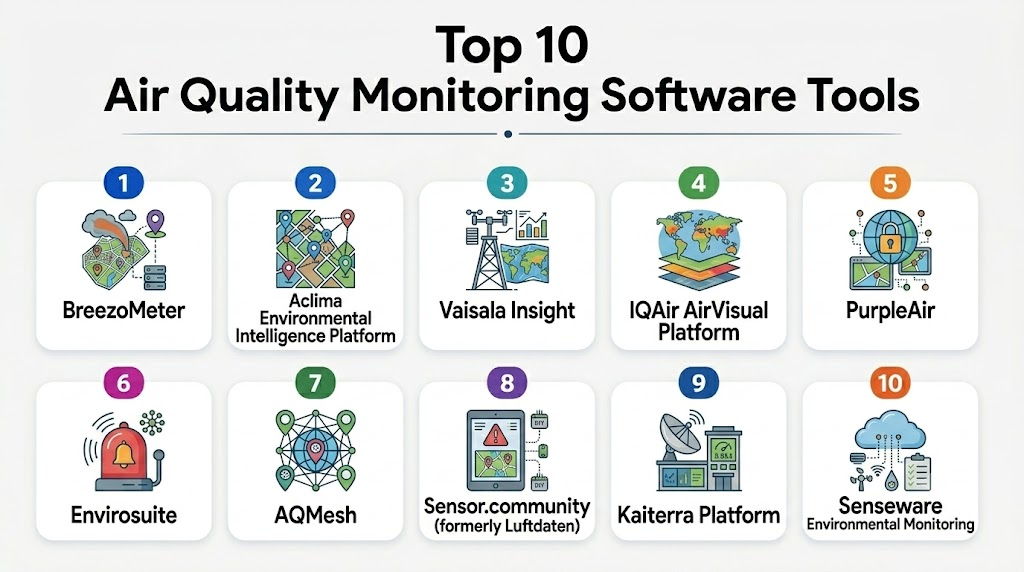
Top 10 Air Quality Monitoring Software Tools
1 — BreezoMeter
Short description: BreezoMeter provides real‑time air quality intelligence with a strong focus on high‑resolution environmental data and health impact insights for cities, enterprises, and applications.
Key Features
- Hyperlocal air quality index (AQI) and pollutant maps
- API access for third‑party applications
- Health risk indicators tied to pollutant levels
- Real‑time alerting and trend analytics
- Traffic and emissions data overlays
- Customizable dashboards
- Developer‑friendly data streaming
Pros
- Highly granular air quality data useful for urban planning
- Strong developer ecosystem and API support
- Health impact context aids communication to non‑technical audiences
Cons
- Focused primarily on air; limited broader environmental metrics
- Advanced analytics may require professional services
- Pricing varies with usage
Platforms / Deployment
- Web / iOS / Android
- Cloud
Security & Compliance
Not publicly stated
Integrations & Ecosystem
BreezoMeter’s platform emphasizes openness with APIs for data ingestion and consumption. Integrations include:
- GIS mapping and spatial platforms
- Public dashboards and mobile apps
- Smart city and environmental research applications
- Custom enterprise systems via APIs
Support & Community
Vendor documentation and developer resources are available; community engagement is moderate with focus on API use cases.
2 — Aclima Environmental Intelligence Platform
Short description: Aclima delivers real‑world air quality intelligence combining sensor networks, spatial analytics, and cloud dashboards for environmental insights.
Key Features
- Distributed sensor network management
- Real‑time pollutant tracking (NO2, PM2.5, O3, etc.)
- AI‑driven analytics and trend forecasting
- Custom geospatial visualization
- Notification and alert configuration
- Historical data exploration
- API access
Pros
- Enterprise‑grade spatial air quality insights
- Good for urban and regional planning teams
- Supports decision making with analytics
Cons
- Deployment requires sensor infrastructure investment
- Less focus on regulatory compliance than some industrial tools
- Training may be needed for advanced features
Platforms / Deployment
- Web / iOS / Android
- Cloud
Security & Compliance
Not publicly stated
Integrations & Ecosystem
Aclima integrates environmental data with spatial and urban planning tools. Common integrations include:
- GIS and mapping platforms
- Municipal data systems
- Third‑party analytics solutions
- Custom enterprise systems via APIs
Support & Community
Documentation and customer support are offered; community forums are limited.
3 — Vaisala Insight
Short description: Vaisala Insight is an industrial‑grade environmental monitoring platform often paired with Vaisala’s sensor hardware to support air quality, weather, and safety monitoring.
Key Features
- Multi‑parameter environmental data collection
- Cloud data visualization and alerts
- Predictive maintenance and trend analysis
- API access for data export
- Custom reporting and dashboards
- Integration with industrial control systems
Pros
- Strong hardware ecosystem with proven reliability
- Suitable for industrial and meteorological use cases
- Detailed trend and historical analysis
Cons
- Higher cost for enterprise deployments
- Complexity may require dedicated resources
- Focus extends beyond air into broader monitoring
Platforms / Deployment
- Web / Windows / Linux
- Cloud / Hybrid
Security & Compliance
Not publicly stated
Integrations & Ecosystem
Vaisala Insight supports integration with larger systems:
- SCADA and industrial automation
- ERP and maintenance systems
- Meteorological and forecasting services
- Custom endpoints via APIs
Support & Community
Vendor support includes onboarding and training; documentation is comprehensive but community channels are limited.
4 — IQAir AirVisual Platform
Short description: IQAir’s AirVisual platform focuses on indoor and outdoor air quality monitoring with user‑friendly dashboards relevant for communities, schools, and enterprises.
Key Features
- Real‑time AQI monitoring
- Indoor and outdoor sensor support
- Alerts based on customizable thresholds
- Health indices and recommendations
- Mobile and web dashboard
- Historical trends and reporting
Pros
- Simple and intuitive for non‑technical users
- Indoor air quality focus complements outdoor data
- Portable devices support flexible deployments
Cons
- Less suitable for industrial compliance reporting
- Limited advanced analytics compared to enterprise tools
- API and integration features are narrower
Platforms / Deployment
- Web / iOS / Android
- Cloud
Security & Compliance
Not publicly stated
Integrations & Ecosystem
Designed to work with IQAir sensor devices and mobile dashboards; integrations typically focus on:
- Mobile applications
- Public display dashboards
- Basic health advisory systems
Support & Community
Documentation is accessible; vendor support is available with a modest user community.
5 — PurpleAir
Short description: PurpleAir is a sensor‑centric air quality monitoring platform that aggregates real‑time data from a widespread network of low‑cost sensors.
Key Features
- Dense network of air quality sensors
- Real‑time particulate matter measurements
- Public and private map overlays
- API for data retrieval
- Historical data and trend visuals
- Device status monitoring
Pros
- Large community of sensor operators
- High spatial resolution data where sensors are dense
- Affordable entry due to low‑cost sensors
Cons
- Sensor accuracy varies by environment
- Primarily focused on particulate matter
- Advanced analytics are limited without external tools
Platforms / Deployment
- Web / Linux / Windows
- Cloud
Security & Compliance
Not publicly stated
Integrations & Ecosystem
PurpleAir integrates with mapping and visualization tools:
- Public air quality maps
- Environmental research datasets
- Custom analytics pipelines via API
Support & Community
Strong community presence, active forums, and user‑generated resources; vendor support is basic.
6 — Envirosuite
Short description: Envirosuite specializes in environmental simulation and predictive analytics, with air quality monitoring as a core component of its broader environmental management suite.
Key Features
- Real‑time air monitoring
- Predictive environmental modeling
- Scenario simulation and planning
- Regulatory reporting tools
- Alerts and threshold settings
- Web and mobile dashboards
Pros
- Predictive analytics enhance planning
- Strong support for industrial and municipal use
- Integrates with broader environmental data
Cons
- Water/soil environmental modules may require extra configuration
- Enterprise focus may be overkill for simple monitoring
- Subscription cost is higher than basic tools
Platforms / Deployment
- Web / iOS / Android
- Cloud
Security & Compliance
Not publicly stated
Integrations & Ecosystem
Envirosuite plugs into industrial systems:
- GIS and spatial analytics
- Facility management systems
- ERP and operational planning tools
- IoT sensor networks
Support & Community
Professional onboarding and customer support; limited open community.
7 — AQMesh
Short description: AQMesh provides compact air quality pods with a cloud‑based analytics platform designed for flexible, distributed monitoring.
Key Features
- Compact multi‑pollutant sensors
- Wireless deployment option
- Cloud analytics and alerts
- Historical trend analysis
- API access
- GIS visualization
Pros
- Easy to deploy in distributed locations
- Multi‑pollutant capability in a compact package
- Good for urban and industrial air monitoring
Cons
- Hardware costs add to platform expense
- Some analytics features are basic
- Deployment at scale requires planning
Platforms / Deployment
- Web / Cloud
- Cloud
Security & Compliance
Not publicly stated
Integrations & Ecosystem
Supports integration with spatial and monitoring systems:
- GIS tools
- Public dashboards
- Third‑party analytics via API
Support & Community
Vendor documentation and onsite support; limited user forums.
8 — Sensor.community (formerly Luftdaten)
Short description: Sensor.community is a crowd‑sourced air quality monitoring platform aggregating data from community‑operated sensors worldwide.
Key Features
- Open sensor data aggregation
- Community‑driven deployments
- Real‑time PM and environmental data
- Public maps and data visualization
- API access for data pulls
- Encourages DIY sensor projects
Pros
- Encourages citizen science and transparency
- Low cost due to community sensors
- Extensive public data availability
Cons
- Data quality varies by sensor deployment
- Not designed for regulated industrial needs
- Feature set is basic compared to enterprise tools
Platforms / Deployment
- Web
- Cloud
Security & Compliance
Not publicly stated
Integrations & Ecosystem
Works with mapping and data science tools; integrations focus on:
- Public visualization platforms
- Analytics and research datasets
- Custom dashboards via API
Support & Community
Strong community engagement with volunteer support and documentation.
9 — Kaiterra Platform
Short description: Kaiterra offers real‑time indoor and outdoor air quality monitoring with a strong focus on sensor quality and data accuracy.
Key Features
- Accurate multi‑pollutant sensor data
- Indoor and outdoor dashboards
- Alerts based on thresholds
- Trend analysis
- API access
- Health‑focused indicators
Pros
- Strong emphasis on sensor accuracy
- Useful for building management and workplace safety
- Clear alerts and dashboards
Cons
- Focus on facilities rather than city‑wide systems
- Advanced integrations may be limited
- Enterprise reporting tools are not comprehensive
Platforms / Deployment
- Web / iOS / Android
- Cloud
Security & Compliance
Not publicly stated
Integrations & Ecosystem
Integration features center on building systems and dashboards:
- Building management systems
- Indoor environmental control systems
- Custom dashboards via API
Support & Community
Documentation available; vendor support provided.
10 — Senseware Environmental Monitoring
Short description: Senseware provides a modular IoT platform that includes air quality monitoring among other environmental sensing capabilities.
Key Features
- Modular sensor ecosystem
- Real‑time analytics and alerting
- Dashboard visualization
- Integration with building and facility systems
- API access
- Wireless sensor networking
Pros
- Supports multi‑environment monitoring
- Scales from single rooms to entire campuses
- Strong IoT foundation
Cons
- Complexity may require technical resources
- Licensing and sensors add to cost
- Specialized integrations can require development
Platforms / Deployment
- Web / Cloud
- Cloud
Security & Compliance
Not publicly stated
Integrations & Ecosystem
Senseware integrates with enterprise systems:
- Facility and building management
- ERP and maintenance platforms
- Third‑party dashboards via API
Support & Community
Vendor support and documentation available; community presence is limited.
Comparison Table (Top 10)
| Tool Name | Best For | Platform(s) Supported | Deployment | Standout Feature | Public Rating |
|---|---|---|---|---|---|
| BreezoMeter | Urban & enterprise air insights | Web, iOS, Android | Cloud | Hyperlocal AQI & health insights | N/A |
| Aclima | Municipal & region planning | Web, iOS, Android | Cloud | Spatial environmental analytics | N/A |
| Vaisala Insight | Industrial & meteorology | Web, Windows, Linux | Cloud/Hybrid | Multi‑parameter environmental data | N/A |
| IQAir AirVisual | Indoor/outdoor air monitoring | Web, iOS, Android | Cloud | Easy dashboards, portable sensor support | N/A |
| PurpleAir | Community & dense sensor networks | Web | Cloud | Large distributed sensor network | N/A |
| Envirosuite | Industrial environmental management | Web, iOS, Android | Cloud | Predictive modeling & compliance | N/A |
| AQMesh | Distributed monitoring | Web | Cloud | Compact multi‑pollutant sensors | N/A |
| Sensor.community | Community & open data | Web | Cloud | Crowd‑sourced air data | N/A |
| Kaiterra Platform | Facilities & workplace safety | Web, iOS, Android | Cloud | Accurate pollutant sensor data | N/A |
| Senseware | IoT & environmental systems | Web | Cloud | Modular IoT sensor ecosystem | N/A |
Evaluation & Scoring of Air Quality Monitoring Software
| Tool Name | Core (25%) | Ease (15%) | Integrations (15%) | Security (10%) | Performance (10%) | Support (10%) | Value (15%) | Weighted Total |
|---|---|---|---|---|---|---|---|---|
| BreezoMeter | 9 | 8 | 8 | 7 | 9 | 7 | 8 | 8.5 |
| Aclima | 9 | 7 | 8 | 7 | 8 | 7 | 7 | 8.1 |
| Vaisala Insight | 8 | 7 | 8 | 7 | 8 | 8 | 7 | 8.0 |
| IQAir AirVisual | 7 | 9 | 7 | 7 | 7 | 7 | 8 | 7.8 |
| PurpleAir | 7 | 8 | 7 | 6 | 7 | 8 | 9 | 7.7 |
| Envirosuite | 8 | 7 | 8 | 7 | 8 | 7 | 7 | 7.9 |
| AQMesh | 8 | 8 | 7 | 7 | 8 | 7 | 7 | 8.0 |
| Sensor.community | 6 | 7 | 8 | 6 | 7 | 8 | 9 | 7.4 |
| Kaiterra Platform | 7 | 8 | 7 | 7 | 7 | 7 | 8 | 7.8 |
| Senseware | 8 | 7 | 8 | 7 | 8 | 7 | 7 | 8.0 |
Which Air Quality Monitoring Tool Is Right for You?
Solo / Freelancer
For individuals or small teams experimenting with air quality data, tools like PurpleAir and Sensor.community offer low‑cost entry points, strong community backing, and accessible data.
SMB
Small to medium businesses looking to monitor indoor and outdoor air quality should consider IQAir AirVisual and Kaiterra Platform for straightforward dashboards and reliable reporting without enterprise complexity.
Mid‑Market
Mid‑market operations that require deeper analytics and scalability will find value in BreezoMeter, Aclima, and AQMesh, which blend real‑time insights, APIs, and spatial analytics.
Enterprise
Large enterprises with compliance needs and integration complexity will benefit from Vaisala Insight, Envirosuite, and Senseware. These platforms offer industrial strength, predictive analytics, and extensibility.
Budget vs Premium
Budget options like Sensor.community and PurpleAir provide high accessibility at the cost of data governance and advanced features. Premium platforms such as BreezoMeter and Vaisala Insight justify higher investment with enterprise‑ready features.
Feature Depth vs Ease of Use
Platforms like IQAir AirVisual strike a balance toward ease of use, while Aclima and Envirosuite lean into deeper analytical capabilities with corresponding training needs.
Integrations & Scalability
If integration with GIS, IoT, or enterprise planning tools is vital, prioritize BreezoMeter, Aclima, or Senseware. These offer robust API support and extensibility.
Security & Compliance Needs
Organizations handling regulatory reporting or sensitive datasets should inquire about security features directly with vendors, given that many offerings list “Not publicly stated” for detailed security posture.
Frequently Asked Questions (FAQs)
1—What pricing models do air quality monitoring platforms use?
Most solutions offer subscription‑based pricing, often tiered by sensor count or data usage. Enterprise contracts may involve custom pricing.
2—How long does onboarding take?
Onboarding can range from a couple days for cloud‑only, basic dashboards to several weeks for enterprise deployments with sensor integration and customized reporting.
3—Can these tools integrate with existing systems?
Yes, many platforms offer APIs and support standards like REST or MQTT, enabling integration with GIS, building systems, or data analytics tools.
4—Are these platforms compliant with industry standards?
Compliance support varies. Some enterprise platforms provide reporting workflows aligned with environmental standards, but certification specifics often require vendor confirmation.
5—Do these platforms support predictive analytics?
Several top tools now include AI‑driven models for forecasting pollution patterns and detecting anomalies, adding value to real‑time monitoring.
6—Are low‑cost sensor networks reliable?
Low‑cost sensors provide useful trend data and high spatial coverage, but accuracy may lag calibrated industrial sensors; calibration and validation should be considered.
7—How scalable are these solutions?
Most cloud solutions scale to thousands of sensors or distributed sites, though architecture and data flows should be reviewed when planning large deployments.
8—Can these platforms monitor indoor air quality?
Yes. Tools like IQAir AirVisual and Kaiterra Platform explicitly support indoor monitors alongside outdoor data.
9—What are common mistakes when deploying these solutions?
Common pitfalls include underestimating sensor calibration needs, insufficient network planning, ignoring power/connectivity constraints, and inadequate stakeholder training.
10—How do I evaluate sensor compatibility?
Check for platform support of standard protocols (e.g., MQTT, REST) and ensure sensors provide the data quality and resolution required for your use case.
Conclusion
Air quality monitoring software is a rapidly evolving category, driven by increased environmental regulation, public health priorities, and technological advancements in AI and IoT. From lightweight community tools to full enterprise platforms with predictive analytics, there’s a wide spectrum of offerings. The right tool depends on scale, data accuracy needs, compliance requirements, and integration ambitions. A practical next step is to shortlist two to three platforms that align with your priorities, test them with pilot deployments, and validate integration and security capabilities before broader rollout.

Find Trusted Cardiac Hospitals
Compare heart hospitals by city and services — all in one place.
Explore Hospitals
Air quality monitoring platforms deliver the most value when they provide continuous, location-based insights rather than periodic measurements. Real-time pollution tracking and predictive analytics help governments and organizations respond faster to environmental risks, improve public health outcomes, and support more informed policy decisions.