Introduction
Smart Meter Data Management Systems (MDMS) are specialized platforms that collect, process, and analyze data from smart meters deployed across utilities like electricity, gas, and water. In plain English, MDMS acts as a central hub that transforms raw meter readings into actionable insights, enabling better energy management, operational efficiency, and customer engagement. MDMS solutions are more critical than ever due to rising energy costs, regulatory compliance pressures, the proliferation of distributed energy resources (DERs), and the integration of AI-driven analytics. These systems provide utilities with near-real-time visibility into energy consumption patterns, helping improve demand response, reduce operational inefficiencies, and support sustainability goals.
Real-world use cases include:
- Energy consumption analysis: Utilities use MDMS to identify peak demand periods and optimize grid load.
- Billing accuracy: Automated meter readings reduce manual errors and enable timely billing.
- Grid management: Utilities monitor anomalies, detect outages, and support predictive maintenance.
- Customer engagement: Consumers can access detailed consumption reports, fostering energy-saving behaviors.
- Regulatory compliance: Ensures reporting and data retention meet local and global standards.
Evaluation criteria for buyers include:
- Core features and analytics capabilities
- Integration with existing grid or ERP systems
- Ease of deployment and scalability
- Security and compliance measures
- Performance and reliability
- Cost and value for money
- Support and customer community
- Data interoperability and API access
Best for: Utilities, energy retailers, municipal water and gas providers, and large-scale industrial consumers needing high-volume meter data management.
Not ideal for: Small-scale operators with minimal meter deployments or companies without automated meter infrastructure, where simpler energy reporting solutions may suffice.
Key Trends in Smart Meter Data Management Systems
- AI-Driven Analytics: Predictive load management, anomaly detection, and energy optimization powered by machine learning.
- Cloud-Native Platforms: Shift toward SaaS and hybrid deployments for scalability and reduced maintenance overhead.
- Enhanced Cybersecurity: Incorporating SSO, MFA, encryption, and audit capabilities to protect sensitive utility data.
- Interoperability Standards: Adoption of protocols like DLMS/COSEM and IEC 61968 to ease integration across meters and systems.
- Edge Computing Integration: On-premises analytics for near-real-time insights without full reliance on cloud latency.
- Regulatory Compliance Updates: GDPR, CCPA, and energy-specific reporting regulations increasingly embedded in MDMS workflows.
- Customer-Facing Insights: Mobile and web dashboards providing real-time consumption and recommendations.
- Data Monetization: Leveraging consumption patterns for dynamic pricing, demand response programs, and energy trading.
- Automated Exception Handling: Reduced manual intervention via AI-enabled data validation, error correction, and alerting.
- Flexible Deployment Models: Hybrid, cloud, and on-prem solutions tailored for utilities of varying sizes and regions.
How We Selected These Tools (Methodology)
- Evaluated market adoption and mindshare to identify widely used and credible platforms.
- Assessed feature completeness, including analytics, reporting, and billing integrations.
- Considered reliability and performance signals, such as uptime, scalability, and load handling.
- Reviewed security posture, including encryption, access controls, and compliance certifications.
- Analyzed integrations and ecosystem support, focusing on APIs, grid systems, and ERP connectivity.
- Evaluated customer fit across segments, including utility size, deployment scope, and regional applicability.
- Factored in ease of use, onboarding, and user interface quality.
- Considered vendor support and community engagement, including documentation and training resources.
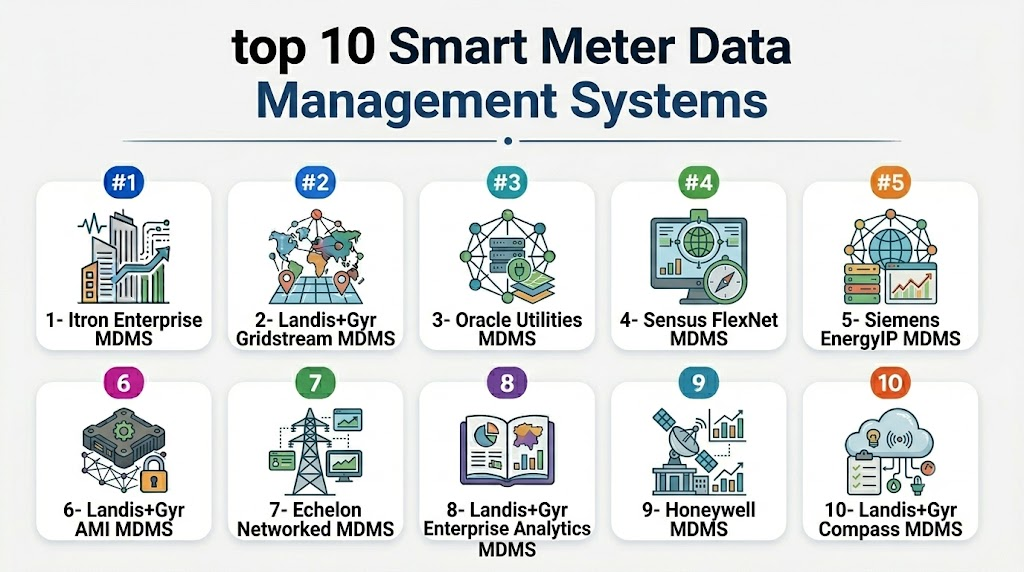
Top 10 Smart Meter Data Management Systems
1- Itron Enterprise MDMS
Short description: Itron Enterprise MDMS centralizes meter data across electricity, water, and gas utilities, providing analytics and billing-ready processing for large-scale deployments.
Key Features
- Scalable multi-utility support
- Automated validation and editing of meter data
- Advanced consumption analytics
- Outage and event management
- Integration with billing and ERP systems
Pros
- Robust enterprise-grade platform
- Supports multiple utilities in one system
Cons
- Implementation can be complex
- Higher licensing costs for smaller utilities
Platforms / Deployment
- Web / Windows
- Cloud / On-prem / Hybrid
Security & Compliance
- Not publicly stated
Integrations & Ecosystem
- APIs for ERP and billing integration
- DLMS/COSEM compliant
- Supports AMI networks
- Extensible via SDK
Support & Community
- Comprehensive vendor support and documentation
- Onboarding services available
- Strong user community forums
2- Landis+Gyr Gridstream MDMS
Short description: Gridstream MDMS provides utilities with scalable meter data management, analytics, and reporting tools for energy efficiency and operational improvements.
Key Features
- Real-time data validation
- Energy consumption forecasting
- Grid monitoring and outage detection
- Mobile and web dashboards
- Integration with smart grid solutions
Pros
- Strong AMI network support
- Predictive analytics features
Cons
- Complex configuration for multi-vendor meters
- Cost may be prohibitive for small utilities
Platforms / Deployment
- Web / Windows
- Cloud / On-prem / Hybrid
Security & Compliance
- SOC 2 Type II, ISO 27001 (Varies / N/A)
Integrations & Ecosystem
- APIs for billing and ERP
- Smart grid and IoT integration
- Data export via standard protocols
Support & Community
- Vendor-provided onboarding and training
- Active customer support
- Limited open community resources
3- Oracle Utilities MDMS
Short description: Oracle Utilities MDMS streamlines meter data collection, processing, and analytics for large-scale utility operations, enabling accurate billing and regulatory compliance.
Key Features
- Multi-utility support
- Exception management and workflow automation
- Customer insight dashboards
- Integration with billing and ERP systems
- Regulatory reporting
Pros
- High reliability and enterprise support
- Extensive analytics capabilities
Cons
- Longer implementation cycles
- Requires specialized IT resources
Platforms / Deployment
- Web / Windows / Linux
- Cloud / On-prem / Hybrid
Security & Compliance
- Not publicly stated
Integrations & Ecosystem
- APIs for ERP and billing
- Supports DLMS/COSEM and AMI networks
- Extensible analytics modules
Support & Community
- Vendor support contracts
- Training resources and knowledge base
4- Sensus FlexNet MDMS
Short description: Sensus FlexNet MDMS centralizes smart meter data for utilities, focusing on accurate billing, outage detection, and operational analytics.
Key Features
- Data collection and normalization
- Advanced event detection
- Customer portal integration
- Automated exception handling
- Scalable for multiple utility types
Pros
- Reliable data processing
- Strong outage and event management
Cons
- Limited AI analytics compared to peers
- Complex deployment for small-scale utilities
Platforms / Deployment
- Web / Windows
- Cloud / On-prem / Hybrid
Security & Compliance
- Not publicly stated
Integrations & Ecosystem
- API connectivity for billing
- Supports AMI and IoT endpoints
- Standard export formats
Support & Community
- Vendor support and consulting services
- Documentation available
5- Siemens EnergyIP MDMS
Short description: EnergyIP MDMS by Siemens provides utilities with a scalable platform for meter data management, analytics, and operational optimization.
Key Features
- Multi-utility and multi-protocol support
- Smart grid integration
- Predictive analytics and forecasting
- Regulatory and billing compliance
- Automated data validation
Pros
- Enterprise-grade reliability
- Flexible deployment options
Cons
- Higher cost for small deployments
- Implementation may require expert consulting
Platforms / Deployment
- Web / Windows / Linux
- Cloud / On-prem / Hybrid
Security & Compliance
- Not publicly stated
Integrations & Ecosystem
- ERP and billing system APIs
- IoT and grid integration
- Supports DLMS/COSEM
Support & Community
- Vendor support and professional services
- Training programs and documentation
6- Landis+Gyr AMI MDMS
Short description: Focused on AMI-enabled utilities, this MDMS ensures real-time meter data collection, processing, and analytics for energy and water management.
Key Features
- Advanced metering integration
- Automated data validation
- Analytics and forecasting
- Customer insights dashboards
- Exception management
Pros
- Real-time data support
- Strong AMI compatibility
Cons
- Limited for small-scale deployments
- Customization can be complex
Platforms / Deployment
- Web / Windows
- Cloud / On-prem / Hybrid
Security & Compliance
- Not publicly stated
Integrations & Ecosystem
- APIs for ERP/billing
- Supports IoT and AMI integration
- Extensible analytics
Support & Community
- Vendor-provided support
- Documentation and training
7- Echelon Networked MDMS
Short description: Echelon MDMS centralizes smart meter data for operational efficiency and compliance, with robust analytics and grid monitoring capabilities.
Key Features
- Automated exception handling
- Analytics dashboards
- Grid monitoring tools
- Multi-protocol support
- Customer engagement portal
Pros
- Flexible protocol support
- Real-time monitoring features
Cons
- Smaller ecosystem compared to enterprise vendors
- Limited AI-driven forecasting
Platforms / Deployment
- Web / Windows
- Cloud / On-prem / Hybrid
Security & Compliance
- Not publicly stated
Integrations & Ecosystem
- API connectivity for billing and ERP
- Supports IoT endpoints
- Data export capabilities
Support & Community
- Vendor support available
- Documentation moderate
8- Landis+Gyr Enterprise Analytics MDMS
Short description: Enterprise-focused MDMS with advanced analytics, integrating meter data across multiple utilities for operational insights and reporting.
Key Features
- Predictive analytics
- Data cleansing and normalization
- Integration with billing and ERP
- Outage detection
- Multi-utility support
Pros
- Strong analytics capabilities
- Enterprise scalability
Cons
- Higher cost
- Steeper learning curve
Platforms / Deployment
- Web / Windows / Linux
- Cloud / On-prem / Hybrid
Security & Compliance
- Not publicly stated
Integrations & Ecosystem
- APIs and SDKs for ERP/billing integration
- IoT device compatibility
- Extensible analytics
Support & Community
- Professional vendor support
- Documentation available
9- Honeywell MDMS
Short description: Honeywell MDMS centralizes smart meter data for energy and water utilities, enabling analytics, billing, and operational efficiency.
Key Features
- Multi-utility support
- Automated exception handling
- Analytics dashboards
- Regulatory reporting
- Integration with billing systems
Pros
- Reliable and mature platform
- Comprehensive reporting
Cons
- Smaller community
- Limited SaaS flexibility
Platforms / Deployment
- Web / Windows
- Cloud / On-prem / Hybrid
Security & Compliance
- Not publicly stated
Integrations & Ecosystem
- APIs for ERP/billing
- Supports AMI networks
- Extensible data analytics
Support & Community
- Vendor support available
- Documentation moderate
10- Landis+Gyr Compass MDMS
Short description: Compass MDMS combines smart meter data management with operational analytics, enabling real-time insights and reporting for utilities.
Key Features
- Data normalization and validation
- Customer dashboards
- Exception management
- Integration with billing systems
- Multi-utility support
Pros
- Real-time analytics
- Scalable for medium-to-large utilities
Cons
- Complex initial deployment
- May require specialized support
Platforms / Deployment
- Web / Windows / Linux
- Cloud / On-prem / Hybrid
Security & Compliance
- Not publicly stated
Integrations & Ecosystem
- APIs for billing and ERP
- IoT device integration
- Data export and reporting
Support & Community
- Vendor support and professional services
- Documentation moderate
Comparison Table (Top 10)
| Tool Name | Best For | Platform(s) Supported | Deployment | Standout Feature | Public Rating |
|---|---|---|---|---|---|
| Itron Enterprise MDMS | Large utilities | Web/Windows | Cloud/On-prem/Hybrid | Scalable multi-utility support | N/A |
| Landis+Gyr Gridstream MDMS | Utilities with AMI networks | Web/Windows | Cloud/On-prem/Hybrid | Predictive analytics | N/A |
| Oracle Utilities MDMS | Enterprise billing | Web/Windows/Linux | Cloud/On-prem/Hybrid | Multi-utility analytics | N/A |
| Sensus FlexNet MDMS | Utilities | Web/Windows | Cloud/On-prem/Hybrid | Outage and event management | N/A |
| Siemens EnergyIP MDMS | Large utilities | Web/Windows/Linux | Cloud/On-prem/Hybrid | Smart grid integration | N/A |
| Landis+Gyr AMI MDMS | AMI-enabled utilities | Web/Windows | Cloud/On-prem/Hybrid | Real-time meter data | N/A |
| Echelon Networked MDMS | Utilities | Web/Windows | Cloud/On-prem/Hybrid | Protocol flexibility | N/A |
| Landis+Gyr Enterprise Analytics MDMS | Enterprise analytics | Web/Windows/Linux | Cloud/On-prem/Hybrid | Advanced analytics | N/A |
| Honeywell MDMS | Energy/water utilities | Web/Windows | Cloud/On-prem/Hybrid | Mature reporting | N/A |
| Landis+Gyr Compass MDMS | Medium-to-large utilities | Web/Windows/Linux | Cloud/On-prem/Hybrid | Real-time insights | N/A |
Evaluation & Scoring of Smart Meter Data Management Systems
| Tool Name | Core (25%) | Ease (15%) | Integrations (15%) | Security (10%) | Performance (10%) | Support (10%) | Value (15%) | Weighted Total |
|---|---|---|---|---|---|---|---|---|
| Itron Enterprise MDMS | 9 | 7 | 8 | 7 | 9 | 8 | 7 | 8.1 |
| Landis+Gyr Gridstream MDMS | 8 | 7 | 7 | 7 | 8 | 7 | 7 | 7.5 |
| Oracle Utilities MDMS | 9 | 6 | 8 | 7 | 9 | 8 | 6 | 7.9 |
| Sensus FlexNet MDMS | 7 | 8 | 7 | 7 | 8 | 7 | 7 | 7.5 |
| Siemens EnergyIP MDMS | 9 | 7 | 8 | 7 | 9 | 8 | 7 | 8.1 |
| Landis+Gyr AMI MDMS | 8 | 8 | 7 | 7 | 8 | 7 | 7 | 7.6 |
| Echelon Networked MDMS | 7 | 7 | 7 | 6 | 7 | 7 | 6 | 6.8 |
| Landis+Gyr Enterprise Analytics MDMS | 9 | 6 | 8 | 7 | 8 | 8 | 6 | 7.8 |
| Honeywell MDMS | 7 | 7 | 7 | 7 | 8 | 7 | 7 | 7.2 |
| Landis+Gyr Compass MDMS | 8 | 7 | 8 | 7 | 8 | 7 | 7 | 7.6 |
Which Smart Meter Data Management System Is Right for You?
Solo / Freelancer
MDMS solutions are generally overkill; consider lightweight consumption tracking apps instead.
SMB
Cloud-based options with limited AMI support (e.g., Sensus FlexNet) offer ease of deployment without extensive IT overhead.
Mid-Market
Platforms like Landis+Gyr AMI MDMS balance scalability, analytics, and cost, suitable for regional utilities.
Enterprise
Itron Enterprise MDMS, Siemens EnergyIP, and Oracle Utilities MDMS provide robust multi-utility, multi-protocol support, ideal for nationwide deployment.
Budget vs Premium
Smaller utilities benefit from SaaS/cloud-first solutions, while premium enterprise platforms justify investment through analytics, reporting, and predictive maintenance.
Feature Depth vs Ease of Use
Enterprise platforms offer comprehensive features but require more setup; mid-market solutions balance feature depth with operational simplicity.
Integrations & Scalability
Assess API compatibility, AMI integration, and ERP connectivity to ensure long-term scalability.
Security & Compliance Needs
Focus on platforms with encryption, SSO/MFA support, and compliance-ready workflows for GDPR, SOC 2, and local regulations.
Frequently Asked Questions (FAQs)
1- What pricing models are common for MDMS?
MDMS platforms often use subscription-based SaaS pricing, one-time licenses, or hybrid models depending on deployment size and utility type.
2- How long does implementation take?
Enterprise deployments may require 6–12 months, while cloud solutions for mid-sized utilities can be implemented in 3–6 months.
3- Can MDMS handle multiple utility types?
Yes, most top MDMS platforms support electricity, water, and gas meters simultaneously, often within one unified system.
4- How secure is meter data?
Modern MDMS solutions provide encryption, access control, and audit logging; always verify vendor security practices before adoption.
5- What integrations are typically supported?
Common integrations include billing systems, ERP platforms, smart grid controllers, IoT devices, and cloud analytics services.
6- Is real-time monitoring possible?
Yes, platforms with AMI and edge computing support can provide near-real-time insights for load management and outage detection.
7- Can I switch MDMS vendors?
Migration is possible but requires careful planning; standardized protocols like DLMS/COSEM help reduce migration friction.
8- What are common mistakes when deploying MDMS?
Underestimating data volume, ignoring integration complexity, and neglecting user training are frequent pitfalls.
9- Are there open-source MDMS options?
Few exist; most widely adopted solutions are commercial enterprise-grade platforms due to reliability and support requirements.
10- How do I evaluate ROI?
Consider operational efficiency gains, reduced manual processing, improved billing accuracy,
and enhanced customer satisfaction as key ROI metrics.
Conclusion
Smart Meter Data Management Systems are critical for utilities aiming to enhance operational efficiency, gain customer insights, and maintain regulatory compliance. Choosing the right platform depends on the utility’s size, deployment scale, and required features. Mid-market utilities often prioritize ease of use and cloud-based deployment for faster implementation, while enterprise operators require robust analytics, multi-utility support, and flexible integration. Evaluating core capabilities, scalability, and security ensures long-term value. The next step is to shortlist 2–3 platforms that match your operational needs. Running a pilot helps validate performance and integration. Finally, confirm security readiness before moving to full-scale deployment.

Find Trusted Cardiac Hospitals
Compare heart hospitals by city and services — all in one place.
Explore Hospitals
Smart meter data management systems deliver the greatest value when they transform raw consumption data into actionable insights for utilities and consumers alike. High-quality data validation, analytics, and real-time processing help improve billing accuracy, detect anomalies, and support more efficient energy usage across the grid.