Introduction
Grid Operations Software (EMS/DMS) refers to advanced operational platforms used by electric utilities and grid operators to monitor, control, and optimize the performance of the electrical transmission and distribution network. Energy Management Systems (EMS) focus on real‑time visibility and control of transmission networks, while Distribution Management Systems (DMS) concentrate on the distribution grid, outage management, and network optimization. Together, they improve reliability, reduce operational costs, and enable smarter grid decision‑making. grid operations systems are critical due to accelerating energy transitions, distributed energy resources (DERs), renewable integration variability, and rising consumer expectations for resilience and reliability. Modern grids are more complex than ever, requiring real‑time decision support that traditional SCADA systems alone cannot deliver.
Real‑world use cases include:
- Demand and load forecasting: Predictive insights that support balancing generation and load.
- Outage detection and restoration: Faster identification and response to faults or service interruptions.
- DER integration: Managing solar, wind, storage, and EV charging impacts on grid stability.
- Volt/VAR optimization: Improving distribution efficiency and reducing energy losses.
- Regulatory compliance and reporting: Automated generation of compliance reports and audit trails.
What buyers should evaluate:
- Real‑time analytics and forecasting
- DER and renewable integration support
- Scalability for large service territories
- Cybersecurity and compliance posture
- Ease of integration with existing operational technology
- Outage and outage restoration capabilities
- Support for AI/ML decision support workflows
- Cloud vs on‑premise deployment options
- Operating costs and total cost of ownership
Best for: Transmission and distribution utilities, independent system operators (ISOs), regional grid operators, and municipal power companies seeking high reliability and operational efficiency.
Not ideal for: Small municipal utilities with minimal automation needs or networks without modern telemetry, where simpler distribution tools or energy reporting solutions may suffice.
Key Trends in Grid Operations (EMS/DMS) Software
- AI‑Enhanced Decision Support: Machine learning for predictive load balancing, fault prediction, and network optimization.
- DER and Microgrid Integration: Native capabilities for managing distributed generation, storage, and aggregated resources.
- Cloud and Hybrid Deployment Models: Utilities increasingly embracing cloud for scalability and cost flexibility while retaining on‑prem where needed for latency or compliance.
- Cybersecurity as an Operational Priority: Built‑in anomaly detection, RBAC, encryption, and secure communication tailored for grid OT environments.
- Interoperability Standards: Adoption of common data models and protocols like IEC 61850, CIM, and IEEE standards to reduce vendor lock‑in.
- Real‑Time Network Digital Twins: Virtual replicas of the physical grid for simulation and impact analysis.
- Mobile and Field Integration: Tools that extend situational awareness to field crews with mobile dashboards and alerts.
- Advanced Forecasting for Renewables: Load and generation forecasting that accounts for weather, market conditions, and DER behavior.
- Regulatory & Compliance Automation: Automated reporting and audit logging for regional grid standards.
- User Experience Focus: Dashboards and workflows that reduce operator fatigue and improve decision throughput.
How We Selected These Tools (Methodology)
- Evaluated market adoption/mindshare by utilities and operators globally.
- Assessed feature completeness, including EMS and DMS core capabilities.
- Considered reliability/performance signals, operational uptime, and real‑time processing.
- Reviewed security posture signals, including access controls, encryption, and audit capabilities.
- Factored in integration and ecosystem support across SCADA, AMI, DERMS, and ERP.
- Examined fit across different utility segments, from regional to national operators.
- Judged ease of deployment and scalability, including cloud/hybrid readiness.
- Looked at support infrastructure, including vendor support tiers, training, and documentation.
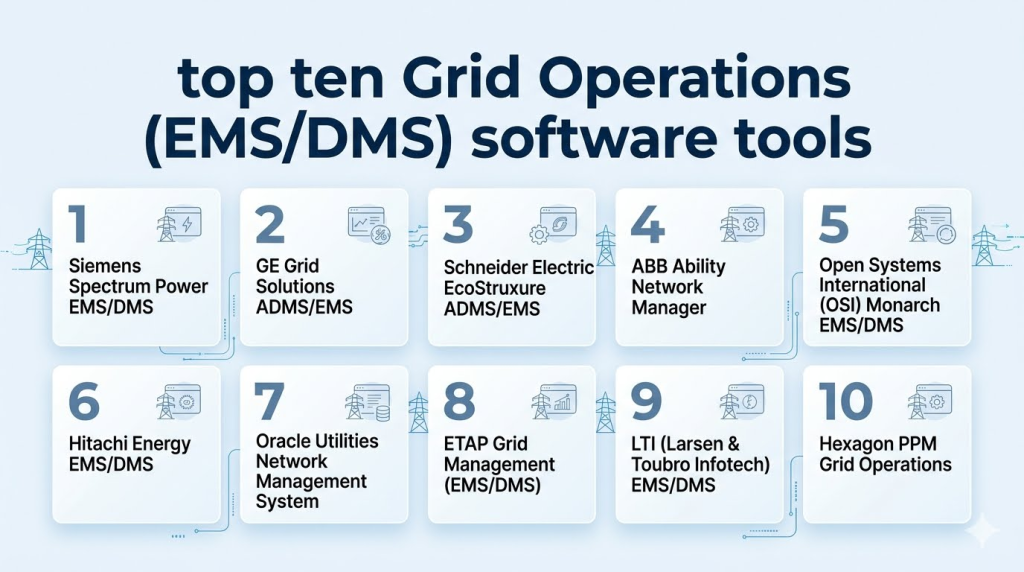
Top 10 Grid Operations (EMS/DMS) Tools
1- Siemens Spectrum Power EMS/DMS
Short description: A comprehensive utility operations platform combining energy management and distribution control, serving large transmission and distribution networks with real‑time grid visibility.
Key Features
- Real‑time state estimation and network modeling
- Load forecasting and contingency analysis
- DER and renewable integration support
- Outage detection and restoration workflows
- Volt/VAR optimization
- Advanced visualization dashboards
Pros
- Strong scalability for large utility footprints
- Robust analytical engines for both EMS and DMS workflows
Cons
- Implementation complexity requiring specialized expertise
- Higher total cost of ownership for smaller utilities
Platforms / Deployment
- Windows / Linux
- Cloud / On‑prem / Hybrid
Security & Compliance
Not publicly stated
Integrations & Ecosystem
The platform integrates with SCADA, DERMS, AMI, and asset management systems, including:
- DER controllers and renewable data feeds
- Outage management and work order systems
- GIS and network modeling tools
- APIs for custom data exchange
Support & Community
Vendor‑provided support tiers with professional services, extensive documentation, and training programs for operators.
2- GE Grid Solutions ADMS/EMS
Short description: A unified Advanced Distribution Management System (ADMS) and EMS platform designed to support real‑time control, outage management, and advanced analytics.
Key Features
- Integrated ADMS and EMS modules
- Load and voltage forecasting
- Fault location, isolation, and service restoration (FLISR)
- DER and renewable monitoring
- Mobile-enabled situation awareness
- Real‑time network simulation
Pros
- Highly integrated ADMS/EMS solution
- Strong support for DER and DER forecasting
Cons
- Configuration may be complex for multi‑vendor environments
- Requires ongoing tuning for forecasting accuracy
Platforms / Deployment
- Windows / Linux
- Cloud / On‑prem / Hybrid
Security & Compliance
Not publicly stated
Integrations & Ecosystem
Supports connections to:
- GIS and outage management systems
- SCADA and field devices
- Third‑party forecasting engines
- DER telemetry and market price feeds
Support & Community
Varies / Not publicly stated
3- Schneider Electric EcoStruxure ADMS/EMS
Short description: An AI‑ready EMS/DMS suite with strong analytics and mobile field extension, designed for utilities of different sizes.
Key Features
- Contingency analysis and load balancing
- Volt/VAR optimization
- Outage management and restoration planning
- DER and storage integration
- AI‑assisted decision support
- Real‑time dashboards
Pros
- Modern interface with strong user experience
- Built‑in AI forecasts and optimization
Cons
- Requires customization for specific regional grid standards
- Enterprise integration can be resource‑intensive
Platforms / Deployment
- Windows / Linux
- Cloud / On‑prem / Hybrid
Security & Compliance
Not publicly stated
Integrations & Ecosystem
Supports common grid data standards and integrates with:
- SCADA, GIS, and asset management
- DER controllers and market systems
- Mobile field applications
Support & Community
Vendor support with tiered service levels and documentation; community engagement varies by region.
4- ABB Ability Network Manager
Short description: A scalable EMS/DMS platform aimed at delivering real‑time operations, analytics, and network optimization for modern grids.
Key Features
- Advanced network modeling and analysis
- Forecasting for load and DER impacts
- FLISR and outage workflows
- Volt/VAR and power quality optimization
- DER visibility and control
- Alarm and event correlation
Pros
- Strong analytical backbone for network optimization
- Good support for distributed energy visibility
Cons
- Hardware and software integration can be complex
- Smaller utilities may find implementation resource‑intensive
Platforms / Deployment
- Windows / Linux
- Cloud / On‑prem / Hybrid
Security & Compliance
Not publicly stated
Integrations & Ecosystem
Integrates with:
- SCADA and telemetry systems
- DER data platforms
- OMS and GIS systems
- Custom APIs for operational data exchange
Support & Community
Documentation and vendor support available; community presence varies.
5- Open Systems International (OSI) Monarch EMS/DMS
Short description: An open enterprise EMS/DMS platform known for flexibility and strong integration capabilities across utility operational stacks.
Key Features
- Real‑time state estimation
- Load and network forecasting
- Distribution automation integration
- DER and renewable dispatch support
- Custom analytics pipeline
- Alarm and event management
Pros
- Highly configurable and adaptable
- Good integration flexibility
Cons
- Requires skilled configuration and support teams
- Analyst training may be necessary for full utilization
Platforms / Deployment
- Windows / Linux
- Cloud / On‑prem / Hybrid
Security & Compliance
Not publicly stated
Integrations & Ecosystem
Connects with myriad operational systems:
- SCADA/RTU interfaces
- OMS and field device telemetry
- DER systems and market data
- GIS and advanced analytics outputs
Support & Community
Professional support available; documentation moderate; user community smaller than enterprise incumbents.
6- Hitachi Energy (formerly ABB) EMS/DMS
Short description: A robust EMS/DMS suite with a focus on grid stability, real‑time control, and DER integration in complex environments.
Key Features
- Network state estimation and power flow analysis
- DER and storage coordination
- Forecasting and contingency planning
- FLISR and automated restoration
- Outage impact visualization
- Integration with market data
Pros
- Strong performance for large transmission networks
- Good DER support
Cons
- Implementation may require specialized partners
- Higher operational training burden
Platforms / Deployment
- Windows / Linux
- Cloud / On‑prem / Hybrid
Security & Compliance
Not publicly stated
Integrations & Ecosystem
Interfaces with:
- SCADA and grid telemetry
- DER management systems
- GIS, OMS, and workflows
Support & Community
Vendor support with professional services; user ecosystem moderate.
7- Oracle Utilities Network Management System
Short description: A grid operations suite offering transmission and distribution network visibility, analytics, and automated workflows.
Key Features
- Real‑time network monitoring
- DER and inverter data handling
- Load and voltage forecasting
- Outage detection and service restoration planning
- Contingency and scenario modeling
- Mobile and operator dashboards
Pros
- Integrated architecture across utility operations
- Strong scenario analysis and planning tools
Cons
- Enterprise integration can be resource heavy
- Smaller utilities may find advanced features underutilized
Platforms / Deployment
- Windows / Linux
- Cloud / On‑prem / Hybrid
Security & Compliance
Not publicly stated
Integrations & Ecosystem
Works with:
- SCADA and telemetry systems
- GIS, OMS, and DER controllers
- Custom APIs for data exchange
Support & Community
Vendor support provided; documentation available; community engagement varies.
8- ETAP Grid Management (EMS/DMS)
Short description: A simulation‑centric grid operations suite with strong modeling, optimization, and real‑time control capabilities.
Key Features
- Network digital twin and simulation
- DER and renewable penetration analysis
- Load flow and fault studies
- Real‑time monitoring and alarms
- Outage and restoration planning
- Optimization modules
Pros
- Excellent modeling depth and digital twin support
- Useful for planning and operations
Cons
- Steep learning curve for simulation features
- Enterprise license costs can be high
Platforms / Deployment
- Windows
- Cloud / On‑prem / Hybrid
Security & Compliance
Not publicly stated
Integrations & Ecosystem
Integrates with SCADA, GIS, and asset management platforms; supports custom scripting and data import/export.
Support & Community
Strong documentation and training resources; support varies by license.
9- LTI (Larsen & Toubro Infotech) EMS/DMS
Short description: A utility operations suite with integration services and localized configuration strengths, particularly for regional utilities.
Key Features
- Real‑time grid state and control
- Forecasting and DER visibility
- Outage management integration
- Load and voltage management
- Custom analytics dashboards
Pros
- Strong services integration for implementation
- Configurable for regional requirements
Cons
- Smaller ecosystem than global incumbents
- Feature depth can vary by deployment
Platforms / Deployment
- Windows / Linux
- Cloud / On‑prem / Hybrid
Security & Compliance
Not publicly stated
Integrations & Ecosystem
Supports integrations with SCADA, OMS, mobile field tools, and DER platforms.
Support & Community
Regional vendor support; documentation varies; growing community.
10- Hexagon PPM Grid Operations
Short description: A grid operations platform emphasizing modeling, analytics, and operational control for modern utilities transitioning to smarter networks.
Key Features
- Network modeling and forecasting
- DER and renewable coordination
- Real‑time monitoring
- Outage and restoration support
- Optimization modules
- Operator dashboards
Pros
- Strong modeling and analytics foundation
- Good customization options
Cons
- Enterprise integration overhead
- Smaller utilities may underuse full capabilities
Platforms / Deployment
- Windows / Linux
- Cloud / On‑prem / Hybrid
Security & Compliance
Not publicly stated
Integrations & Ecosystem
Integrates with SCADA/telemetry, GIS systems, field devices, and custom APIs.
Support & Community
Vendor support available; documentation comprehensive; user community moderate.
Comparison Table (Top 10)
| Tool Name | Best For | Platform(s) Supported | Deployment | Standout Feature | Public Rating |
|---|---|---|---|---|---|
| Siemens Spectrum Power EMS/DMS | Large grids | Windows/Linux | Cloud/On‑prem/Hybrid | Real‑time grid optimization | N/A |
| GE Grid Solutions ADMS/EMS | Integrated ADMS/EMS | Windows/Linux | Cloud/On‑prem/Hybrid | Unified outage & control | N/A |
| Schneider EcoStruxure ADMS/EMS | Utilities of varied sizes | Windows/Linux | Cloud/On‑prem/Hybrid | AI‑assisted decision support | N/A |
| ABB Ability Network Manager | Grid optimization | Windows/Linux | Cloud/On‑prem/Hybrid | Network analytics | N/A |
| OSI Monarch EMS/DMS | Flexible integration | Windows/Linux | Cloud/On‑prem/Hybrid | Configurable operations | N/A |
| Hitachi Energy EMS/DMS | Transmission focus | Windows/Linux | Cloud/On‑prem/Hybrid | DER handling | N/A |
| Oracle Utilities NMS | Enterprise operations | Windows/Linux | Cloud/On‑prem/Hybrid | Scenario planning | N/A |
| ETAP Grid Management | Simulation & ops | Windows | Cloud/On‑prem/Hybrid | Digital twin focus | N/A |
| LTI EMS/DMS | Regional utilities | Windows/Linux | Cloud/On‑prem/Hybrid | Service integration | N/A |
| Hexagon PPM Grid Operations | Smart grid modeling | Windows/Linux | Cloud/On‑prem/Hybrid | Modeling depth | N/A |
Evaluation & Scoring of Grid Operations (EMS/DMS)
| Tool Name | Core (25%) | Ease (15%) | Integrations (15%) | Security (10%) | Performance (10%) | Support (10%) | Value (15%) | Weighted Total |
|---|---|---|---|---|---|---|---|---|
| Siemens Spectrum Power EMS/DMS | 9 | 7 | 8 | 7 | 9 | 8 | 7 | 8.1 |
| GE Grid Solutions ADMS/EMS | 8 | 7 | 8 | 7 | 8 | 7 | 7 | 7.6 |
| Schneider EcoStruxure ADMS/EMS | 8 | 8 | 8 | 7 | 8 | 7 | 8 | 7.8 |
| ABB Ability Network Manager | 8 | 7 | 8 | 7 | 8 | 7 | 7 | 7.6 |
| OSI Monarch EMS/DMS | 7 | 7 | 9 | 7 | 7 | 7 | 8 | 7.5 |
| Hitachi Energy EMS/DMS | 8 | 7 | 8 | 7 | 8 | 7 | 7 | 7.7 |
| Oracle Utilities NMS | 8 | 7 | 8 | 7 | 8 | 7 | 7 | 7.7 |
| ETAP Grid Management | 7 | 6 | 7 | 7 | 7 | 7 | 6 | 6.9 |
| LTI EMS/DMS | 7 | 7 | 7 | 7 | 7 | 6 | 7 | 7.0 |
| Hexagon PPM Grid Operations | 7 | 7 | 7 | 7 | 7 | 7 | 7 | 7.2 |
Interpretation: Scores are comparative across key criteria. Core features and performance weigh most heavily, followed by integrations and value. A higher weighted total suggests broad operational strength, but specific utility needs should guide final selection.
Which Grid Operations (EMS/DMS) Tool Is Right for You?
Solo / Freelancer
Grid operations suites are generally too complex; lightweight network diagnostic tools or reporting platforms are more appropriate.
SMB
Mid‑sized utilities with growing automation needs may benefit from Schneider EcoStruxure ADMS/EMS or GE Grid Solutions, which balance feature depth with usability.
Mid‑Market
Regional utilities with moderate DER penetration and grid complexity may find ABB Ability Network Manager, Hitachi Energy EMS/DMS, or Oracle Utilities NMS effective.
Enterprise
Large transmission and distribution operators should consider Siemens Spectrum Power EMS/DMS or integrated OSI Monarch EMS/DMS for robust, scalable network control.
Budget vs Premium
Cost‑sensitive entities may focus on deployment efficiency and basic automation first. Premium platforms offer deep analytics and forecasting but require greater upfront investment.
Feature Depth vs Ease of Use
ETAP excels in modeling and digital twin capabilities but comes with a learning curve. Solutions with more intuitive interfaces may accelerate frontline adoption.
Integrations & Scalability
Prioritize tools with broad SCADA/OMS/GIS integration support and a flexible API ecosystem, ensuring future expandability.
Security & Compliance Needs
Across all scenarios, verify encryption, access control, and compliance capabilities — grid operations tools handle mission‑critical OT data requiring secure practices.
Frequently Asked Questions (FAQs)
1- What pricing models do EMS/DMS platforms use?
Pricing often includes license fees, subscription models, and usage‑based components. Deployment scale and customization levels influence total costs.
2- How long does implementation typically take?
Enterprise grid operations implementations can range from 6 months to over a year depending on custom integration needs and existing technology stack.
3- Can EMS/DMS work with existing SCADA systems?
Yes, most tools are designed to integrate with legacy SCADA systems, enabling phased modernization.
4- Do these platforms support DER and renewable energy?
Leading EMS/DMS tools include modules for DER visibility, forecasting, and coordination with network operations.
5- What is FLISR?
Fault Location, Isolation, and Service Restoration (FLISR) automates outage detection and restoration workflows, improving reliability and reducing response times.
6- Are cloud deployments secure for grid operations?
Cloud deployments can be secure when built with encryption, access control, and compliance practices tailored for operational data, but utilities must evaluate vendor security postures.
7- How does AI improve grid operations?
AI and ML support load forecasting, anomaly detection, contingency planning, and decision recommendations, enhancing human operator workflows.
8- Can smaller utilities use EMS/DMS tools?
Yes, tools vary in scale — smaller operators can adopt lighter configurations or hybrid deployments suitable for their network size.
9- What integrations are critical in EMS/DMS?
SCADA, OMS, GIS, DER platforms, AMI, and asset management integrations are fundamental for comprehensive grid operations.
10- How do I choose the right grid operations software?
Define your grid size, DER complexity, automation needs, regulatory requirements, and integration landscape before comparing features and vendor fit.
Conclusion
Grid Operations (EMS/DMS) software is an essential backbone for modern power networks facing renewable integration, distributed generation, and real‑time reliability demands. Choosing the right tool depends on grid size, operational complexity, DER penetration, integration requirements, and long‑term strategic goals. Utilities should shortlist 2–3 platforms aligned to their architecture, run proof‑of‑concept pilots, and verify integration and security needs before full deployment. Robust planning today accelerates secure, efficient, and reliable grid operations tomorrow.

Find Trusted Cardiac Hospitals
Compare heart hospitals by city and services — all in one place.
Explore Hospitals
Grid operations platforms are most valuable when they provide operators with real-time visibility and control across increasingly complex power networks. By integrating monitoring, outage management, and predictive analytics, EMS/DMS solutions help improve grid reliability, support renewable energy integration, and enable faster responses to changing demand and system events.