Introduction
Data Science Platforms are integrated software solutions designed to streamline the end-to-end lifecycle of data science, including data ingestion, preparation, exploration, modeling, deployment, and monitoring. These platforms provide teams with centralized tools and resources, enabling faster experimentation, collaboration, and model operationalization.
In and beyond, organizations rely heavily on data-driven insights for business decisions, AI/ML deployments, and predictive analytics. Data Science Platforms help standardize workflows, enforce governance, and ensure reproducibility across teams, reducing errors and accelerating project delivery.
Real-world use cases include predictive maintenance, customer segmentation, fraud detection, recommendation engines, and automated reporting. Buyers should evaluate scalability, collaboration features, integrated machine learning libraries, data connectors, visualization capabilities, security and compliance, ease of deployment, monitoring and governance, and pricing models.
Best for: Data scientists, ML engineers, analysts, and enterprises deploying predictive analytics at scale. Works for organizations of all sizes seeking structured AI/ML workflows.
Not ideal for: Teams needing only isolated tools for coding or small-scale experiments. Lightweight notebooks or individual ML libraries may suffice instead.
Key Trends in Data Science Platforms
- AI-assisted model building and automated feature engineering
- Integration with cloud-native data warehouses and lakes
- Collaboration tools for cross-functional data teams
- Support for multiple languages: Python, R, SQL, Java
- MLOps integration for deployment, monitoring, and retraining
- Pre-built connectors for enterprise applications and APIs
- Enhanced data governance, lineage, and compliance reporting
- Serverless or containerized deployment options
- Democratization through self-service analytics modules
- Flexible pricing models: subscription, consumption, or enterprise licensing
How We Selected These Tools (Methodology)
- Market adoption and mindshare across industries
- Feature completeness for the end-to-end data science lifecycle
- Reliability and performance metrics for large-scale processing
- Security and compliance posture including auditability and access control
- Extensibility and ecosystem integrations
- Customer fit across small, mid-market, and enterprise segments
- Scalability for concurrent projects and large datasets
- Support for collaboration and reproducibility
- Ease of deployment and maintenance
- Total cost of ownership and pricing transparency
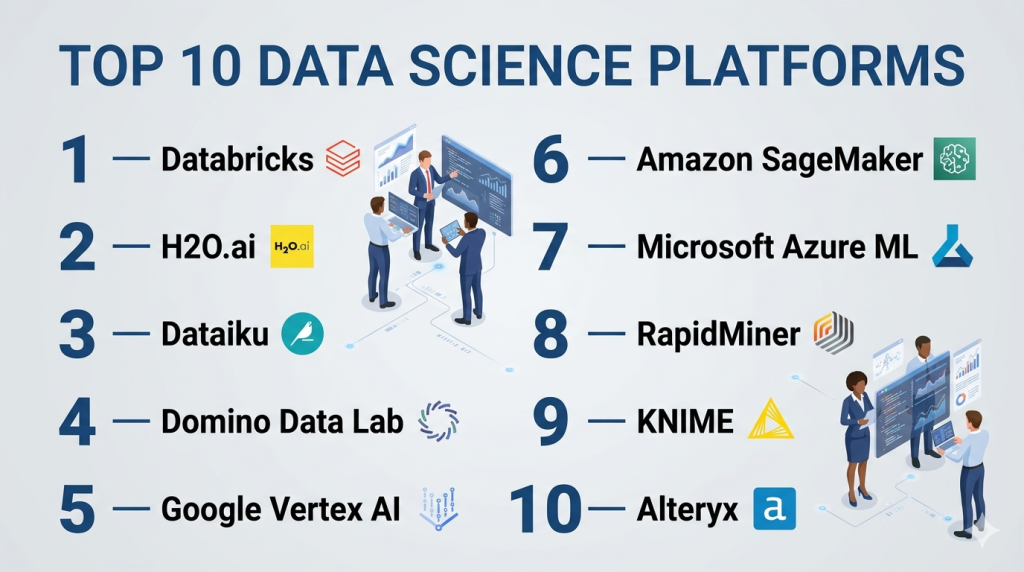
Top 10 Data Science Platforms
#1 — Databricks
Short description: Databricks is a cloud-native platform that combines data engineering, data science, and AI workflows in a single workspace. It enables collaborative development, large-scale ML, and real-time analytics using Apache Spark and Delta Lake.
Key Features
- Unified data lakehouse platform
- Collaborative notebooks and MLflow integration
- Auto-scaling clusters for batch and streaming jobs
- Delta Lake for ACID-compliant storage
- Extensive machine learning and AI libraries
- Python, R, SQL, and Scala support
- Integration with major cloud providers
Pros
- High scalability for large datasets
- Streamlined collaboration and MLOps integration
Cons
- Pricing can be high for small teams
- Learning curve for Spark optimizations
Platforms / Deployment
- Web / Linux / Windows / macOS
- Cloud
Security & Compliance
- RBAC, SSO/SAML, encryption
- SOC 2, ISO 27001, GDPR
Integrations & Ecosystem
- AWS, Azure, GCP
- BI tools like Tableau, Power BI
- APIs for custom connectors
Support & Community
- Strong support tiers, active community, detailed documentation
#2 — H2O.ai
Short description: H2O.ai offers an open-source and enterprise AI platform for machine learning and predictive analytics. It is suitable for business analysts, data scientists, and developers aiming to build and deploy ML models at scale.
Key Features
- AutoML capabilities
- Distributed and in-memory computing
- Integration with Python, R, Java, and REST APIs
- Model explainability and interpretability tools
- Supports supervised and unsupervised learning
- Scalable for large datasets
Pros
- Accelerates model development with AutoML
- Open-source and enterprise options available
Cons
- Limited UI for non-technical users
- Enterprise edition pricing can be high
Platforms / Deployment
- Web / Linux / Windows / macOS
- Cloud / Self-hosted / Hybrid
Security & Compliance
- SSO/SAML, encryption
- SOC 2, GDPR
Integrations & Ecosystem
- Spark, Hadoop, AWS, Azure
- REST APIs for deployment
Support & Community
- Active open-source community, enterprise support available
#3 — Dataiku
Short description: Dataiku is a collaborative data science platform that simplifies ML and analytics workflows for both technical and business users. It offers visual interfaces along with code-based tools for advanced model development.
Key Features
- Visual pipeline building
- AutoML and deep learning support
- Data preparation and feature engineering
- Integration with SQL, Hadoop, Spark
- Collaboration for business and data teams
- Model deployment and monitoring
Pros
- User-friendly visual interface
- Strong collaboration and governance features
Cons
- Can be resource-heavy for large deployments
- Some advanced features require coding expertise
Platforms / Deployment
- Web / Linux / Windows
- Cloud / Self-hosted / Hybrid
Security & Compliance
- RBAC, SSO, audit logs
- SOC 2, ISO 27001, GDPR
Integrations & Ecosystem
- BI tools like Tableau and Power BI
- Cloud data warehouses, APIs
- Python, R, Spark integration
Support & Community
- Extensive documentation, training, and support tiers
#4 — Domino Data Lab
Short description: Domino Data Lab is an enterprise-grade data science platform that supports model development, reproducibility, and deployment at scale. It is ideal for regulated industries requiring governance and audit trails.
Key Features
- Centralized compute and storage management
- Reproducible notebooks and experiments
- MLOps deployment support
- Collaboration tools for teams
- Integration with Python, R, and Spark
Pros
- Strong focus on reproducibility and governance
- Supports enterprise compliance requirements
Cons
- Enterprise-focused pricing
- Steeper learning curve for beginners
Platforms / Deployment
- Web / Linux / Windows / macOS
- Cloud / Self-hosted / Hybrid
Security & Compliance
- Encryption, RBAC, SSO
- SOC 2, ISO 27001, HIPAA
Integrations & Ecosystem
- AWS, Azure, GCP
- APIs for model serving
Support & Community
- Enterprise support, detailed guides, active community
#5 — Google Vertex AI
Short description: Vertex AI is a managed machine learning platform on Google Cloud that unifies ML workflows, offering tools for model building, training, and deployment with minimal infrastructure management.
Key Features
- AutoML and custom model training
- Managed datasets and pipelines
- Integration with BigQuery and GCP storage
- Real-time and batch prediction
- Monitoring and explainability tools
Pros
- Fully managed with strong cloud integration
- Simplifies ML model lifecycle
Cons
- Cloud lock-in with GCP
- Limited offline/on-premise deployment
Platforms / Deployment
- Web
- Cloud
Security & Compliance
- IAM, encryption, audit logs
- SOC 2, ISO 27001, GDPR
Integrations & Ecosystem
- BigQuery, Cloud Storage, Pub/Sub
- APIs and SDKs for deployment
Support & Community
- Google Cloud support tiers and documentation
#6 — Amazon SageMaker
Short description: SageMaker is a fully managed AWS service enabling data scientists and developers to build, train, and deploy ML models at scale. It supports batch processing, real-time predictions, and automated model tuning.
Key Features
- Integrated Jupyter notebooks
- AutoML and hyperparameter optimization
- Deployment and monitoring tools
- Built-in algorithms and ML frameworks
- End-to-end MLOps support
Pros
- Fully managed with cloud scalability
- Extensive ML tooling and automation
Cons
- AWS-specific ecosystem
- Cost can grow with usage
Platforms / Deployment
- Web
- Cloud
Security & Compliance
- IAM, SSO, encryption
- SOC 2, ISO 27001, GDPR
Integrations & Ecosystem
- S3, Redshift, Lambda
- API and SDK integration
Support & Community
- AWS support tiers, community forums
#7 — Microsoft Azure ML
Short description: Azure Machine Learning is a cloud-based platform enabling developers and data scientists to build, train, and deploy ML models efficiently using automated tools and drag-and-drop interfaces.
Key Features
- AutoML for rapid model building
- Pipelines for batch and real-time ML
- Integration with Azure Synapse and storage
- Model versioning and deployment management
- Supports Python, R, and popular ML frameworks
Pros
- Simplifies MLOps and model management
- Strong cloud integration and security
Cons
- Dependent on Azure ecosystem
- Some advanced features require coding
Platforms / Deployment
- Web
- Cloud
Security & Compliance
- RBAC, encryption, audit logs
- ISO 27001, SOC 2, GDPR
Integrations & Ecosystem
- Azure Storage, Synapse, Data Lake
- APIs for model serving
Support & Community
- Microsoft support and developer community
#8 — RapidMiner
Short description: RapidMiner is a data science platform focused on visual workflows, enabling teams to prepare data, create predictive models, and deploy solutions without extensive coding.
Key Features
- Visual workflow builder
- AutoML capabilities
- Pre-built connectors for databases
- Model evaluation and deployment
- Collaboration tools for business users
Pros
- Intuitive visual interface for non-technical users
- Quick prototyping and deployment
Cons
- Limited scalability for extremely large datasets
- Advanced features require premium licenses
Platforms / Deployment
- Web / Windows / macOS / Linux
- Cloud / Self-hosted / Hybrid
Security & Compliance
- SSO, RBAC
- Not publicly stated
Integrations & Ecosystem
- SQL, Excel, cloud storage
- APIs and connectors
Support & Community
- Documentation, tutorials, support tiers
#9 — KNIME
Short description: KNIME is an open-source analytics and data science platform that allows users to build workflows, perform ETL, and deploy models using visual programming and integration with R and Python.
Key Features
- Node-based workflow design
- Integration with ML and deep learning libraries
- Batch and streaming data support
- Extensible with plugins
- Collaboration for teams
Pros
- Open-source and extensible
- Strong visualization and workflow design
Cons
- Less polished UI compared to commercial platforms
- Enterprise support requires paid version
Platforms / Deployment
- Web / Windows / macOS / Linux
- Cloud / Self-hosted / Hybrid
Security & Compliance
- LDAP and SSO
- Not publicly stated
Integrations & Ecosystem
- R, Python, Spark, databases
- APIs for custom connectors
Support & Community
- Active open-source community, paid enterprise support
#10 — Alteryx
Short description: Alteryx is a self-service data analytics platform enabling data prep, blending, and predictive modeling with visual workflows and minimal coding requirements.
Key Features
- Drag-and-drop workflow builder
- Predictive and spatial analytics
- Integration with BI tools and databases
- Data preparation and cleansing
- Collaboration and sharing features
Pros
- Quick adoption for business analysts
- Simplifies repetitive analytics tasks
Cons
- Licensing cost is high
- Limited for complex ML workflows
Platforms / Deployment
- Windows / Web
- Cloud / Self-hosted / Hybrid
Security & Compliance
- RBAC, encryption
- Not publicly stated
Integrations & Ecosystem
- Tableau, Power BI, SQL databases
- APIs for automation
Support & Community
- Enterprise support, active documentation
Conclusion
Data Science Platforms accelerate AI and ML initiatives by standardizing workflows, ensuring collaboration, and providing governance for large-scale projects. Open-source platforms like H2O.ai and KNIME offer cost-effective flexibility, while managed platforms such as Databricks, AWS SageMaker, and Vertex AI streamline large-scale deployments with full MLOps capabilities. Platform choice depends on team size, technical expertise, deployment needs, and integration requirements. Organizations should pilot tools, validate workflows, and ensure alignment with business objectives to achieve reproducible, scalable, and secure data science outcomes.

Find Trusted Cardiac Hospitals
Compare heart hospitals by city and services — all in one place.
Explore Hospitals
When several teams use the same datasets, features, or pipelines, one change can affect many projects. Teams should clearly document important dependencies and test major data changes before applying them everywhere. This can reduce unexpected problems and make collaboration much easier.