Introduction
Data Warehouse Platforms are specialized systems designed to consolidate and analyze large volumes of structured and semi-structured data. They allow organizations to centralize data from multiple sources, run complex queries, and generate insights for reporting, analytics, and business intelligence.In these platforms are crucial due to the explosion of data across enterprises, IoT, and cloud-native applications. Businesses leverage data warehouses to enable AI-powered analytics, real-time dashboards, predictive modeling, and informed decision-making.
Key evaluation criteria for buyers include query performance, scalability, cloud vs. on-premise deployment, integration ecosystem, security and compliance, AI/ML support, cost structure, analytics capabilities, and multi-tenancy support.
Best for: Data engineers, analytics teams, IT managers, medium-to-large enterprises, and organizations with multi-source data needs.
Not ideal for: Small businesses with limited data volumes or where simple databases or analytics tools suffice.
Key Trends in Data Warehouse Platforms
- Cloud-native and serverless data warehouse adoption.
- AI-assisted query optimization and predictive analytics.
- Integration with real-time streaming data sources.
- Multi-cloud and hybrid deployments for resilience.
- Enhanced security, compliance with SOC 2, GDPR, ISO 27001.
- Cost optimization with consumption-based pricing.
- Automation of ETL/ELT pipelines.
- Multi-model support combining relational, JSON, and time-series data.
- Pre-built connectors to BI and visualization tools.
How We Selected These Tools (Methodology)
- Market adoption and enterprise mindshare.
- Feature completeness for analytics, queries, and storage.
- Performance signals for query latency and throughput.
- Security and compliance posture.
- Ecosystem and third-party integrations.
- Support and community presence.
- Flexibility across SMB to large enterprises.
- Cloud-native vs. on-prem deployment options.
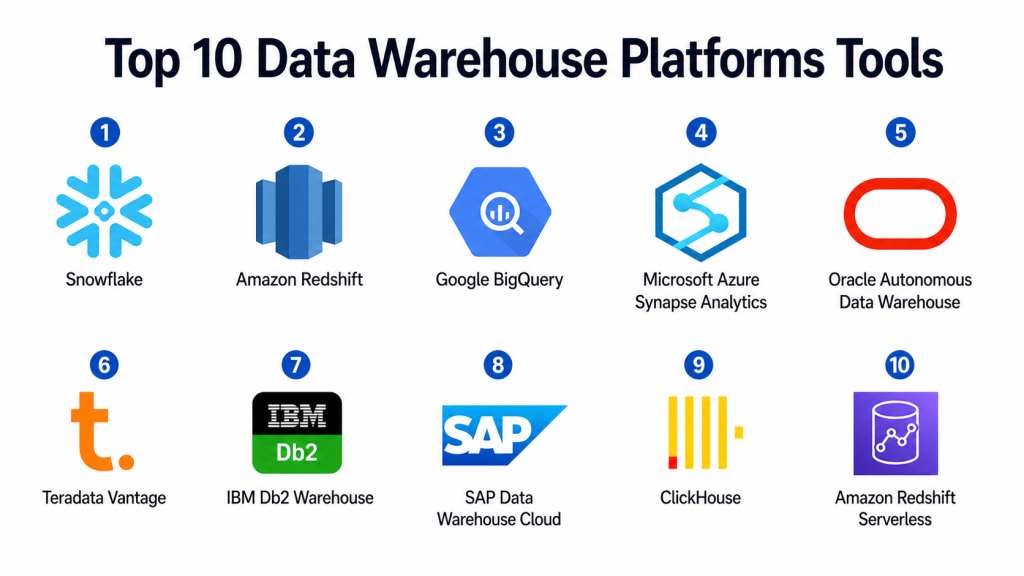
Top 10 Data Warehouse Platforms Tools
#1 — Snowflake
Short description: Snowflake is a cloud-native data warehouse offering high scalability, multi-cloud support, and strong analytics capabilities. It’s used widely for enterprise analytics, BI, and AI/ML workflows.
Key Features
- Multi-cloud deployment (AWS, Azure, GCP)
- Zero-copy cloning and time travel
- Auto-scaling compute and storage
- Native semi-structured data support (JSON, Avro, Parquet)
- Data sharing and collaboration
- Advanced security features
Pros
- Effortless scalability with cloud infrastructure
- Simplifies multi-cloud analytics
- Strong ecosystem and marketplace integrations
Cons
- Cloud-only platform, no on-premise
- Consumption-based pricing may be complex
- Learning curve for advanced features
Platforms / Deployment
- Web
- Cloud
Security & Compliance
- SOC 2, ISO 27001, GDPR, HIPAA
- RBAC, MFA, encryption
Integrations & Ecosystem
- BI tools like Tableau, Power BI
- ETL/ELT tools: Fivetran, Matillion
- APIs for programmatic access
Support & Community
- Enterprise support, documentation, active community
#2 — Amazon Redshift
Short description: Amazon Redshift is a cloud data warehouse optimized for large-scale analytics workloads, tightly integrated with AWS ecosystem.
Key Features
- Massively parallel processing
- Columnar storage for fast queries
- Integration with AWS analytics and ML services
- Concurrency scaling and auto-snapshot
- Spectrum for querying external S3 data
Pros
- Optimized for large-scale analytics
- Deep AWS ecosystem integration
- Reliable and well-supported
Cons
- Limited non-AWS cloud support
- Scaling may require cluster resizing
- Requires tuning for optimal performance
Platforms / Deployment
- Web
- Cloud (AWS)
Security & Compliance
- Encryption at rest and in transit
- IAM integration, SOC 2, HIPAA
Integrations & Ecosystem
- AWS Glue, SageMaker, QuickSight
- ETL pipelines and BI connectors
Support & Community
- AWS enterprise support, forums, tutorials
#3 — Google BigQuery
Short description: BigQuery is Google Cloud’s serverless, highly scalable data warehouse for analytics and machine learning workflows.
Key Features
- Serverless, auto-scaling architecture
- Standard SQL support
- Machine learning integration via BigQuery ML
- Real-time analytics with streaming ingestion
- Partitioned and clustered tables
Pros
- Fully managed with zero infrastructure overhead
- Native ML integration
- Optimized for big data analytics
Cons
- Cloud-only solution
- Query costs can accumulate
- Limited control over underlying infrastructure
Platforms / Deployment
- Web
- Cloud (GCP)
Security & Compliance
- IAM roles, encryption
- SOC 2, ISO 27001, GDPR, HIPAA
Integrations & Ecosystem
- Dataflow, Dataproc, Looker
- ETL connectors, APIs
Support & Community
- Google Cloud support, developer community, documentation
#4 — Microsoft Azure Synapse Analytics
Short description: Azure Synapse Analytics is a unified data platform combining data warehousing, big data, and AI analytics for cloud-scale workloads.
Key Features
- Integrated SQL and Spark engines
- Data lake integration
- Real-time analytics pipelines
- Security with managed identities and encryption
- Scalable compute and storage
Pros
- Unified analytics platform
- Strong integration with Azure ecosystem
- Flexible scaling options
Cons
- Complexity for beginners
- Azure ecosystem lock-in
- Costs can increase with high query volume
Platforms / Deployment
- Web
- Cloud (Azure)
Security & Compliance
- RBAC, encryption, MFA
- SOC 2, ISO 27001, GDPR
Integrations & Ecosystem
- Power BI, Azure ML, Databricks
- ETL and pipeline tools
Support & Community
- Enterprise support and Microsoft documentation
#5 — Oracle Autonomous Data Warehouse
Short description: Oracle’s cloud-native data warehouse with automation for tuning, scaling, and security.
Key Features
- Self-driving database automation
- Real-time analytics
- Advanced compression and storage optimization
- Multi-cloud deployment
- Security automation
Pros
- Reduced administrative overhead
- Strong performance for complex queries
- Enterprise-grade security
Cons
- Enterprise-focused pricing
- Complexity for small teams
- Learning curve for Oracle SQL variants
Platforms / Deployment
- Web
- Cloud / Hybrid
Security & Compliance
- Encryption, RBAC, MFA
- SOC 2, GDPR, ISO 27001
Integrations & Ecosystem
- Oracle BI, ETL pipelines, APIs
- Cloud apps and analytics tools
Support & Community
- Enterprise support, Oracle forums
#6 — Teradata Vantage
Short description: Teradata Vantage is a cloud-scale data warehouse platform designed for analytics at enterprise level, supporting multi-cloud operations.
Key Features
- Unified analytics across data types
- Scalable compute and storage
- Integration with AI/ML workflows
- Advanced security and access controls
- Multi-cloud support
Pros
- High performance for large datasets
- Multi-cloud flexibility
- Strong enterprise analytics capabilities
Cons
- Higher total cost of ownership
- Complexity in deployment
- Steeper learning curve
Platforms / Deployment
- Web
- Cloud / Hybrid
Security & Compliance
- SOC 2, ISO 27001
- Encryption, RBAC
Integrations & Ecosystem
- BI tools, Python/R integration
- APIs, connectors for ETL
Support & Community
- Enterprise support, documentation
#7 — IBM Db2 Warehouse
Short description: IBM Db2 Warehouse is a scalable data warehouse for analytics and AI workloads, optimized for both on-prem and cloud deployments.
Key Features
- MPP (massively parallel processing)
- In-database analytics
- AI integration capabilities
- Columnar storage for fast queries
- Flexible deployment options
Pros
- Strong AI/ML capabilities
- Flexible deployment options
- Enterprise-grade performance
Cons
- Enterprise licensing costs
- Complex setup for smaller teams
- Less community compared to open-source platforms
Platforms / Deployment
- Linux, Windows
- Cloud / Self-hosted / Hybrid
Security & Compliance
- Encryption, RBAC
- SOC 2, ISO 27001
Integrations & Ecosystem
- IBM Cognos, SPSS, ETL tools
- APIs for programmatic access
Support & Community
- Enterprise support and IBM resources
#8 — SAP Data Warehouse Cloud
Short description: SAP Data Warehouse Cloud integrates analytics, business processes, and cloud-scale data management for enterprise intelligence.
Key Features
- Real-time data integration
- Advanced analytics and visualization
- Scalable compute and storage
- Prebuilt connectors for SAP ecosystem
- Security and governance features
Pros
- Strong integration with SAP applications
- Unified cloud analytics
- Real-time insights
Cons
- SAP ecosystem lock-in
- Pricing can be high for small businesses
- Requires SAP expertise
Platforms / Deployment
- Web
- Cloud
Security & Compliance
- RBAC, encryption, MFA
- GDPR, SOC 2
Integrations & Ecosystem
- SAP Analytics Cloud, ETL pipelines
- APIs, business apps
Support & Community
- SAP enterprise support, community forums
#9 — ClickHouse
Short description: ClickHouse is an open-source columnar DBMS designed for analytical workloads, capable of handling real-time big data queries efficiently.
Key Features
- Columnar storage for analytics
- High performance for large datasets
- SQL support
- Real-time query processing
- Open-source with commercial options
Pros
- High-performance analytics
- Open-source flexibility
- Efficient storage and query processing
Cons
- Limited GUI for management
- Learning curve for clustering and scaling
- Enterprise support requires subscription
Platforms / Deployment
- Linux, macOS
- Cloud / Self-hosted / Hybrid
Security & Compliance
- TLS, authentication
- Not publicly stated
Integrations & Ecosystem
- Grafana, BI connectors
- APIs for custom integration
Support & Community
- Active open-source community, optional enterprise support
#10 — Amazon Redshift Serverless
Short description: A serverless version of Redshift, offering auto-scaling and pay-per-use analytics for modern cloud workloads.
Key Features
- Serverless scaling and compute auto-allocation
- Integration with AWS ecosystem
- Real-time analytics and machine learning support
- Columnar storage for high-performance queries
- Security with IAM and encryption
Pros
- Simplified cloud deployment
- Scales automatically
- Reduced management overhead
Cons
- Cloud-only solution
- Costs scale with usage
- Less control over tuning parameters
Platforms / Deployment
- Web
- Cloud (AWS)
Security & Compliance
- TLS, IAM roles, encryption
- SOC 2, HIPAA
Integrations & Ecosystem
- AWS Glue, SageMaker, BI tools
- API access for ETL and analytics
Support & Community
- AWS enterprise support, documentation
Comparison Table (Top 10)
| Tool Name | Best For | Platform(s) Supported | Deployment | Standout Feature | Public Rating |
|---|---|---|---|---|---|
| Snowflake | Multi-cloud analytics | Web | Cloud | Multi-cloud scaling | N/A |
| Amazon Redshift | AWS analytics workloads | Web | Cloud | Spectrum for S3 data | N/A |
| Google BigQuery | Big data cloud analytics | Web | Cloud | Serverless architecture | N/A |
| Azure Synapse Analytics | Unified analytics | Web | Cloud | SQL + Spark integration | N/A |
| Oracle Autonomous DW | Automated analytics | Web | Cloud / Hybrid | Self-driving performance | N/A |
| Teradata Vantage | Enterprise-scale analytics | Web | Cloud / Hybrid | Multi-cloud capability | N/A |
| IBM Db2 Warehouse | AI and analytics | Linux, Windows | Cloud / Hybrid | In-database analytics | N/A |
| SAP Data Warehouse Cloud | SAP ecosystem analytics | Web | Cloud | Real-time integration | N/A |
| ClickHouse | Open-source analytics | Linux, macOS | Cloud / Hybrid | Columnar storage | N/A |
| Amazon Redshift Serverless | Serverless cloud analytics | Web | Cloud | Auto-scaling serverless queries | N/A |
Evaluation & Scoring of Data Warehouse Platforms
| Tool Name | Core | Ease | Integrations | Security | Performance | Support | Value | Weighted Total |
|---|---|---|---|---|---|---|---|---|
| Snowflake | 9 | 8 | 9 | 9 | 9 | 8 | 7 | 8.5 |
| Amazon Redshift | 8 | 7 | 8 | 8 | 8 | 7 | 7 | 7.7 |
| Google BigQuery | 9 | 8 | 8 | 8 | 9 | 8 | 7 | 8.3 |
| Azure Synapse Analytics | 8 | 7 | 8 | 8 | 8 | 7 | 7 | 7.7 |
| Oracle Autonomous DW | 9 | 7 | 8 | 9 | 9 | 8 | 6 | 8.1 |
| Teradata Vantage | 8 | 7 | 8 | 8 | 9 | 7 | 6 | 7.8 |
| IBM Db2 Warehouse | 8 | 7 | 8 | 8 | 8 | 7 | 6 | 7.7 |
| SAP Data Warehouse Cloud | 8 | 7 | 7 | 8 | 8 | 7 | 6 | 7.5 |
| ClickHouse | 8 | 7 | 7 | 7 | 8 | 7 | 6 | 7.3 |
| Amazon Redshift Serverless | 8 | 8 | 8 | 8 | 8 | 7 | 7 | 7.9 |
Which Data Warehouse Platforms Tool Is Right for You?
Solo / Freelancer
- ClickHouse or Redshift Serverless for cost-effective cloud analytics.
SMB
- Snowflake or BigQuery for scalable, multi-source analytics.
Mid-Market
- Azure Synapse Analytics or Teradata Vantage for cross-cloud and enterprise analytics.
Enterprise
- Snowflake Enterprise, Oracle Autonomous DW, IBM Db2 Warehouse for large-scale, mission-critical analytics.
Budget vs Premium
- Open-source/managed: ClickHouse, Redshift Serverless
- Premium enterprise: Snowflake, Teradata, Oracle DW
Feature Depth vs Ease of Use
- Snowflake, Oracle DW: deep feature set, requires expertise
- BigQuery, Redshift Serverless: easy setup and query
Integrations & Scalability
- Multi-cloud: Snowflake, Teradata
- ETL and analytics integration: BigQuery, Azure Synapse
Security & Compliance Needs
- Enterprise editions provide RBAC, encryption, SOC 2, GDPR, HIPAA.
Frequently Asked Questions (FAQs)
1. What is a data warehouse?
A centralized repository optimized for analytical queries across structured and semi-structured data.
2. How does it differ from a database?
Databases are transactional; warehouses are optimized for analytics and reporting.
3. Are data warehouses scalable?
Yes, most modern warehouses support cloud-based auto-scaling and multi-node deployments.
4. Can I use them for AI/ML?
Yes, many support direct integration with AI/ML tools and workflows.
5. Are they suitable for real-time analytics?
Cloud-native warehouses offer near real-time ingestion and analytics.
6. Do they support multiple data types?
Yes, structured, semi-structured (JSON, Avro, Parquet), and some time-series data.
7. Are there open-source options?
ClickHouse is a notable open-source alternative.
8. How do I optimize costs?
Use consumption-based pricing and query optimization strategies.
9. What industries use data warehouses?
Finance, retail, IoT, healthcare, SaaS, and e-commerce rely heavily on warehouses.
10. How to choose the right platform?
Consider data volume, query patterns, cloud preference, integrations, security, and budget.
Conclusion
Data Warehouse Platforms are essential for organizations looking to centralize, analyze, and derive actionable insights from large-scale data. Cloud-native solutions like Snowflake and BigQuery provide flexibility and ease of scaling, while enterprise-focused platforms like Oracle DW and Teradata Vantage offer advanced analytics and compliance capabilities. Carefully evaluating workload requirements, deployment preferences, and integration needs ensures optimal selection for long-term business intelligence success.

Find Trusted Cardiac Hospitals
Compare heart hospitals by city and services — all in one place.
Explore Hospitals
A new column, renamed field, or changed data type in a source system can break reports and downstream pipelines. Teams should test important schema changes and check which dashboards or jobs may be affected before applying them. This can prevent small data changes from causing bigger reporting problems.