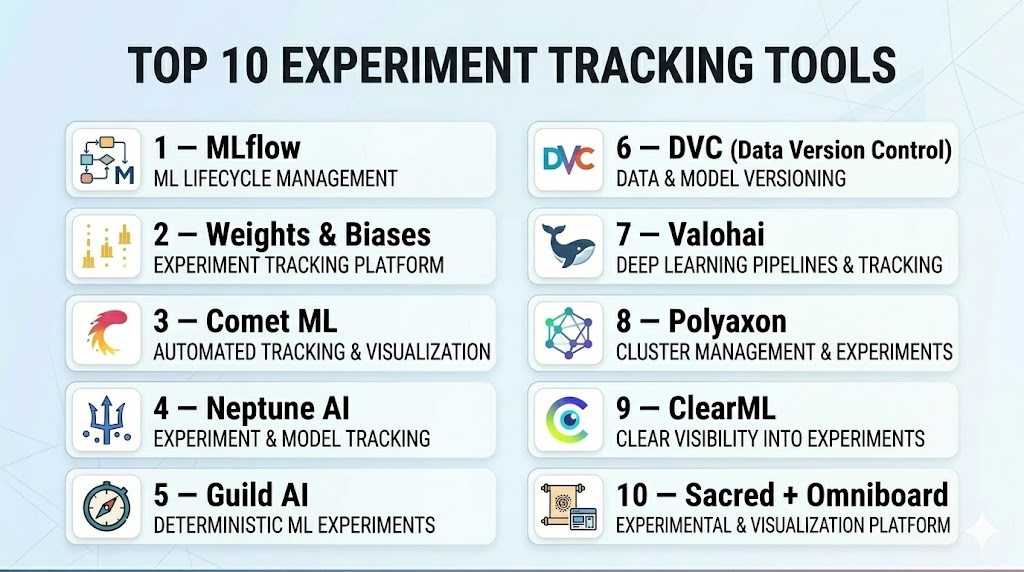
Introduction
Experiment Tracking Tools are specialized platforms that help data science and machine learning teams record, manage, and analyze experiments during model development. They ensure reproducibility, provide visibility into model performance over time, and support collaboration across distributed teams. In , as AI projects grow in complexity, experiment tracking has become critical for maintaining quality, reducing errors, and scaling ML operations efficiently.
Real-world applications include tracking hyperparameter tuning experiments for deep learning models, managing multiple versions of recommendation systems, comparing A/B testing outcomes in predictive analytics, monitoring performance metrics for fraud detection, and documenting feature impacts for production-ready ML pipelines. Buyers evaluating experiment tracking tools should consider:
- Experiment versioning and reproducibility
- Real-time logging of metrics, parameters, and artifacts
- Integration with ML frameworks and MLOps pipelines
- Collaboration and access control features
- Scalability for multiple models and users
- Visualization and reporting dashboards
- Automation of workflow and CI/CD integration
- Security and compliance with enterprise standards
- Ease of adoption and learning curve
- Pricing and support options
Best for: Data scientists, ML engineers, research teams, and enterprises managing multiple models or collaborative AI projects.
Not ideal for: Small-scale experiments or teams with minimal ML activity; for simpler workflows, spreadsheet tracking or lightweight open-source logging may suffice.
Key Trends in Experiment Tracking Tools
- Increased adoption of end-to-end MLOps pipelines integrating experiment tracking
- Real-time tracking and visualization of experiment metrics
- Automated logging of hyperparameters, artifacts, and data versions
- Support for multiple ML frameworks and programming languages
- Collaboration tools for distributed teams with role-based access
- Integration with CI/CD pipelines for automated retraining
- Cloud-native SaaS platforms alongside open-source options
- Experiment reproducibility and audit logging for compliance
- Interactive dashboards and visualization tools for rapid insights
- Pricing flexibility via subscription or pay-as-you-go models
How We Selected These Tools (Methodology)
- Evaluated global adoption, mindshare, and enterprise usage
- Assessed feature completeness, including logging, metrics, and artifact management
- Reviewed reliability, uptime, and performance for production workflows
- Examined security posture, access control, and compliance certifications
- Considered integration with cloud platforms, ML frameworks, and MLOps pipelines
- Analyzed suitability for solo developers, SMBs, mid-market, and enterprise teams
- Reviewed collaboration, reproducibility, and experiment reporting capabilities
- Prioritized active development, community support, and vendor engagement
- Evaluated ease of use, learning curve, and adoption speed
- Balanced open-source flexibility with enterprise-grade features
Top 10 Experiment Tracking Tools
#1 — MLflow
Short description : MLflow is an open-source experiment tracking tool that helps data scientists record and reproduce experiments. It is suitable for teams seeking a flexible, framework-agnostic solution.
Key Features
- Tracking of experiments, metrics, parameters, and artifacts
- Model versioning and reproducibility
- Integration with Python, R, and Java
- REST APIs for automation
- Multi-framework support (TensorFlow, PyTorch, Scikit-learn)
- Deployment pipelines for production models
Pros
- Open-source and free to use
- Flexible and framework-agnostic
- Strong community support
Cons
- Enterprise-grade support requires Databricks
- GUI less polished than some commercial alternatives
- Setup can be complex for beginners
Platforms / Deployment
- Windows / macOS / Linux / Web
- Cloud / Self-hosted / Hybrid
Security & Compliance
- Not publicly stated
Integrations & Ecosystem
- Python, R, Java SDKs
- Spark, TensorFlow, PyTorch integration
- REST APIs for CI/CD pipelines
Support & Community
Active open-source community; Databricks enterprise support available.
#2 — Weights & Biases
Short description : Weights & Biases is a SaaS experiment tracking platform focusing on collaborative workflows, dashboards, and reproducibility. It’s ideal for teams needing visualization-rich tracking.
Key Features
- Experiment logging for metrics, parameters, and artifacts
- Interactive visualization dashboards
- Model versioning and comparison
- Collaboration features for teams
- Integration with Python ML frameworks
- API and SDK for automation
Pros
- Excellent visualization and dashboards
- Supports team collaboration
- Quick setup and adoption
Cons
- Cloud subscription required
- Some advanced features may have a learning curve
- Limited offline deployment
Platforms / Deployment
- Windows / macOS / Linux / Web
- Cloud
Security & Compliance
- SOC 2, GDPR
- Encryption and RBAC
Integrations & Ecosystem
- Python SDK
- TensorFlow, PyTorch, Scikit-learn
- REST APIs for pipelines
Support & Community
Enterprise support; extensive tutorials and documentation.
#3 — Comet ML
Short description : Comet ML tracks experiments, metrics, and code for reproducibility. It is ideal for teams that want a centralized view of experiments with detailed logging.
Key Features
- Experiment tracking and versioning
- Code and dataset logging
- Model performance dashboards
- Collaboration and reporting
- REST APIs and Python SDK
- Integration with CI/CD pipelines
Pros
- Centralized experiment management
- Easy collaboration and reporting
- Framework-agnostic
Cons
- Premium features require subscription
- Cloud-based for full functionality
- Learning curve for advanced features
Platforms / Deployment
- Windows / macOS / Linux / Web
- Cloud / Hybrid
Security & Compliance
- SOC 2, GDPR
- RBAC and encryption
Integrations & Ecosystem
- TensorFlow, PyTorch, Keras
- Jupyter notebooks
- REST API and SDK
Support & Community
Documentation, enterprise support, community forums.
#4 — Neptune AI
Short description : Neptune AI is an experiment tracking tool designed for MLOps teams needing tracking, visualization, and collaboration for multiple experiments.
Key Features
- Logging of experiments, metrics, parameters, and artifacts
- Team collaboration and access control
- Visualization dashboards
- Integration with Python frameworks
- API and SDK for automation
- Multi-model tracking
Pros
- Intuitive interface
- Scalable for multiple experiments
- Collaboration-friendly
Cons
- Cloud subscription required
- Limited on-premise deployment
- Some advanced visualizations require setup
Platforms / Deployment
- Windows / macOS / Linux / Web
- Cloud
Security & Compliance
- SOC 2, GDPR
- Encryption and RBAC
Integrations & Ecosystem
- TensorFlow, PyTorch, Scikit-learn
- Python SDK
- REST API
Support & Community
Enterprise support, tutorials, active community.
#5 — Guild AI
Short description : Guild AI focuses on experiment tracking and reproducibility with lightweight, framework-agnostic workflows. It’s suitable for teams preferring code-first tracking.
Key Features
- Experiment logging for parameters and metrics
- Versioning and reproducibility
- Command-line and Python SDK
- Artifact and dataset tracking
- Lightweight setup
Pros
- Minimal overhead
- Flexible for multiple ML frameworks
- Open-source
Cons
- Less visual than SaaS tools
- Enterprise support limited
- Requires command-line familiarity
Platforms / Deployment
- Windows / macOS / Linux
- Cloud / Self-hosted
Security & Compliance
- Not publicly stated
Integrations & Ecosystem
- Python SDK
- TensorFlow, PyTorch
- REST API
Support & Community
Open-source community; documentation available.
#6 — DVC (Data Version Control)
Short description : DVC is a data-centric experiment tracking and versioning tool, ideal for teams managing datasets, code, and ML pipelines together.
Key Features
- Dataset and code versioning
- Experiment tracking
- Pipeline reproducibility
- Integration with Git and CI/CD
- Remote storage support
- Metrics tracking
Pros
- Open-source and free
- Git-native workflows
- Scalable for large datasets
Cons
- Less visual UI
- Requires Git familiarity
- Limited real-time dashboards
Platforms / Deployment
- Windows / macOS / Linux
- Cloud / Self-hosted
Security & Compliance
- Not publicly stated
Integrations & Ecosystem
- Git, Python
- REST API
- CI/CD pipelines
Support & Community
Active open-source community; tutorials available.
#7 — Valohai
Short description : Valohai is an MLOps platform with built-in experiment tracking, pipeline orchestration, and reproducibility, suitable for production ML workflows.
Key Features
- Experiment tracking
- Pipeline orchestration
- Artifact and model versioning
- API and Python SDK
- Team collaboration
- Cloud and on-prem deployment
Pros
- End-to-end ML lifecycle support
- Enterprise-ready
- Scalable pipelines
Cons
- Premium pricing
- Cloud deployment preferred
- Learning curve for complex workflows
Platforms / Deployment
- Web / Linux
- Cloud / Hybrid
Security & Compliance
- SOC 2, GDPR
- RBAC and encryption
Integrations & Ecosystem
- TensorFlow, PyTorch, Keras
- REST API
- CI/CD integration
Support & Community
Enterprise support, documentation, onboarding guides.
#8 — Polyaxon
Short description : Polyaxon is an open-source platform for experiment tracking, model management, and reproducibility, designed for teams using multiple ML frameworks.
Key Features
- Experiment logging and tracking
- Artifact management
- Pipeline orchestration
- Multi-framework support
- Cloud and on-premise deployment
Pros
- Open-source flexibility
- Scalable for multiple experiments
- Reproducible pipelines
Cons
- Requires infrastructure setup
- Less polished UI
- Enterprise features need configuration
Platforms / Deployment
- Linux / Web
- Cloud / Self-hosted
Security & Compliance
- Not publicly stated
Integrations & Ecosystem
- TensorFlow, PyTorch
- Python SDK
- REST API
Support & Community
Open-source community; documentation and tutorials.
#9 — ClearML
Short description : ClearML is a free and open-source experiment manager and ML orchestration platform with logging, monitoring, and reproducibility.
Key Features
- Experiment tracking and logging
- Pipeline orchestration
- Artifact and model versioning
- Integration with ML frameworks
- Cloud and on-premise support
Pros
- Free and open-source
- Easy integration with pipelines
- Scalable for multiple experiments
Cons
- UI less advanced
- Some enterprise features require paid version
- Documentation can be technical
Platforms / Deployment
- Windows / macOS / Linux / Web
- Cloud / Self-hosted
Security & Compliance
- Not publicly stated
Integrations & Ecosystem
- Python, TensorFlow, PyTorch
- REST APIs
- CI/CD pipelines
Support & Community
Open-source support; optional enterprise support.
#10 — Sacred + Omniboard
Short description : Sacred is an open-source experiment tracking tool with Omniboard for visualization, ideal for researchers and small ML teams.
Key Features
- Experiment parameter and metric tracking
- Logging of artifacts
- Omniboard dashboards
- Multi-framework support
- Lightweight and code-first
Pros
- Free and open-source
- Flexible and minimal overhead
- Easy for code-first workflows
Cons
- Limited enterprise support
- Requires setup and scripting
- Smaller community
Platforms / Deployment
- Windows / macOS / Linux
- Self-hosted
Security & Compliance
- Not publicly stated
Integrations & Ecosystem
- Python SDK
- REST API
- CI/CD integration optional
Support & Community
Open-source documentation; community-driven support.
Comparison Table (Top 10)
| Tool Name | Best For | Platform(s) Supported | Deployment | Standout Feature | Public Rating |
|---|---|---|---|---|---|
| MLflow | Framework-agnostic tracking | Windows/macOS/Linux/Web | Cloud / Self-hosted / Hybrid | Experiment logging & versioning | N/A |
| Weights & Biases | Visualization & collaboration | Windows/macOS/Linux/Web | Cloud | Rich dashboards & collaboration | N/A |
| Comet ML | Centralized logging | Windows/macOS/Linux/Web | Cloud / Hybrid | Centralized experiment management | N/A |
| Neptune AI | Multi-experiment dashboards | Windows/macOS/Linux/Web | Cloud | Team collaboration & visualization | N/A |
| Guild AI | Code-first lightweight tracking | Windows/macOS/Linux | Cloud / Self-hosted | Command-line & Python SDK | N/A |
| DVC | Data-centric versioning | Windows/macOS/Linux | Cloud / Self-hosted | Git-based dataset & experiment tracking | N/A |
| Valohai | Pipeline orchestration | Web / Linux | Cloud / Hybrid | End-to-end ML lifecycle | N/A |
| Polyaxon | Open-source ML workflow | Linux / Web | Cloud / Self-hosted | Experiment & pipeline orchestration | N/A |
| ClearML | Free & open-source tracking | Windows/macOS/Linux/Web | Cloud / Self-hosted | Logging & pipeline orchestration | N/A |
| Sacred + Omniboard | Research-oriented tracking | Windows/macOS/Linux | Self-hosted | Lightweight & code-first tracking | N/A |
Evaluation & Scoring of Experiment Tracking Tools
| Tool Name | Core (25%) | Ease (15%) | Integrations (15%) | Security (10%) | Performance (10%) | Support (10%) | Value (15%) | Weighted Total (0–10) |
|---|---|---|---|---|---|---|---|---|
| MLflow | 9 | 7 | 8 | 6 | 8 | 7 | 8 | 7.8 |
| Weights & Biases | 9 | 8 | 8 | 7 | 8 | 8 | 7 | 8.0 |
| Comet ML | 8 | 8 | 7 | 7 | 8 | 7 | 7 | 7.5 |
| Neptune AI | 8 | 8 | 7 | 7 | 7 | 7 | 7 | 7.4 |
| Guild AI | 7 | 7 | 7 | 6 | 7 | 6 | 8 | 7.1 |
| DVC | 8 | 7 | 7 | 6 | 7 | 6 | 8 | 7.2 |
| Valohai | 9 | 7 | 8 | 7 | 8 | 7 | 7 | 7.8 |
| Polyaxon | 8 | 7 | 7 | 6 | 7 | 6 | 7 | 7.0 |
| ClearML | 8 | 8 | 7 | 6 | 7 | 6 | 8 | 7.3 |
| Sacred + Omniboard | 7 | 7 | 6 | 6 | 6 | 6 | 8 | 6.7 |
These scores provide comparative insights into core features, usability, integration capabilities, security, and enterprise value.
Which Experiment Tracking Tools Tool Is Right for You?
Solo / Freelancer
Guild AI, MLflow, or Sacred are ideal for lightweight, code-first tracking.
SMB
Weights & Biases, Neptune AI, or ClearML provide collaborative dashboards and experiment management for small teams.
Mid-Market
Comet ML, Valohai, or Polyaxon support multiple experiments, CI/CD integration, and team workflows.
Enterprise
Weights & Biases, Neptune AI, Valohai, or MLflow (enterprise) deliver governance, scalability, and enterprise support.
Budget vs Premium
Open-source tools like MLflow, Guild AI, and DVC are cost-effective; SaaS platforms offer premium dashboards, collaboration, and support.
Feature Depth vs Ease of Use
Weights & Biases and Neptune AI focus on usability; Valohai and MLflow (enterprise) offer advanced features and CI/CD integration.
Integrations & Scalability
Cloud-native platforms integrate with MLOps pipelines, ML frameworks, and multi-model workflows for scalable deployment.
Security & Compliance Needs
Enterprise platforms provide encryption, access control, and compliance; open-source tools require configuration.
Frequently Asked Questions (FAQs)
1. What pricing models exist for experiment tracking tools?
Open-source tools are free; SaaS platforms charge subscriptions often based on users and compute usage.
2. How quickly can teams onboard?
SaaS solutions like Weights & Biases or Neptune AI offer guided onboarding; open-source tools require manual setup.
3. Can multiple users track experiments simultaneously?
Yes, role-based access and collaboration features support team workflows in enterprise platforms.
4. Are experiment tracking tools secure?
Enterprise tools provide encryption, RBAC, and compliance; open-source requires custom security setup.
5. Do these tools integrate with ML frameworks?
Yes, they typically support TensorFlow, PyTorch, Keras, and scikit-learn, with SDKs and REST APIs.
6. Can experiment tracking tools integrate with CI/CD?
Yes, many platforms support automation of retraining, deployment, and monitoring through CI/CD pipelines.
7. How scalable are these platforms?
Cloud-native solutions scale horizontally for multiple experiments and large datasets.
8. Do these tools support artifact tracking?
Yes, models, datasets, and logs can be versioned and linked to experiments.
9. Can experiment tracking help with reproducibility?
Absolutely, versioning and logging ensure experiments can be replicated across teams and time.
10. Are there alternatives to dedicated tracking tools?
Notebook-based logging, Git integration, and lightweight CSV/JSON logs can substitute for small teams.
Conclusion
Experiment Tracking Tools have become indispensable for managing complex ML workflows. They ensure reproducibility, support collaboration, and enable teams to monitor experiments and model performance effectively. Open-source solutions like MLflow, DVC, and Guild AI provide cost-effective flexibility, while enterprise SaaS platforms like Weights & Biases, Neptune AI, and Valohai deliver advanced dashboards, team collaboration, and CI/CD integration. Selecting the right platform depends on team size, ML complexity, collaboration needs, and infrastructure. Pilot trials and hands-on evaluation are highly recommended to validate fit and scalability before full-scale adoption.

Find Trusted Cardiac Hospitals
Compare heart hospitals by city and services — all in one place.
Explore Hospitals
Large teams can quickly collect thousands of runs, logs, models, and artifacts, making the tracking system harder and more expensive to manage. Teams should have simple rules for keeping important experiments and archiving or removing unnecessary data. This can keep the system useful without letting storage and management costs grow too much.