Introduction
Age Verification Tools are digital solutions that help businesses confirm whether a user meets the required age threshold before accessing age-restricted products, services, content, or online communities. These tools may use document checks, database verification, facial age estimation, consent workflows, identity verification, or risk-based screening to reduce underage access and support regulatory compliance. age verification has become more important because digital platforms are facing stronger rules around online safety, child protection, adult content, gaming, alcohol, tobacco, financial products, social media, and regulated e-commerce. Businesses now need systems that balance compliance, privacy, user experience, fraud prevention, and global scalability.
Real-world use cases:
- E-commerce stores restricting alcohol, tobacco, or age-controlled products
- Gaming and betting platforms verifying users before account access
- Adult-content platforms managing legal age gates
- Social platforms protecting minors from restricted features
- Fintech or crypto platforms verifying age before onboarding
What buyers should evaluate:
- Verification methods such as ID scan, selfie, database check, or age estimation
- Accuracy and fraud detection capability
- Privacy-first design and data minimization
- Geographic coverage and regulatory flexibility
- API and SDK integration options
- User experience and completion rates
- Security controls, encryption, and audit logs
- Support for web, mobile, and embedded workflows
- Reporting, consent, and compliance documentation
- Pricing model based on volume, verification type, or platform tier
Best for:
Age Verification Tools are best for regulated businesses, marketplaces, gaming companies, social platforms, fintech apps, e-commerce brands, and digital publishers that must restrict access by age and maintain auditable compliance workflows.
Not ideal for:
These tools may not be necessary for small websites with general public content, private internal platforms, or businesses that do not sell restricted products or provide age-sensitive services. In those cases, a basic self-declaration age gate may be enough, though it is weaker than formal verification.
Key Trends in Age Verification Tools
- Privacy-first verification is becoming essential: Businesses are moving toward data minimization, temporary document processing, and privacy-preserving checks to reduce risk while still meeting legal expectations.
- AI-based age estimation is expanding: Facial age estimation is increasingly used where full identity verification is too heavy, especially for quick online access decisions.
- Hybrid verification models are growing: Many platforms combine self-declaration, risk scoring, document checks, database matching, and manual review depending on the user journey.
- Regulatory pressure is increasing: Online safety rules, gambling regulation, alcohol delivery rules, adult content access laws, and youth protection policies are pushing platforms to adopt stronger verification.
- Reusable identity and age credentials are emerging: Some providers are moving toward reusable verification so users do not need to repeatedly upload documents across different platforms.
- API-first deployment is now standard: Modern buyers expect easy integration through APIs, SDKs, hosted flows, webhooks, and low-code checkout or onboarding tools.
- Fraud prevention is becoming part of age checks: Deepfake detection, document fraud analysis, liveness checks, and device-risk signals are increasingly paired with age verification.
- Global coverage is a key differentiator: Businesses operating internationally need tools that support multiple ID types, languages, countries, and compliance requirements.
- User experience matters more than ever: If the verification process is slow or confusing, users abandon checkout, onboarding, or account creation.
- Auditability is becoming a buying requirement: Businesses need logs, reports, decision records, and verification evidence to support compliance reviews and dispute handling.
How We Selected These Tools
- We selected tools that are widely recognized in identity verification, age verification, online safety, fraud prevention, or regulated onboarding.
- We considered feature completeness across document checks, biometric checks, database verification, age estimation, and risk-based verification.
- We prioritized tools that can support digital businesses across web, mobile, e-commerce, gaming, fintech, and marketplace environments.
- We considered integration flexibility, including APIs, SDKs, hosted flows, checkout integrations, and developer documentation.
- We evaluated buyer fit across small businesses, mid-market companies, and enterprise organizations with complex compliance needs.
- We considered security posture signals such as encryption, access control, audit trails, privacy workflows, and data retention controls.
- We avoided guessing public ratings, certifications, or compliance details where they are not confidently known.
- We included a balanced mix of global ID verification platforms, age-specific providers, e-commerce-focused tools, and enterprise-grade identity solutions.
- We considered the ability to scale verification volume while maintaining user experience and operational reliability.
- We reviewed whether each tool can support modern compliance expectations without creating unnecessary friction for users.
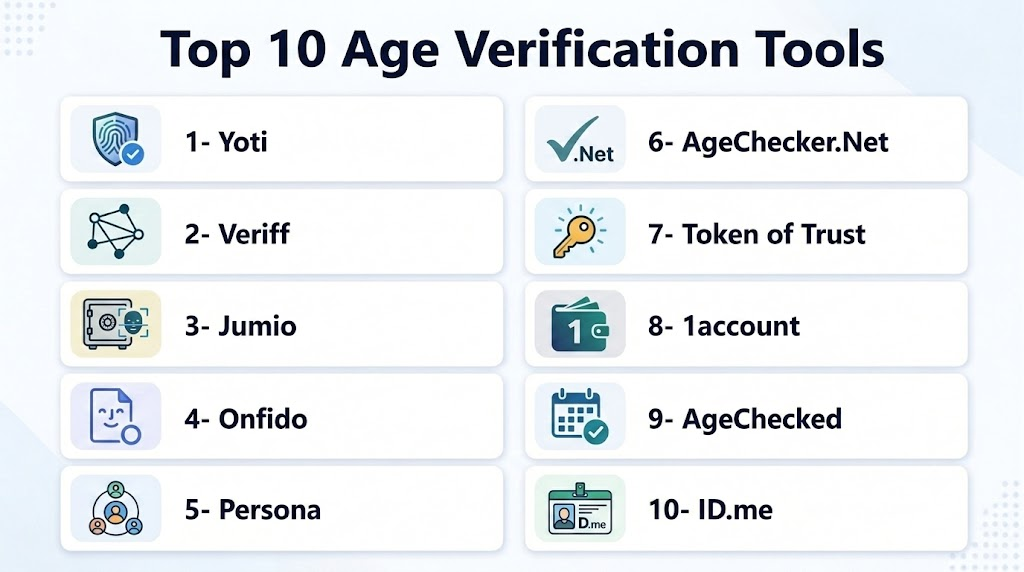
Top 10 Age Verification Tools
1- Yoti
Short description: Yoti provides digital identity and age verification solutions, including age estimation and document-based verification. It is suitable for online safety, retail, gaming, social platforms, and regulated digital services.
Key Features
- Facial age estimation
- Document-based identity verification
- Digital identity app support
- Privacy-focused verification workflows
- API and SDK integration
- Reusable identity verification options
- Age assurance for online and offline use cases
Pros
- Strong focus on privacy and age assurance
- Suitable for both document and non-document verification
- Useful for platforms that want lower-friction age checks
Cons
- Some use cases may require additional identity checks
- Implementation depends on verification method selected
- Pricing and availability may vary by region and volume
Platforms / Deployment
- Web, iOS, Android
- Cloud
- API / SDK-based deployment
Security & Compliance
- Encryption and secure identity workflows
- Privacy-focused data handling
- Specific certifications: Not publicly stated
Integrations & Ecosystem
Yoti integrates into digital platforms through APIs and SDKs, making it suitable for apps, websites, online communities, and regulated access flows.
- Web and mobile apps
- Online safety platforms
- E-commerce and retail workflows
- Gaming and social platforms
- Identity verification pipelines
Support & Community
Yoti provides business support, documentation, and onboarding resources for organizations implementing age assurance. Support depth may vary by product, region, and customer plan.
2- Veriff
Short description: Veriff is an identity verification platform that supports document verification, biometric checks, fraud prevention, and age verification workflows. It is suitable for fintech, marketplaces, gaming, mobility, and regulated platforms.
Key Features
- Government ID document verification
- Selfie and liveness checks
- Age verification through identity documents
- Fraud detection and risk signals
- API and SDK integration
- Global document coverage
- Verification decision workflows
Pros
- Strong identity verification capabilities
- Good fit for high-risk or regulated onboarding
- Scalable for global digital businesses
Cons
- May be more than required for simple age gates
- Document-based flows can add user friction
- Pricing depends on volume and verification needs
Platforms / Deployment
- Web, iOS, Android
- Cloud
- API / SDK-based deployment
Security & Compliance
- Encryption and identity security controls
- Access and workflow controls available
- Specific certifications: Not publicly stated
Integrations & Ecosystem
Veriff is commonly used in onboarding systems where age, identity, and fraud checks are part of the same workflow.
- Fintech onboarding
- Marketplace registration
- Gaming and betting platforms
- Mobile apps
- Risk and compliance systems
Support & Community
Documentation and implementation support are available for development and compliance teams. Enterprise onboarding support may vary depending on plan and use case.
3- Jumio
Short description: Jumio provides identity verification, document authentication, biometric verification, and compliance-focused onboarding. It is suitable for enterprises needing age verification as part of broader KYC or identity checks.
Key Features
- ID document verification
- Biometric selfie verification
- Liveness detection
- Age verification through document checks
- Fraud and risk detection
- API and SDK integration
- Global identity verification coverage
Pros
- Strong enterprise identity verification depth
- Suitable for regulated industries
- Useful for combining age, identity, and fraud checks
Cons
- Can be complex for small businesses
- May create friction for low-risk use cases
- Enterprise pricing may be high for small teams
Platforms / Deployment
- Web, iOS, Android
- Cloud
- API / SDK-based deployment
Security & Compliance
- Secure identity verification workflows
- Encryption and access controls
- Specific certifications: Not publicly stated
Integrations & Ecosystem
Jumio fits into enterprise onboarding and compliance ecosystems where identity verification is central.
- KYC platforms
- Fintech apps
- Gaming and regulated onboarding
- Marketplace verification
- Compliance dashboards
Support & Community
Jumio provides enterprise support, implementation guidance, and documentation. Support depth depends on contract, deployment scope, and verification volume.
4- Onfido
Short description: Onfido provides identity verification and biometric verification tools that can support age checks through document and identity workflows. It is suited for fintech, marketplaces, mobility, gaming, and digital onboarding.
Key Features
- Document verification
- Facial biometric checks
- Liveness detection
- Age verification through ID data
- Fraud signal analysis
- API and SDK integration
- Workflow automation for onboarding
Pros
- Strong digital onboarding experience
- Good balance of automation and review
- Flexible for multiple regulated industries
Cons
- May require technical setup
- Better suited to identity verification than lightweight age gates
- Pricing varies by volume and verification type
Platforms / Deployment
- Web, iOS, Android
- Cloud
- API / SDK-based deployment
Security & Compliance
- Encryption and secure verification flows
- Access control options
- Specific certifications: Not publicly stated
Integrations & Ecosystem
Onfido can be integrated into user onboarding journeys where identity proofing and age verification are needed together.
- Fintech apps
- Marketplaces
- Mobility platforms
- Gaming platforms
- Internal risk systems
Support & Community
Documentation and business onboarding support are available. Implementation support is typically strongest for mid-market and enterprise customers.
5- Persona
Short description: Persona is an identity platform that helps businesses build customizable verification workflows, including age verification through documents, database checks, and risk-based rules. It is suitable for modern digital platforms needing flexible identity orchestration.
Key Features
- Custom identity verification workflows
- Document verification
- Database and risk-based checks
- Age verification through identity data
- Case management and review tools
- API and SDK integrations
- Workflow automation and policy controls
Pros
- Highly configurable verification flows
- Strong for complex onboarding journeys
- Useful for combining age, identity, and fraud controls
Cons
- Configuration may require planning
- Advanced workflows can be complex
- May be more than needed for simple e-commerce age gates
Platforms / Deployment
- Web, iOS, Android
- Cloud
- API / SDK-based deployment
Security & Compliance
- Encryption and access control support
- Audit and workflow governance capabilities
- Specific certifications: Not publicly stated
Integrations & Ecosystem
Persona is commonly used where identity verification must be customized across multiple user segments, countries, and risk levels.
- Marketplaces
- Fintech platforms
- SaaS onboarding
- Gaming and community platforms
- Compliance operations
Support & Community
Persona provides documentation, implementation resources, and customer support. Enterprise support may include workflow design and onboarding assistance.
6- AgeChecker.Net
Short description: AgeChecker.Net is an age verification solution focused on e-commerce and regulated online sales. It is commonly used by businesses selling age-restricted products such as alcohol, vape, tobacco, supplements, and similar categories where legally appropriate.
Key Features
- Age verification for online stores
- Document upload review when needed
- Checkout and account-based verification
- E-commerce integration support
- Manual review workflows
- Customer verification history
- Compliance-oriented age gate support
Pros
- Strong fit for e-commerce use cases
- Easier to deploy than broad identity platforms
- Useful for regulated online product sales
Cons
- Less suited for complex enterprise identity orchestration
- Primarily age verification focused
- Global coverage may vary by region and product category
Platforms / Deployment
- Web
- Cloud
- E-commerce plugin / API-based deployment
Security & Compliance
- Secure document handling workflows
- Access controls may vary by plan
- Specific certifications: Not publicly stated
Integrations & Ecosystem
AgeChecker.Net is best suited for online stores that need age checks during checkout or customer account creation.
- E-commerce platforms
- Checkout flows
- Regulated product stores
- Order management workflows
- Customer verification records
Support & Community
Support and onboarding resources are available for merchants. Support depth may vary depending on store platform, plan, and verification volume.
7- Token of Trust
Short description: Token of Trust provides identity, trust, and age verification tools for platforms that need to verify users, reduce fraud, and manage compliance. It is suitable for marketplaces, communities, e-commerce, and regulated businesses.
Key Features
- Age and identity verification
- Document verification
- Risk and trust scoring
- Workflow customization
- Fraud prevention support
- API and platform integrations
- Review and decision tools
Pros
- Strong fit for trust-driven platforms
- Combines age, identity, and risk signals
- Useful for marketplaces and community platforms
Cons
- May require configuration for specific policies
- Pricing and workflow details vary by use case
- Not always necessary for simple age confirmation
Platforms / Deployment
- Web
- Cloud
- API / integration-based deployment
Security & Compliance
- Secure verification workflows
- Access controls and data handling vary by configuration
- Specific certifications: Not publicly stated
Integrations & Ecosystem
Token of Trust is useful when age verification is part of a broader trust and safety or fraud prevention process.
- Marketplaces
- E-commerce platforms
- Community platforms
- Regulated onboarding
- Fraud prevention workflows
Support & Community
Support is available for business users and implementation teams. Documentation and onboarding resources vary depending on selected deployment model.
8- 1account
Short description: 1account provides age verification and identity verification services for regulated sectors such as online retail, gambling, adult access, and restricted products. It is useful for businesses needing compliance-focused age assurance.
Key Features
- Online age verification
- Identity verification support
- Document and data-based checks
- Reusable verification workflows
- Compliance-oriented access controls
- Business integration options
- Regulated sector support
Pros
- Focused on age-restricted access
- Useful for regulated industries
- Supports multiple verification approaches
Cons
- Regional availability may vary
- Implementation depends on sector requirements
- May not be ideal for general-purpose identity verification
Platforms / Deployment
- Web
- Cloud
- API / integration-based deployment
Security & Compliance
- Secure verification process
- Compliance support for age-restricted use cases
- Specific certifications: Not publicly stated
Integrations & Ecosystem
1account is designed for businesses that need age assurance before allowing access, purchase, or participation.
- Online retail
- Gambling and gaming workflows
- Adult content access gates
- Restricted-product checkout
- Compliance systems
Support & Community
Business support and onboarding guidance are available. Support depth may vary by industry, location, and regulatory requirements.
9- AgeChecked
Short description: AgeChecked provides online age verification services for businesses that need to check customer age before access or purchase. It supports regulated digital services, e-commerce, gaming, and age-restricted content workflows.
Key Features
- Online age verification
- Document and data-based checks
- API integration
- Age-gate support
- Compliance-focused reporting
- User verification workflows
- Merchant and platform support
Pros
- Purpose-built for age verification
- Good fit for regulated online businesses
- Can support access and checkout workflows
Cons
- May be more regional depending on use case
- Less broad than full identity platforms
- Advanced customization may vary
Platforms / Deployment
- Web
- Cloud
- API-based deployment
Security & Compliance
- Secure verification workflow
- Data handling controls vary by configuration
- Specific certifications: Not publicly stated
Integrations & Ecosystem
AgeChecked can be used where businesses need age checks before purchase, access, or account activation.
- E-commerce checkout
- Gaming platforms
- Adult content access systems
- Regulated digital services
- Custom website workflows
Support & Community
Support and implementation guidance are available for business users. Documentation and integration help vary by platform and customer requirements.
10- ID.me
Short description: ID.me provides digital identity verification services, including identity proofing and eligibility verification. It can support age verification where businesses need reliable identity-based checks for regulated access or user onboarding.
Key Features
- Digital identity verification
- Document and selfie verification
- Eligibility verification workflows
- Reusable identity account model
- Fraud prevention signals
- API and integration support
- Secure user verification experience
Pros
- Strong digital identity ecosystem
- Useful for regulated access and eligibility workflows
- Reusable verification can reduce repeat friction
Cons
- May be more identity-focused than age-specific
- Not ideal for simple website age gates
- Implementation can be heavier for small businesses
Platforms / Deployment
- Web, iOS, Android
- Cloud
- API / integration-based deployment
Security & Compliance
- Secure identity verification workflows
- Encryption and identity controls
- Specific certifications: Not publicly stated
Integrations & Ecosystem
ID.me is useful for organizations that need verified identity, eligibility, or age-related access controls as part of onboarding.
- Government and public-sector workflows
- E-commerce and regulated access
- Healthcare and benefits ecosystems
- Account verification
- Identity-based access systems
Support & Community
Support resources are available for users and business customers. Enterprise support depends on contract, integration complexity, and deployment scope.
Comparison Table
| Tool Name | Best For | Platform(s) Supported | Deployment | Standout Feature | Public Rating |
|---|---|---|---|---|---|
| Yoti | Privacy-focused age assurance | Web, iOS, Android | Cloud | Facial age estimation | N/A |
| Veriff | Global identity and age verification | Web, iOS, Android | Cloud | ID and liveness checks | N/A |
| Jumio | Enterprise identity verification | Web, iOS, Android | Cloud | Document and biometric checks | N/A |
| Onfido | Digital onboarding | Web, iOS, Android | Cloud | Automated identity checks | N/A |
| Persona | Custom verification workflows | Web, iOS, Android | Cloud | Flexible policy orchestration | N/A |
| AgeChecker.Net | E-commerce age checks | Web | Cloud | Checkout age verification | N/A |
| Token of Trust | Trust and risk workflows | Web | Cloud | Age plus risk scoring | N/A |
| 1account | Regulated sector access | Web | Cloud | Age assurance workflows | N/A |
| AgeChecked | Online age-restricted access | Web | Cloud | Purpose-built age verification | N/A |
| ID.me | Reusable digital identity | Web, iOS, Android | Cloud | Verified identity network | N/A |
Evaluation & Scoring of Age Verification Tools
| Tool Name | Core (25%) | Ease (15%) | Integrations (15%) | Security (10%) | Performance (10%) | Support (10%) | Value (15%) | Weighted Total |
|---|---|---|---|---|---|---|---|---|
| Yoti | 9 | 8 | 8 | 9 | 8 | 8 | 8 | 8.3 |
| Veriff | 9 | 8 | 9 | 9 | 9 | 8 | 8 | 8.6 |
| Jumio | 10 | 7 | 9 | 9 | 9 | 9 | 7 | 8.6 |
| Onfido | 9 | 8 | 9 | 9 | 9 | 8 | 8 | 8.6 |
| Persona | 9 | 8 | 10 | 9 | 9 | 8 | 8 | 8.7 |
| AgeChecker.Net | 8 | 9 | 8 | 8 | 8 | 8 | 9 | 8.3 |
| Token of Trust | 8 | 8 | 8 | 8 | 8 | 8 | 8 | 8.0 |
| 1account | 8 | 8 | 8 | 8 | 8 | 8 | 8 | 8.0 |
| AgeChecked | 8 | 8 | 8 | 8 | 8 | 8 | 8 | 8.0 |
| ID.me | 9 | 7 | 8 | 9 | 9 | 8 | 7 | 8.1 |
Which Age Verification Tool Is Right for You?
Solo / Freelancer
Small website owners or solo merchants should start with simple age-focused tools such as AgeChecker.Net, AgeChecked, or basic e-commerce age verification integrations. These options are easier to deploy than full identity platforms and are more suitable when the main need is checkout or access-based age confirmation.
SMB
Small and mid-sized businesses selling regulated products should consider AgeChecker.Net, Token of Trust, 1account, or Yoti. These tools provide stronger verification than simple age gates while still being manageable for lean teams. SMB buyers should prioritize easy setup, checkout compatibility, and low-friction verification.
Mid-Market
Mid-market companies with growing traffic should evaluate Yoti, Veriff, Onfido, Persona, and Token of Trust. These platforms offer more flexible verification flows, better integration options, and stronger risk controls. They are suitable for businesses that need to verify age across multiple customer journeys or regions.
Enterprise
Enterprise teams should consider Persona, Jumio, Veriff, Onfido, ID.me, and Yoti depending on verification depth and compliance needs. These platforms are more suitable for global operations, high-volume onboarding, fraud prevention, auditability, and complex identity workflows. Enterprise buyers should involve legal, compliance, product, and security teams during evaluation.
Budget vs Premium
Budget-conscious teams should look at age-focused tools that fit directly into checkout or website access workflows. Premium buyers should evaluate broader identity platforms that combine age verification, fraud prevention, biometric checks, and workflow orchestration. The best choice depends on whether the business needs only age confirmation or full identity assurance.
Feature Depth vs Ease of Use
For ease of use, AgeChecker.Net, AgeChecked, and 1account may be better starting points. For deeper identity verification, Persona, Veriff, Jumio, and Onfido offer stronger customization and risk control. Businesses should avoid overbuilding if a lightweight compliance workflow is enough.
Integrations & Scalability
API-first tools such as Persona, Veriff, Onfido, Jumio, and Yoti are stronger for scalable platforms and custom apps. E-commerce-focused tools are better for merchants that want fast checkout integration. Large businesses should test webhooks, SDKs, error handling, and verification fallback paths before rollout.
Security & Compliance Needs
Security-sensitive businesses should prioritize encryption, access controls, audit logs, privacy controls, and clear data retention policies. Certifications and legal claims should always be verified directly with the vendor. Age verification is not only a technical feature; it must align with the business’s regulatory obligations and privacy commitments.
Frequently Asked Questions
1. What are Age Verification Tools?
Age Verification Tools help businesses confirm whether a user meets the minimum age requirement for a product, service, or platform. They may use ID documents, selfies, database checks, age estimation, or consent workflows. These tools are commonly used in regulated industries and age-sensitive digital services.
2. Why do businesses need age verification?
Businesses need age verification to reduce underage access, meet regulatory expectations, and protect users from age-restricted products or content. It also helps reduce legal, financial, and reputational risk. For regulated sectors, a basic checkbox age gate may not be enough.
3. How do Age Verification Tools work?
They usually verify age through government ID checks, database records, selfie matching, facial age estimation, or risk-based workflows. Some tools check age only, while others verify full identity. The right method depends on risk level, regulation, and user experience needs.
4. Are Age Verification Tools accurate?
Accuracy depends on the verification method and provider. Document-based checks are generally stronger for formal identity verification, while age estimation can be faster and more privacy-friendly. Businesses should test accuracy with real users before final rollout.
5. Are these tools expensive?
Pricing varies based on verification volume, method, country coverage, and support level. Lightweight age-check tools may be more affordable for small stores, while enterprise identity platforms can cost more. Buyers should compare cost with compliance risk and user conversion impact.
6. Can Age Verification Tools integrate with websites and apps?
Yes, most modern tools offer APIs, SDKs, hosted flows, plugins, or checkout integrations. E-commerce tools are often easier to deploy, while enterprise identity platforms may need developer resources. Integration testing is important before launching to all users.
7. Do these tools protect user privacy?
Many providers offer privacy-focused workflows, but privacy depends on data collection, retention, storage, and processing practices. Businesses should review data minimization, deletion options, consent flows, and vendor security controls. Privacy should be a key buying criterion.
8. What is the biggest mistake when choosing an Age Verification Tool?
The biggest mistake is choosing a tool only for compliance claims without testing user experience and verification accuracy. A tool that causes too much friction can reduce conversions. A weak tool can increase compliance risk. A pilot helps balance both.
9. Can age verification be done without collecting ID documents?
Yes, some tools use facial age estimation, database checks, reusable credentials, or verified digital identity methods. These approaches can reduce friction and improve privacy. However, some regulations or business risks may still require stronger document-based verification.
10. What are alternatives to Age Verification Tools?
Alternatives include self-declaration age gates, manual document review, payment-card checks, parental consent flows, or platform-level access controls. These may work for low-risk situations but can be weaker for regulated products or high-risk content. Stronger verification is usually needed when legal exposure is high.
Conclusion
Age Verification Tools are becoming essential for businesses that manage age-restricted products, content, services, or communities because they help reduce underage access, support compliance, and protect brand trust. The best tool depends on your industry, risk level, geography, user experience goals, and technical environment. E-commerce merchants may prefer simple checkout-based age verification, while gaming, fintech, adult content, and marketplace platforms may need stronger identity verification, fraud detection, and audit workflows. A practical next step is to shortlist 2–3 tools, test them with real users, compare completion rates and verification accuracy, review privacy and security controls, and validate integrations before full deployment.

Find Trusted Cardiac Hospitals
Compare heart hospitals by city and services — all in one place.
Explore Hospitals
Age verification tools are most valuable when they provide accurate identity checks while maintaining a smooth user experience. By combining secure verification methods, privacy protection, and compliance support, these platforms help businesses meet regulatory requirements, reduce access risks, and build safer digital environments.