Introduction
Capital Project Management Software (CPMS) is designed to streamline the planning, execution, and monitoring of large-scale capital projects such as infrastructure development, manufacturing facilities, and energy installations. These platforms provide end-to-end visibility, connecting project teams, stakeholders, budgets, schedules, and compliance requirements within a centralized system. CPMS has become critical due to increased project complexity, digital transformation demands, and the integration of AI-driven insights for predictive planning and risk mitigation.
Real-world use cases include:
- Planning and budgeting for multi-site infrastructure projects.
- Tracking construction milestones and contractor performance.
- Managing procurement, vendor contracts, and compliance documentation.
- Forecasting project risks and mitigating delays using predictive analytics.
- Coordinating cross-functional teams across geographies and time zones.
Evaluation Criteria for Buyers:
- Core project planning and scheduling features.
- Budgeting, cost tracking, and financial integration.
- Risk management and compliance capabilities.
- Ease of use and intuitive dashboards.
- Integration with ERP, procurement, and collaboration tools.
- Cloud or hybrid deployment options.
- Security, encryption, and audit trails.
- Performance and reliability for large-scale projects.
- Support and training ecosystem.
- Scalability for enterprise-grade or multi-project portfolios.
Best for: Project managers, construction firms, manufacturing companies, energy sector enterprises, and infrastructure developers. Particularly valuable for organizations managing multiple large-scale projects simultaneously.
Not ideal for: Small teams or businesses managing limited, low-budget projects where simple project management tools suffice. Alternative lightweight platforms may offer more cost-effective solutions for low-complexity work.
Key Trends in Capital Project Management Software
- AI-driven project forecasting for schedule and cost optimization.
- Predictive risk management leveraging historical data and real-time monitoring.
- Cloud-first deployment with hybrid support for on-premises integrations.
- Enhanced collaboration tools including real-time dashboards and mobile apps.
- Integration with ERP and financial systems for automated cost tracking.
- Sustainability and ESG tracking integrated into project lifecycle management.
- Digital twins and 3D modeling for construction and infrastructure planning.
- Automated compliance and documentation management to meet regulatory requirements.
- Flexible pricing models including subscription, pay-per-project, and enterprise licenses.
- Improved performance analytics with KPIs and customizable reporting.
How We Selected These Tools (Methodology)
- Evaluated market adoption and overall brand presence.
- Assessed feature completeness for project planning, cost tracking, and risk management.
- Considered performance and reliability signals from enterprise deployments.
- Examined security posture including encryption, authentication, and compliance.
- Analyzed integration capabilities with ERP, procurement, and collaboration platforms.
- Reviewed customer fit across small, mid-market, and enterprise segments.
- Considered vendor support, training, and community engagement.
- Factored in innovation, AI-driven analytics, and roadmap relevance for 2026+.
- Checked deployment flexibility: cloud, on-prem, hybrid.
- Cross-referenced multiple reviews and client case studies for practical usability.
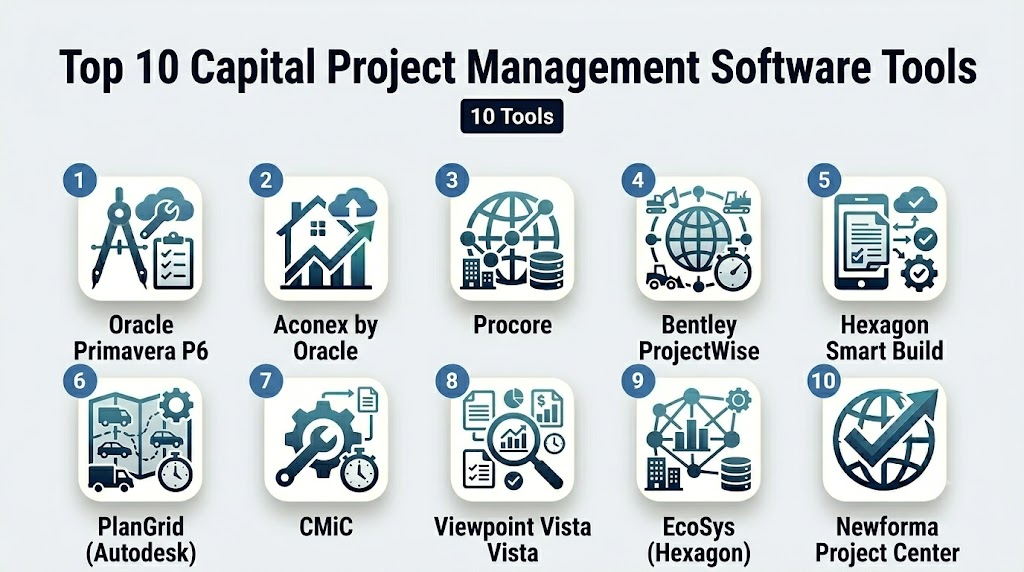
Top 10 Capital Project Management Software Tools
1- Oracle Primavera P6
Short description: Enterprise-grade project and portfolio management tool designed for large-scale capital projects, ideal for construction, energy, and infrastructure enterprises.
Key Features
- Advanced scheduling and resource optimization.
- Portfolio management with multi-project visibility.
- Cost tracking and financial integration.
- Risk and issue management.
- Reporting dashboards and analytics.
- Mobile access for field teams.
Pros
- Robust scalability for mega projects.
- Extensive integration with ERP and financial systems.
Cons
- Steep learning curve for new users.
- High licensing costs.
Platforms / Deployment
- Windows, Web, Mobile
- Cloud / On-premises / Hybrid
Security & Compliance
- SSO/SAML, MFA, encryption, RBAC
- SOC 2, ISO 27001, GDPR
Integrations & Ecosystem
Enterprise-focused integrations and API support.
- Oracle ERP Cloud
- AutoCAD and BIM platforms
- Microsoft Project
- Custom API endpoints
Support & Community
- Comprehensive documentation, training programs, enterprise support tiers
- Strong global user community
2- Aconex by Oracle
Short description: Cloud-based capital project management platform for collaboration, document control, and project communication across large construction and engineering projects.
Key Features
- Centralized document management.
- Workflow automation and approval tracking.
- Subcontractor and vendor communication.
- Audit trail and compliance reporting.
- Mobile access for project teams.
Pros
- Cloud-first approach reduces IT overhead.
- Excellent for document-heavy projects.
Cons
- Limited offline functionality.
- Cost may be high for small projects.
Platforms / Deployment
- Web, iOS, Android
- Cloud
Security & Compliance
- SOC 2, ISO 27001, GDPR
- Encryption, RBAC, audit logs
Integrations & Ecosystem
- BIM and CAD integration
- ERP systems (SAP, Oracle)
- API for custom integrations
Support & Community
- 24/7 support, online resources, training modules
- Moderate community presence
3- Procore
Short description: Modern construction-focused CPMS offering project management, budgeting, and field collaboration for enterprises and mid-size contractors.
Key Features
- Project scheduling and task management.
- Budget tracking and cost forecasting.
- Document and drawing management.
- Field reporting and mobile app.
- Customizable dashboards and reports.
Pros
- User-friendly interface.
- Strong mobile functionality for field teams.
Cons
- Limited portfolio-level analytics compared to enterprise-only tools.
- Pricing scales with user count and project complexity.
Platforms / Deployment
- Web, iOS, Android
- Cloud
Security & Compliance
- SSO, MFA, encryption, audit logs
- SOC 2, ISO 27001
Integrations & Ecosystem
Extensive integrations with collaboration and financial tools.
- Sage, QuickBooks
- BIM 360
- Microsoft Office
- Custom API integrations
Support & Community
- Online documentation, training webinars, responsive support
- Active user community forums
4- Bentley ProjectWise
Short description: CPMS for engineering and infrastructure projects focusing on document management, workflow control, and collaborative design processes.
Key Features
- Document control and versioning.
- Workflow automation and approvals.
- Integrated BIM and CAD support.
- Audit and compliance tracking.
- Cloud and hybrid deployment options.
Pros
- Strong engineering design collaboration.
- Supports complex infrastructure projects.
Cons
- Interface may be complex for non-engineering users.
- Requires specialized training.
Platforms / Deployment
- Windows, Web
- Cloud / Hybrid
Security & Compliance
- Encryption, audit logs, RBAC
- Not publicly stated for certifications
Integrations & Ecosystem
- BIM 360, AutoCAD, Revit
- ERP connectors
- APIs for custom workflows
Support & Community
- Professional training programs, enterprise support
- Moderate community forums
5- Hexagon Smart Build
Short description: Integrated platform for capital project management in construction, engineering, and industrial projects with emphasis on digital workflows.
Key Features
- Scheduling and project planning.
- Cost and resource tracking.
- Document management.
- Risk and issue tracking.
- Mobile field apps.
Pros
- Strong workflow automation.
- Integrates with design and BIM tools.
Cons
- Less known in North American mid-market.
- Limited native financial analytics.
Platforms / Deployment
- Web, Mobile
- Cloud / Hybrid
Security & Compliance
- Encryption, SSO, audit logs
- Not publicly stated for certifications
Integrations & Ecosystem
- CAD/BIM platforms
- ERP integrations
- API-based extensibility
Support & Community
- Enterprise support tiers, knowledge base
- Limited user forums
6- PlanGrid (Autodesk)
Short description: Mobile-first construction project management solution for field data, blueprints, and project collaboration.
Key Features
- Blueprint management and markups.
- Task tracking and field reports.
- Issue and punch list management.
- Offline access and mobile synchronization.
- Integration with Autodesk design suite.
Pros
- Excellent for field teams.
- Simple onboarding for mobile users.
Cons
- Less robust for enterprise portfolio management.
- Limited advanced analytics.
Platforms / Deployment
- Web, iOS, Android
- Cloud
Security & Compliance
- Encryption, SSO
- SOC 2, ISO 27001
Integrations & Ecosystem
- Autodesk suite
- BIM 360
- API for custom integrations
Support & Community
- Online support, documentation, training
- Active user community
7- CMiC
Short description: End-to-end construction enterprise platform with project management, financials, and field productivity modules.
Key Features
- Project scheduling and cost management.
- Financial management and procurement.
- Field collaboration tools.
- Mobile data collection and reporting.
- Risk and compliance management.
Pros
- Strong integration of financials with project management.
- Cloud and hybrid deployment flexibility.
Cons
- Complex configuration may be needed.
- Learning curve for new users.
Platforms / Deployment
- Web, Windows, iOS, Android
- Cloud / Hybrid
Security & Compliance
- Encryption, SSO
- Not publicly stated for certifications
Integrations & Ecosystem
- ERP and accounting software
- BIM and design platforms
- Custom API support
Support & Community
- Dedicated enterprise support, training modules
- Moderate community
8- Viewpoint Vista
Short description: Comprehensive construction ERP and project management solution focusing on financials, project controls, and operations.
Key Features
- Project scheduling and cost tracking.
- Contract and procurement management.
- Document and workflow management.
- Mobile field reporting.
- Integration with accounting and ERP systems.
Pros
- Strong finance and ERP alignment.
- Scalable for large projects.
Cons
- Less intuitive interface for non-finance users.
- Requires training for advanced features.
Platforms / Deployment
- Web, Windows
- Cloud / On-premises
Security & Compliance
- Encryption, audit logs
- Not publicly stated for certifications
Integrations & Ecosystem
- ERP systems
- BIM platforms
- APIs for workflow automation
Support & Community
- Enterprise support tiers, training programs
- Moderate user community
9- EcoSys (Hexagon)
Short description: Enterprise project performance platform for budgeting, forecasting, and reporting of capital projects across multiple portfolios.
Key Features
- Portfolio and program management.
- Budgeting, forecasting, and cost tracking.
- Risk and change management.
- Dashboards and analytics.
- Integration with ERP and financial systems.
Pros
- Robust analytics and reporting.
- Supports multi-project portfolios.
Cons
- Implementation can be lengthy.
- User interface may feel dated.
Platforms / Deployment
- Web, Windows
- Cloud / On-premises
Security & Compliance
- SSO, encryption, audit logs
- Not publicly stated for certifications
Integrations & Ecosystem
- ERP systems (SAP, Oracle)
- BIM tools
- APIs and connectors
Support & Community
- Enterprise support, training
- Moderate community presence
10- Newforma Project Center
Short description: Focused on project information management for design and construction teams to centralize documents, emails, and workflows.
Key Features
- Document and email management.
- Workflow and task tracking.
- Collaboration across teams.
- Reporting dashboards.
- Mobile and desktop access.
Pros
- Centralizes project communications effectively.
- Supports engineering and design collaboration.
Cons
- Limited advanced scheduling features.
- Less suited for financial management.
Platforms / Deployment
- Windows, Web
- Cloud / On-premises
Security & Compliance
- Encryption, SSO
- Not publicly stated for certifications
Integrations & Ecosystem
- CAD/BIM software
- ERP systems
- API support for automation
Support & Community
- Online documentation, support tiers
- Moderate community
Comparison Table (Top 10)
| Tool Name | Best For | Platform(s) Supported | Deployment | Standout Feature | Public Rating |
|---|---|---|---|---|---|
| Oracle Primavera P6 | Mega projects, enterprises | Windows, Web, Mobile | Cloud/On-prem/Hybrid | Advanced scheduling & resource optimization | N/A |
| Aconex by Oracle | Document-heavy construction projects | Web, iOS, Android | Cloud | Document control & workflow automation | N/A |
| Procore | Construction mid-size to enterprise | Web, iOS, Android | Cloud | Field collaboration & mobile apps | N/A |
| Bentley ProjectWise | Engineering & infrastructure projects | Windows, Web | Cloud / Hybrid | BIM & CAD collaboration | N/A |
| Hexagon Smart Build | Industrial & construction projects | Web, Mobile | Cloud / Hybrid | Workflow automation | N/A |
| PlanGrid (Autodesk) | Field teams in construction | Web, iOS, Android | Cloud | Mobile-first blueprint management | N/A |
| CMiC | Enterprise construction projects | Web, Windows, iOS, Android | Cloud / Hybrid | Integration of financials with PM | N/A |
| Viewpoint Vista | Construction ERP alignment | Web, Windows | Cloud / On-prem | Finance and project controls | N/A |
| EcoSys | Multi-project portfolio management | Web, Windows | Cloud / On-prem | Analytics & budgeting | N/A |
| Newforma Project Center | Design & engineering collaboration | Windows, Web | Cloud / On-prem | Centralized project communications | N/A |
Evaluation & Scoring of Capital Project Management Software
| Tool Name | Core (25%) | Ease (15%) | Integrations (15%) | Security (10%) | Performance (10%) | Support (10%) | Value (15%) | Weighted Total (0–10) |
|---|---|---|---|---|---|---|---|---|
| Oracle Primavera P6 | 10 | 7 | 9 | 9 | 9 | 8 | 7 | 8.85 |
| Aconex by Oracle | 8 | 8 | 8 | 9 | 8 | 7 | 6 | 7.85 |
| Procore | 9 | 9 | 8 | 8 | 9 | 8 | 8 | 8.70 |
| Bentley ProjectWise | 8 | 7 | 7 | 8 | 8 | 7 | 7 | 7.60 |
| Hexagon Smart Build | 8 | 8 | 7 | 8 | 8 | 7 | 7 | 7.65 |
| PlanGrid (Autodesk) | 7 | 9 | 6 | 8 | 8 | 7 | 7 | 7.50 |
| CMiC | 8 | 7 | 7 | 8 | 8 | 7 | 7 | 7.55 |
| Viewpoint Vista | 8 | 7 | 7 | 8 | 8 | 7 | 7 | 7.55 |
| EcoSys | 9 | 7 | 8 | 8 | 8 | 7 | 7 | 7.95 |
| Newforma Project Center | 7 | 8 | 7 | 8 | 7 | 7 | 7 | 7.40 |
Which Capital Project Management Tool Is Right for You?
Solo / Freelancer
- Lightweight tools like PlanGrid or Procore mobile modules are sufficient for small-scale projects or individual contractors.
SMB
- Procore, Hexagon Smart Build, and CMiC provide robust features without overwhelming complexity.
Mid-Market
- EcoSys and CMiC balance analytics, budgeting, and portfolio management for mid-size enterprises.
Enterprise
- Oracle Primavera P6, Aconex, and Bentley ProjectWise are ideal for multi-billion-dollar capital programs requiring advanced scheduling, compliance, and integration.
Budget vs Premium
- Budget-conscious projects may prioritize PlanGrid or Procore.
- Premium tools like Primavera P6 or EcoSys provide deeper analytics, multi-project portfolio management, and advanced risk forecasting.
Feature Depth vs Ease of Use
- Tools like Procore and PlanGrid emphasize ease of use.
- Enterprise-grade tools like Primavera P6 and Bentley ProjectWise offer depth at the cost of a steeper learning curve.
Integrations & Scalability
- For organizations with existing ERP and CAD ecosystems, Primavera P6, CMiC, and EcoSys offer the most seamless integration.
- SMBs may rely on cloud-native solutions with simple API connectivity.
Security & Compliance Needs
- Large-scale infrastructure projects require SOC 2, ISO 27001, and GDPR-compliant solutions. Primavera P6, Procore, and Aconex meet these expectations.
Frequently Asked Questions (FAQs)
1- What is the typical pricing model for Capital Project Management Software?
Pricing usually varies: subscription-based SaaS, per-user licenses, or enterprise licenses. Costs depend on project size, feature set, and deployment mode.
2- How long does implementation take?
Implementation ranges from a few weeks for cloud tools to several months for enterprise platforms with extensive configuration.
3- Can small teams use these tools effectively?
Yes, tools like PlanGrid and Procore are optimized for small to mid-size teams, though enterprise-grade features may be underutilized.
4- Are these platforms secure?
Most enterprise tools support SSO, MFA, encryption, and audit logging. Compliance certifications vary by vendor.
5- How do these tools integrate with ERP systems?
Leading CPMS platforms offer prebuilt integrations or APIs for ERP systems like SAP, Oracle, or QuickBooks to align project and financial data.
6- Can I manage multiple projects from one platform?
Enterprise-grade solutions like Primavera P6, EcoSys, and CMiC offer portfolio and multi-project management, while smaller tools may focus on single-project tracking.
7- What are common mistakes when adopting CPMS?
Common pitfalls include underestimating training needs, choosing overly complex tools for small teams, and failing to align workflows across departments.
8- Can field teams access project data remotely?
Yes, mobile apps and web dashboards allow real-time access for field teams, with
offline synchronization in tools like PlanGrid and Procore.
9- Is AI functionality common in CPMS?
Increasingly, tools incorporate AI for predictive scheduling, cost forecasting, and risk management, particularly in enterprise-grade solutions.
10- How do I switch from one CPMS to another?
Migrating data requires careful planning, export/import of project documents, and validating workflow continuity. Some vendors provide migration support services.
Conclusion
Capital Project Management Software is essential for organizations managing complex, large-scale capital projects. Selection depends on project size, team structure, budget, and desired feature depth. Solo practitioners may opt for lightweight solutions like PlanGrid, SMBs for Procore or Hexagon Smart Build, while enterprises benefit from Primavera P6, Aconex, or EcoSys. Key considerations include ease of use, integration with existing systems, security compliance, and support ecosystem. The recommended next step is to shortlist 2–3 tools aligned with your organizational needs, run pilot projects, and validate integration, reporting, and security requirements before full-scale adoption.

Find Trusted Cardiac Hospitals
Compare heart hospitals by city and services — all in one place.
Explore Hospitals
This was a helpful read. I am exploring this topic and learned something new from this blog.