Introduction
Clinical Terminology Management Tools are specialized software platforms that help healthcare and life sciences organizations standardize, manage, and map clinical terminologies, vocabularies, and ontologies such as SNOMED CT, LOINC, ICD-10, and MedDRA. These tools ensure consistent data capture, accurate reporting, and semantic interoperability across clinical trials, EHR systems, and regulatory submissions. clinical data is increasingly complex, originating from multi-site trials, electronic health records, and real-world evidence sources. Standardizing terminologies is critical for data quality, regulatory compliance, and AI-driven analytics. These tools help reduce errors, facilitate cross-study comparisons, and improve data aggregation and reporting.
Real-world use cases include:
- Mapping clinical trial data to regulatory standards.
- Harmonizing adverse event reporting using MedDRA and SNOMED CT.
- Standardizing laboratory and lab test results across multiple sites with LOINC.
- Facilitating semantic interoperability between EHR, CDMS, and data warehouses.
- Supporting AI and analytics initiatives with consistent coded clinical data.
Evaluation criteria for buyers:
- Supported terminology standards (SNOMED, LOINC, ICD, MedDRA)
- Data mapping and crosswalk functionality
- Version control and governance workflows
- Integration with CDMS, EHR, and regulatory platforms
- Reporting and analytics capabilities
- Scalability across sites and studies
- Security and access control standards
- User interface and ease of adoption
- AI-assisted code suggestion or validation
- Vendor support and regulatory alignment
Best for: Clinical data managers, regulatory affairs professionals, life sciences organizations, hospitals, and CROs managing multi-site studies.
Not ideal for: Organizations with limited clinical trial activity or those relying on legacy manual coding processes.
Key Trends in Clinical Terminology Management Tools
- AI-assisted term mapping and validation for faster, accurate coding.
- Cloud-based platforms supporting global multi-site deployments.
- Integration with EHR, CDMS, and data warehouses for interoperability.
- Automated version control and terminology governance.
- Semantic enrichment to support AI and predictive analytics.
- Cross-standard mapping for multi-ontology compliance (SNOMED ↔ MedDRA ↔ ICD).
- Role-based access control and audit logs for regulatory compliance.
- Collaborative workflows for clinical and data management teams.
- Support for real-world evidence data standardization.
- Subscription-based SaaS models for scalable adoption.
How We Selected These Tools (Methodology)
- Evaluated market adoption and recognition in life sciences and clinical trials.
- Assessed feature completeness for terminology mapping, crosswalks, and governance.
- Verified reliability and performance in real-world multi-site deployments.
- Checked security and compliance standards including encryption, RBAC, and audit logs.
- Considered integration capabilities with EHR, CDMS, analytics, and regulatory systems.
- Measured fit for SMB, mid-market, and enterprise organizations.
- Reviewed AI capabilities for automated coding suggestions and term validation.
- Evaluated scalability and support for multi-site clinical studies.
- Analyzed reporting, analytics, and governance features.
- Reviewed vendor support and documentation quality.
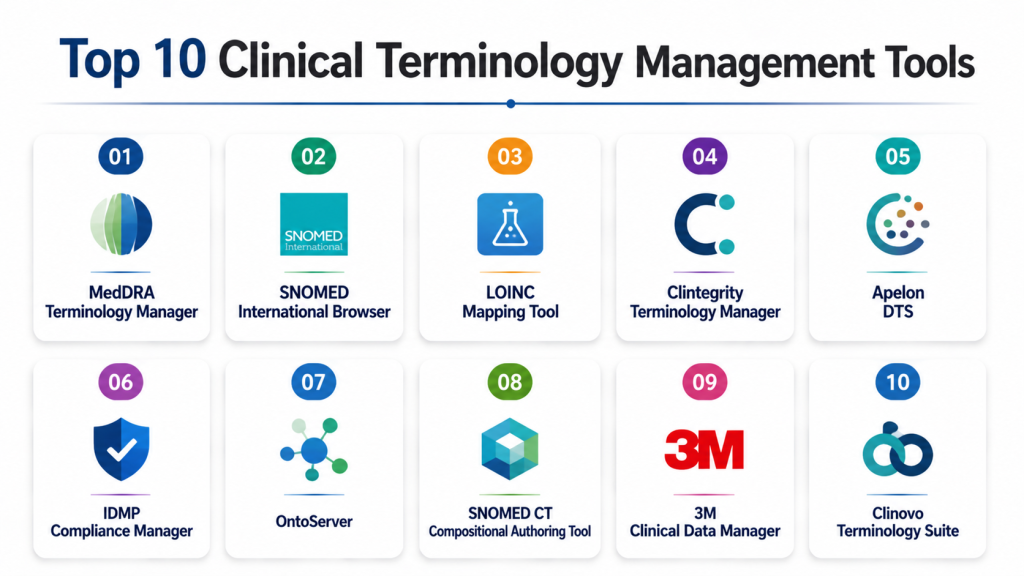
Top 10 Clinical Terminology Management Tools
1- MedDRA Terminology Manager
Short description: Cloud-based tool for managing MedDRA terminologies and supporting adverse event coding in clinical trials.
Key Features
- Adverse event coding with MedDRA
- Cross-version mapping and governance
- Role-based access control
- Integration with CDMS and EHR systems
- Audit logs and compliance reporting
Pros
- Reduces coding errors
- Streamlines AE reporting
- Supports regulatory submissions
Cons
- Focused primarily on MedDRA
- Premium licensing costs
- Learning curve for new users
Platforms / Deployment
- Web
- Cloud
Security & Compliance
- Encryption, audit logs, RBAC
- Not publicly stated
Integrations & Ecosystem
- CDMS integration
- EHR mapping
- Reporting APIs
- Collaboration modules
Support & Community
Varies / Not publicly stated
2- SNOMED International Browser
Short description: Official SNOMED CT management platform for viewing, mapping, and managing clinical terminologies.
Key Features
- SNOMED CT browsing and search
- Mapping and crosswalk to other ontologies
- Version and release management
- Collaborative terminology management
- Integration APIs
Pros
- Authoritative SNOMED support
- Multi-language term browsing
- Cross-standard mapping
Cons
- Limited workflow automation
- Requires external tools for advanced analytics
- Cloud deployment only
Platforms / Deployment
- Web
- Cloud
Security & Compliance
- Encryption, access control
- Not publicly stated
Integrations & Ecosystem
- EHR integration
- CDMS mapping tools
- API for clinical data pipelines
Support & Community
Documentation and community forums.
3- LOINC Mapping Tool
Short description: Specialized tool for laboratory test standardization and mapping to LOINC codes.
Key Features
- Lab test mapping and crosswalks
- LOINC version control
- Terminology governance
- API access for CDMS/EHR integration
- Reporting dashboards
Pros
- Ensures lab result standardization
- Supports multi-site trial data
- Reduces manual coding effort
Cons
- Focused on LOINC only
- Limited AI-assisted features
- Subscription required
Platforms / Deployment
- Web
- Cloud / Hybrid
Security & Compliance
- Encryption, audit logs
- Not publicly stated
Integrations & Ecosystem
- EHR and lab systems
- CDMS integration
- API for analytics pipelines
Support & Community
Varies / Not publicly stated
4- Clintegrity Terminology Manager
Short description: Enterprise tool for managing clinical terminologies across trials, regulatory submissions, and healthcare data.
Key Features
- Multi-standard terminology management
- Crosswalk and mapping tools
- Workflow and governance support
- Reporting and compliance dashboards
- Integration with CDMS and EDC systems
Pros
- Supports multiple standards simultaneously
- Enterprise-grade scalability
- Workflow automation
Cons
- Complex setup
- Premium licensing
- Training required
Platforms / Deployment
- Web / Windows / Linux
- Cloud / Hybrid
Security & Compliance
- Encryption, RBAC, audit logs
- Not publicly stated
Integrations & Ecosystem
- CDMS, EDC, EHR systems
- Reporting and analytics API
- Data governance modules
Support & Community
Strong documentation and enterprise support.
5- Apelon DTS
Short description: Clinical terminology server for managing, mapping, and distributing vocabularies across healthcare systems.
Key Features
- Multi-ontology support (SNOMED, LOINC, ICD)
- Version management and crosswalks
- Terminology governance
- API access for clinical applications
- Reporting and audit logs
Pros
- Supports multiple clinical standards
- Centralized terminology management
- API-driven integration
Cons
- Requires technical expertise
- Complex for small teams
- On-premise setup may be heavy
Platforms / Deployment
- Web / Windows / Linux
- Cloud / On-premise
Security & Compliance
- Encryption, RBAC
- Not publicly stated
Integrations & Ecosystem
- EHR, CDMS, analytics systems
- API-based term distribution
- Data governance integrations
Support & Community
Enterprise support available.
6- IDMP Compliance Manager
Short description: Specialized tool for managing ISO IDMP standards in regulatory submissions and clinical data.
Key Features
- IDMP data standard compliance
- Mapping to other ontologies
- Governance workflows
- Reporting dashboards
- Integration with submission systems
Pros
- Ensures regulatory compliance
- Multi-standard mapping
- Automates IDMP reporting
Cons
- Focused primarily on IDMP
- Subscription required
- Requires workflow setup
Platforms / Deployment
- Web
- Cloud
Security & Compliance
- Encryption, audit logs
- ISO standards compliant
Integrations & Ecosystem
- CDMS integration
- Regulatory submission systems
- API access
Support & Community
Varies / Not publicly stated
7- OntoServer
Short description: Terminology server for real-time management and distribution of clinical vocabularies.
Key Features
- Real-time terminology distribution
- Cross-standard mapping
- API access for CDMS and EHR
- Governance and version control
- Reporting dashboards
Pros
- Fast deployment
- API-first design
- Supports SNOMED, LOINC, ICD
Cons
- Requires technical integration
- Training recommended
- Advanced analytics limited
Platforms / Deployment
- Web / Windows / Linux
- Cloud / On-premise
Security & Compliance
- Encryption, audit logs
- Not publicly stated
Integrations & Ecosystem
- EHR, CDMS, analytics
- API connectivity
- Multi-site deployment
Support & Community
Enterprise support available.
8- SNOMED CT Compositional Authoring Tool
Short description: Tool for building and managing compositional SNOMED CT expressions for clinical data capture.
Key Features
- Compositional expression authoring
- Version control
- Terminology governance
- API integration
- Reporting and validation
Pros
- Expert-level SNOMED management
- Reduces manual errors
- Supports multi-language terminologies
Cons
- Advanced tool; requires training
- Limited to SNOMED CT
- On-premise deployment may be complex
Platforms / Deployment
- Web
- Cloud / On-premise
Security & Compliance
- Encryption, audit logs
- Not publicly stated
Integrations & Ecosystem
- EHR, CDMS integration
- API for analytics and reporting
- Governance workflows
Support & Community
Documentation and community forums.
9- 3M Clinical Data Manager
Short description: Terminology management tool for clinical trials, adverse events, and regulatory submissions.
Key Features
- Multi-standard terminology support
- Mapping and crosswalks
- Audit-ready version control
- Workflow and collaboration features
- Reporting dashboards
Pros
- Supports regulatory standards
- Enterprise-grade scalability
- Multi-site deployment
Cons
- Requires subscription
- Setup may require training
- Advanced analytics limited
Platforms / Deployment
- Web / Windows
- Cloud / Hybrid
Security & Compliance
- Encryption, audit logs
- Not publicly stated
Integrations & Ecosystem
- CDMS and EHR integration
- API-based workflows
- Reporting tools
Support & Community
Enterprise support available.
10- Clinovo Terminology Suite
Short description: Comprehensive platform for clinical terminology standardization, mapping, and governance.
Key Features
- Multi-standard terminology management
- Crosswalks and mapping tools
- Governance workflows
- API connectivity
- Reporting dashboards
Pros
- Centralized terminology management
- Supports multi-site trials
- Compliance-ready for regulatory submissions
Cons
- Premium pricing
- Training required
- Advanced integration may require IT support
Platforms / Deployment
- Web
- Cloud
Security & Compliance
- Encryption, audit logs
- Not publicly stated
Integrations & Ecosystem
- CDMS, EHR, analytics
- API for workflow automation
- Data governance modules
Support & Community
Varies / Not publicly stated
Comparison Table (Top 10)
| Tool Name | Best For | Platform(s) Supported | Deployment | Standout Feature | Public Rating |
|---|---|---|---|---|---|
| MedDRA Terminology Manager | AE coding | Web | Cloud | MedDRA coding | N/A |
| SNOMED International Browser | SNOMED CT | Web | Cloud | Official SNOMED support | N/A |
| LOINC Mapping Tool | Laboratory test mapping | Web | Cloud/Hybrid | LOINC standardization | N/A |
| Clintegrity Terminology Manager | Multi-standard trials | Web/Windows/Linux | Cloud/Hybrid | Governance workflows | N/A |
| Apelon DTS | Enterprise terminology server | Web/Windows/Linux | Cloud/On-premise | Multi-ontology support | N/A |
| IDMP Compliance Manager | Regulatory IDMP | Web | Cloud | IDMP compliance | N/A |
| OntoServer | Real-time terminology distribution | Web/Windows/Linux | Cloud/On-premise | API-first design | N/A |
| SNOMED CT Compositional Authoring Tool | Expert SNOMED authoring | Web | Cloud/On-premise | Compositional expressions | N/A |
| 3M Clinical Data Manager | Clinical trials | Web/Windows | Cloud/Hybrid | Multi-standard support | N/A |
| Clinovo Terminology Suite | Terminology governance | Web | Cloud | Multi-standard mapping | N/A |
Evaluation & Scoring of Clinical Terminology Management Tools
| Tool Name | Core (25%) | Ease (15%) | Integrations (15%) | Security (10%) | Performance (10%) | Support (10%) | Value (15%) | Weighted Total (0–10) |
|---|---|---|---|---|---|---|---|---|
| MedDRA Terminology Manager | 9 | 7 | 8 | 8 | 8 | 7 | 7 | 7.9 |
| SNOMED International Browser | 8 | 8 | 7 | 7 | 7 | 7 | 7 | 7.5 |
| LOINC Mapping Tool | 8 | 7 | 7 | 7 | 7 | 7 | 7 | 7.2 |
| Clintegrity Terminology Manager | 9 | 7 | 8 | 8 | 8 | 7 | 7 | 7.9 |
| Apelon DTS | 9 | 6 | 8 | 8 | 8 | 7 | 7 | 7.8 |
| IDMP Compliance Manager | 8 | 7 | 7 | 7 | 7 | 7 | 7 | 7.2 |
| OntoServer | 8 | 7 | 8 | 7 | 7 | 7 | 7 | 7.3 |
| SNOMED CT Compositional Authoring Tool | 9 | 6 | 7 | 8 | 8 | 7 | 7 | 7.6 |
| 3M Clinical Data Manager | 8 | 7 | 7 | 7 | 7 | 7 | 7 | 7.2 |
| Clinovo Terminology Suite | 8 | 7 | 7 | 7 | 7 | 7 | 7 | 7.2 |
Which Clinical Terminology Management Tool Is Right for You?
Solo / Freelancer
Lightweight cloud tools like SNOMED International Browser or LOINC Mapping Tool are suitable for small-scale term management.
SMB
Platforms like MedDRA Terminology Manager or Clinovo Terminology Suite provide multi-standard support and basic governance features.
Mid-Market
Clintegrity Terminology Manager or Apelon DTS deliver workflow automation, mapping, and integration for multi-site studies.
Enterprise
IDMP Compliance Manager and OntoServer provide full governance, cross-standard mapping, and enterprise-scale integration.
Budget vs Premium
Budget cloud-native tools support smaller teams; premium enterprise platforms offer deep AI-assisted mapping, multi-standard support, and cross-site deployment.
Feature Depth vs Ease of Use
Enterprise tools offer robust functionality but require training; cloud SaaS solutions balance usability with essential capabilities.
Integrations & Scalability
Enterprise systems integrate with CDMS, EHR, regulatory submissions, and analytics; cloud-native tools focus on essential integrations.
Security & Compliance Needs
Encryption, RBAC, audit logs, and regulatory alignment (ISO, FDA, EMA) are critical in selecting the right platform.
Frequently Asked Questions (FAQs)
1- What pricing models exist?
Most platforms are subscription-based SaaS; enterprise licensing may include implementation fees.
2- Are multi-standard mappings supported?
Yes, leading tools support SNOMED, LOINC, ICD, MedDRA, and crosswalks between them.
3- Can these tools integrate with CDMS or EHR?
Yes, APIs and connectors enable integration with clinical and electronic health record systems.
4- Do these platforms support AI-assisted coding?
Some tools provide AI recommendations to improve coding speed and accuracy.
5- Are audit logs available?
Yes, all major platforms provide version control and audit-ready reporting.
6- How secure is the data?
Encryption, RBAC, audit logs, MFA, and SSO/SAML are standard security measures.
7- Are mobile interfaces available?
Some tools offer mobile dashboards and data entry for field studies.
8- How steep is the learning curve?
Cloud-native SaaS tools are easier to adopt; enterprise solutions require more training.
9- Are these tools suitable for small studies?
Yes, cloud-based lightweight tools support small studies and limited term management.
10- What are common adoption mistakes?
Neglecting governance workflows, underestimating integration complexity, and skipping training.
Conclusion
Clinical Terminology Management Tools are critical for ensuring consistent, accurate, and compliant clinical data across trials, EHRs, and regulatory submissions. Cloud-based solutions offer flexibility and rapid deployment for small to mid-sized teams, while enterprise platforms deliver multi-standard, cross-site governance and AI-assisted mapping. Security, audit readiness, and regulatory compliance are essential selection criteria. Companies should shortlist 2–3 tools, run pilot testing, and validate integrations and data governance workflows. The right tool depends on the organization’s size, study complexity, and standards requirements.

Find Trusted Cardiac Hospitals
Compare heart hospitals by city and services — all in one place.
Explore Hospitals
Clinical terminology management plays a critical role in ensuring that healthcare data has the same meaning across different applications and organizations. Consistent coding and standardized vocabularies not only improve reporting accuracy but also strengthen interoperability, analytics, and clinical decision-making.