Introduction
Distributed Denial of Service (DDoS) Protection Tools are specialized security solutions designed to detect, mitigate, and prevent attacks that overwhelm networks, servers, or applications with malicious traffic. These tools are critical for maintaining the availability and reliability of online services, especially as organizations increasingly rely on digital platforms for revenue and operations.
In the importance of DDoS protection has grown due to the proliferation of IoT devices, cloud services, and high-volume web applications. Real-world use cases include protecting e-commerce platforms during high-traffic events, safeguarding financial institutions from targeted attacks, ensuring uptime for SaaS applications, defending government portals from politically motivated attacks, and mitigating volumetric and application-layer DDoS attacks.
When evaluating DDoS protection tools, buyers should consider attack detection accuracy, mitigation speed, deployment flexibility, integration with existing security tools, automation and AI-driven threat response, scalability, reporting and analytics, pricing models, customer support, and compliance capabilities.
Best for: Security teams, network operations centers, DevOps engineers, enterprises, mid-market organizations, and industries with high-traffic online platforms such as finance, e-commerce, media, and government.
Not ideal for: Small organizations with minimal online exposure or internal-only networks that do not face public-facing attacks.
Key Trends in DDoS Protection Tools
- AI-powered threat detection for rapid anomaly identification
- Real-time automated mitigation and traffic shaping
- Integration with cloud-native services and multi-cloud deployments
- Application-layer attack detection for web and API endpoints
- Adaptive threat intelligence from global attack monitoring networks
- Subscription-based and usage-based pricing models
- Integration with SIEM, SOAR, and network monitoring tools
- API-driven automation for DevOps and security workflows
- Zero-trust and micro-segmentation integration
- Enhanced reporting and regulatory compliance dashboards
How We Selected These Tools (Methodology)
- Market adoption and recognition in the cybersecurity space
- Feature completeness including volumetric, protocol, and application-layer protection
- Speed and reliability of attack mitigation
- Security posture including compliance certifications
- Integrations with network and cloud monitoring tools
- Suitability for different business sizes and segments
- Scalability for enterprise and high-traffic applications
- AI and automation capabilities for proactive threat management
- Customer support, training, and documentation
- Cost-effectiveness relative to features and performance
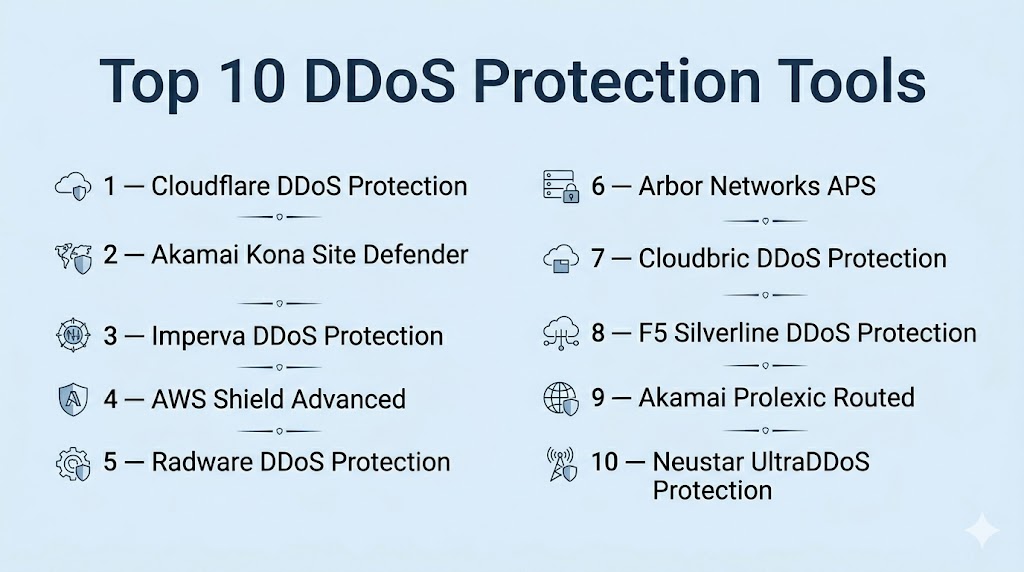
Top 10 DDoS Protection Tools
#1 — Cloudflare DDoS Protection
Short description : Cloudflare DDoS Protection provides cloud-native mitigation, network edge filtering, and real-time traffic analysis, ideal for enterprises and cloud-first organizations seeking scalable protection.
Key Features
- Global edge network mitigation
- Volumetric and application-layer protection
- Automated traffic anomaly detection
- Real-time dashboards and analytics
- API and bot mitigation
- Integration with CDN for performance
Pros
- Rapid deployment with minimal configuration
- Scales automatically with traffic
- Global network reduces latency impact
Cons
- Advanced configuration requires enterprise plan
- Limited on-premises options
Platforms / Deployment
- Web
- Cloud
Security & Compliance
- SOC 2, ISO 27001, GDPR
Integrations & Ecosystem
- SIEM integration
- DevOps pipeline APIs
- CDN integration
Support & Community
- Multi-tier support and robust online knowledge base
#2 — Akamai Kona Site Defender
Short description : Kona Site Defender delivers enterprise-grade DDoS protection and web application security, optimized for high-volume and distributed applications across hybrid and cloud environments.
Key Features
- Application-layer DDoS mitigation
- Global traffic scrubbing
- Bot detection and mitigation
- API security monitoring
- Real-time analytics
- Policy automation
Pros
- Excellent global performance
- Strong protection against multi-vector attacks
- Cloud-native scalability
Cons
- High pricing for smaller organizations
- Requires dedicated setup and configuration
Platforms / Deployment
- Web
- Cloud
Security & Compliance
- SOC 2, ISO 27001, PCI-DSS
Integrations & Ecosystem
- SIEM tools
- Security orchestration platforms
- APIs for automation
Support & Community
- Enterprise support and training resources
#3 — Imperva DDoS Protection
Short description : Imperva DDoS Protection safeguards on-premises, hybrid, and cloud applications, combining real-time threat intelligence with automated attack mitigation for critical infrastructures.
Key Features
- Network and application-layer protection
- Global traffic scrubbing
- Automated threat response
- Bot and API mitigation
- Real-time monitoring and reporting
- Integration with security tools
Pros
- Comprehensive enterprise protection
- Effective against large-scale attacks
- Advanced analytics for threat insights
Cons
- Enterprise-focused pricing
- Learning curve for policy management
Platforms / Deployment
- Web
- Cloud / On-premises
Security & Compliance
- SOC 2, ISO 27001, GDPR
Integrations & Ecosystem
- SIEM integration
- DevOps APIs
- Security orchestration
Support & Community
- Enterprise support and knowledge base
#4 — AWS Shield Advanced
Short description : AWS Shield Advanced provides integrated DDoS protection for AWS-hosted workloads, offering real-time detection, mitigation, and reporting with close integration to other AWS services.
Key Features
- AWS service integration (CloudFront, ALB, API Gateway)
- Automatic detection and mitigation
- Advanced analytics and reporting
- 24/7 DDoS response team access
- API and application-layer protection
- Cost protection against volumetric attacks
Pros
- Native integration with AWS
- Rapid scalability with cloud workloads
- Detailed reporting and attack analytics
Cons
- Limited to AWS ecosystem
- Requires AWS expertise for advanced features
Platforms / Deployment
- Web
- Cloud
Security & Compliance
- SOC 2, ISO 27001, PCI-DSS
Integrations & Ecosystem
- AWS services
- SIEM integration
- DevOps CI/CD pipelines
Support & Community
- AWS enterprise support and developer community
#5 — Radware DDoS Protection
Short description : Radware DDoS Protection offers hybrid mitigation for on-premises and cloud environments, leveraging behavioral analysis and automated response for enterprise-grade attack protection.
Key Features
- Behavioral-based threat detection
- Multi-layer DDoS mitigation
- Automated traffic filtering
- Real-time monitoring and analytics
- API security
- Integration with security tools
Pros
- Adaptive protection for complex environments
- Effective multi-vector attack mitigation
- Real-time analytics
Cons
- Complex initial setup
- Costly for SMBs
Platforms / Deployment
- Web
- Cloud / On-premises
Security & Compliance
- SOC 2, ISO 27001
Integrations & Ecosystem
- SIEM
- DevOps integration
- APIs for automation
Support & Community
- Enterprise support and documentation
#6 — Arbor Networks APS
Short description : Arbor APS provides enterprise DDoS mitigation with global scrubbing centers, real-time attack intelligence, and integration with network monitoring for large-scale networks.
Key Features
- Global traffic scrubbing
- Volumetric and application-layer protection
- Threat intelligence feeds
- Automated mitigation
- Real-time dashboards
- Reporting and analytics
Pros
- High-volume attack protection
- Real-time mitigation
- Integrates with network monitoring tools
Cons
- Enterprise-focused deployment
- Requires advanced network expertise
Platforms / Deployment
- Web
- Cloud / On-premises
Security & Compliance
- SOC 2, ISO 27001
Integrations & Ecosystem
- SIEM
- Network monitoring
- APIs for automation
Support & Community
- Enterprise support and knowledge base
#7 — Cloudbric DDoS Protection
Short description : Cloudbric DDoS Protection offers automated cloud-based mitigation and analytics for SMBs and mid-market organizations, providing affordable and scalable protection.
Key Features
- Cloud-native mitigation
- Real-time traffic analysis
- Layer 3 and Layer 7 protection
- Bot and application-layer attack prevention
- Easy policy management
- Compliance reporting
Pros
- Simple deployment for SMBs
- Affordable pricing
- Cloud-native scalability
Cons
- Limited advanced enterprise features
- Less customization for hybrid environments
Platforms / Deployment
- Web
- Cloud
Security & Compliance
- Not publicly stated
Integrations & Ecosystem
- SIEM
- APIs for automation
- DevOps integration
Support & Community
- Vendor support and documentation
#8 — F5 Silverline DDoS Protection
Short description : F5 Silverline provides managed DDoS protection with cloud-based mitigation, global traffic scrubbing, and detailed analytics for enterprise environments.
Key Features
- Managed cloud DDoS mitigation
- Global scrubbing network
- Real-time analytics
- Policy automation
- Application-layer attack protection
- Threat intelligence
Pros
- Managed service reduces operational overhead
- Scalable for enterprise traffic
- Real-time monitoring
Cons
- Enterprise-focused pricing
- Limited on-premises flexibility
Platforms / Deployment
- Web
- Cloud
Security & Compliance
- SOC 2, ISO 27001
Integrations & Ecosystem
- SIEM
- Security orchestration
- APIs for DevOps
Support & Community
- Enterprise support and documentation
#9 — Akamai Prolexic Routed
Short description : Akamai Prolexic Routed offers high-capacity cloud-based DDoS protection with traffic diversion and global scrubbing centers for enterprise-grade mitigation.
Key Features
- Traffic diversion and scrubbing
- Multi-vector attack mitigation
- Application-layer protection
- Real-time monitoring
- Analytics and reporting
- API integration
Pros
- Effective for large-scale global attacks
- Real-time mitigation and reporting
- Cloud-native scalability
Cons
- High cost for SMBs
- Requires traffic routing changes
Platforms / Deployment
- Web
- Cloud
Security & Compliance
- SOC 2, ISO 27001
Integrations & Ecosystem
- SIEM
- Network monitoring
- APIs for automation
Support & Community
- Enterprise support and knowledge base
#10 — Neustar UltraDDoS Protection
Short description : Neustar UltraDDoS Protection provides cloud-based mitigation with automated threat detection, multi-layer attack filtering, and real-time analytics for enterprises and mid-market companies.
Key Features
- Layer 3/4 and application-layer protection
- Automated mitigation
- Traffic analysis and alerting
- Global cloud scrubbing
- Reporting and compliance
- API integration
Pros
- Rapid cloud-based deployment
- Strong analytics and visibility
- Multi-layer protection
Cons
- Enterprise pricing
- Limited on-premises integration
Platforms / Deployment
- Web
- Cloud
Security & Compliance
- SOC 2, ISO 27001
Integrations & Ecosystem
- SIEM integration
- APIs for automation
- Network monitoring
Support & Community
- Vendor support and documentation
Comparison Table (Top 10)
| Tool Name | Best For | Platform(s) Supported | Deployment | Standout Feature | Public Rating |
|---|---|---|---|---|---|
| Cloudflare DDoS Protection | Cloud-first apps | Web | Cloud | Global edge mitigation | N/A |
| Akamai Kona | Large-scale enterprise | Web | Cloud | Multi-vector protection | N/A |
| Imperva DDoS | Enterprise hybrid | Web | Cloud / On-prem | Automated threat response | N/A |
| AWS Shield Advanced | AWS-hosted apps | Web | Cloud | AWS integration | N/A |
| Radware DDoS Protection | Enterprise multi-layer | Web | Cloud / On-prem | Behavioral threat detection | N/A |
| Arbor APS | Large networks | Web | Cloud / On-prem | Traffic scrubbing | N/A |
| Cloudbric DDoS | SMBs & mid-market | Web | Cloud | Automated protection | N/A |
| F5 Silverline | Enterprise cloud apps | Web | Cloud | Managed mitigation | N/A |
| Akamai Prolexic Routed | Global enterprise | Web | Cloud | Traffic diversion & scrubbing | N/A |
| Neustar UltraDDoS | Enterprise & mid-market | Web | Cloud | Multi-layer filtering | N/A |
Evaluation & Scoring of DDoS Protection Tools
| Tool Name | Core (25%) | Ease (15%) | Integrations (15%) | Security (10%) | Performance (10%) | Support (10%) | Value (15%) | Weighted Total |
|---|---|---|---|---|---|---|---|---|
| Cloudflare | 8 | 9 | 8 | 8 | 9 | 8 | 8 | 8.3 |
| Akamai Kona | 9 | 7 | 8 | 9 | 9 | 8 | 7 | 8.2 |
| Imperva | 9 | 7 | 8 | 9 | 9 | 8 | 7 | 8.2 |
| AWS Shield | 8 | 8 | 8 | 8 | 9 | 8 | 8 | 8.2 |
| Radware | 8 | 7 | 7 | 8 | 8 | 8 | 7 | 7.8 |
| Arbor APS | 8 | 7 | 7 | 8 | 8 | 8 | 7 | 7.8 |
| Cloudbric | 7 | 8 | 7 | 7 | 8 | 7 | 8 | 7.6 |
| F5 Silverline | 9 | 7 | 8 | 9 | 9 | 8 | 7 | 8.2 |
| Prolexic Routed | 9 | 7 | 8 | 9 | 9 | 8 | 7 | 8.2 |
| Neustar UltraDDoS | 8 | 7 | 7 | 8 | 8 | 8 | 7 | 7.8 |
Interpretation: Higher weighted totals indicate stronger capabilities, integration support, and overall performance for large-scale attack protection.
Which DDoS Protection Tools Tool Is Right for You?
Solo / Freelancer
Cloudbric offers cloud-native simplicity and affordability for smaller workloads.
SMB
Cloudflare and AWS Shield provide scalable and easy-to-deploy protection.
Mid-Market
Imperva, Radware, and Neustar provide multi-layer protection and analytics suitable for growing organizations.
Enterprise
Akamai Kona, F5 Silverline, and Prolexic Routed deliver enterprise-grade multi-cloud and global protection.
Budget vs Premium
Budget-friendly tools suffice for SMBs; premium solutions are better for high-volume and multi-cloud environments.
Feature Depth vs Ease of Use
Enterprise-grade tools offer advanced features but require configuration; SMB-focused solutions prioritize simplicity.
Integrations & Scalability
APIs and SIEM integrations support large-scale, hybrid deployments.
Security & Compliance Needs
SOC 2, PCI-DSS, and ISO 27001 compliance are critical for sensitive data and regulatory industries.
Frequently Asked Questions (FAQs)
1. What pricing models are common?
Cloud subscriptions, usage-based billing, and enterprise licensing with premium plans for advanced analytics.
2. How quickly can DDoS protection be deployed?
Cloud-native solutions deploy within hours; on-premises require days to weeks.
3. Do these tools support API protection?
Yes, modern DDoS tools protect API endpoints from volumetric and application-layer attacks.
4. Can DDoS tools integrate with multi-cloud environments?
Yes, enterprise tools like Akamai, Cloudflare, and F5 Silverline support hybrid and multi-cloud setups.
5. Are AI features included?
Some platforms leverage AI for anomaly detection, adaptive mitigation, and automated threat response.
6. How do these tools integrate with DevOps?
APIs allow automated mitigation policies and monitoring in CI/CD pipelines.
7. Are cloud solutions secure?
Yes, they use encryption, RBAC, audit logs, and multi-tenant isolation to secure traffic.
8. Can DDoS tools reduce traffic impact?
Yes, cloud-based mitigation and scrubbing minimize service disruption during attacks.
9. Do they provide compliance reporting?
Enterprise-grade platforms offer dashboards for SOC 2, PCI-DSS, and GDPR compliance.
10. What are common mistakes when using DDoS tools?
Misconfigured policies, ignoring API endpoints, insufficient monitoring, and over-reliance on defaults.
Conclusion
DDoS Protection Tools are essential for safeguarding networks and applications from high-volume attacks, maintaining uptime, and ensuring compliance. SMBs benefit from simple cloud-native solutions like Cloudbric or AWS Shield, while enterprises should consider Akamai Kona, F5 Silverline, or Imperva for global, multi-cloud, and AI-driven protection. Key considerations include deployment flexibility, automation, analytics, integration with security infrastructure, and regulatory compliance. Organizations should pilot solutions, validate policies, and use adaptive threat intelligence to optimize protection.

Find Trusted Cardiac Hospitals
Compare heart hospitals by city and services — all in one place.
Explore Hospitals
During a real DDoS attack, traffic may be filtered successfully but the application can still become slow or unavailable. It would be useful to also test how the application, DNS, CDN, and backend services behave while mitigation is active. This kind of end-to-end testing can show problems that a DDoS tool alone may not catch.