Introduction
Digital Experience Monitoring (DEM) platforms are specialized tools designed to track and analyze user experiences across digital channels, including web applications, mobile apps, and cloud services. DEM provides IT and business teams with real-time insights into application performance, user satisfaction, and potential bottlenecks, helping organizations proactively manage digital interactions and enhance overall customer experience. DEM has become increasingly critical due to the growing reliance on cloud services, distributed workforces, and omnichannel customer engagement. With user expectations at an all-time high, ensuring seamless digital experiences is a competitive differentiator. DEM platforms help businesses understand user journeys, detect performance anomalies, and correlate technical metrics with business outcomes.
Real-world use cases include:
- Monitoring website load times and responsiveness for e-commerce platforms.
- Tracking mobile app performance and usage analytics.
- Measuring end-user experience in SaaS and cloud applications.
- Diagnosing performance issues for hybrid enterprise environments.
- Supporting digital transformation initiatives with actionable insights.
Key evaluation criteria:
- Real-time user monitoring and synthetic testing.
- End-to-end visibility across applications, networks, and devices.
- Integration with ITSM, APM, and observability platforms.
- AI/ML-driven analytics and anomaly detection.
- Dashboards, reporting, and KPI tracking.
- Scalability for enterprise or multi-site deployments.
- Ease of deployment and agent management.
- Security, privacy, and compliance features.
Best for: IT managers, digital experience teams, DevOps, and customer experience managers across enterprises and large SMBs.
Not ideal for: Organizations with limited digital infrastructure or minimal user interaction analytics needs.
Key Trends in DEM for 2026 and Beyond
- AI and machine learning for predictive performance analytics and anomaly detection.
- Full-stack observability integration, combining DEM with APM and network monitoring.
- Cloud-native and SaaS-based DEM solutions for flexible deployment.
- Automated remediation workflows triggered by performance alerts.
- Mobile and hybrid application monitoring to cover remote and distributed users.
- Synthetic monitoring with real-user telemetry for proactive issue detection.
- Enhanced dashboards with business KPIs correlated to technical metrics.
- API-based integrations with ITSM, CMDB, and observability platforms.
- Data privacy and regulatory compliance (GDPR, HIPAA) for user telemetry.
- Subscription and usage-based pricing models for scalable adoption.
How We Selected These Tools (Methodology)
- Evaluated market adoption and industry mindshare.
- Reviewed feature completeness: real-user monitoring, synthetic testing, analytics.
- Assessed reliability and performance under large-scale deployments.
- Verified security posture, including encryption, RBAC, and compliance standards.
- Checked integration capabilities with APM, ITSM, and observability ecosystems.
- Considered scalability and suitability across SMB, mid-market, and enterprise.
- Analyzed AI/ML analytics and predictive capabilities.
- Compared deployment flexibility: cloud, on-prem, hybrid.
- Reviewed documentation quality, onboarding process, and support tiers.
- Balanced total cost of ownership with feature depth.
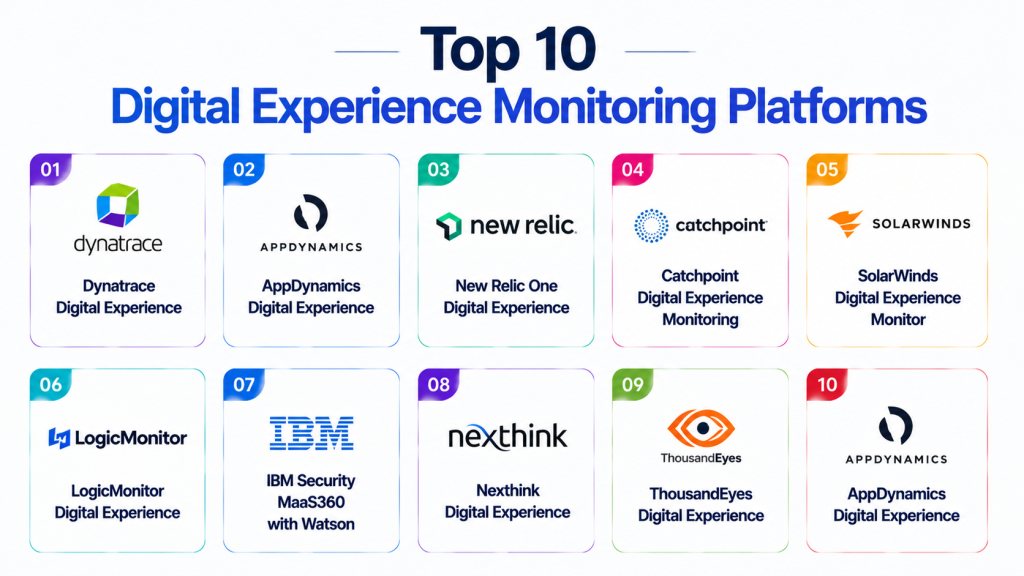
Top 10 Digital Experience Monitoring Tools
1- Dynatrace Digital Experience
Short description: Provides real-time user experience monitoring with AI-driven insights for web, mobile, and cloud applications.
Key Features
- Real-user monitoring and session replay
- Synthetic testing and transaction monitoring
- AI-powered root cause analysis
- Full-stack observability integration
- Business impact analysis
- Automated alerts and remediation
Pros
- AI reduces manual troubleshooting
- Excellent multi-channel visibility
Cons
- Premium pricing for small teams
- Steeper learning curve
Platforms / Deployment
- Web / Windows / macOS / Linux / iOS / Android
- Cloud / Hybrid
Security & Compliance
- SOC 2, GDPR
- Encryption, RBAC
Integrations & Ecosystem
- ITSM, APM, cloud monitoring
- APIs for automation
- Observability platforms
Support & Community
- Professional support, extensive documentation, active forums
2- New Relic One Digital Experience
Short description: DEM platform offering real-time visibility into application performance and user satisfaction across devices.
Key Features
- End-to-end monitoring of web and mobile apps
- Synthetic and real-user monitoring
- AI-based anomaly detection
- Custom dashboards and KPIs
- API and workflow automation
Pros
- Easy to deploy across multiple environments
- Flexible analytics and reporting
Cons
- Complexity in configuring advanced dashboards
- Premium modules add to cost
Platforms / Deployment
- Web / Windows / macOS / Linux / iOS / Android
- Cloud
Security & Compliance
- Encryption, audit logs, SOC 2
- Not publicly stated
Integrations & Ecosystem
- ITSM, APM tools, cloud monitoring APIs
- Observability and analytics integration
Support & Community
- Documentation, onboarding guides, professional support tiers
3- AppDynamics Digital Experience
Short description: Monitors end-user interactions with applications, providing actionable insights and business-level impact analysis.
Key Features
- Real-user monitoring and analytics
- Synthetic monitoring
- Session replay and journey tracking
- AI-powered anomaly detection
- Integration with business KPIs
Pros
- Strong correlation between business impact and technical metrics
- Supports complex enterprise applications
Cons
- Configuration can be complex
- Costly for SMBs
Platforms / Deployment
- Web / Windows / macOS / Linux / iOS / Android
- Cloud / Hybrid
Security & Compliance
- SOC 2, ISO 27001
- Encryption and audit logging
Integrations & Ecosystem
- ITSM, APM, observability
- API integrations for workflows
Support & Community
- Extensive documentation and enterprise support
4- Catchpoint Digital Experience Monitoring
Short description: Focused on proactive performance monitoring with synthetic and real-user telemetry for web applications.
Key Features
- Global synthetic testing
- Real-user performance analytics
- Alerting and SLA monitoring
- Multi-device and browser support
- Customizable dashboards
Pros
- Excellent proactive monitoring
- Strong synthetic testing capabilities
Cons
- Less robust for mobile analytics
- Enterprise pricing
Platforms / Deployment
- Web / Cloud
- Cloud
Security & Compliance
- Encryption, RBAC
- Not publicly stated
Integrations & Ecosystem
- ITSM, APM, API connectors
- Cloud performance platforms
Support & Community
- Documentation, professional support, customer forums
5- SolarWinds Digital Experience Monitor
Short description: Provides visibility into end-user experience for web and cloud applications with real-time metrics.
Key Features
- Real-user monitoring and dashboards
- Synthetic testing
- SLA tracking
- Alerts and automated reporting
- Cloud application support
Pros
- Easy deployment
- Intuitive dashboards
Cons
- Limited AI capabilities
- Less advanced anomaly detection
Platforms / Deployment
- Web / Cloud
- Cloud / On-prem
Security & Compliance
- Encryption and access controls
- Not publicly stated
Integrations & Ecosystem
- ITSM, cloud monitoring
- API connectors for automation
Support & Community
- Support tiers, documentation, community forums
6- LogicMonitor Digital Experience
Short description: Cloud-based DEM solution offering end-to-end visibility and predictive analytics for IT operations.
Key Features
- Synthetic and real-user monitoring
- AI-based anomaly detection
- Alerting and reporting dashboards
- Multi-cloud and hybrid environment support
- SLA monitoring
Pros
- Strong predictive analytics
- Scales across multiple environments
Cons
- Requires training for advanced analytics
- Premium pricing
Platforms / Deployment
- Web / Cloud
- Cloud
Security & Compliance
- Encryption, RBAC
- SOC 2 Not publicly stated
Integrations & Ecosystem
- ITSM, APM, APIs
- Cloud observability platforms
Support & Community
- Professional support, documentation, community forums
7- Dynatrace Digital Experience
Short description: AI-driven DEM platform providing automated insights into user journeys and application performance.
Key Features
- Real-user monitoring and session replay
- Synthetic testing
- AI-driven root cause analysis
- Business impact analytics
- Automated alerting
Pros
- Advanced AI reduces manual troubleshooting
- Strong correlation of business metrics
Cons
- Higher learning curve
- Enterprise pricing
Platforms / Deployment
- Web / Windows / macOS / Linux / iOS / Android
- Cloud
Security & Compliance
- SOC 2, GDPR
- Encryption, MFA, audit logs
Integrations & Ecosystem
- ITSM, APM, observability platforms
- API for custom workflows
Support & Community
- Documentation, training, professional support
8- Nexthink Digital Experience
Short description: Focuses on employee digital experience monitoring and proactive IT issue resolution.
Key Features
- Endpoint telemetry and UX monitoring
- AI-driven analytics and alerts
- Dashboard for employee experience
- Integration with ITSM
- Reporting and insights
Pros
- Employee-centric insights
- Strong automation features
Cons
- Requires endpoint agents
- Costly for smaller organizations
Platforms / Deployment
- Windows / macOS / Linux / Cloud
- Cloud / Hybrid
Security & Compliance
- Encryption, RBAC
- GDPR compliance
Integrations & Ecosystem
- ITSM, SIEM, automation workflows
- APIs for analytics
Support & Community
- Professional support, training, community resources
9- ThousandEyes Digital Experience
Short description: Monitors digital performance across networks, applications, and services for global visibility.
Key Features
- End-to-end network and application monitoring
- Synthetic and real-user monitoring
- Alerting and SLA tracking
- Cloud and hybrid support
- Integration with observability platforms
Pros
- Global monitoring capability
- Excellent for distributed applications
Cons
- Limited focus on mobile endpoints
- Premium pricing
Platforms / Deployment
- Web / Cloud
- Cloud
Security & Compliance
- Encryption, RBAC
- SOC 2 Not publicly stated
Integrations & Ecosystem
- ITSM, APM, cloud monitoring APIs
- Observability tools
Support & Community
- Documentation, training, professional support
10- AppDynamics Digital Experience
Short description: Provides deep visibility into user interactions and application performance across web and mobile platforms.
Key Features
- Real-user monitoring and analytics
- Session replay and transaction tracking
- AI-driven anomaly detection
- Integration with business KPIs
- Alerts and dashboards
Pros
- Strong correlation of business impact and technical metrics
- Multi-platform monitoring
Cons
- Complexity in configuration
- Premium cost
Platforms / Deployment
- Web / Windows / macOS / Linux / iOS / Android
- Cloud / Hybrid
Security & Compliance
- SOC 2, ISO 27001
- Encryption, RBAC
Integrations & Ecosystem
- ITSM, APM, observability
- APIs for automation and reporting
Support & Community
- Professional support, documentation, community forums
Comparison Table (Top 10)
| Tool Name | Best For | Platform(s) Supported | Deployment | Standout Feature | Public Rating |
|---|---|---|---|---|---|
| Dynatrace | Enterprise | Web/Windows/macOS/Linux/iOS/Android | Cloud | AI-driven insights & root cause analysis | N/A |
| AppDynamics | Enterprise | Web/Windows/macOS/Linux/iOS/Android | Cloud/Hybrid | Business impact correlation | N/A |
| New Relic One | Enterprise | Web/Windows/macOS/Linux/iOS/Android | Cloud | Flexible dashboards | N/A |
| Catchpoint | Enterprise | Web/Cloud | Cloud | Synthetic monitoring | N/A |
| SolarWinds DEM | Mid/Enterprise | Web/Cloud | Cloud/Hybrid | Intuitive dashboards | N/A |
| LogicMonitor | Enterprise | Web/Cloud | Cloud | Predictive analytics | N/A |
| IBM MaaS360 | Enterprise | Web/Windows/macOS/Linux/iOS/Android | Cloud/Hybrid | AI-driven insights | N/A |
| Nexthink | Enterprise | Windows/macOS/Linux/Cloud | Cloud/Hybrid | Employee digital experience focus | N/A |
| ThousandEyes | Enterprise | Web/Cloud | Cloud | Global network monitoring | N/A |
| Dynatrace DEM | Enterprise | Web/Windows/macOS/Linux/iOS/Android | Cloud | Automated AI analytics | N/A |
Evaluation & Scoring of DEM Platforms
| Tool Name | Core | Ease | Integrations | Security | Performance | Support | Value | Weighted Total |
|---|---|---|---|---|---|---|---|---|
| Dynatrace | 9 | 8 | 9 | 8 | 9 | 8 | 7 | 8.4 |
| AppDynamics | 8 | 8 | 8 | 8 | 8 | 8 | 7 | 7.9 |
| New Relic One | 8 | 8 | 8 | 8 | 8 | 8 | 7 | 7.9 |
| Catchpoint | 8 | 8 | 7 | 8 | 8 | 7 | 7 | 7.7 |
| SolarWinds DEM | 7 | 8 | 7 | 8 | 8 | 7 | 7 | 7.5 |
| LogicMonitor | 8 | 7 | 8 | 8 | 8 | 7 | 7 | 7.6 |
| IBM MaaS360 | 8 | 8 | 8 | 8 | 8 | 7 | 7 | 7.7 |
| Nexthink | 8 | 7 | 8 | 8 | 8 | 7 | 7 | 7.6 |
| ThousandEyes | 8 | 7 | 8 | 8 | 8 | 7 | 7 | 7.6 |
| Dynatrace DEM | 9 | 8 | 9 | 8 | 9 | 8 | 7 | 8.4 |
Which DEM Tool Is Right for You?
Solo / Freelancer
- New Relic One or SolarWinds DEM for simple web app monitoring and dashboards.
SMB
- LogicMonitor or IBM MaaS360 for cost-effective insights and cloud-native deployment.
Mid-Market
- AppDynamics or Dynatrace DEM for full-stack and multi-application visibility.
Enterprise
- Dynatrace, Catchpoint, Nexthink, or ThousandEyes for AI-driven analytics and global monitoring.
Budget vs Premium
- Budget: SolarWinds DEM, New Relic One
- Premium: Dynatrace, AppDynamics, Catchpoint
Feature Depth vs Ease of Use
- Feature depth: Dynatrace, AppDynamics, ThousandEyes
- Ease of use: SolarWinds DEM, New Relic One
Integrations & Scalability
- Large-scale integrations: Dynatrace, Nexthink, ThousandEyes
- Moderate integrations: SolarWinds, New Relic One
Security & Compliance Needs
- Enterprise-grade: Dynatrace, AppDynamics, Catchpoint
- SMB/medium: SolarWinds, LogicMonitor
Frequently Asked Questions (FAQs)
1- What pricing models are typical for DEM platforms?
Most platforms use subscription-based licensing, often tiered by number of monitored endpoints or applications. Enterprise modules for AI analytics or synthetic monitoring may cost extra. Some vendors also offer usage-based pricing for global monitoring.
2- How long does deployment take?
Small or cloud-native DEM platforms can be set up in a few days. Enterprise deployments with multiple endpoints, cloud apps, and network integrations may take several weeks to fully configure and test.
3- Can small businesses benefit from DEM platforms?
Yes, lightweight platforms like SolarWinds DEM or New Relic One can help SMBs monitor website and app performance, identify user experience issues, and optimize cloud services without the complexity of enterprise-scale tools.
4- Are these platforms secure for sensitive data?
Top DEM platforms encrypt telemetry data, provide role-based access control, audit logs, and often comply with SOC 2, ISO 27001, or GDPR. Organizations should verify compliance requirements before deployment, especially for regulated industries.
5- Can DEM tools integrate with ITSM and observability platforms?
Yes, most platforms offer native integrations or APIs for ITSM, CMDB, SIEM, and APM tools, allowing seamless correlation of technical metrics with business KPIs and enabling automated workflows.
6- How customizable are alerting workflows?
Platforms allow configurable alerts based on performance thresholds, user journeys, or SLA violations. Advanced platforms provide AI-driven anomaly detection, which can trigger automated remediation or notify IT and business stakeholders.
7- What are common mistakes when deploying DEM platforms?
Typical mistakes include insufficient endpoint coverage, ignoring mobile applications, misconfigured alert thresholds, not integrating with observability or ITSM platforms, and failing to define KPIs aligned with business goals.
8- How scalable are these solutions?
Enterprise-grade platforms scale to thousands of endpoints, multiple applications, and global sites. Cloud-native solutions offer elastic scaling, while agent-based solutions require careful planning for distributed environments.
9- Do these tools monitor both web and mobile apps?
Yes, modern DEM platforms provide multi-channel monitoring, including web, mobile, SaaS, cloud, and hybrid applications, capturing real-user telemetry and synthetic performance metrics.
10- Can telemetry data be exported or migrated?
Data export depends on vendor capabilities. Most platforms provide APIs or connectors for reporting, analytics, and migration to other observability or SIEM platforms. Planning is key for continuity.
Conclusion
Digital Experience Monitoring platforms are essential for organizations seeking to optimize user satisfaction and application performance. SMBs can leverage SolarWinds DEM or New Relic One for cost-effective monitoring, while mid-market and enterprise organizations benefit from Dynatrace, AppDynamics, or Catchpoint for comprehensive AI-driven insights. Evaluate platforms based on deployment scale, integrations, AI analytics, and security requirements. Pilot 2–3 platforms to validate telemetry coverage, anomaly detection, and workflow alignment before enterprise-wide adoption.

Find Trusted Cardiac Hospitals
Compare heart hospitals by city and services — all in one place.
Explore Hospitals
Digital experience monitoring becomes far more meaningful when technical performance data is connected to actual user outcomes. A system may appear healthy from an infrastructure perspective, yet users can still experience delays, interruptions, or workflow frustrations that affect overall business performance.