Introduction
Insurance Broker Management Systems (IBMS) are specialized software platforms designed to help insurance brokers and agencies streamline their operations, manage client relationships, and enhance policy administration. the demand for such systems has grown due to increasing regulatory requirements, the need for digital-first client engagement, and the complexity of multi-line insurance portfolios.
Real-world use cases include:
- Centralizing policy and client data for quick retrieval.
- Automating renewals, claims tracking, and compliance reporting.
- Enabling brokers to generate quotes and manage commissions efficiently.
- Providing dashboards and analytics for portfolio performance.
- Supporting multi-channel client communication, including digital and mobile interactions.
What buyers should evaluate:
- Ease of use and user interface.
- Integration capabilities with carriers and accounting systems.
- Automation features (renewals, claims, workflows).
- Compliance and regulatory reporting support.
- Security and data protection measures.
- Scalability for SMBs to enterprise agencies.
- Mobile access and remote functionality.
- Customization and configurability.
- Pricing models and total cost of ownership.
Best for: Insurance brokers, small to large agencies, and financial services firms seeking centralized operations, compliance assurance, and enhanced client engagement.
Not ideal for: Individual agents with minimal policy volume or brokers already using carrier-provided management platforms that cover all operational needs.
Key Trends in Insurance Broker Management Systems
- Increased adoption of AI for risk assessment, quote recommendations, and client segmentation.
- Workflow automation to reduce manual administrative tasks.
- Cloud-first deployment models enabling remote and hybrid work.
- Integration with carrier portals, CRM, and accounting software for seamless data flow.
- Advanced analytics and reporting dashboards for performance and portfolio monitoring.
- Enhanced client engagement via mobile apps and digital portals.
- Focus on compliance automation with local and international regulations.
- Modular pricing structures to accommodate brokers of different sizes.
- Cybersecurity focus: MFA, encryption, audit logs, and SOC 2 standards.
- Data-driven sales and marketing insights powered by integrated analytics.
How We Selected These Tools (Methodology)
- Market adoption and mindshare among insurance brokerages.
- Completeness of core features (policy management, client tracking, claims).
- Reliability and performance indicators from user feedback.
- Security posture, including encryption, access control, and auditability.
- Ecosystem integrations with carriers, accounting, and CRM systems.
- Scalability and flexibility for SMBs and enterprise agencies.
- Support quality, training, and documentation availability.
- Pricing and total cost relative to value delivered.
- Innovation: AI features, analytics, and automation capabilities.
- Overall customer fit across different insurance lines and business models.
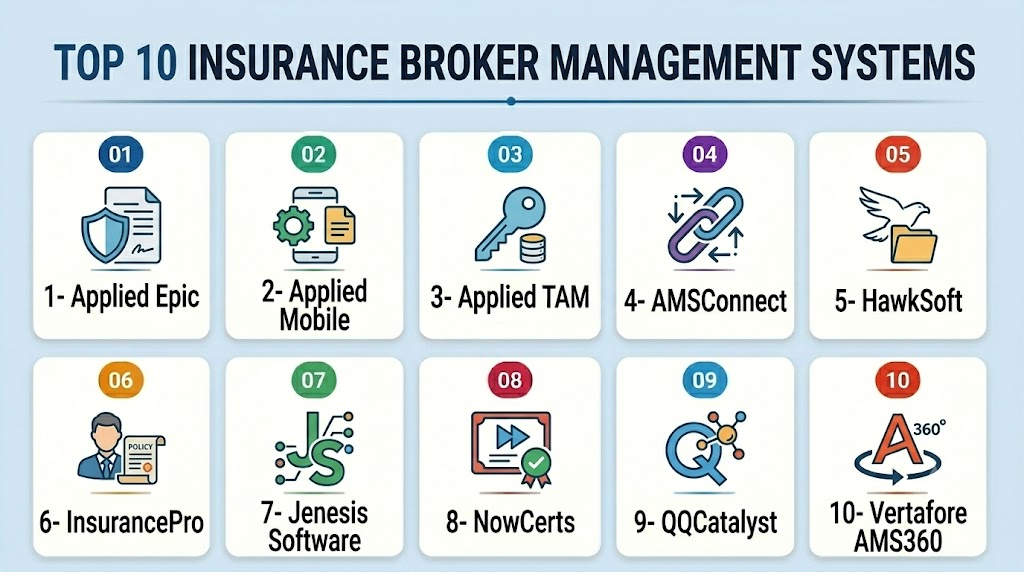
Top 10 Insurance Broker Management Systems
1- Applied Epic
Short description: Comprehensive IBMS for mid-to-large brokerages with multi-line support, analytics, and workflow automation.
Key Features
- Policy and client management across multiple lines.
- Automated renewals and commission tracking.
- Integrated analytics dashboards.
- Mobile access for field agents.
- Carrier connectivity and document management.
Pros
- Scalable for growing brokerages.
- Strong compliance and reporting features.
Cons
- Higher cost for smaller agencies.
- Learning curve for new users.
Platforms / Deployment
- Windows / Web / iOS / Android
- Cloud / Hybrid
Security & Compliance
- Not publicly stated
Integrations & Ecosystem
Supports accounting, CRM, and carrier portals.
- API for custom integrations
- Document management tools
- Email & messaging systems
- Analytics platforms
Support & Community
- Comprehensive documentation, tiered support, and active user community.
2- Applied TAM
Short description: Robust platform for mid-sized agencies emphasizing policy management and automated workflows.
Key Features
- Multi-line policy management.
- Automated renewals and alerts.
- Commission and billing tracking.
- Integrated reporting.
- Client portal access.
Pros
- Streamlined workflow automation.
- Strong reporting capabilities.
Cons
- Less flexible UI customization.
- Training required for complex features.
Platforms / Deployment
- Web / Windows / iOS
- Cloud / Hybrid
Security & Compliance
- Not publicly stated
Integrations & Ecosystem
- Carrier portals
- Accounting and CRM integration
- Document storage
- Reporting and analytics
Support & Community
- Varies / Not publicly stated
3- Vertafore AMS360
Short description: Enterprise-ready IBMS with powerful analytics and compliance tools, suitable for large agencies.
Key Features
- Centralized policy management.
- Automated renewals and claims tracking.
- Real-time portfolio analytics.
- Role-based dashboards.
- Integration with multiple carrier systems.
Pros
- Highly scalable for enterprise brokers.
- Strong compliance and reporting modules.
Cons
- Implementation can be complex.
- Premium pricing structure.
Platforms / Deployment
- Web / Windows / iOS / Android
- Cloud / Hybrid
Security & Compliance
- Not publicly stated
Integrations & Ecosystem
- Accounting software
- Carrier portals
- CRM platforms
- Workflow automation tools
Support & Community
- Tiered support and extensive documentation.
4- HawkSoft
Short description: User-friendly IBMS for small to mid-sized agencies with integrated policy, client, and billing management.
Key Features
- Policy tracking and renewals.
- Client management and communications.
- Automated billing and commission tracking.
- Customizable dashboards.
- Reporting and analytics.
Pros
- Intuitive interface for small teams.
- Cost-effective for SMBs.
Cons
- Limited enterprise scalability.
- Fewer advanced automation features.
Platforms / Deployment
- Windows / Web
- Cloud / On-premise
Security & Compliance
- Not publicly stated
Integrations & Ecosystem
- CRM tools
- Accounting platforms
- Carrier portals
- Email automation
Support & Community
- Strong documentation and responsive support team.
5- QQCatalyst
Short description: Cloud-based IBMS targeting SMBs with easy-to-use policy, client, and commission management.
Key Features
- Policy and client database.
- Automated renewals and reminders.
- Commission tracking and reporting.
- Document storage.
- Mobile agent access.
Pros
- Affordable and cloud-based.
- Easy setup for smaller agencies.
Cons
- Less suitable for complex enterprise workflows.
- Limited advanced analytics.
Platforms / Deployment
- Web / iOS / Android
- Cloud
Security & Compliance
- Not publicly stated
Integrations & Ecosystem
- Carrier connectivity
- Accounting software
- CRM integrations
- Email automation
Support & Community
- Online help center, responsive support.
6- Jenesis Software
Short description: IBMS designed for small and mid-sized agencies emphasizing simplicity and workflow efficiency.
Key Features
- Policy management and tracking.
- Automated billing and renewals.
- Client database and communications.
- Commission management.
- Reporting and analytics.
Pros
- Easy to implement and use.
- Focused on SMB requirements.
Cons
- Limited scalability for larger brokers.
- Fewer integrations with third-party tools.
Platforms / Deployment
- Windows / Web
- Cloud / On-premise
Security & Compliance
- Not publicly stated
Integrations & Ecosystem
- Accounting tools
- CRM integration
- Carrier portals
Support & Community
- Varies / Not publicly stated
7- NowCerts
Short description: Cloud-based IBMS for small agencies, emphasizing policy management, automation, and carrier integration.
Key Features
- Policy lifecycle management.
- Automated renewals and commissions.
- Client communications and alerts.
- Reporting dashboards.
- Carrier portal integration.
Pros
- Cloud-native and easy access.
- Simplifies daily broker operations.
Cons
- Limited enterprise capabilities.
- Analytics features are basic.
Platforms / Deployment
- Web / iOS / Android
- Cloud
Security & Compliance
- Not publicly stated
Integrations & Ecosystem
- CRM systems
- Accounting software
- Email tools
- Carrier portals
Support & Community
- Online documentation, responsive support.
8- Applied Mobile
Short description: Mobile-focused solution for brokers needing field access to policy and client data.
Key Features
- Mobile policy management.
- Client communications on-the-go.
- Commission tracking and alerts.
- Real-time updates with cloud sync.
- Basic reporting tools.
Pros
- Enhances mobile workflow.
- Real-time access to client data.
Cons
- Limited desktop features.
- Not ideal for full enterprise management.
Platforms / Deployment
- iOS / Android
- Cloud
Security & Compliance
- Not publicly stated
Integrations & Ecosystem
- Sync with main IBMS platform
- Carrier data integration
- CRM integration
Support & Community
- Varies / Not publicly stated
9- AMSConnect
Short description: Cloud-first IBMS connecting brokers to multiple carriers with policy and client management.
Key Features
- Multi-carrier policy management.
- Automated renewals and billing.
- Client communication portals.
- Commission tracking.
- Basic analytics dashboards.
Pros
- Good carrier connectivity.
- Cloud-first solution for small to mid-sized agencies.
Cons
- Limited advanced analytics.
- Smaller support community.
Platforms / Deployment
- Web / iOS / Android
- Cloud
Security & Compliance
- Not publicly stated
Integrations & Ecosystem
- CRM and accounting software
- Carrier portals
- Document management
Support & Community
- Online helpdesk, limited community.
10- InsurancePro
Short description: Comprehensive IBMS suitable for growing agencies, with multi-line policy management and reporting.
Key Features
- Centralized policy and client database.
- Automated renewals and commission tracking.
- Reporting dashboards.
- Workflow management.
- Document storage and sharing.
Pros
- Scalable for growing SMBs.
- Streamlined operational workflows.
Cons
- UI may feel dated.
- Advanced analytics limited.
Platforms / Deployment
- Web / Windows / iOS
- Cloud / Hybrid
Security & Compliance
- Not publicly stated
Integrations & Ecosystem
- Carrier portals
- Accounting software
- CRM systems
- Email and workflow tools
Support & Community
- Responsive support, documentation available.
Comparison Table (Top 10)
| Tool Name | Best For | Platform(s) Supported | Deployment | Standout Feature | Public Rating |
|---|---|---|---|---|---|
| Applied Epic | Mid-to-large agencies | Windows / Web / iOS / Android | Cloud / Hybrid | Multi-line policy management | N/A |
| Applied TAM | Mid-sized agencies | Web / Windows / iOS | Cloud / Hybrid | Workflow automation | N/A |
| Vertafore AMS360 | Enterprise brokers | Web / Windows / iOS / Android | Cloud / Hybrid | Real-time portfolio analytics | N/A |
| HawkSoft | Small-mid agencies | Windows / Web | Cloud / On-premise | User-friendly interface | N/A |
| QQCatalyst | SMBs | Web / iOS / Android | Cloud | Cloud-based simplicity | N/A |
| Jenesis Software | Small-mid agencies | Windows / Web | Cloud / On-premise | Simple workflow management | N/A |
| NowCerts | Small agencies | Web / iOS / Android | Cloud | Multi-carrier integration | N/A |
| Applied Mobile | Field brokers | iOS / Android | Cloud | Mobile-first policy access | N/A |
| AMSConnect | Mid-sized agencies | Web / iOS / Android | Cloud | Multi-carrier connectivity | N/A |
| InsurancePro | Growing SMBs | Web / Windows / iOS | Cloud / Hybrid | Centralized client management | N/A |
Evaluation & Scoring of Insurance Broker Management Systems
| Tool Name | Core (25%) | Ease (15%) | Integrations (15%) | Security (10%) | Performance (10%) | Support (10%) | Value (15%) | Weighted Total (0–10) |
|---|---|---|---|---|---|---|---|---|
| Applied Epic | 9 | 7 | 8 | 7 | 8 | 8 | 6 | 7.95 |
| Applied TAM | 8 | 7 | 7 | 7 | 7 | 7 | 7 | 7.35 |
| Vertafore AMS360 | 9 | 6 | 8 | 7 | 8 | 7 | 6 | 7.65 |
| HawkSoft | 7 | 8 | 6 | 6 | 7 | 7 | 8 | 7.20 |
| QQCatalyst | 7 | 8 | 6 | 6 | 6 | 7 | 8 | 7.10 |
| Jenesis Software | 6 | 8 | 5 | 6 | 6 | 7 | 8 | 6.75 |
| NowCerts | 6 | 8 | 5 | 6 | 6 | 6 | 8 | 6.70 |
| Applied Mobile | 5 | 8 | 5 | 6 | 6 | 6 | 7 | 6.45 |
| AMSConnect | 6 | 7 | 6 | 6 | 6 | 6 | 7 | 6.55 |
| InsurancePro | 7 | 7 | 6 | 6 | 6 | 6 | 7 | 6.80 |
Which Insurance Broker Management System Tool Is Right for You?
Solo / Freelancer
- HawkSoft or QQCatalyst for simplicity, ease of setup, and affordable cloud-based features.
SMB
- QQCatalyst, Jenesis Software, NowCerts for small-mid agencies requiring automation and basic analytics.
Mid-Market
- Applied TAM, AMSConnect, InsurancePro for multi-line support and workflow efficiencies.
Enterprise
- Applied Epic, Vertafore AMS360 for advanced analytics, scalability, and multi-carrier operations.
Budget vs Premium
- Budget: QQCatalyst, HawkSoft, Jenesis.
- Premium: Applied Epic, Vertafore AMS360, Applied TAM.
Feature Depth vs Ease of Use
- Feature depth: Vertafore AMS360, Applied Epic.
- Ease of use: HawkSoft, QQCatalyst.
Integrations & Scalability
- Agencies with multiple carriers and accounting needs: Applied Epic, Vertafore AMS360, AMSConnect.
Security & Compliance Needs
- Large brokers handling sensitive client data: Applied Epic, Vertafore AMS360.
Frequently Asked Questions (FAQs)
1- How much do Insurance Broker Management Systems cost?
Costs vary based on features, deployment, and number of users. Cloud solutions are subscription-based, while on-premise systems may require upfront licensing.
2- How long does onboarding take?
Implementation typically ranges from 2–12 weeks depending on agency size, data migration complexity, and staff training.
3- Can these systems integrate with carrier portals?
Most leading IBMS offer integration with major carriers, accounting software, and CRM platforms to streamline workflows.
4- Are mobile apps available?
Yes, many platforms provide mobile access for field agents, enabling policy and client management on-the-go.
5- How do these systems support compliance?
They offer automated reporting, audit trails, and document management to meet regulatory standards, though details depend on the vendor.
6- Can I switch systems later?
Data migration is possible but requires planning. Ensure your chosen IBMS supports export and integration options.
7- What are common mistakes when implementing IBMS?
Skipping workflow analysis, underestimating training needs, and neglecting integration planning are frequent pitfalls.
8- How scalable are these systems?
Platforms range from small agency-focused to enterprise-grade solutions capable of handling thousands of policies and multi-line portfolios.
9- Do these systems provide analytics?
Yes, dashboards and reporting tools provide insights into commissions, policy renewals, client engagement, and overall agency performance.
10- Are there alternatives to IBMS?
Alternative options include carrier-provided portals, general CRM platforms with insurance plugins, or custom-built internal solutions for small teams.
Conclusion
Insurance Broker Management Systems are essential for modern brokers seeking operational efficiency, compliance assurance, and enhanced client engagement. Selection should balance scale, feature depth, integrations, and budget. Start by shortlisting 2–3 tools, run a pilot, validate security and integrations, and then scale adoption. Careful evaluation ensures your agency maximizes efficiency, minimizes risk, and delivers a superior client experience. Choosing the right system also empowers brokers to leverage AI-driven insights for smarter decision-making and faster policy processing. A modern IBMS improves collaboration across teams and enhances customer satisfaction through timely communication and transparency. Finally, adopting a system that grows with your agency future-proofs operations while supporting regulatory and market changes.

Find Trusted Cardiac Hospitals
Compare heart hospitals by city and services — all in one place.
Explore Hospitals
Broker management systems make the biggest difference when they provide a complete view of client relationships across multiple insurers and policy types. Better visibility into renewals, commissions, and client interactions can help brokers deliver faster service while building stronger long-term relationships.