Introduction
Hospital Bed Management Systems are specialized software platforms designed to optimize patient admissions, track bed availability, and coordinate hospital resources efficiently. In simple terms, these systems ensure that hospitals can manage patient flow effectively, reduce wait times, and maximize bed utilization. With increasing healthcare demands in 2026, real-time insights and predictive analytics have become essential to avoid bottlenecks and improve patient care.
Real-world use cases include:
- Emergency department optimization: Automatically assign beds based on priority and availability.
- ICU and critical care management: Monitor occupancy and ensure critical resources are allocated efficiently.
- Patient transfers and discharges: Streamline movement between departments or facilities.
- Surgical scheduling: Align operating room availability with bed management.
- Hospital reporting and analytics: Generate occupancy, turnover, and utilization reports for management.
Evaluation criteria for buyers:
- Real-time bed availability and status tracking
- Integration with EHR and HIS systems
- Automated alerts and notifications for staff
- Analytics and reporting capabilities
- Scalability across multiple wards or hospitals
- Ease of use and intuitive dashboard
- Mobile and web access
- Security and regulatory compliance (HIPAA, GDPR)
- Workflow automation and AI-driven recommendations
- Vendor support and training resources
Best for: Hospitals, healthcare networks, ICU/ward managers, administrators, and IT teams.
Not ideal for: Small clinics with limited beds, standalone practices, or facilities with minimal patient flow complexity.
Key Trends in Hospital Bed Management Systems
- AI-driven predictive bed occupancy and patient flow analytics
- Mobile-first staff dashboards for instant updates
- Cloud-native deployments for multi-site hospitals
- Integration with EHR/HIS and telemedicine platforms
- IoT-enabled bed and device monitoring
- Automated alerts for cleaning, maintenance, and discharge readiness
- Data-driven reporting for hospital accreditation and compliance
- Enhanced patient experience through online bed status and pre-admission planning
- Dynamic resource allocation for ICU and high-demand wards
- Subscription-based pricing models and API-first architecture for extensibility
How We Selected These Tools (Methodology)
- Evaluated market adoption across hospitals and healthcare networks
- Reviewed feature completeness, including real-time tracking and AI analytics
- Assessed performance and reliability signals, such as uptime and response time
- Verified security posture, including HIPAA/GDPR compliance and encryption
- Checked integration capabilities with HIS/EHR, mobile, and IoT devices
- Considered customer fit across solo hospitals, mid-sized networks, and enterprise systems
- Analyzed support and documentation quality
- Observed scalability for multi-ward and multi-hospital deployments
- Factored in vendor track record and reputation in healthcare IT
- Compared pricing transparency and deployment flexibility
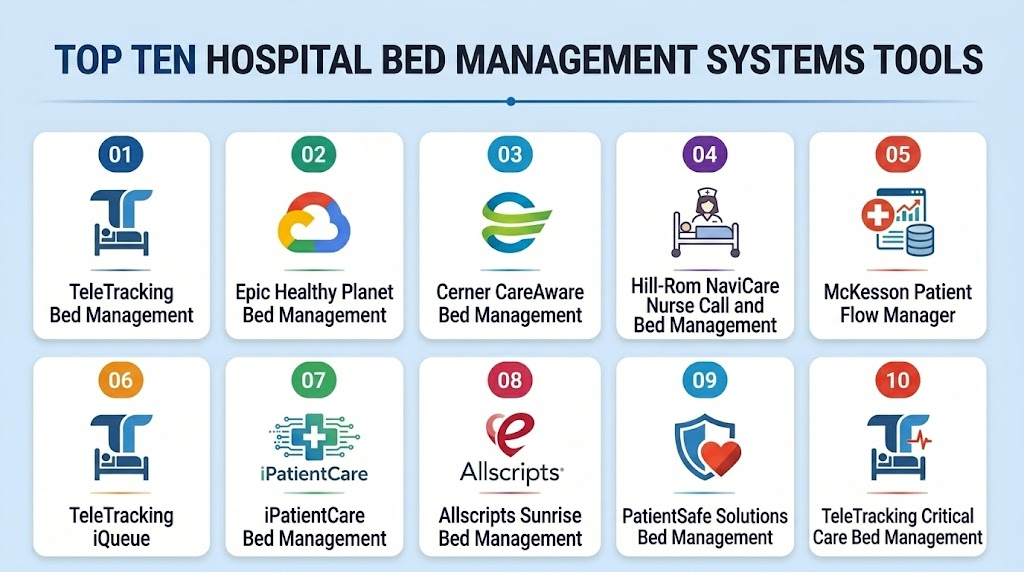
Top 10 Hospital Bed Management Systems
1- TeleTracking Bed Management
Short description: Cloud-based system for large hospitals and healthcare networks that provides real-time bed visibility and patient flow optimization.
Key Features:
- Real-time bed occupancy dashboard
- Predictive analytics for patient flow
- Integration with EHR and HIS
- Mobile notifications for staff
- Automated discharge alerts
- Reporting and compliance tools
Pros:
- Excellent scalability for large hospitals
- Real-time operational insights
Cons:
- May be complex for smaller facilities
- Premium pricing
Platforms / Deployment: Web, iOS, Android / Cloud
Security & Compliance: HIPAA, SOC 2, encryption, audit logs
Integrations & Ecosystem:
- EHR/HIS systems
- Telemedicine platforms
- IoT devices for patient monitoring
Support & Community: Comprehensive onboarding, enterprise support, moderate developer community
2- Epic Healthy Planet Bed Management
Short description: Integrated within Epic’s EHR suite, enabling hospitals to manage bed capacity and optimize patient admissions efficiently.
Key Features:
- Bed allocation tied to patient records
- Real-time dashboard and alerts
- Workflow automation for admissions
- SMART on FHIR integration
- Reporting and analytics
Pros:
- Tight integration with Epic EHR
- Streamlines admission and discharge processes
Cons:
- Limited flexibility outside Epic ecosystem
- Requires Epic-certified training
Platforms / Deployment: Web / Cloud / Hybrid
Security & Compliance: HIPAA, SOC 2, encryption, RBAC
Integrations & Ecosystem:
- Epic EHR modules
- Telehealth apps
- Patient management systems
Support & Community: Enterprise support, vendor training, moderate external developer resources
3- Cerner CareAware Bed Management
Short description: Provides real-time bed tracking and patient flow analytics for Cerner EHR hospitals and integrated healthcare facilities.
Key Features:
- Bed occupancy and availability monitoring
- Automated patient assignment
- Predictive discharge planning
- Reporting dashboards
- Mobile access for staff
Pros:
- Strong Cerner EHR integration
- Supports real-time analytics
Cons:
- Limited to Cerner ecosystem
- May require IT support for configuration
Platforms / Deployment: Web / Cloud / Hybrid
Security & Compliance: HIPAA, SOC 2, encryption
Integrations & Ecosystem:
- Cerner EHR
- Patient transport and telemetry systems
- Analytics tools
Support & Community: Documentation, training, enterprise-level support
4- Hill-Rom NaviCare Nurse Call and Bed Management
Short description: Combines bed management with nurse call and workflow optimization for hospitals seeking integrated solutions.
Key Features:
- Real-time bed availability
- Staff communication tools
- Alerts for discharge readiness
- Patient flow analytics
- Integration with medical devices
Pros:
- Combines patient flow and staff communication
- Supports smaller and mid-sized hospitals
Cons:
- Hardware dependencies may increase costs
- Setup can be complex
Platforms / Deployment: Web, iOS / Cloud / Hybrid
Security & Compliance: HIPAA, encryption
Integrations & Ecosystem:
- Nurse call systems
- EHR/HIS platforms
- Patient monitoring devices
Support & Community: Documentation, vendor training, support lines available
5- McKesson Patient Flow Manager
Short description: Designed to optimize admissions, bed assignment, and patient discharge across hospital networks.
Key Features:
- Real-time bed dashboards
- Automated alerts for admissions
- Predictive analytics
- Multi-hospital management
- Customizable workflows
Pros:
- Strong analytics capabilities
- Supports multi-site hospitals
Cons:
- Requires experienced IT team
- Premium pricing
Platforms / Deployment: Web / Cloud
Security & Compliance: HIPAA, SOC 2
Integrations & Ecosystem:
- McKesson EHR
- Lab and radiology systems
- Telemedicine platforms
Support & Community: Enterprise support, onboarding resources
6- TeleTracking iQueue
Short description: Focuses on bed, staff, and OR optimization for hospitals with high patient volumes.
Key Features:
- Queue management and bed allocation
- Predictive discharge analytics
- Dashboard for OR and ICU beds
- Staff notifications
- Analytics and reporting
Pros:
- Optimizes high-volume hospitals
- Comprehensive dashboards
Cons:
- Complexity for smaller facilities
- Costly implementation
Platforms / Deployment: Web / Cloud
Security & Compliance: HIPAA, SOC 2
Integrations & Ecosystem:
- EHR systems
- OR scheduling tools
- ICU monitoring devices
Support & Community: Documentation, enterprise support
7- iPatientCare Bed Management
Short description: Cloud-based solution providing hospitals with real-time bed tracking and patient flow optimization.
Key Features:
- Real-time bed status
- Integration with HIS/EHR
- Alerts for admissions/discharges
- Reporting and analytics
- Mobile dashboard
Pros:
- Affordable for mid-sized hospitals
- Simple onboarding
Cons:
- May lack advanced predictive analytics
- Fewer integrations than enterprise tools
Platforms / Deployment: Web, iOS, Android / Cloud
Security & Compliance: HIPAA, encryption
Integrations & Ecosystem:
- EHR/HIS systems
- Telemedicine apps
- Patient monitoring devices
Support & Community: Documentation, email support
8- Allscripts Sunrise Bed Management
Short description: Part of Allscripts EHR suite, focusing on bed allocation and patient flow automation.
Key Features:
- Real-time dashboards
- Alerts for discharges
- Automated bed assignment
- Analytics for management
- Mobile access
Pros:
- EHR integration reduces manual entry
- Supports workflow automation
Cons:
- Limited to Allscripts ecosystem
- Enterprise-level complexity
Platforms / Deployment: Web / Cloud / Hybrid
Security & Compliance: HIPAA, encryption, audit logs
Integrations & Ecosystem:
- Allscripts EHR modules
- Analytics tools
- Telehealth platforms
Support & Community: Vendor support, enterprise training
9- PatientSafe Solutions Bed Management
Short description: Provides cloud-based bed and patient flow management with staff collaboration features.
Key Features:
- Real-time bed tracking
- Alerts and notifications
- Mobile dashboards
- Analytics and reporting
- Staff communication integration
Pros:
- Mobile-friendly and easy to adopt
- Affordable for small hospitals
Cons:
- Limited predictive analytics
- Fewer integrations than enterprise systems
Platforms / Deployment: Web, iOS, Android / Cloud
Security & Compliance: HIPAA
Integrations & Ecosystem:
- EHR connectors
- Telemedicine apps
- Device monitoring
Support & Community: Documentation, onboarding, email support
10- TeleTracking Critical Care Bed Management
Short description: Specialized for ICU and critical care units, offering real-time bed monitoring and patient flow analytics.
Key Features:
- ICU bed status tracking
- Predictive analytics for admissions
- Staff notifications
- Multi-unit coordination
- Reporting dashboards
Pros:
- Ideal for critical care environments
- Real-time alerts improve responsiveness
Cons:
- Focused on ICU, less suitable for general wards
- Enterprise-level cost
Platforms / Deployment: Web, iOS, Android / Cloud
Security & Compliance: HIPAA, encryption
Integrations & Ecosystem:
- EHR and HIS
- ICU monitoring devices
- Telemedicine platforms
Support & Community: Enterprise support, vendor training
Comparison Table (Top 10)
| Tool Name | Best For | Platform(s) Supported | Deployment | Standout Feature | Public Rating |
|---|---|---|---|---|---|
| TeleTracking Bed Management | Large hospitals | Web, iOS, Android | Cloud | Real-time bed visibility | N/A |
| Epic Healthy Planet | Epic hospitals | Web | Cloud / Hybrid | EHR-integrated bed management | N/A |
| Cerner CareAware | Cerner hospitals | Web | Cloud / Hybrid | Real-time patient flow analytics | N/A |
| Hill-Rom NaviCare | Mid-sized hospitals | Web, iOS | Cloud / Hybrid | Bed + nurse call integration | N/A |
| McKesson Patient Flow Manager | Multi-hospital networks | Web | Cloud | Predictive analytics | N/A |
| TeleTracking iQueue | High-volume hospitals | Web | Cloud | Queue + OR optimization | N/A |
| iPatientCare | Mid-sized hospitals | Web, iOS, Android | Cloud | Affordable cloud solution | N/A |
| Allscripts Sunrise | Allscripts EHR hospitals | Web | Cloud / Hybrid | Workflow automation | N/A |
| PatientSafe Solutions | Small hospitals | Web, iOS, Android | Cloud | Staff collaboration | N/A |
| TeleTracking Critical Care | ICU/critical care | Web, iOS, Android | Cloud | ICU-specific analytics | N/A |
Evaluation & Scoring of Hospital Bed Management Systems
| Tool Name | Core (25%) | Ease (15%) | Integrations (15%) | Security (10%) | Performance (10%) | Support (10%) | Value (15%) | Weighted Total |
|---|---|---|---|---|---|---|---|---|
| TeleTracking Bed Management | 9 | 8 | 9 | 9 | 8 | 8 | 7 | 8.5 |
| Epic Healthy Planet | 9 | 7 | 8 | 9 | 9 | 7 | 7 | 8.1 |
| Cerner CareAware | 8 | 7 | 8 | 9 | 8 | 7 | 7 | 7.8 |
| Hill-Rom NaviCare | 8 | 8 | 7 | 8 | 8 | 7 | 7 | 7.8 |
| McKesson Patient Flow Manager | 9 | 7 | 8 | 9 | 9 | 7 | 6 | 7.9 |
| TeleTracking iQueue | 9 | 7 | 8 | 9 | 8 | 7 | 6 | 7.8 |
| iPatientCare | 7 | 9 | 7 | 8 | 8 | 7 | 8 | 7.8 |
| Allscripts Sunrise | 8 | 7 | 7 | 9 | 8 | 6 | 6 | 7.2 |
| PatientSafe Solutions | 7 | 9 | 6 | 8 | 7 | 6 | 7 | 7.0 |
| TeleTracking Critical Care | 9 | 7 | 8 | 9 | 8 | 7 | 6 | 7.7 |
Which Hospital Bed Management System Is Right for You?
Solo / Freelancer: Small clinics can use iPatientCare or PatientSafe Solutions for simple, mobile-friendly bed tracking.
SMB Hospitals: Mid-sized hospitals benefit from Hill-Rom NaviCare or iPatientCare for combined bed and staff workflow management.
Mid-Market: Multi-ward hospitals can leverage McKesson Patient Flow Manager, TeleTracking Bed Management, or TeleTracking iQueue for predictive analytics and real-time dashboards.
Enterprise: Large hospitals and networks with EHR integration should consider Epic Healthy Planet, Cerner CareAware, or Allscripts Sunrise.
Budget vs Premium: Affordable solutions include iPatientCare and PatientSafe Solutions, whereas enterprise-grade tools such as Epic Healthy Planet or TeleTracking Bed Management involve higher costs but deeper functionality.
Feature Depth vs Ease of Use: Enterprise solutions offer rich analytics and predictive capabilities; mid-sized hospitals prioritize ease of onboarding and mobile accessibility.
Integrations & Scalability: Cloud-native and EHR-integrated systems like TeleTracking, Epic, and Cerner provide the best scalability across multiple wards or facilities.
Security & Compliance Needs: Choose HIPAA/SOC 2-certified tools for regulated hospitals; smaller clinics may prioritize simplicity over certification if regulatory needs are minimal.
Frequently Asked Questions (FAQs)
1- What pricing models do bed management systems use?
Subscription-based, per-bed, or enterprise licensing; some vendors offer tiered pricing for SMB vs enterprise deployments.
2- How long does implementation typically take?
Small facilities may onboard in weeks; large multi-ward hospitals require several months.
3- Do these systems integrate with EHRs?
Yes, top tools like Epic, Cerner, and TeleTracking provide deep EHR/HIS integration.
4- Can predictive analytics optimize patient flow?
Yes, AI-driven predictions help assign beds efficiently and anticipate discharge timing.
5- Are mobile dashboards available?
Most modern systems support iOS/Android for staff alerts and real-time updates.
6- Is training required for staff?
Enterprise tools often need structured training; simpler SMB solutions require minimal onboarding.
7- Do these systems support multi-hospital networks?
Enterprise-grade platforms like TeleTracking and McKesson support multi-facility coordination.
8- Are these systems secure and compliant?
Top vendors comply with HIPAA, SOC 2, encryption standards, and audit logging.
9- Can I switch systems easily?
Migration requires mapping bed data, workflows, and integrations; proper planning is critical.
10- Are IoT-enabled features available?
Yes, some tools support device integration for bed occupancy, patient monitoring, and maintenance alerts.
Conclusion
Hospital Bed Management Systems are essential for efficient patient flow, optimal bed utilization, and improved hospital operations. Selection depends on hospital size, EHR integration needs, predictive analytics requirements, and regulatory compliance. Smaller clinics may prefer mobile-friendly and affordable tools like iPatientCare, while multi-hospital networks benefit from enterprise-grade solutions such as Epic Healthy Planet or TeleTracking Bed Management. To adopt successfully, shortlist 2–3 solutions, pilot test workflows, and validate integrations, security, and usability to ensure optimal ROI and operational efficiency.

Find Trusted Cardiac Hospitals
Compare heart hospitals by city and services — all in one place.
Explore Hospitals
Hospital bed management has a direct impact on patient flow throughout the entire facility. Real-time visibility into bed availability, discharge status, and cleaning progress can help reduce waiting times, improve admission efficiency, and make better use of existing capacity.