Introduction
Vulnerability Assessment Tools are cybersecurity solutions designed to identify, evaluate, and report security weaknesses across an organization’s digital infrastructure. They scan systems, networks, applications, and endpoints to detect vulnerabilities such as misconfigurations, missing patches, and insecure configurations. By highlighting these issues, these tools help security teams prioritize remediation efforts and strengthen overall cyber resilience.In , with the increasing complexity of IT environments, regulatory compliance requirements, and sophisticated cyber threats, proactive vulnerability management is more critical than ever. Real-world use cases include network vulnerability scanning, web application security testing, compliance verification, risk-based prioritization of vulnerabilities, and integration with SIEM/SOAR platforms for automated remediation.
Key evaluation criteria for buyers include coverage (network, endpoint, web apps), scanning frequency, automation capabilities, integration with security workflows, reporting and analytics, ease of deployment, compliance support, scalability, update frequency, and pricing models.
Best for: IT and security teams in enterprises and mid-market organizations, compliance officers, and risk management teams.
Not ideal for: Small organizations with minimal digital footprint or teams lacking resources to act on identified vulnerabilities.
Key Trends in Vulnerability Assessment Tools
- AI-driven vulnerability detection for faster and more accurate scanning
- Integration with SOAR and SIEM for automated remediation
- Cloud-native scanning and hybrid deployment models
- Continuous vulnerability monitoring instead of periodic scans
- API-first platforms for custom integrations and automation
- Enhanced reporting for compliance with GDPR, HIPAA, PCI DSS
- Predictive analytics to prioritize high-risk vulnerabilities
- Automated patching and remediation workflows
- Collaborative risk dashboards for security teams
- Subscription and consumption-based pricing models
How We Selected These Tools (Methodology)
- Market adoption and customer mindshare
- Feature completeness including scanning, analytics, and reporting
- Accuracy and reliability of vulnerability detection
- Security posture and compliance coverage
- Integration with SIEM, SOAR, EDR, and patch management tools
- Ease of use and deployment
- Scalability across enterprise environments
- Vendor support and community strength
- Frequency of updates and threat feed accuracy
- Cost-effectiveness relative to features
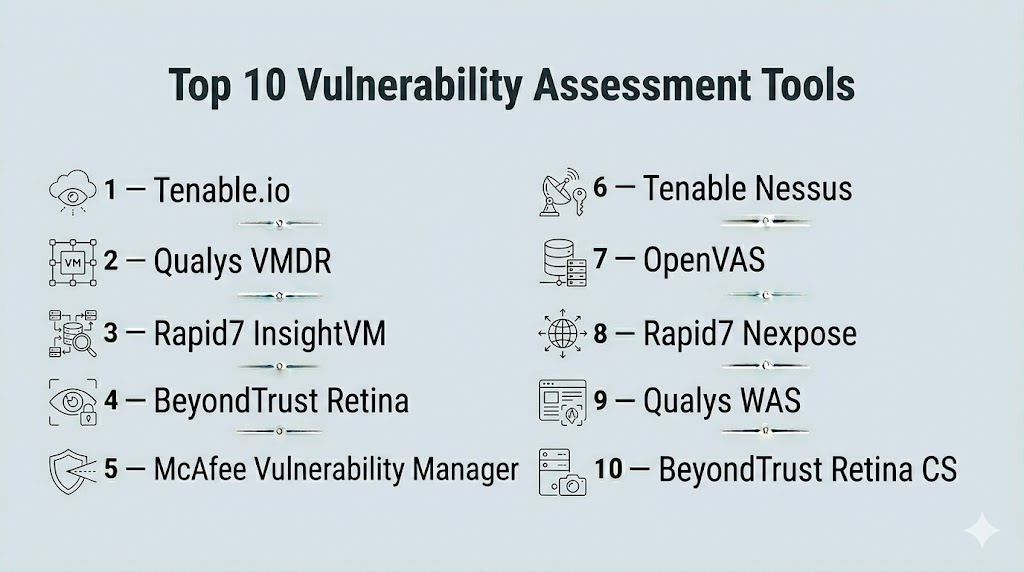
Top 10 Vulnerability Assessment Tools
#1 — Tenable.io
Short description : Tenable.io provides cloud-based vulnerability management, continuous monitoring, and risk-based prioritization for networks, cloud, and web applications. Ideal for enterprises and mid-market organizations.
Key Features
- Continuous vulnerability scanning
- Cloud and on-premises coverage
- Risk-based vulnerability prioritization
- Integration with SIEM/SOAR
- Detailed reporting and dashboards
- Asset discovery and inventory management
- API access for automation
Pros
- Comprehensive coverage
- Cloud-native, scalable solution
- Strong integration ecosystem
Cons
- Higher cost for full feature set
- Complexity for small teams
Platforms / Deployment
- Web / Windows / Linux
- Cloud / Hybrid
Security & Compliance
- SOC 2, ISO 27001, GDPR
- Audit logging, RBAC
Integrations & Ecosystem
- SIEM, SOAR, EDR integrations
- Patch management systems
- APIs for workflow automation
Support & Community
- Enterprise support, extensive documentation, active community forums
#2 — Qualys VMDR
Short description : Qualys Vulnerability Management, Detection, and Response (VMDR) is a cloud-native platform offering real-time vulnerability scanning and prioritization across IT assets.
Key Features
- Continuous vulnerability scanning
- Automated patch prioritization
- Cloud and on-premises coverage
- Integration with ticketing and SIEM systems
- Compliance reporting
- API access for automation
Pros
- Cloud-native and scalable
- Strong automation capabilities
- Detailed compliance reporting
Cons
- Steep learning curve
- Requires subscription for advanced features
Platforms / Deployment
- Web / Windows / Linux
- Cloud
Security & Compliance
- SOC 2, ISO 27001, GDPR
- MFA, encryption
Integrations & Ecosystem
- SIEM and SOAR platforms
- ITSM/ticketing tools
- APIs for automated workflows
Support & Community
- Enterprise support, knowledge base, user forums
#3 — Rapid7 InsightVM
Short description : InsightVM provides live vulnerability monitoring, risk prioritization, and automated remediation for networks, cloud, and endpoints. It targets enterprise security teams seeking real-time intelligence.
Key Features
- Live vulnerability and asset monitoring
- Risk-based prioritization
- Automated remediation workflows
- Integration with SIEM/SOAR
- Cloud and on-premises coverage
- Reporting and compliance dashboards
Pros
- Real-time monitoring
- Strong automation and remediation
- Intuitive interface
Cons
- Advanced features require configuration
- Premium pricing
Platforms / Deployment
- Web / Windows / Linux
- Cloud / Hybrid
Security & Compliance
- SOC 2, ISO 27001, GDPR
- Audit logging and RBAC
Integrations & Ecosystem
- SIEM, SOAR, ticketing systems
- APIs for automation
- Vulnerability feed integration
Support & Community
- Enterprise support, active documentation, forums
#4 — BeyondTrust Retina
Short description : Retina by BeyondTrust offers vulnerability assessment for networks, endpoints, and web applications with risk scoring and reporting capabilities for enterprise security teams.
Key Features
- Network and endpoint scanning
- Risk scoring and prioritization
- Compliance reporting
- Automated patch integration
- Asset discovery and management
Pros
- Comprehensive vulnerability coverage
- Integration with patch management
- Scalable for large networks
Cons
- Onboarding can be complex
- UI less intuitive than peers
Platforms / Deployment
- Web / Windows / Linux
- Cloud / Self-hosted
Security & Compliance
- SOC 2, ISO 27001
- Audit logs and encryption
Integrations & Ecosystem
- SIEM, SOAR, patch management
- APIs for automation
- Reporting systems
Support & Community
- Enterprise support, knowledge base, community forums
#5 — McAfee Vulnerability Manager
Short description : McAfee Vulnerability Manager offers automated scanning, asset discovery, and prioritization for enterprise networks and cloud infrastructures.
Key Features
- Automated vulnerability scanning
- Asset discovery
- Patch prioritization
- Integration with SIEM/SOAR
- Compliance reporting
Pros
- Integration with McAfee ecosystem
- Automation capabilities
- Broad asset coverage
Cons
- Limited reporting customization
- UI complexity for new users
Platforms / Deployment
- Web / Windows / Linux
- Cloud / Hybrid
Security & Compliance
- SOC 2, ISO 27001
- Audit logging
Integrations & Ecosystem
- SIEM, SOAR, patch management
- APIs and connectors
Support & Community
- Enterprise support, knowledge base, forums
#6 — Tenable Nessus
Short description : Nessus is a widely-used vulnerability scanner for endpoint and network security, suitable for mid-market and enterprise security teams.
Key Features
- Endpoint and network scanning
- Pre-configured vulnerability templates
- Risk prioritization
- Reporting and dashboards
- Integration with SIEM/SOAR
Pros
- Industry-standard scanner
- Fast and reliable scans
- Rich vulnerability database
Cons
- Limited automation for remediation
- Needs professional expertise for complex environments
Platforms / Deployment
- Windows / Linux / macOS
- Cloud / Self-hosted
Security & Compliance
- SOC 2, ISO 27001
- RBAC, encryption
Integrations & Ecosystem
- SIEM, SOAR, ticketing systems
- APIs for workflow integration
Support & Community
- Support plans, documentation, active forums
#7 — OpenVAS
Short description : OpenVAS is an open-source vulnerability scanner for networks and endpoints, providing risk detection and reporting for security teams with open-source expertise.
Key Features
- Network and host vulnerability scanning
- Risk scoring and prioritization
- Reporting and dashboards
- Plugin-based extensibility
Pros
- Free and open-source
- Flexible and extensible
- Active community support
Cons
- Steep learning curve
- Limited automation and reporting
Platforms / Deployment
- Linux / Windows / macOS
- Self-hosted
Security & Compliance
- Varies / N/A
Integrations & Ecosystem
- SIEM integrations possible
- Open-source APIs
- Plugin ecosystem
Support & Community
- Community forums, documentation, GitHub support
#8 — Rapid7 Nexpose
Short description : Nexpose is a vulnerability management solution that provides scanning, risk scoring, and reporting across networks and cloud assets.
Key Features
- Continuous scanning
- Risk-based prioritization
- Asset discovery
- Reporting dashboards
- Integration with SIEM/SOAR
Pros
- Real-time scanning
- Strong risk scoring
- Integration-friendly
Cons
- Premium features are costly
- Initial setup requires configuration
Platforms / Deployment
- Web / Windows / Linux
- Cloud / Hybrid
Security & Compliance
- SOC 2, ISO 27001
- Encryption, RBAC
Integrations & Ecosystem
- SIEM, SOAR, patching systems
- APIs for automation
Support & Community
- Enterprise support, documentation, forums
#9 — Qualys WAS
Short description : Qualys Web Application Scanning (WAS) assesses web applications for vulnerabilities, misconfigurations, and compliance gaps.
Key Features
- Automated web application scanning
- Risk scoring and prioritization
- Detailed compliance reporting
- Integration with SIEM/SOAR
Pros
- Effective web application scanning
- Cloud-native deployment
- Compliance-focused
Cons
- Limited network scanning capabilities
- Subscription-based pricing
Platforms / Deployment
- Web / Windows / Linux
- Cloud
Security & Compliance
- SOC 2, ISO 27001, GDPR
- Encryption, audit logs
Integrations & Ecosystem
- SIEM, SOAR, ticketing systems
- APIs for automated workflows
Support & Community
- Enterprise support, documentation, forums
#10 — BeyondTrust Retina CS
Short description : Retina CS provides vulnerability assessment and management for enterprise networks, endpoints, and cloud assets with risk-based prioritization.
Key Features
- Network and endpoint scanning
- Risk scoring and prioritization
- Patch management integration
- Reporting and dashboards
Pros
- Broad vulnerability coverage
- Integration with patching solutions
- Scalable for large organizations
Cons
- UI may be less intuitive
- Advanced reporting requires configuration
Platforms / Deployment
- Web / Windows / Linux
- Cloud / Self-hosted
Security & Compliance
- SOC 2, ISO 27001
- Audit logging, encryption
Integrations & Ecosystem
- SIEM, SOAR, patch management
- APIs for workflow automation
Support & Community
- Enterprise support, documentation, community forums
Comparison Table (Top 10)
| Tool Name | Best For | Platform(s) Supported | Deployment | Standout Feature | Public Rating |
|---|---|---|---|---|---|
| Tenable.io | Enterprise | Web, Windows, Linux | Cloud/Hybrid | AI-driven insights | N/A |
| Qualys VMDR | Mid-Market | Web, Windows, Linux | Cloud | Continuous scanning & patching | N/A |
| Rapid7 InsightVM | Enterprise | Web, Windows, Linux | Cloud/Hybrid | Real-time monitoring | N/A |
| BeyondTrust Retina | Enterprise | Web, Windows, Linux | Cloud/Self-hosted | Comprehensive risk scoring | N/A |
| McAfee Vulnerability Manager | Enterprise | Web, Windows, Linux | Cloud/Hybrid | Automation & integration | N/A |
| Tenable Nessus | Mid-Market | Windows, Linux, macOS | Cloud/Self-hosted | Industry-standard scanning | N/A |
| OpenVAS | SMB / Mid-Market | Linux, Windows, macOS | Self-hosted | Open-source flexibility | N/A |
| Rapid7 Nexpose | Mid-Market | Web, Windows, Linux | Cloud/Hybrid | Continuous scanning | N/A |
| Qualys WAS | Enterprise | Web, Windows, Linux | Cloud | Web application scanning | N/A |
| BeyondTrust Retina CS | Enterprise | Web, Windows, Linux | Cloud/Self-hosted | Broad vulnerability coverage | N/A |
Evaluation & Scoring of Vulnerability Assessment Tools
| Tool Name | Core (25%) | Ease (15%) | Integrations (15%) | Security (10%) | Performance (10%) | Support (10%) | Value (15%) | Weighted Total |
|---|---|---|---|---|---|---|---|---|
| Tenable.io | 10 | 9 | 10 | 9 | 9 | 9 | 8 | 9.2 |
| Qualys VMDR | 9 | 8 | 9 | 9 | 8 | 8 | 8 | 8.5 |
| Rapid7 InsightVM | 9 | 8 | 9 | 9 | 8 | 8 | 8 | 8.5 |
| BeyondTrust Retina | 8 | 8 | 8 | 8 | 8 | 8 | 7 | 7.9 |
| McAfee Vulnerability Manager | 8 | 8 | 8 | 8 | 8 | 8 | 7 | 7.9 |
| Tenable Nessus | 8 | 8 | 8 | 8 | 8 | 8 | 7 | 7.9 |
| OpenVAS | 7 | 7 | 7 | 7 | 7 | 7 | 8 | 7.2 |
| Rapid7 Nexpose | 8 | 8 | 8 | 8 | 8 | 8 | 7 | 7.9 |
| Qualys WAS | 8 | 8 | 8 | 8 | 8 | 8 | 7 | 7.9 |
| BeyondTrust Retina CS | 8 | 8 | 8 | 8 | 8 | 8 | 7 | 7.9 |
Interpretation: Higher scores indicate better coverage, integration, and usability relative to peers. Organizations should use this comparative scoring to select tools aligned with SOC size, regulatory needs, and remediation workflow capabilities.
Which Vulnerability Assessment Tools Tool Is Right for You?
Solo / Freelancer
Open-source tools like OpenVAS offer cost-effective scanning for smaller networks and endpoints.
SMB
Mid-market tools such as Tenable Nessus or Rapid7 Nexpose provide comprehensive vulnerability scanning without enterprise complexity.
Mid-Market
Solutions like Qualys VMDR or Rapid7 InsightVM deliver real-time monitoring, patch prioritization, and reporting suited for mid-size IT teams.
Enterprise
Tenable.io, BeyondTrust Retina, and McAfee Vulnerability Manager provide enterprise-grade coverage, analytics, and integration capabilities.
Budget vs Premium
Cloud-based and open-source solutions reduce costs, while premium enterprise solutions offer advanced analytics, automation, and compliance reporting.
Feature Depth vs Ease of Use
Enterprise tools deliver comprehensive scanning and reporting but may require dedicated security expertise. Mid-market solutions balance features and ease of use.
Integrations & Scalability
TIPs with robust SIEM, SOAR, and patch management integrations allow seamless scaling of vulnerability management programs.
Security & Compliance Needs
Organizations with strict regulatory requirements should prioritize tools with compliance reporting, audit trails, and secure data handling.
Frequently Asked Questions (FAQs)
1. What is a Vulnerability Assessment Tool?
A vulnerability assessment tool scans IT assets to detect weaknesses, misconfigurations, and missing patches, providing actionable insights to strengthen security posture.
2. How often should I perform vulnerability assessments?
Continuous monitoring is recommended, though many organizations run full scans weekly or monthly, with real-time alerts for critical issues.
3. Can small businesses use enterprise-grade tools?
Yes, but open-source or mid-market solutions are often more cost-effective and easier to manage for smaller IT teams.
4. Do these tools integrate with SIEM/SOAR platforms?
Most enterprise and mid-market tools offer integrations to feed vulnerability data into SIEM or trigger automated SOAR workflows.
5. Are vulnerability assessments sufficient for compliance?
They are a critical component but should be complemented with patch management, access controls, and policy enforcement to meet full compliance requirements.
6. How do these tools prioritize vulnerabilities?
They use risk scoring based on severity, asset criticality, exploit availability, and threat intelligence to rank remediation priorities.
7. Can vulnerability scanners detect zero-day threats?
While most scanners detect known vulnerabilities, zero-day detection relies on behavioral analytics and integration with threat intelligence feeds.
8. What deployment models are available?
Cloud, hybrid, and self-hosted deployment options exist, allowing organizations to align with infrastructure and security policies.
9. Is automation supported for remediation?
Many tools provide APIs or integrations to trigger patching or ticketing workflows, reducing manual intervention.
10. What is the cost range for these tools?
Costs vary from free open-source scanners to premium enterprise subscriptions with advanced analytics, cloud integration, and automation.
Conclusion
Vulnerability Assessment Tools are essential for proactively managing security risks across networks, endpoints, and applications. They provide actionable insights to prevent exploits, reduce attack surfaces, and ensure compliance. Selection depends on organizational scale, security maturity, and integration needs. Smaller organizations can benefit from open-source or mid-market solutions, while enterprises require comprehensive, automated, and integrative platforms like Tenable.io, Qualys VMDR, or Rapid7 InsightVM. To maximize security posture, organizations should pilot selected tools, validate integration with SIEM/SOAR workflows, and continuously monitor vulnerabilities to safeguard digital assets.

Find Trusted Cardiac Hospitals
Compare heart hospitals by city and services — all in one place.
Explore Hospitals
Vulnerability scans can produce a long list of findings, but not every issue needs the same level of attention. It helps when teams consider the affected system and real business impact before deciding what to fix first. This makes remediation more focused and avoids spending too much time on low-risk findings.