Introduction
Penetration Testing Tools are specialized cybersecurity solutions that simulate real-world attacks to identify vulnerabilities in networks, applications, and systems before malicious actors can exploit them. These tools enable security teams to assess the effectiveness of security controls, uncover weaknesses, and prioritize remediation efforts. In the rapidly evolving threat landscape of penetration testing is no longer optional—it is a critical element of a proactive security strategy.Real-world use cases include network penetration testing, web application security assessments, internal endpoint testing, cloud infrastructure security checks, and compliance verification for standards like PCI DSS, ISO 27001, and HIPAA. Effective penetration testing tools provide automation, reporting, and integration capabilities to streamline vulnerability management workflows.
Key evaluation criteria include coverage (network, endpoint, web, cloud), ease of use, automation features, integration with security platforms (SIEM, SOAR, vulnerability management), reporting and analytics, compliance support, scalability, real-time updates, threat intelligence integration, and cost.
Best for: IT security teams, ethical hackers, compliance officers, and enterprises needing robust security assessments.
Not ideal for: Small organizations without dedicated security staff or limited digital infrastructure; simpler vulnerability scanners may suffice.
Key Trends in Penetration Testing Tools
- AI and machine learning to identify novel attack vectors
- Automated testing workflows and continuous pen-testing
- Integration with SIEM, SOAR, and vulnerability management platforms
- Cloud-native and hybrid testing capabilities
- Compliance reporting for PCI DSS, HIPAA, and GDPR
- Threat intelligence feeds to inform testing scenarios
- Scenario-based and real-world attack simulations
- Remote testing for distributed IT environments
- Subscription-based and usage-based pricing models
- Enhanced dashboards for collaborative team analysis
How We Selected These Tools (Methodology)
- Market adoption and mindshare across industries
- Feature completeness and attack simulation coverage
- Accuracy, reliability, and performance in real-world tests
- Security posture and compliance support
- Integrations with SIEM, SOAR, and vulnerability management tools
- Ease of deployment and use
- Scalability for enterprise environments
- Vendor support and active community
- Frequency of updates and access to threat intelligence
- Value relative to features and enterprise needs
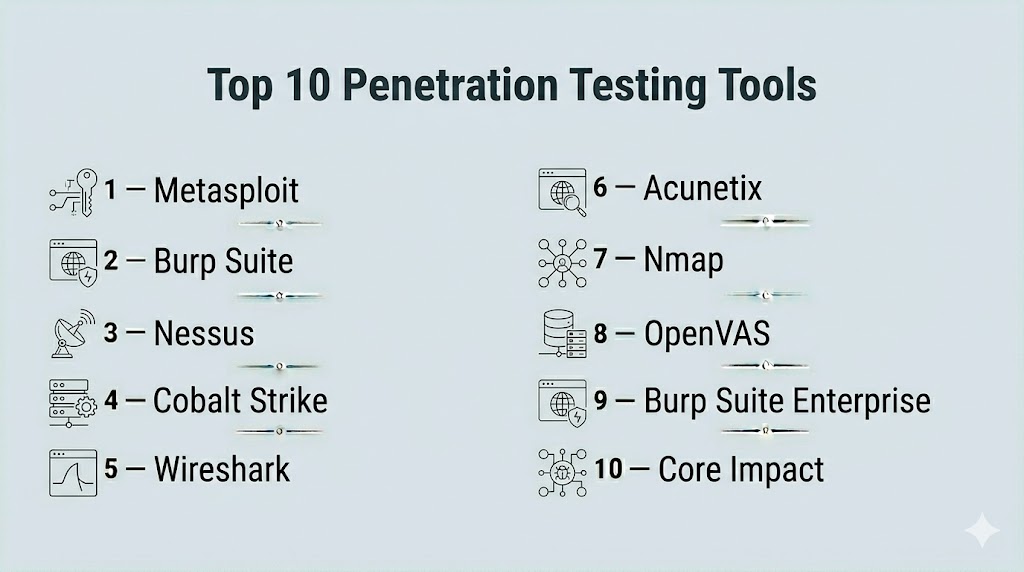
Top 10 Penetration Testing Tools
#1 — Metasploit
Short description : Metasploit is a leading penetration testing framework for ethical hackers, providing extensive exploit modules, payloads, and auxiliary tools to simulate attacks on networks, systems, and applications.
Key Features
- Large library of exploits and payloads
- Network and web application testing
- Integration with vulnerability scanners
- Automated attack simulations
- Reporting and session management
- Community and commercial support
Pros
- Highly extensible and customizable
- Strong community and resource support
- Free and commercial editions available
Cons
- Requires technical expertise to use effectively
- Can be complex for beginners
Platforms / Deployment
- Windows / Linux / macOS
- Self-hosted
Security & Compliance
- Not publicly stated
Integrations & Ecosystem
- Integration with Nessus, OpenVAS, and SIEMs
- APIs for custom scripting
- Plugin ecosystem for new exploits
Support & Community
- Extensive documentation, active forums, commercial support available
#2 — Burp Suite
Short description : Burp Suite is a web application security testing platform widely used by security professionals to identify vulnerabilities like SQL injection, XSS, and authentication flaws.
Key Features
- Proxy and web traffic interception
- Automated vulnerability scanning
- Repeater and intruder tools for attack simulation
- Reporting and analytics
- Extensible via plugins and API
Pros
- Industry-standard for web app security
- Comprehensive testing features
- Active plugin marketplace
Cons
- Premium version required for full automation
- Learning curve for advanced features
Platforms / Deployment
- Windows / Linux / macOS
- Self-hosted
Security & Compliance
- Not publicly stated
Integrations & Ecosystem
- APIs for CI/CD integration
- Integration with bug tracking and SIEM tools
- Extensible via BApps marketplace
Support & Community
- Documentation, forums, and professional training available
#3 — Nessus
Short description : Nessus is a widely used vulnerability assessment and penetration testing tool for identifying security weaknesses across endpoints, networks, and applications.
Key Features
- Pre-configured vulnerability templates
- Endpoint and network scanning
- Compliance reporting for multiple standards
- Risk prioritization
- Integration with SIEM and patch management
Pros
- Fast and accurate scanning
- Industry-recognized vulnerability coverage
- Scalable for enterprise environments
Cons
- Limited exploit simulation
- Premium features require subscription
Platforms / Deployment
- Windows / Linux / macOS
- Cloud / Self-hosted
Security & Compliance
- SOC 2, ISO 27001
- Audit logs, RBAC
Integrations & Ecosystem
- SIEM and SOAR integrations
- Patch management systems
- APIs for automation
Support & Community
- Commercial support, documentation, and forums
#4 — Cobalt Strike
Short description : Cobalt Strike is a commercial penetration testing tool used for advanced threat simulation and red team exercises, offering post-exploitation and command-and-control capabilities.
Key Features
- Advanced threat emulation
- Post-exploitation tools
- Team collaboration for red team exercises
- Reporting and session management
- Integration with Metasploit
Pros
- Realistic threat simulations
- Ideal for red team operations
- Customizable attack scenarios
Cons
- High cost
- Requires advanced security expertise
Platforms / Deployment
- Windows / Linux
- Self-hosted
Security & Compliance
- Not publicly stated
Integrations & Ecosystem
- Metasploit integration
- APIs for automated workflows
- SIEM integration possible
Support & Community
- Commercial support, documentation, training programs
#5 — Wireshark
Short description : Wireshark is a network protocol analyzer used in penetration testing to capture and analyze network traffic to identify vulnerabilities and suspicious activity.
Key Features
- Deep packet inspection
- Real-time traffic analysis
- Protocol decoding
- Filters and custom scripts
- Integration with other testing tools
Pros
- Free and open-source
- Industry standard for network analysis
- Detailed traffic insights
Cons
- Does not perform automated exploit testing
- Steep learning curve for beginners
Platforms / Deployment
- Windows / Linux / macOS
- Self-hosted
Security & Compliance
- Not publicly stated
Integrations & Ecosystem
- Integration with penetration frameworks
- Supports plugins and scripting
- SIEM data export
Support & Community
- Extensive community, tutorials, forums
#6 — Acunetix
Short description : Acunetix is a web vulnerability scanner that automates web application penetration testing, identifying security issues such as XSS, SQL injection, and misconfigurations.
Key Features
- Automated web scanning
- Vulnerability detection and reporting
- CI/CD integration
- Authentication testing
- Compliance reporting
Pros
- Automated and easy to use
- Detailed vulnerability reports
- Integration with DevOps pipelines
Cons
- Focused mainly on web applications
- Premium features are subscription-based
Platforms / Deployment
- Windows / Linux / macOS
- Cloud / Self-hosted
Security & Compliance
- GDPR, PCI DSS reporting
- Audit logs
Integrations & Ecosystem
- CI/CD tools
- Bug tracking systems
- APIs for automation
Support & Community
- Professional support, documentation, community forums
#7 — Nmap
Short description : Nmap is an open-source network scanning tool used in penetration testing to discover hosts, services, and vulnerabilities on a network.
Key Features
- Host discovery and port scanning
- Service enumeration
- OS detection
- Scripting engine for custom checks
- Integration with other tools
Pros
- Free and flexible
- Extensive network discovery capabilities
- Scripting engine for automation
Cons
- Does not provide exploit simulation
- Requires technical expertise
Platforms / Deployment
- Windows / Linux / macOS
- Self-hosted
Security & Compliance
- Not publicly stated
Integrations & Ecosystem
- Integration with Metasploit and SIEM
- Custom scripts via Nmap Scripting Engine
- Open-source plugin ecosystem
Support & Community
- Community-driven support, forums, documentation
#8 — OpenVAS
Short description : OpenVAS is an open-source vulnerability scanner and penetration testing tool providing network and host assessments with reporting and risk scoring.
Key Features
- Network and host scanning
- Risk scoring and prioritization
- Reporting and dashboards
- Plugin-based extensibility
Pros
- Free and open-source
- Flexible and extensible
- Active community
Cons
- Steep learning curve
- Less automation compared to commercial solutions
Platforms / Deployment
- Linux / Windows / macOS
- Self-hosted
Security & Compliance
- Not publicly stated
Integrations & Ecosystem
- SIEM integrations
- API for automation
- Plugin ecosystem
Support & Community
- Community forums, documentation
#9 — Burp Suite Enterprise
Short description : Burp Suite Enterprise is designed for automated web application penetration testing at scale, focusing on continuous scanning in enterprise environments.
Key Features
- Automated web vulnerability scanning
- CI/CD integration
- Centralized reporting
- Role-based access control
- API for automation
Pros
- Scalable for enterprise use
- Automated scanning reduces manual effort
- Compliance-focused reporting
Cons
- Premium licensing cost
- Requires setup and configuration
Platforms / Deployment
- Windows / Linux / macOS
- Cloud / Self-hosted
Security & Compliance
- SOC 2, ISO 27001
- Audit logs, RBAC
Integrations & Ecosystem
- CI/CD pipelines
- Bug trackers and SIEM
- API-based automation
Support & Community
- Enterprise support, documentation, training
#10 — Core Impact
Short description : Core Impact is a commercial penetration testing platform for simulating real-world attacks across networks, applications, and endpoints to assess security posture.
Key Features
- Network, endpoint, and web application testing
- Pre-built attack scenarios
- Automated reporting
- Integration with SIEM/SOAR
- Risk scoring and prioritization
Pros
- Comprehensive penetration testing
- Advanced attack simulation
- Detailed reporting
Cons
- High cost
- Requires experienced security personnel
Platforms / Deployment
- Windows / Linux / macOS
- Cloud / Self-hosted
Security & Compliance
- Not publicly stated
Integrations & Ecosystem
- SIEM, SOAR, patch management integration
- API for automation
- Plugin ecosystem
Support & Community
- Enterprise support, professional training, documentation
Comparison Table (Top 10)
| Tool Name | Best For | Platform(s) Supported | Deployment | Standout Feature | Public Rating |
|---|---|---|---|---|---|
| Metasploit | Enterprise | Windows, Linux, macOS | Self-hosted | Extensive exploit library | N/A |
| Burp Suite | Web Security Teams | Windows, Linux, macOS | Self-hosted | Web vulnerability testing | N/A |
| Nessus | Enterprise / Mid-Market | Windows, Linux, macOS | Cloud/Self-hosted | Fast and accurate scanning | N/A |
| Cobalt Strike | Red Teams | Windows, Linux | Self-hosted | Post-exploitation simulation | N/A |
| Wireshark | Network Analysts | Windows, Linux, macOS | Self-hosted | Deep packet inspection | N/A |
| Acunetix | Web Security | Windows, Linux, macOS | Cloud/Self-hosted | Automated web scanning | N/A |
| Nmap | Security Engineers | Windows, Linux, macOS | Self-hosted | Network discovery | N/A |
| OpenVAS | SMB / Mid-Market | Windows, Linux, macOS | Self-hosted | Open-source flexibility | N/A |
| Burp Suite Enterprise | Enterprise | Windows, Linux, macOS | Cloud/Self-hosted | Automated enterprise scanning | N/A |
| Core Impact | Enterprise | Windows, Linux, macOS | Cloud/Self-hosted | Comprehensive attack simulation | N/A |
Evaluation & Scoring of Penetration Testing Tools
| Tool Name | Core (25%) | Ease (15%) | Integrations (15%) | Security (10%) | Performance (10%) | Support (10%) | Value (15%) | Weighted Total |
|---|---|---|---|---|---|---|---|---|
| Metasploit | 10 | 8 | 9 | 8 | 9 | 8 | 8 | 8.9 |
| Burp Suite | 9 | 8 | 9 | 8 | 8 | 8 | 8 | 8.4 |
| Nessus | 9 | 8 | 8 | 8 | 8 | 8 | 8 | 8.3 |
| Cobalt Strike | 9 | 7 | 8 | 8 | 8 | 7 | 7 | 7.9 |
| Wireshark | 8 | 7 | 7 | 8 | 8 | 7 | 9 | 7.8 |
| Acunetix | 9 | 8 | 8 | 8 | 8 | 8 | 7 | 8.2 |
| Nmap | 8 | 7 | 7 | 7 | 7 | 7 | 9 | 7.6 |
| OpenVAS | 7 | 7 | 7 | 7 | 7 | 7 | 8 | 7.1 |
| Burp Suite Enterprise | 9 | 8 | 8 | 8 | 8 | 8 | 7 | 8.2 |
| Core Impact | 9 | 7 | 8 | 8 | 8 | 7 | 7 | 7.9 |
Interpretation: Higher scores reflect stronger capabilities in core penetration testing functions, integration, and overall value. Organizations should use this comparative scoring to align tool selection with team expertise and security requirements.
Which Penetration Testing Tools Tool Is Right for You?
Solo / Freelancer
Open-source tools like Nmap or OpenVAS provide cost-effective options for individual security assessments.
SMB
Tools like Nessus or Acunetix offer automation and scalability suitable for small and mid-sized organizations.
Mid-Market
Burp Suite and Metasploit balance usability with feature depth, ideal for growing security teams.
Enterprise
Core Impact, Cobalt Strike, and Burp Suite Enterprise provide comprehensive testing, realistic attack simulations, and integration capabilities for enterprise security operations.
Budget vs Premium
Open-source options reduce upfront cost, while commercial enterprise solutions offer advanced automation, integration, and reporting.
Feature Depth vs Ease of Use
Enterprise tools provide deep capabilities but require security expertise, whereas mid-market and SMB-focused solutions prioritize usability and automation.
Integrations & Scalability
Enterprise penetration testing platforms integrate with SIEM, SOAR, and vulnerability management systems to scale security testing programs.
Security & Compliance Needs
Organizations with strict regulatory requirements should prioritize tools with audit logs, compliance reporting, and secure access controls.
Frequently Asked Questions (FAQs)
1. What is a penetration testing tool?
A penetration testing tool simulates cyberattacks to identify vulnerabilities in networks, endpoints, and applications, helping organizations improve security posture.
2. How often should penetration tests be conducted?
Organizations typically conduct tests quarterly or after major system changes; continuous monitoring is recommended for critical systems.
3. Can small businesses use enterprise-grade tools?
Yes, but open-source or mid-market solutions are often more cost-effective and easier to manage.
4. Do these tools integrate with SIEM/SOAR platforms?
Most commercial tools provide integration capabilities to feed findings into SIEM and SOAR platforms for automation.
5. Are penetration tests sufficient for compliance?
They are a vital component but should be combined with vulnerability management, access control, and monitoring for full compliance.
6. Can these tools detect zero-day vulnerabilities?
Detection of zero-day vulnerabilities depends on AI-driven analytics and threat intelligence integration; traditional scanners cover known vulnerabilities.
7. What deployment options are available?
Options include cloud-based, self-hosted, and hybrid deployments, depending on organizational policies.
8. Is automation supported in penetration testing?
Enterprise tools offer automation for scanning, reporting, and integrating with CI/CD workflows.
9. How do I choose the right tool?
Consider team expertise, deployment needs, asset coverage, integration requirements, and budget constraints.
10. What are common mistakes in penetration testing?
Common mistakes include insufficient scope, infrequent testing, lack of integration with security workflows, and inadequate remediation follow-up.
Conclusion
Penetration Testing Tools are indispensable for proactively identifying and mitigating security vulnerabilities. Selecting the right tool depends on organizational size, technical expertise, regulatory needs, and integration requirements. Open-source tools like Nmap and OpenVAS suit freelancers and SMBs, while enterprise-grade platforms like Core Impact, Cobalt Strike, and Burp Suite Enterprise deliver advanced automation, realistic attack simulations, and seamless integration with SIEM and SOAR systems. Organizations should pilot multiple tools, validate integration capabilities, and implement continuous testing workflows to ensure robust cybersecurity.

Find Trusted Cardiac Hospitals
Compare heart hospitals by city and services — all in one place.
Explore Hospitals
Penetration testing is more useful when teams also check what happens after a vulnerability is found. Fixing the issue is important, but it helps to test the same weakness again after the fix to make sure it is actually resolved. Keeping a record of these follow-up checks can make security testing much more effective.