Introduction
Water Quality Monitoring Software helps organizations track, measure, and analyze water parameters in real time or over historical periods. It is designed to provide actionable insights for ensuring water safety, compliance, and operational efficiency. With increasing environmental regulations, public health concerns, and industrial process requirements, these platforms are essential for water utilities, industrial operations, municipal monitoring, and environmental research.
Real-world use cases include:
- Municipal water safety: Continuous monitoring of city water supplies for contaminants like bacteria, heavy metals, and pH fluctuations.
- Industrial process control: Tracking water quality for manufacturing processes, cooling systems, and chemical treatments.
- Environmental monitoring: Assessing lakes, rivers, and groundwater for pollution levels or ecological impact studies.
- Agricultural water management: Optimizing irrigation quality and preventing crop contamination.
- Regulatory compliance reporting: Automating reports for agencies and certifications, ensuring adherence to local and international standards.
Evaluation Criteria for Buyers:
- Real-time monitoring and alerts
- Historical data analytics and reporting
- Sensor and device integration capabilities
- AI or predictive analytics support
- Regulatory compliance and certification support
- User interface and ease of use
- Scalability for large networks or multiple sites
- Security and access control
- Mobile or remote monitoring capabilities
- Integration with ERP or environmental platforms
Best for: Municipal water authorities, industrial operators, environmental agencies, and agricultural enterprises. Ideal for teams needing centralized monitoring with automated alerts.
Not ideal for: Small-scale water users, hobbyists, or organizations without regulatory reporting needs. Simple manual testing may suffice in these cases.
Key Trends in Water Quality Monitoring Software
- Adoption of AI-driven predictive analytics for early contamination detection.
- Integration with IoT sensors and smart meters for continuous real-time monitoring.
- Use of cloud-based dashboards for remote and multi-site visibility.
- Emphasis on regulatory compliance automation (EPA, WHO, ISO standards).
- Increasing mobile app support for field operators.
- Deployment of low-maintenance wireless sensor networks to reduce operational costs.
- Integration with environmental and industrial ERP systems for holistic insights.
- Advanced data visualization and anomaly detection features.
- Adoption of blockchain-based data integrity for compliance reporting.
- Flexible subscription-based pricing and SaaS delivery models.
How We Selected These Tools (Methodology)
- Market adoption and industry mindshare.
- Comprehensive feature sets including AI, IoT, and reporting capabilities.
- Reliability and uptime performance metrics.
- Security posture including authentication, encryption, and access controls.
- Integration ecosystem with sensors, ERP, and analytics tools.
- Customer fit across small, mid-market, and enterprise segments.
- Ease of deployment and platform flexibility (cloud, on-premise, hybrid).
- Vendor support and community strength.
- Scalability for large water networks or multiple sites.
- Data visualization, anomaly detection, and alerting capabilities.
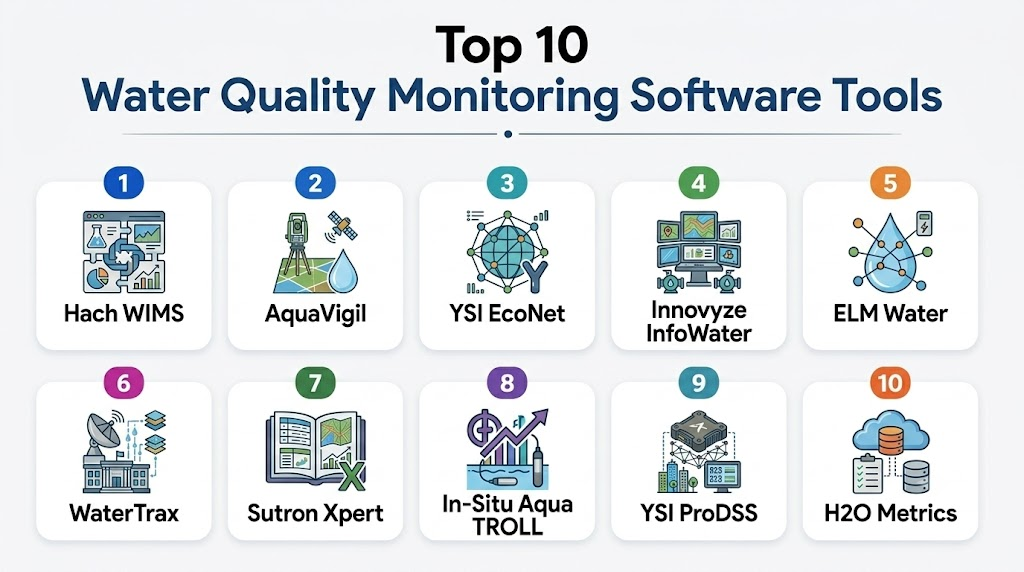
Top 10 Water Quality Monitoring Software Tools
1- Hach WIMS
Short description: Hach WIMS provides comprehensive water quality management for utilities, industrial, and environmental applications, supporting real-time monitoring and historical data analysis.
Key Features
- Real-time data capture from sensors
- Automated compliance reporting
- Data visualization dashboards
- Predictive analytics for maintenance
- Integration with SCADA and IoT sensors
- Mobile and web access
Pros
- Strong regulatory compliance tools
- Scalable for large water networks
- Advanced reporting and analytics
Cons
- Can be complex to configure
- Higher initial cost
- Requires specialized training
Platforms / Deployment
- Web / Windows / iOS / Android
- Cloud / Hybrid
Security & Compliance
- Not publicly stated
Integrations & Ecosystem
- Integrates with SCADA, IoT devices, laboratory instruments
- APIs for custom dashboards
- Supports industrial and municipal water systems
Support & Community
- Comprehensive vendor support, documentation, and training resources
2- AquaVigil
Short description: AquaVigil offers continuous water quality monitoring with a focus on industrial and municipal water safety, delivering alerts and predictive insights.
Key Features
- IoT sensor integration
- Automated alerts for anomalies
- Data logging and historical analysis
- Cloud dashboards with real-time visibility
- Predictive contamination modeling
Pros
- Easy deployment and mobile access
- Strong anomaly detection
- Supports regulatory compliance
Cons
- Limited offline capabilities
- Subscription cost may be high
- Fewer integrations with legacy systems
Platforms / Deployment
- Web / iOS / Android
- Cloud
Security & Compliance
- Not publicly stated
Integrations & Ecosystem
- Supports third-party sensors
- API access for ERP and environmental systems
- Real-time alerting ecosystem
Support & Community
- Vendor provides training, email, and phone support
3- YSI EcoNet
Short description: EcoNet delivers cloud-based water quality management, primarily for environmental monitoring, research, and field data collection.
Key Features
- Field data capture from YSI sensors
- Cloud-based data storage and visualization
- Automated alerts and trend analysis
- Integration with lab instruments
- Mobile access for field teams
Pros
- Strong for research and environmental studies
- Easy mobile deployment
- Extensive sensor compatibility
Cons
- Limited industrial features
- Some advanced analytics require add-ons
- Dependence on proprietary sensors
Platforms / Deployment
- Web / iOS / Android
- Cloud
Security & Compliance
- Not publicly stated
Integrations & Ecosystem
- Integrates with YSI devices, lab instruments, third-party APIs
Support & Community
- Vendor offers tutorials, documentation, and support tiers
4- Innovyze InfoWater
Short description: InfoWater specializes in urban water networks and utilities, enabling advanced modeling, analysis, and monitoring for water quality and infrastructure.
Key Features
- Hydraulic and water quality modeling
- Simulation for contamination events
- Real-time sensor data integration
- Scenario planning and predictive analysis
- Dashboard visualization
Pros
- Excellent for municipal water systems
- Strong modeling and simulation
- Comprehensive reporting
Cons
- Steeper learning curve
- Cost may be prohibitive for SMBs
- Requires advanced technical skills
Platforms / Deployment
- Windows / Web
- On-premise / Cloud
Security & Compliance
- Not publicly stated
Integrations & Ecosystem
- Integrates with SCADA, GIS, IoT sensors
- API access for data exchange
Support & Community
- Extensive documentation, professional services, and user community
5- ELM Water
Short description: ELM Water offers modular monitoring solutions for industrial and municipal water, including IoT integration, analytics, and compliance reporting.
Key Features
- Modular IoT sensor networks
- Predictive maintenance alerts
- Cloud dashboards and mobile monitoring
- Compliance tracking and reporting
- Data logging and analytics
Pros
- Flexible deployment for SMBs and enterprises
- Strong predictive maintenance features
- Easy to scale
Cons
- Customization may require vendor support
- Limited offline capabilities
- Some integrations are vendor-specific
Platforms / Deployment
- Web / iOS / Android
- Cloud / Hybrid
Security & Compliance
- Not publicly stated
Integrations & Ecosystem
- IoT sensors, third-party lab instruments, ERP integration
- API access
Support & Community
- Vendor support, onboarding, and training available
6- WaterTrax
Short description: WaterTrax provides cloud-based environmental and industrial water monitoring, combining real-time alerts with comprehensive reporting.
Key Features
- Real-time sensor integration
- Automated compliance reporting
- Customizable dashboards
- Mobile and remote access
- Historical trend analysis
Pros
- Easy to use and deploy
- Regulatory compliance focused
- Cloud-first platform
Cons
- Some advanced analytics require premium plans
- Limited modeling features
- Offline access is limited
Platforms / Deployment
- Web / iOS / Android
- Cloud
Security & Compliance
- Not publicly stated
Integrations & Ecosystem
- Sensor networks, laboratory instruments, reporting systems
- API available for custom workflows
Support & Community
- Documentation and vendor support available
7- Sutron Xpert
Short description: Xpert offers environmental water monitoring, emphasizing remote sensing, telemetry, and alerting for field teams and researchers.
Key Features
- Telemetry and remote monitoring
- Cloud-based data visualization
- Custom alerts for water parameters
- Historical analysis and trend reporting
- Integration with field sensors
Pros
- Strong for environmental agencies
- Mobile and web access
- Reliable remote telemetry
Cons
- Industrial process features are limited
- Vendor-dependent sensor ecosystem
- Learning curve for setup
Platforms / Deployment
- Web / iOS / Android
- Cloud
Security & Compliance
- Not publicly stated
Integrations & Ecosystem
- Supports Sutron devices, IoT sensors, APIs
Support & Community
- Vendor support and user forums available
8- In-Situ Aqua TROLL
Short description: Aqua TROLL focuses on field water monitoring, offering sensor-to-cloud capabilities with dashboards for environmental and industrial data.
Key Features
- Sensor integration and telemetry
- Real-time cloud dashboards
- Predictive alerts and notifications
- Mobile field apps
- Historical data analytics
Pros
- Easy field deployment
- Good for research and industrial monitoring
- Sensor accuracy is strong
Cons
- Limited enterprise features
- Custom reporting may require vendor assistance
- Proprietary sensors may limit flexibility
Platforms / Deployment
- Web / iOS / Android
- Cloud
Security & Compliance
- Not publicly stated
Integrations & Ecosystem
- IoT sensors, telemetry devices, cloud API integration
Support & Community
- Documentation and vendor support
9- YSI ProDSS
Short description: ProDSS delivers portable water monitoring with real-time analytics for field sampling, environmental research, and regulatory reporting.
Key Features
- Portable multi-parameter sensors
- Data logging and mobile dashboards
- Automated alerts for thresholds
- Cloud synchronization
- Historical trend analysis
Pros
- Highly portable and field-friendly
- Quick setup and easy data capture
- Strong environmental monitoring
Cons
- Limited multi-site enterprise dashboards
- Advanced analytics require add-ons
- Proprietary hardware
Platforms / Deployment
- Web / iOS / Android
- Cloud
Security & Compliance
- Not publicly stated
Integrations & Ecosystem
- Cloud API, sensor devices, mobile data collection
Support & Community
- Vendor support and user guides
10- H2O Metrics
Short description: H2O Metrics provides comprehensive water quality management for industrial and municipal users, offering cloud dashboards and predictive insights.
Key Features
- Real-time sensor data
- Compliance tracking and reporting
- Predictive maintenance alerts
- Historical analysis and dashboards
- Mobile access
Pros
- User-friendly interface
- Scalable for multiple sites
- Supports predictive insights
Cons
- Integration options limited
- Offline mode limited
- Some analytics require premium plan
Platforms / Deployment
- Web / iOS / Android
- Cloud
Security & Compliance
- Not publicly stated
Integrations & Ecosystem
- IoT sensors, ERP integration, cloud APIs
Support & Community
- Vendor support and onboarding resources
Comparison Table (Top 10)
| Tool Name | Best For | Platform(s) Supported | Deployment | Standout Feature | Public Rating |
|---|---|---|---|---|---|
| Hach WIMS | Municipal/Industrial | Web, Windows, iOS, Android | Cloud / Hybrid | Compliance & analytics | N/A |
| AquaVigil | Industrial/Municipal | Web, iOS, Android | Cloud | Predictive alerts | N/A |
| YSI EcoNet | Environmental research | Web, iOS, Android | Cloud | Field sensor integration | N/A |
| Innovyze InfoWater | Urban utilities | Web, Windows | Cloud / On-prem | Hydraulic modeling | N/A |
| ELM Water | Industrial/SMB | Web, iOS, Android | Cloud / Hybrid | Modular IoT networks | N/A |
| WaterTrax | Environmental/Industrial | Web, iOS, Android | Cloud | Automated compliance reporting | N/A |
| Sutron Xpert | Environmental agencies | Web, iOS, Android | Cloud | Remote telemetry | N/A |
| In-Situ Aqua TROLL | Field monitoring | Web, iOS, Android | Cloud | Sensor-to-cloud dashboards | N/A |
| YSI ProDSS | Field & portable monitoring | Web, iOS, Android | Cloud | Portable multi-parameter sensors | N/A |
| H2O Metrics | Industrial/Municipal | Web, iOS, Android | Cloud | Predictive insights | N/A |
Evaluation & Scoring of Water Quality Monitoring Software
| Tool Name | Core (25%) | Ease (15%) | Integrations (15%) | Security (10%) | Performance (10%) | Support (10%) | Value (15%) | Weighted Total |
|---|---|---|---|---|---|---|---|---|
| Hach WIMS | 9 | 7 | 8 | 6 | 8 | 8 | 7 | 8.0 |
| AquaVigil | 8 | 8 | 7 | 6 | 7 | 7 | 7 | 7.5 |
| YSI EcoNet | 7 | 8 | 7 | 6 | 7 | 7 | 7 | 7.2 |
| Innovyze InfoWater | 9 | 6 | 8 | 6 | 8 | 7 | 6 | 7.7 |
| ELM Water | 8 | 8 | 7 | 6 | 7 | 7 | 7 | 7.5 |
| WaterTrax | 7 | 8 | 7 | 6 | 7 | 7 | 7 | 7.2 |
| Sutron Xpert | 7 | 7 | 7 | 6 | 7 | 7 | 6 | 6.9 |
| In-Situ Aqua TROLL | 7 | 8 | 7 | 6 | 7 | 7 | 6 | 7.1 |
| YSI ProDSS | 7 | 8 | 7 | 6 | 7 | 7 | 6 | 7.1 |
| H2O Metrics | 8 | 8 | 7 | 6 | 7 | 7 | 7 | 7.5 |
Which Water Quality Monitoring Software Tool Is Right for You?
Solo / Freelancer
Lightweight platforms like YSI EcoNet or ProDSS are ideal for small-scale monitoring or environmental research.
SMB
Tools like AquaVigil or ELM Water offer modular deployment and cloud dashboards suited for small municipal utilities or industrial sites.
Mid-Market
WaterTrax and H2O Metrics provide robust analytics, predictive alerts, and compliance reporting suitable for growing water networks.
Enterprise
Hach WIMS and Innovyze InfoWater deliver large-scale integration, modeling, and regulatory compliance for extensive municipal or industrial operations.
Budget vs Premium
- Budget-conscious users may prioritize cloud SaaS options with modular sensors.
- Premium buyers benefit from predictive analytics, simulation, and advanced compliance automation.
Feature Depth vs Ease of Use
- Field or environmental teams may favor intuitive dashboards with mobile access.
- Complex municipal or industrial networks benefit from deep modeling and integration capabilities.
Integrations & Scalability
Select tools that support IoT sensors, SCADA, ERP, and lab instruments for future-proof scaling across multiple sites.
Security & Compliance Needs
For regulated industries, focus on platforms with strong access control, encrypted data storage, and reporting features.
Frequently Asked Questions (FAQs)
1- What pricing models are common?
Most platforms use subscription-based SaaS pricing, sometimes with sensor or module-based add-ons. Enterprise licenses vary widely.
2- How difficult is onboarding?
Ease varies by platform. Cloud-based solutions are faster; tools with advanced modeling may require training and professional services.
3- Can these tools scale to multiple sites?
Yes. Most cloud and hybrid solutions support multi-site deployments with centralized dashboards and reporting.
4- Are AI features widely available?
AI-driven predictive alerts are increasingly common for contamination detection and maintenance forecasting, mainly in premium offerings.
5- How secure is the data?
Many platforms support encryption and access control. Verify SSO, RBAC, and audit logging with vendors before deployment.
6- Can I integrate with existing sensors?
Most tools support standard IoT sensors, SCADA, and lab instruments. Confirm compatibility with your device brands.
7- How is compliance reporting handled?
Platforms automate reporting to standards like EPA, WHO, or ISO. Some offer pre-built templates for regulatory submissions.
8- What are common mistakes when choosing a tool?
Ignoring sensor compatibility, underestimating data storage needs, or overlooking regulatory reporting can lead to inefficiencies.
9- Can these platforms work offline?
Some offer limited offline logging, but most require network connectivity for real-time monitoring and cloud dashboards.
10- Are mobile apps included?
Yes. Most modern solutions provide iOS/Android apps for field data collection and monitoring alerts.
Conclusion
Water Quality Monitoring Software is essential for municipal, industrial, environmental, and agricultural applications. Choosing the right platform depends on scale, compliance requirements, and integration needs. Buyers should shortlist 2–3 tools, run pilot programs, validate sensor and system integration, and confirm security and regulatory compliance before full deployment. Selecting a solution that balances ease of use, predictive analytics, and scalable architecture ensures long-term operational efficiency and water safety.

Find Trusted Cardiac Hospitals
Compare heart hospitals by city and services — all in one place.
Explore Hospitals
Water quality monitoring software is most effective when it combines real-time sensor data with historical analysis to detect contamination trends early. Continuous monitoring helps utilities and environmental agencies respond faster to quality issues, ensure regulatory compliance, and protect public health more effectively.