Introduction
Asset Performance Management (APM) Platforms are enterprise software systems that help organizations monitor, maintain, and optimize the performance of industrial assets throughout their lifecycle. These platforms unify real‑time data from sensors, IoT devices, and enterprise systems to provide visibility into asset health, forecast failures, and guide maintenance decisions. By leveraging analytics, machine learning, and predictive insights, APM solutions improve uptime, reduce operational risk, and extend equipment life. industrial operations are under increasing pressure to deliver higher output with lower unplanned downtime. Digital transformation initiatives across manufacturing, utilities, energy, transportation, and process industries are driving APM adoption. Modern APM goes beyond traditional maintenance tracking it provides predictive and prescriptive guidance, integrates with broader enterprise systems, and supports decision‑making at scale.
Real‑world use cases include:
- Predicting pump and compressor failure in oil and gas facilities to avoid shutdowns.
- Optimizing maintenance scheduling for turbines and generators in power plants.
- Monitoring conveyor and robot performance in automotive manufacturing.
- Identifying vibration anomalies in heavy machinery at mining operations.
- Prioritizing capital repair decisions for process equipment in chemical plants.
What buyers should evaluate:
- Data ingestion and sensor connectivity
- Predictive analytics and machine learning models
- Real‑time dashboards and alerting
- Integration with ERP, CMMS, MES, and IoT platforms
- Ease of use and visualization quality
- Deployment flexibility (cloud, on‑premise, hybrid)
- Scalability across sites and asset classes
- Security posture and compliance support
- Reporting, audit trails, and regulatory readiness
- Cost of implementation and total cost of ownership
Best for: Industrial operations leaders, maintenance and reliability engineers, asset managers, CIOs, and digital transformation teams in medium to large enterprises across manufacturing, energy, utilities, transportation, and process industries.
Not ideal for: Very small operations with limited assets, startups without sensor infrastructure, or organizations that only require basic maintenance scheduling without analytics.
Key Trends in Asset Performance Management (Industrial) Platforms
- AI‑enhanced analytics: Platforms increasingly embed machine learning to detect anomalies and predict asset failure earlier and with higher accuracy.
- Edge computing for speed: Edge analytics processes data closer to assets, reducing latency for critical decisions and lowering bandwidth dependencies.
- Digital twin adoption: Digital twin models simulate asset behavior in real time to support scenario planning, root cause analysis, and predictive maintenance.
- IoT‑first architectures: Plug‑and‑play IoT sensor integration and standardized connectivity are standard expectations.
- Cloud‑native operations: Cloud deployments improve scalability, multi‑site visibility, and centralized analytics without heavy on‑premise infrastructure.
- Prescriptive insights: Beyond prediction, platforms now recommend optimal schedules, spare parts, and resource planning.
- Risk and safety integration: APM increasingly ties into operational risk and safety management frameworks.
- Enterprise ecosystem connectivity: Seamless integration with ERP, MES, CMMS, and financial planning increases operational value.
- Security and compliance focus: Strong access control, encryption, and audit capabilities to meet strict industrial security standards.
- As‑a‑Service models: Subscription and outcome‑based pricing lower entry barriers for mid‑market and emerging operations.
How We Selected These Tools (Methodology)
- Market adoption and mindshare: Tools widely recognized and deployed in industrial environments.
- Core feature completeness: Depth of analytics, predictive models, and asset support.
- Performance and reliability: Consistent uptime, real‑time processing, and dependable scoring.
- Security posture: Authentication, authorization, encryption, and audit capabilities.
- Integration ecosystem: Connectivity to ERP, CMMS, MES, IoT sensors, and third‑party tools.
- Customer fit diversity: Suitability for SME, mid‑market, and enterprise needs.
- Ease of use: Intuitive dashboards, visualization capabilities, and onboarding experience.
- Deployment flexibility: Support for cloud, on‑premise, hybrid, and edge computing.
- Support and community: Documentation, support tiers, and user communities.
- Innovation trajectory: Continued investment in AI, digital twin, and predictive technologies.
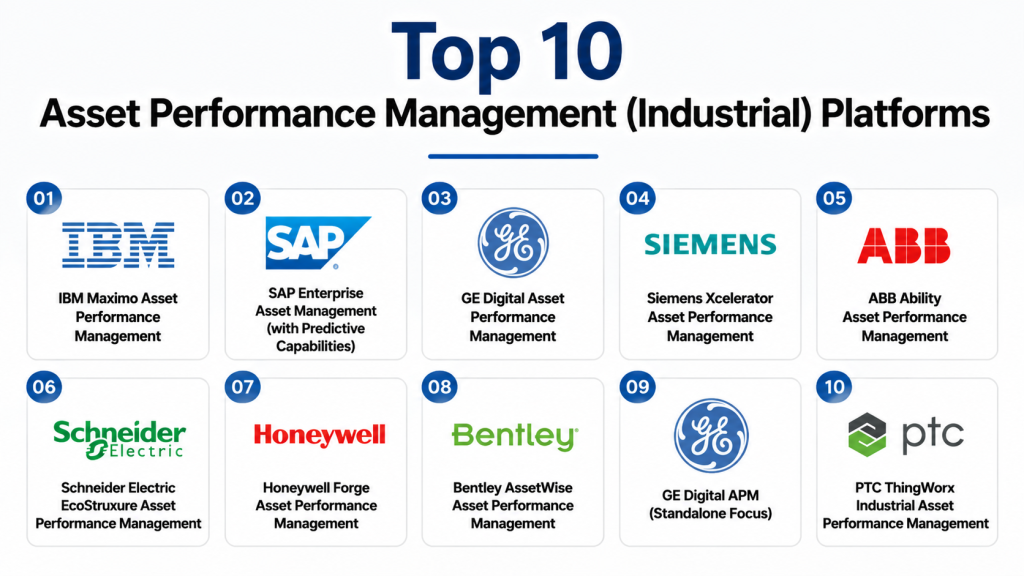
Top 10 Asset Performance Management (Industrial) Platforms
1 — IBM Maximo Asset Performance Management
Short description:
IBM Maximo APM is an enterprise asset management suite that combines real‑time monitoring, predictive analytics, and maintenance execution tools for complex industrial environments.
Key Features
- Predictive analytics and AI‑driven insights
- Enterprise work order and maintenance execution tracking
- Sensor and IoT data ingestion from diverse equipment
- Integration with enterprise ERP and CMMS systems
- Mobile access for technicians in the field
- Digital twin and asset modeling capabilities
Pros
- Strong fit for large enterprises with complex asset estates
- Deep integration with maintenance workflows and work execution
- Rich analytics and reporting for reliability teams
Cons
- Implementation complexity can be high for mid‑market customers
- Requires investment in training and change management
- Can be expensive relative to lighter tools
Platforms / Deployment
- Web / Cloud / Hybrid
Security & Compliance
Not publicly stated
Integrations & Ecosystem
IBM Maximo integrates across enterprise ecosystems and industrial environments:
- ERP and CMMS connectivity
- IoT platforms and sensor networks
- APIs for custom data flows and reporting
Support & Community
Robust enterprise support, training programs, and an established user community.
2 — SAP Enterprise Asset Management (EAM) with Predictive Capabilities
Short description:
SAP EAM offers asset lifecycle and performance management tightly integrated with SAP S/4HANA, supporting predictive insights and maintenance optimization.
Key Features
- Asset health tracking and performance KPIs
- Predictive analytics via embedded machine learning
- Deep integration with SAP finance and operations
- Centralized dashboards for global operations
- Workflow automation for maintenance and repairs
- IoT data aggregation from connected devices
Pros
- Unified asset and financial planning for enterprise visibility
- Strong integration with SAP ERP and operational systems
- Predictive insights tied to work execution and cost planning
Cons
- Primarily beneficial for existing SAP environments
- Custom configuration may be required for predictive AI models
- Not lightweight for smaller operations
Platforms / Deployment
- Cloud / Hybrid
Security & Compliance
Not publicly stated
Integrations & Ecosystem
SAP EAM connects deeply within SAP landscapes and external industrial systems:
- SAP ERP, finance, and supply chain modules
- IoT devices and plant systems
- APIs and extensions for analytics and automation
Support & Community
SAP enterprise support and certified partner programs.
3 — GE Digital Asset Performance Management
Short description:
GE Digital’s APM solution focuses on industrial operations, connecting sensor data with predictive models to optimize equipment uptime and reliability.
Key Features
- Machine health scoring and anomaly detection
- Industrial IoT ingestion and standard connectors
- Asset lifecycle and failure mode analysis
- Performance benchmarking across sites
- Predictive alerts tied to maintenance workflows
Pros
- Strong track record within heavy industrial environments
- Scalable for multi‑site operations
- Clear visualization of asset risk and health metrics
Cons
- Complexity in onboarding and data integration
- Requires expert tuning of predictive models
- May involve additional licensing overhead
Platforms / Deployment
- Cloud / Hybrid
Security & Compliance
Not publicly stated
Integrations & Ecosystem
GE Digital APM connects across industrial tech stacks:
- IoT sensor networks and edge gateways
- CMMS and maintenance systems
- APIs for custom analytics and dashboards
Support & Community
Enterprise support and professional services available.
4 — Siemens Xcelerator Asset Performance Management
Short description:
Siemens Xcelerator APM leverages digital twins and IoT data to drive predictive insights and maintenance intelligence on industrial assets.
Key Features
- Digital twin creation and simulation
- Real‑time data ingestion from industrial IoT sources
- Predictive analytics for failure forecasting
- Asset risk scoring and lifecycle dashboards
- Integration with MES and automation controllers
Pros
- Deep integration with industrial automation systems
- Digital twin support enhances scenario planning
- Enterprise scale for large operations
Cons
- Best suited for Siemens‑centric ecosystems
- Complexity increases with scale and customization
- Higher cost for smaller deployments
Platforms / Deployment
- Cloud / Edge / Hybrid
Security & Compliance
Not publicly stated
Integrations & Ecosystem
Xcelerator APM integrates with:
- Industrial automation systems
- MES, ERP, and PLC networks
- APIs and data exchange layers
Support & Community
Siemens industrial support and training.
5 — ABB Ability Asset Performance Management
Short description:
ABB Ability APM supports industrial asset monitoring, failure prediction, and reliability planning using advanced analytics and IoT connectivity.
Key Features
- Predictive health scoring and alerts
- Condition‑based monitoring using sensor data
- Real‑time operational dashboards
- Maintenance planning and work prioritization
- Integration with control systems and CMMS
Pros
- Strong support for process and manufacturing environments
- Real‑time actionable health insights
- Scales across distributed operations
Cons
- Integration setup can require specialist expertise
- Analytics may require tuning for specific asset types
- Enterprise focus limits appeal for smaller teams
Platforms / Deployment
- Cloud / Hybrid
Security & Compliance
Not publicly stated
Integrations & Ecosystem
ABB Ability connects with:
- Industrial control systems
- ERP and maintenance systems
- APIs for analytics export
Support & Community
Enterprise support with implementation services.
6 — Schneider Electric EcoStruxure APM
Short description:
Schneider EcoStruxure APM provides asset performance and reliability insights optimized for energy, manufacturing, and critical infrastructure sectors.
Key Features
- Sensor and IoT data integration
- Predictive analytics and operational dashboards
- Condition monitoring and alerts
- Risk and reliability scoring
- Workflow alignment with maintenance crews
Pros
- Strong presence in energy and infrastructure
- Designed for critical uptime environments
- Practical condition‑based monitoring tools
Cons
- Customization requires specialist planning
- Not as flexible outside infrastructure industries
- Predictive model training may need vendor support
Platforms / Deployment
- Cloud / Hybrid
Security & Compliance
Not publicly stated
Integrations & Ecosystem
EcoStruxure APM integrates with:
- IoT sensors and process control systems
- CMMS and maintenance work queues
- APIs for extended analytics
Support & Community
Dedicated support and industry expertise.
7 — Honeywell Forge APM
Short description:
Honeywell Forge APM combines industrial reliability analytics with operational insights focused on uptime and risk reduction.
Key Features
- Predictive equipment health scoring
- Real‑time alerting and condition dashboards
- IoT data mining and asset scoring
- Maintenance recommendation engine
- Historical trend review tools
Pros
- Real‑time insights with actionable recommendations
- Designed for large industrial ecosystems
- Strong analytics across asset classes
Cons
- Implementation complexity for diverse environments
- Premium pricing for enterprise packages
- Integration may need professional services
Platforms / Deployment
- Cloud / Hybrid
Security & Compliance
Not publicly stated
Integrations & Ecosystem
Honeywell Forge links with:
- Industrial IoT sensors
- ERP and CMMS systems
- APIs for reporting
Support & Community
Enterprise support with customization options.
8 — Bentley AssetWise APM
Short description:
Bentley AssetWise APM supports digital infrastructure performance and reliability using data integration and advanced analytics.
Key Features
- Operational dashboards and risk assessment
- Asset performance benchmarking
- Data federation from diverse systems
- Predictive health analytics and failure trends
- Maintenance scheduling and prioritization
Pros
- Well‑suited for infrastructure and engineering projects
- Flexible data ingestion from multi‑vendor sources
- Good support for compliance reporting
Cons
- Less common in traditional manufacturing
- Setup and data harmonization require planning
- Analytics depth varies by configuration
Platforms / Deployment
- Cloud / Hybrid
Security & Compliance
Not publicly stated
Integrations & Ecosystem
Bentley networks with:
- IoT sensors and enterprise systems
- ERP and maintenance platforms
- API connectors for analytics
Support & Community
Professional support and training resources.
9 — GE Digital APM (Standalone Focus)
Short description:
GE Digital’s standalone APM offering targets industrial asset health and performance tracking with predictive insights.
Key Features
- Predictive scoring and anomaly alerts
- Real‑time IoT sensor ingestion
- Trend analysis dashboards
- Failure mode tracking
- Operational risk visualization
Pros
- Strong industrial credibility
- Clear visualization of asset health
- Focus on uptime improvement
Cons
- May overlap with broader GE suites
- Predictive setup requires expertise
- Less modular for small teams
Platforms / Deployment
- Web / Cloud / Hybrid
Security & Compliance
Not publicly stated
Integrations & Ecosystem
Connects with:
- IoT devices
- ERP and maintenance systems
- Analytics export APIs
Support & Community
Enterprise support channels.
10 — PTC ThingWorx Industrial APM
Short description:
PTC ThingWorx APM uses IoT‑first connectivity and analytics to monitor industrial assets, forecast failures, and guide maintenance decisions.
Key Features
- Predictive analytics powered by IoT data
- Visual dashboards and KPIs
- Integration with AR/remote maintenance tools
- Asset health scoring and alerts
- Workflow automation support
Pros
- IoT native architecture
- Supports remote and augmented maintenance workflows
- Scales across complex asset estates
Cons
- Best suited for IoT‑ready environments
- Integration overhead for legacy systems
- Configuration may require professional services
Platforms / Deployment
- Cloud / Hybrid
Security & Compliance
Not publicly stated
Integrations & Ecosystem
Includes:
- IoT sensor networks
- ERP and CMMS tools
- APIs and extensibility modules
Support & Community
Vendor support and industrial integration assistance.
Comparison Table (Top 10)
| Tool Name | Best For | Platform(s) Supported | Deployment | Standout Feature | Public Rating |
|---|---|---|---|---|---|
| IBM Maximo APM | Enterprise reliability teams | Web | Cloud / Hybrid | Deep maintenance workflows | N/A |
| SAP EAM | SAP enterprises | Web | Cloud / Hybrid | ERP‑integrated performance | N/A |
| GE Digital APM | Industrial operations | Web | Cloud / Hybrid | Asset scoring & risk | N/A |
| Siemens Xcelerator APM | Automation‑centric plants | Web | Cloud/Edge/Hybrid | Digital twin support | N/A |
| ABB Ability APM | Manufacturing & energy | Web | Cloud / Hybrid | Condition monitoring | N/A |
| Schneider EcoStruxure APM | Energy & infrastructure | Web | Cloud / Hybrid | IoT‑centric analytics | N/A |
| Honeywell Forge APM | Large industrial operations | Web | Cloud / Hybrid | Predictive recommendations | N/A |
| Bentley AssetWise APM | Infrastructure | Web | Cloud / Hybrid | Multi‑source data fusion | N/A |
| GE Digital APM (Standalone) | Industrial reliability | Web | Cloud / Hybrid | Operational risk views | N/A |
| PTC ThingWorx APM | IoT‑native systems | Web | Cloud / Hybrid | IoT and AR readiness | N/A |
Evaluation & Scoring of Asset Performance Management (Industrial) Platforms
| Tool Name | Core (25%) | Ease (15%) | Integrations (15%) | Security (10%) | Performance (10%) | Support (10%) | Value (15%) | Weighted Total |
|---|---|---|---|---|---|---|---|---|
| IBM Maximo APM | 9 | 7 | 8 | 7 | 9 | 8 | 7 | 8.2 |
| SAP EAM | 8 | 8 | 8 | 7 | 8 | 7 | 7 | 7.9 |
| GE Digital APM | 8 | 7 | 7 | 7 | 8 | 7 | 7 | 7.7 |
| Siemens Xcelerator APM | 8 | 7 | 8 | 7 | 8 | 7 | 7 | 7.8 |
| ABB Ability APM | 8 | 7 | 7 | 7 | 8 | 7 | 7 | 7.7 |
| Schneider EcoStruxure APM | 8 | 7 | 8 | 7 | 8 | 7 | 7 | 7.8 |
| Honeywell Forge APM | 8 | 7 | 7 | 7 | 8 | 7 | 7 | 7.7 |
| Bentley AssetWise APM | 7 | 7 | 8 | 7 | 7 | 7 | 7 | 7.4 |
| GE Digital APM (Stand.) | 8 | 7 | 7 | 7 | 8 | 7 | 7 | 7.7 |
| PTC ThingWorx APM | 8 | 7 | 8 | 7 | 8 | 7 | 7 | 7.8 |
Which Asset Performance Management Tool Is Right for You?
Solo / Freelancer
Individual consultants or small operations rarely need full APM suites; lightweight IoT dashboards or basic analytics tools may suffice. Platforms above are more enterprise‑oriented.
SMB
Mid‑market operations with structured maintenance planning needs can benefit from flexible, cloud‑first tools like ABB Ability APM or Schneider EcoStruxure APM for reliability planning without heavy infrastructure.
Mid‑Market
Organizations with diverse asset estates and multi‑site complexity should prioritize scalability and integration. IBM Maximo APM and Siemens Xcelerator APM provide strong analytics and lifecycle oversight.
Enterprise
Large enterprises with global operations and complex workflows benefit from deeply integrated platforms like SAP EAM and GE Digital APM, which connect analytics to financial and operational systems.
Budget vs Premium
Budget constraints favor modular APM solutions with cloud hosting and incremental deployment. Premium options include enterprise suites with predictive, prescriptive, and digital twin capabilities.
Feature Depth vs Ease of Use
Feature‑rich tools (IBM Maximo APM, Siemens Xcelerator) require training but offer deeper insights. More intuitive dashboards (Schneider EcoStruxure APM) help adoption among broader teams.
Integrations & Scalability
Evaluate how well an APM connects with CMMS, ERP, IoT, MES, and PLC systems. Platforms supporting wide integration and API extensibility adapt better to evolving operational ecosystems.
Security & Compliance Needs
Industrial environments demand strong access control, encryption, and audit logging. Confirm platform security posture, especially if operations are subject to regulatory oversight.
Frequently Asked Questions (FAQs)
1- What is Asset Performance Management (APM)?
Asset Performance Management refers to systems that monitor and optimize the health and utilization of industrial assets. It uses data, analytics, and predictive modeling to guide maintenance and reliability decisions. APM supports uptime, lifecycle cost reduction, and operational performance. It is foundational to modern industrial digital transformation.
2- How does APM differ from CMMS?
APM focuses on analytics, prediction, and performance optimization across asset lifecycles, while CMMS centers on work order and maintenance task tracking. APM often integrates with CMMS to inform what work needs to be done and when. APM brings predictive insights beyond schedule‑based maintenance. CMMS manages execution more than prediction.
3- What industries benefit most from APM?
Manufacturing, energy, utilities, transportation, oil & gas, and chemicals commonly use APM. Any industry with high value or critical assets benefits from monitoring and prediction. Sectors managing distributed infrastructure (e.g., power grids) especially see ROI. Asset performance directly ties to operational costs in these environments.
4- What is predictive maintenance within APM?
Predictive maintenance uses real‑time and historical data to forecast when equipment is likely to fail. APM platforms combine machine learning and analytics to generate these predictions. This enables maintenance before failures occur, reducing downtime and expenses. Predictive maintenance is a core value driver of APM.
5- How difficult is APM implementation?
Implementation complexity varies by existing systems, data quality, and asset diversity. Enterprise platforms often require data integration and model configuration. Starting with a pilot on a subset of assets helps control risk. Collaboration across IT, OT, and reliability teams improves success.
6- Are cloud deployments better than on‑premise?
Cloud deployments offer scalability, centralized analytics, and lower infrastructure burden. On‑premise may be preferred for highly sensitive or regulated environments. Hybrid architectures balance both needs. Choice depends on security posture, connectivity, and data sovereignty concerns.
7- What data sources do APM platforms use?
APM ingests sensor/IoT data, PLC and SCADA feeds, ERP and CMMS information, and historical performance records. High‑quality, frequent data improves predictive accuracy. Cross‑system data integration supports richer models and insights.
8- How scalable are these platforms?
APM platforms scale from single‑site deployments to global asset estates. Cloud architectures and modular designs allow incremental rollout. Scalability depends on platform design and enterprise commitment. Multi‑site dashboards and analytics underscore enterprise readiness.
9- What common mistakes occur during APM rollout?
Common pitfalls include poor data quality, unclear KPIs, missing integrations with CMMS/ERP, and ignoring change management. Starting with a small, defined use case avoids overreach. Ensuring sensor data maturity accelerates value realization.
10- How should organizations choose an APM tool?
Define asset criticality and maintenance objectives first. Evaluate data connectivity, analytics depth, integration needs, deployment preferences, ease of use, and security requirements. Shortlist 2–3 vendors and pilot on representative assets before enterprise expansion.
Conclusion
Industrial Asset Performance Management platforms are central to modern operations seeking higher reliability, lower downtime, and better lifecycle insights for critical assets. Choosing the right APM requires evaluating analytics capabilities, integration breadth, deployment flexibility, and operational fit with maintenance processes. Smaller operations can start with modular or cloud‑first solutions, while mid‑market and enterprise organizations benefit from deep analytics and ecosystem connectivity. Prioritizing data quality, cross‑system integration, and staged deployments increases success odds. The best platform is one aligned with specific performance objectives and organizational readiness.

Find Trusted Cardiac Hospitals
Compare heart hospitals by city and services — all in one place.
Explore Hospitals
Asset Performance Management platforms are most valuable when they combine real-time equipment monitoring with predictive maintenance insights. By identifying potential failures before they occur, organizations can reduce unplanned downtime, extend asset lifespan, and make more informed maintenance decisions while improving overall operational reliability.