Introduction
Building Information Modeling (BIM) Software is a digital process and set of tools used to create, manage, and analyze building designs in a collaborative, data-rich environment. Unlike traditional CAD, BIM integrates geometry, materials, cost, scheduling, and lifecycle data into a single model, enabling smarter decision-making across construction and infrastructure projects.
With the global push toward digital construction, smart cities, and sustainable design, BIM has become a critical standard in architecture, engineering, and construction (AEC). Modern BIM tools now include cloud collaboration, AI-assisted design validation, and real-time visualization, making them essential for complex, multi-stakeholder projects.
Common Use Cases
- Architectural and structural design coordination
- Construction planning and clash detection
- Infrastructure and urban planning
- Cost estimation and project lifecycle management
- Digital twins and facility management
What Buyers Should Evaluate
- Modeling capabilities (3D/4D/5D BIM)
- Collaboration and cloud workflows
- Interoperability (IFC, CAD formats)
- Performance with large models
- Integration with ERP, GIS, and project tools
- Visualization and rendering support
- Automation and AI features
- Scalability across teams and projects
- Compliance with industry standards
- Pricing and licensing flexibility
Best for: Architects, engineers, construction firms, infrastructure planners, and enterprises managing large-scale or collaborative building projects.
Not ideal for: Small teams needing only basic drafting; simpler CAD tools may be sufficient for low-complexity projects.
Key Trends in Building Information Modeling (BIM) Software
- Cloud-based BIM platforms enabling real-time collaboration across geographies
- Digital twin integration for lifecycle asset management
- AI-driven clash detection and design optimization
- Open BIM standards (IFC) improving interoperability
- Integration with GIS and IoT systems for smart infrastructure
- 4D (time) and 5D (cost) BIM adoption increasing project accuracy
- Automation and generative design workflows
- Mobile BIM access for on-site collaboration
- Subscription and SaaS pricing models dominating the market
- Sustainability and carbon tracking features becoming essential
How We Selected These Tools (Methodology)
- Evaluated industry adoption across AEC sectors
- Assessed feature completeness across BIM lifecycle
- Reviewed performance and scalability for large projects
- Considered interoperability and open standards support
- Analyzed integration with construction and enterprise systems
- Included tools for SMB to enterprise use cases
- Prioritized cloud and collaboration capabilities
- Focused on active development and ecosystem strength
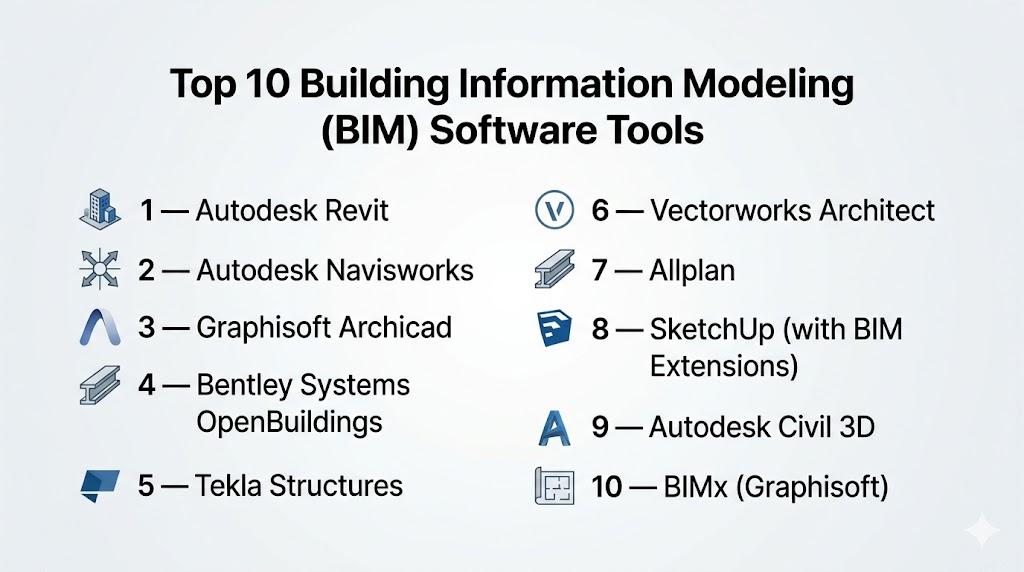
Top 10 Building Information Modeling (BIM) Software Tools
1 — Autodesk Revit
Short description: A leading BIM platform for architecture, engineering, and construction, widely used for collaborative building design.
Key Features
- Parametric modeling
- Multi-discipline collaboration
- Clash detection
- 4D/5D BIM support
- Documentation automation
- Cloud collaboration (via Autodesk ecosystem)
Pros
- Industry standard
- Strong ecosystem
Cons
- High cost
- Steep learning curve
Platforms / Deployment
Windows / Cloud
Security & Compliance
Not publicly stated
Integrations & Ecosystem
Extensive Autodesk ecosystem.
- AutoCAD
- Navisworks
- BIM 360
Support & Community
Strong enterprise support and global community.
2 — Autodesk Navisworks
Short description: A BIM coordination tool focused on project review, clash detection, and simulation.
Key Features
- Clash detection
- Model aggregation
- 4D simulation
- Visualization tools
- Coordination workflows
Pros
- Excellent coordination tool
- Handles large models
Cons
- Not a design tool
- Requires other BIM software
Platforms / Deployment
Windows
Security & Compliance
Not publicly stated
Integrations & Ecosystem
- Revit
- AutoCAD
- BIM 360
Support & Community
Enterprise-grade support.
3 — Graphisoft Archicad
Short description: A BIM solution designed for architects with strong design and visualization capabilities.
Key Features
- Parametric design
- Open BIM support (IFC)
- Real-time collaboration
- Visualization tools
- Integrated rendering
Pros
- Strong design workflow
- User-friendly interface
Cons
- Limited engineering features
- Cost considerations
Platforms / Deployment
Windows / macOS
Security & Compliance
Not publicly stated
Integrations & Ecosystem
- Rhino
- Grasshopper
Support & Community
Active global community.
4 — Bentley Systems OpenBuildings
Short description: An enterprise BIM solution for infrastructure and large-scale building projects.
Key Features
- Infrastructure modeling
- Digital twin support
- Multi-discipline workflows
- Advanced simulation
- Cloud collaboration
Pros
- Strong for infrastructure
- Scalable
Cons
- Complex interface
- Learning curve
Platforms / Deployment
Windows / Cloud
Security & Compliance
Not publicly stated
Integrations & Ecosystem
- Bentley ecosystem
- GIS tools
Support & Community
Enterprise-level support.
5 — Tekla Structures
Short description: A BIM tool focused on structural engineering and construction detailing.
Key Features
- Structural modeling
- Fabrication workflows
- Clash detection
- Construction sequencing
- Detailed drawings
Pros
- Highly accurate models
- Strong for structural work
Cons
- Specialized use
- Complex for beginners
Platforms / Deployment
Windows
Security & Compliance
Not publicly stated
Integrations & Ecosystem
- Trimble ecosystem
- CAD tools
Support & Community
Strong professional support.
6 — Vectorworks Architect
Short description: A BIM solution combining design flexibility with documentation capabilities.
Key Features
- 3D modeling
- BIM workflows
- Rendering tools
- Landscape design
- Documentation
Pros
- Flexible design tools
- Cross-discipline support
Cons
- Performance limitations
- Smaller ecosystem
Platforms / Deployment
Windows / macOS
Security & Compliance
Not publicly stated
Integrations & Ecosystem
- Rendering engines
- CAD tools
Support & Community
Moderate support and community.
7 — Allplan
Short description: A BIM platform focused on architecture and civil engineering workflows.
Key Features
- Parametric modeling
- Structural engineering tools
- BIM collaboration
- Infrastructure design
- Automation tools
Pros
- Strong engineering features
- Efficient workflows
Cons
- Less global adoption
- Learning curve
Platforms / Deployment
Windows
Security & Compliance
Not publicly stated
Integrations & Ecosystem
- CAD tools
- BIM standards
Support & Community
Professional support available.
8 — SketchUp (with BIM Extensions)
Short description: A user-friendly modeling tool enhanced with BIM plugins for lightweight workflows.
Key Features
- Easy 3D modeling
- Plugin ecosystem
- Visualization tools
- Cloud sharing
- BIM extensions
Pros
- Easy to learn
- Large plugin library
Cons
- Not full BIM by default
- Limited scalability
Platforms / Deployment
Web / Windows / macOS
Security & Compliance
Not publicly stated
Integrations & Ecosystem
- V-Ray
- Extensions marketplace
Support & Community
Large community and tutorials.
9 — Autodesk Civil 3D
Short description: A BIM solution focused on civil engineering and infrastructure design.
Key Features
- Terrain modeling
- Road and corridor design
- Survey data integration
- BIM workflows
- Documentation
Pros
- Strong for civil projects
- Integrated workflows
Cons
- Specialized use
- Complex interface
Platforms / Deployment
Windows
Security & Compliance
Not publicly stated
Integrations & Ecosystem
- AutoCAD
- Revit
Support & Community
Strong Autodesk support.
10 — BIMx (Graphisoft)
Short description: A BIM presentation and collaboration tool for project visualization.
Key Features
- Interactive model viewing
- Mobile access
- Real-time navigation
- Documentation access
- Collaboration tools
Pros
- Great for presentations
- Mobile-friendly
Cons
- Not a full BIM authoring tool
- Limited editing features
Platforms / Deployment
iOS / Android / Web
Security & Compliance
Not publicly stated
Integrations & Ecosystem
- Archicad
Support & Community
Moderate support resources.
Comparison Table (Top 10)
| Tool Name | Best For | Platform(s) | Deployment | Standout Feature | Public Rating |
|---|---|---|---|---|---|
| Revit | Full BIM | Windows | Hybrid | Industry standard | N/A |
| Navisworks | Coordination | Windows | Local | Clash detection | N/A |
| Archicad | Architects | Win/macOS | Local | Open BIM | N/A |
| OpenBuildings | Infrastructure | Windows | Hybrid | Digital twins | N/A |
| Tekla | Structural | Windows | Local | Fabrication detail | N/A |
| Vectorworks | Designers | Win/macOS | Local | Flexible design | N/A |
| Allplan | Engineering | Windows | Local | Civil workflows | N/A |
| SketchUp | Beginners | Web/Win/macOS | Hybrid | Ease of use | N/A |
| Civil 3D | Civil engineers | Windows | Local | Terrain modeling | N/A |
| BIMx | Visualization | Mobile/Web | Cloud | Mobile BIM | N/A |
Evaluation & Scoring of Building Information Modeling (BIM) Software
| Tool | Core | Ease | Integrations | Security | Performance | Support | Value | Weighted Total |
|---|---|---|---|---|---|---|---|---|
| Revit | 10 | 6 | 10 | 7 | 9 | 9 | 6 | 8.6 |
| Navisworks | 8 | 7 | 9 | 6 | 9 | 8 | 7 | 8.0 |
| Archicad | 9 | 8 | 8 | 6 | 8 | 8 | 7 | 8.1 |
| OpenBuildings | 9 | 6 | 9 | 7 | 9 | 9 | 6 | 8.3 |
| Tekla | 9 | 6 | 8 | 6 | 9 | 8 | 7 | 8.0 |
| Vectorworks | 8 | 8 | 7 | 5 | 7 | 7 | 7 | 7.5 |
| Allplan | 8 | 6 | 7 | 6 | 8 | 7 | 7 | 7.4 |
| SketchUp | 7 | 9 | 8 | 5 | 7 | 8 | 9 | 7.9 |
| Civil 3D | 9 | 6 | 9 | 6 | 9 | 8 | 7 | 8.1 |
| BIMx | 6 | 9 | 6 | 5 | 7 | 7 | 8 | 7.2 |
Interpretation:
These scores are comparative and reflect relative strengths across BIM workflows. Enterprise tools score higher in integrations and scalability, while simpler tools excel in ease of use and value. Select based on project complexity and team size.
Which Building Information Modeling (BIM) Software Tool Is Right for You?
Solo / Freelancer
- SketchUp → easy and flexible
- Archicad → strong design workflows
SMB
- Vectorworks → balanced capabilities
- Archicad → collaborative design
Mid-Market
- Revit → full BIM workflows
- Civil 3D → infrastructure projects
Enterprise
- Revit + Navisworks → full lifecycle
- OpenBuildings → infrastructure scale
Budget vs Premium
- Budget: SketchUp
- Premium: Revit, Tekla
Feature Depth vs Ease of Use
- Deep: Revit, Tekla
- Easy: SketchUp, Vectorworks
Integrations & Scalability
- Best: Revit, OpenBuildings
- Moderate: Archicad, Civil 3D
Security & Compliance Needs
- Enterprise setups require internal governance
- Most tools: Not publicly stated
Frequently Asked Questions (FAQs)
1. What is BIM software?
BIM software creates intelligent 3D models with embedded data for building design and construction.
2. How is BIM different from CAD?
BIM includes data and collaboration features, while CAD focuses mainly on geometry.
3. Is BIM mandatory?
In many regions, BIM is required for large infrastructure projects.
4. Can small teams use BIM?
Yes, but simpler tools may be more practical for smaller projects.
5. What is 4D and 5D BIM?
4D adds time scheduling; 5D includes cost estimation.
6. Is cloud BIM better?
Cloud BIM enables collaboration but depends on internet access.
7. What industries use BIM?
Construction, architecture, engineering, and infrastructure sectors.
8. Is BIM expensive?
Enterprise tools can be costly; pricing varies widely.
9. Can BIM integrate with ERP systems?
Yes, many tools support enterprise integrations.
10. What are common mistakes?
Ignoring interoperability and scalability early on.
Conclusion
Building Information Modeling software has become the backbone of modern construction and infrastructure projects, enabling teams to move beyond static drawings into intelligent, data-driven environments. While tools like Revit dominate enterprise workflows, alternatives like Archicad and SketchUp offer flexibility for different project scales and budgets. The right choice depends on your team size, project complexity, and integration needs rather than a single universal solution. As BIM continues to evolve with cloud, AI, and digital twin capabilities, selecting a tool that aligns with future scalability is critical. The best next step is to shortlist two or three platforms, run pilot projects, and evaluate collaboration, performance, and integration before committing.

Find Trusted Cardiac Hospitals
Compare heart hospitals by city and services — all in one place.
Explore Hospitals