Introduction
CAD/CAM Manufacturing Software combines design (CAD) and production (CAM) into a unified digital workflow—allowing engineers to design parts and instantly convert them into machine-ready instructions for CNC, milling, turning, and hybrid manufacturing systems.
In today’s advanced manufacturing landscape, speed, precision, and automation are non-negotiable. CAD/CAM tools now go far beyond simple drafting—they enable multi-axis machining, real-time simulation, AI-assisted toolpaths, and digital twin workflows, making them essential for modern factories and product teams.
Common Use Cases
- CNC machining and toolpath generation
- Product design and rapid prototyping
- Mold, die, and tooling manufacturing
- Aerospace and automotive component production
- Hybrid manufacturing (additive + subtractive)
What Buyers Should Evaluate
- Depth of CAD + CAM integration
- Multi-axis machining (3-axis to 5-axis+)
- Simulation and collision detection
- Ease of programming CNC operations
- Post-processor support for machines
- Integration with PLM, ERP, MES systems
- Automation and AI-assisted workflows
- Performance with complex geometries
- Scalability across teams and facilities
- Pricing flexibility and licensing model
Best for: Manufacturing engineers, CNC programmers, production teams, job shops, and enterprises aiming to streamline digital manufacturing workflows.
Not ideal for: Users who only need basic drafting or simple 3D modeling without manufacturing workflows.
Key Trends in CAD/CAM Manufacturing Software
- AI-powered toolpath optimization reducing machining time and errors
- Cloud-native CAD/CAM platforms enabling remote collaboration
- Digital twin simulation for real-world machining validation
- Multi-axis (5-axis+) machining adoption accelerating across industries
- Hybrid manufacturing workflows combining 3D printing + CNC
- Automation-first CNC programming reducing manual effort
- Integration with smart factory systems (IoT, MES)
- Subscription and SaaS pricing models replacing perpetual licenses
- Real-time simulation and collision detection improving reliability
- Cross-platform workflows connecting design, engineering, and production
How We Selected These Tools (Methodology)
- Evaluated global adoption in manufacturing industries
- Assessed CAD + CAM integration depth
- Reviewed toolpath capabilities and machining precision
- Analyzed performance in complex, multi-axis scenarios
- Considered integration with enterprise ecosystems (PLM/ERP)
- Included tools for SMB, mid-market, and enterprise users
- Prioritized modern, scalable, and actively developed platforms
- Balanced ease of use vs advanced manufacturing power
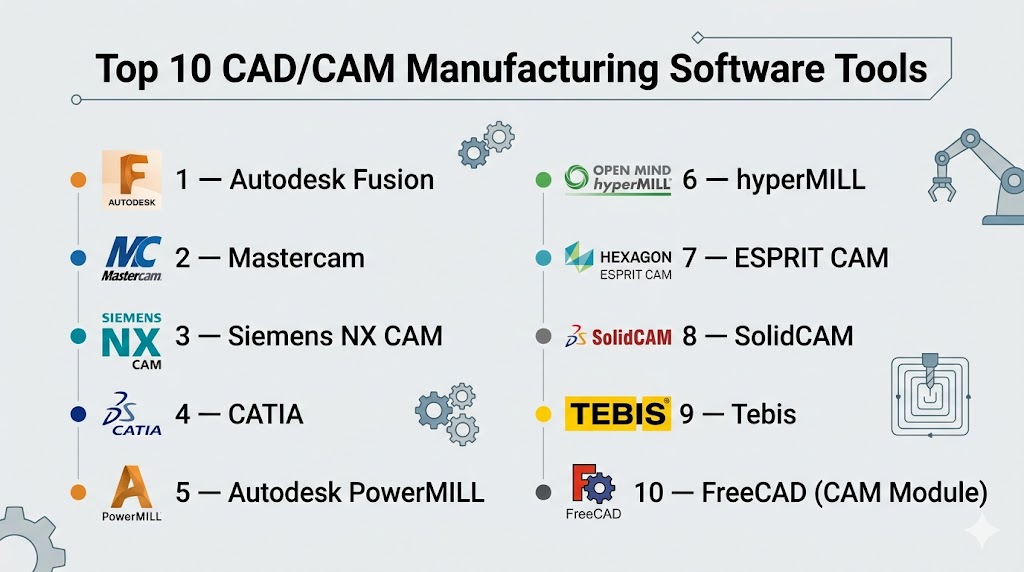
Top 10 CAD/CAM Manufacturing Software Tools
#1 — Autodesk Fusion
Short description: A modern, cloud-enabled CAD/CAM platform that combines design, simulation, and manufacturing in one unified environment.
Key Features
- Integrated CAD, CAM, and CAE workflows
- 2D–5-axis machining support
- Cloud collaboration and version control
- Generative design capabilities
- Built-in simulation and validation
- Automated toolpath generation
Pros
- True all-in-one workflow
- Excellent for modern distributed teams
Cons
- Subscription-based pricing
- Cloud dependency for some features
Platforms / Deployment
Windows / macOS / Cloud
Security & Compliance
Not publicly stated
Integrations & Ecosystem
Strong Autodesk ecosystem connectivity.
- AutoCAD
- Inventor
- CNC libraries
Support & Community
Large global community with extensive tutorials and forums.
#2 — Mastercam
Short description: One of the most widely adopted CAM tools globally, known for reliable CNC programming and machining precision.
Key Features
- Advanced multi-axis machining
- Toolpath optimization
- CAD modeling tools
- Machine simulation
- Post-processing customization
Pros
- Industry-proven reliability
- Strong CNC ecosystem
Cons
- Windows-only
- UI can feel dated
Platforms / Deployment
Windows
Security & Compliance
Not publicly stated
Integrations & Ecosystem
- CNC machines
- CAD file imports
Support & Community
Extensive training network and industry adoption.
#3 — Siemens NX CAM
Short description: A high-end enterprise CAD/CAM solution designed for complex, large-scale manufacturing environments.
Key Features
- Advanced multi-axis machining
- Integrated CAD/CAE/CAM
- Digital twin simulation
- Automated programming workflows
- Robotic machining support
Pros
- Extremely powerful and scalable
- Ideal for complex engineering
Cons
- Expensive
- Steep learning curve
Platforms / Deployment
Windows / Cloud
Security & Compliance
Not publicly stated
Integrations & Ecosystem
- Siemens PLM ecosystem
- ERP/PLM systems
Support & Community
Enterprise-grade support and consulting.
#4 — CATIA
Short description: A comprehensive engineering platform widely used in aerospace and automotive manufacturing.
Key Features
- Advanced 3D design and modeling
- Integrated manufacturing workflows
- Simulation and analysis
- PLM integration
- Multi-discipline collaboration
Pros
- Industry-standard in aerospace
- Highly advanced capabilities
Cons
- High cost
- Complex interface
Platforms / Deployment
Windows / Unix
Security & Compliance
Not publicly stated
Integrations & Ecosystem
- Dassault ecosystem
- PLM systems
Support & Community
Enterprise-level support and training.
#5 — Autodesk PowerMILL
Short description: A specialized CAM tool focused on high-speed and complex machining strategies.
Key Features
- Advanced 5-axis machining
- Toolpath optimization
- Surface finishing tools
- Simulation and validation
- Automation workflows
Pros
- Excellent for complex geometries
- High machining precision
Cons
- Specialized use case
- Premium pricing
Platforms / Deployment
Windows
Security & Compliance
Not publicly stated
Integrations & Ecosystem
- Autodesk ecosystem
- CNC machines
Support & Community
Professional support resources.
#6 — hyperMILL
Short description: A high-performance CAM solution designed for efficient and automated machining processes.
Key Features
- Multi-axis machining
- Automation tools
- Simulation and verification
- CAD integration
- Toolpath optimization
Pros
- High efficiency
- Strong automation
Cons
- Learning curve
- Enterprise-focused pricing
Platforms / Deployment
Windows
Security & Compliance
Not publicly stated
Integrations & Ecosystem
- CAD systems
- CNC workflows
Support & Community
Professional training and support.
#7 — ESPRIT CAM
Short description: A precision-focused CAM platform designed for complex CNC and multi-tasking machines.
Key Features
- Multi-axis machining
- Digital twin simulation
- CNC programming
- Automation tools
- Machine-aware programming
Pros
- High accuracy
- Strong simulation capabilities
Cons
- Complex setup
- Cost considerations
Platforms / Deployment
Windows
Security & Compliance
Not publicly stated
Integrations & Ecosystem
- CNC systems
- CAD tools
Support & Community
Professional support ecosystem.
#8 — SolidCAM
Short description: A CAM solution tightly integrated with SolidWorks for seamless design-to-manufacturing workflows.
Key Features
- Native SolidWorks integration
- iMachining technology
- Multi-axis support
- Toolpath optimization
- Simulation tools
Pros
- Seamless workflow for SolidWorks users
- Efficient machining strategies
Cons
- Requires SolidWorks
- Licensing cost
Platforms / Deployment
Windows
Security & Compliance
Not publicly stated
Integrations & Ecosystem
- SolidWorks
- CNC machines
Support & Community
Strong partner network.
#9 — Tebis
Short description: A specialized CAD/CAM platform focused on mold, die, and surface manufacturing.
Key Features
- Surface modeling
- Multi-axis machining
- Toolpath planning
- Simulation tools
- Manufacturing automation
Pros
- Strong for mold and die industries
- High precision
Cons
- Niche focus
- Limited accessibility
Platforms / Deployment
Windows
Security & Compliance
Not publicly stated
Integrations & Ecosystem
- Manufacturing systems
- CNC workflows
Support & Community
Enterprise support and consulting.
#10 — FreeCAD (CAM Module)
Short description: An open-source CAD tool with basic CAM capabilities, ideal for learning and small-scale projects.
Key Features
- Parametric modeling
- Basic CAM module
- Python scripting
- Open-source flexibility
- Cross-platform support
Pros
- Free and customizable
- Strong community
Cons
- Limited CAM capabilities
- Not enterprise-ready
Platforms / Deployment
Windows / macOS / Linux
Security & Compliance
Not publicly stated
Integrations & Ecosystem
- Python scripting
- Open-source plugins
Support & Community
Active open-source community.
Comparison Table (Top 10)
| Tool Name | Best For | Platform(s) Supported | Deployment | Standout Feature | Public Rating |
|---|---|---|---|---|---|
| Autodesk Fusion | All-in-one workflows | Win/macOS/Web | Cloud | Unified CAD+CAM | N/A |
| Mastercam | CNC machining | Windows | Local | Industry adoption | N/A |
| Siemens NX | Enterprise | Windows | Hybrid | Digital twin | N/A |
| CATIA | Aerospace | Win/Unix | Hybrid | PLM integration | N/A |
| PowerMILL | Complex machining | Windows | Local | Advanced toolpaths | N/A |
| hyperMILL | Automation | Windows | Local | High-performance CAM | N/A |
| ESPRIT | Precision machining | Windows | Local | Machine-aware CAM | N/A |
| SolidCAM | SolidWorks users | Windows | Local | Native integration | N/A |
| Tebis | Mold/die | Windows | Local | Surface machining | N/A |
| FreeCAD | Open-source | Win/macOS/Linux | Local | Free CAD/CAM | N/A |
Evaluation & Scoring of CAD/CAM Manufacturing Software
| Tool | Core | Ease | Integrations | Security | Performance | Support | Value | Weighted Total |
|---|---|---|---|---|---|---|---|---|
| Fusion | 9 | 8 | 9 | 6 | 9 | 9 | 8 | 8.6 |
| Mastercam | 9 | 7 | 8 | 6 | 9 | 9 | 7 | 8.2 |
| NX | 10 | 6 | 10 | 7 | 10 | 9 | 6 | 8.6 |
| CATIA | 10 | 6 | 10 | 7 | 9 | 9 | 6 | 8.5 |
| PowerMILL | 9 | 6 | 8 | 6 | 10 | 8 | 6 | 8.0 |
| hyperMILL | 9 | 6 | 8 | 6 | 9 | 8 | 6 | 7.9 |
| ESPRIT | 9 | 6 | 8 | 6 | 9 | 8 | 6 | 7.9 |
| SolidCAM | 8 | 7 | 9 | 6 | 8 | 8 | 7 | 8.0 |
| Tebis | 9 | 6 | 7 | 6 | 9 | 7 | 6 | 7.8 |
| FreeCAD | 7 | 7 | 6 | 5 | 7 | 7 | 10 | 7.5 |
Interpretation:
These scores are comparative—not absolute. Enterprise tools dominate in power and integrations, while modern platforms like Fusion balance usability and capability. Open-source tools lead in value but lag in advanced manufacturing features.
Which CAD/CAM Manufacturing Software Tool Is Right for You?
Solo / Freelancer
- FreeCAD → best for learning and budget
- Fusion → best all-in-one starter
SMB
- Fusion → modern workflows
- Mastercam → CNC-focused shops
Mid-Market
- SolidCAM → integrated workflows
- PowerMILL → complex machining
Enterprise
- Siemens NX → full digital manufacturing
- CATIA → aerospace-grade engineering
Budget vs Premium
- Budget: FreeCAD
- Premium: NX, CATIA
Feature Depth vs Ease of Use
- Deep: NX, CATIA
- Easy: Fusion
Integrations & Scalability
- Strong: NX, Fusion
- Moderate: Mastercam
Security & Compliance Needs
- Most tools: Not publicly stated
- Enterprises should enforce internal governance
Frequently Asked Questions (FAQs)
1. What is CAD/CAM software?
CAD/CAM software connects design and manufacturing, allowing you to create parts and generate machine instructions in one workflow.
2. What industries use CAD/CAM?
It’s widely used in aerospace, automotive, manufacturing, and industrial engineering sectors.
3. Is CAD/CAM software expensive?
Costs vary—from free tools like FreeCAD to high-end enterprise platforms like NX and CATIA.
4. What is CNC in CAM?
CNC stands for Computer Numerical Control, where machines follow programmed instructions to manufacture parts.
5. Can beginners use CAD/CAM tools?
Yes, but starting with simpler tools like Fusion or FreeCAD is recommended.
6. What is multi-axis machining?
It refers to machining operations that move across multiple axes, enabling complex part manufacturing.
7. Is cloud CAD/CAM better?
Cloud tools improve collaboration but may depend on internet connectivity.
8. Can CAD/CAM integrate with ERP systems?
Yes, especially enterprise tools that support full manufacturing workflows.
9. What are common mistakes when choosing CAD/CAM software?
Ignoring machine compatibility, scalability, and integration needs.
10. Is open-source CAD/CAM viable for production?
It can work for small-scale use but lacks advanced enterprise capabilities.
Conclusion
CAD/CAM manufacturing software has evolved into a powerful foundation for modern digital production, enabling faster design-to-manufacturing cycles and significantly improving precision and efficiency. While tools like Fusion offer an accessible, all-in-one approach for growing teams, enterprise platforms like Siemens NX and CATIA deliver unmatched depth for complex, large-scale operations. The key is not chasing the most powerful tool, but choosing the one that aligns with your workflows, machines, and long-term scalability needs. As automation, AI, and smart factory integrations continue to shape manufacturing, selecting a future-ready platform becomes critical. Start by shortlisting two or three tools, run real-world machining tests, and validate performance, integrations, and usability before making a final decision.

Find Trusted Cardiac Hospitals
Compare heart hospitals by city and services — all in one place.
Explore Hospitals