Introduction
Game development IDEs (Integrated Development Environments) are software applications that provide developers with comprehensive tools for writing, editing, debugging, testing, and deploying game code. They help streamline the entire development lifecycle by integrating code editors, build tools, compilers, asset management, and debugging utilities in one cohesive interface.
In game development, IDEs play a central role because modern games demand complex logic, asset pipelines, performance tuning, and multi‑platform deployment. Whether building for mobile, desktop, consoles, or web, an IDE helps developers manage codebases efficiently, reduces errors, and supports version control workflows.
Real‑world use cases:
- Writing gameplay logic, AI systems, and physics behavior.
- Debugging complex interactions and optimizing performance.
- Integrating assets like models, textures, audio, and animations.
- Building, testing, and deploying games on PC, mobile, or consoles.
- Collaborating across distributed development teams.
What buyers should evaluate:
- Support for common languages (C#, C++, Python, JavaScript).
- Built‑in debugging and profiling tools.
- Performance and reliability with large projects.
- Version control integration.
- Deployment and build pipeline support.
- Asset management capabilities.
- Extensibility with plugins and marketplace resources.
- Ease of use and learning curve.
- Cross‑platform support.
- Community and documentation resources.
Best for: Game developers, development teams (indie to enterprise), technical artists, and studios needing robust code and asset workflows.
Not ideal for: Casual designers or hobbyists who only need simple visual tools; lighter editors, visual scripting platforms, or engine‑specific editors may be more appropriate.
Key Trends in Game Development IDEs
- AI‑assisted coding and auto‑completion to speed development and reduce errors.
- Cloud‑based IDEs enabling development from browser interfaces and remote collaboration.
- Tighter integration with game engines for streamlined asset pipelines and build workflows.
- Improved debugging and profiling for real‑time performance tuning and memory analysis.
- Version control and team workflows built in with native Git and collaboration tools.
- Integration with CI/CD pipelines to automate testing and builds.
- Visual scripting support alongside traditional text‑based development.
- Enhanced support for multi‑platform compilation targeting consoles, mobile, desktop, and web.
- Plugin marketplaces expanding IDE capabilities with community‑built extensions.
How We Selected These Tools (Methodology)
- We reviewed market adoption and industry recognition across game development segments.
- We prioritized feature completeness, including code editing, debugging, profiling, and integration.
- We considered performance and reliability signals from developer communities and professional use.
- We analyzed signs of robust security posture for enterprise collaboration.
- We checked integration ecosystems with version control, build systems, and game engines.
- We looked at cross‑platform and extensibility support via plugins and APIs.
- We balanced coverage across beginner, indie, and enterprise workflows.
- We included both commercial and open‑source/uptake tools.
- We assessed community and documentation support for real‑user onboarding and support.
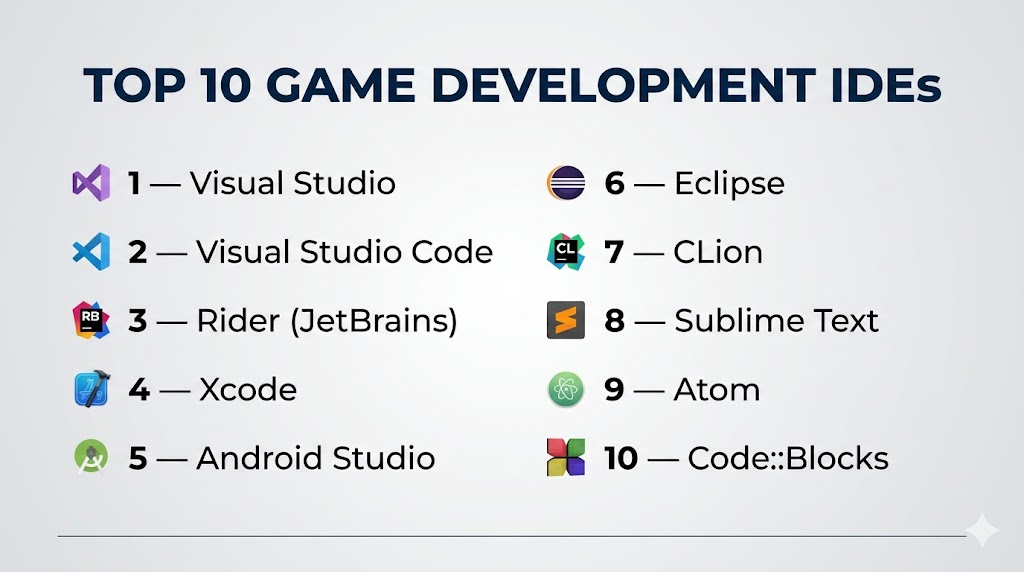
Top 10 Game Development IDEs
#1 — Visual Studio
Short description: A powerful IDE from Microsoft, widely used for C++, C#, and game development with engines like Unity and Unreal.
Key Features
- Advanced code editor with intelligent completion.
- Integrated debugging tools.
- Profiling and performance analysis.
- Native Git and version control support.
- Extension ecosystem covering game engine integrations.
- Build systems and project templates.
Pros
- Deep language support for C++ and C#.
- Tight integration with major game engines.
- Mature and feature‑rich environment.
Cons
- Can be resource‑intensive.
- Learning curve for advanced features.
Platforms / Deployment
Windows / macOS
Security & Compliance
Not publicly stated
Integrations & Ecosystem
Visual Studio supports plugins and extensions — including game engine toolchains and Git integration.
- Unity and Unreal integration plugins
- Git and GitHub extensions
- Profiling and performance tools
- Build automation
Support & Community
Strong documentation, official training resources, and a large global community.
#2 — Visual Studio Code
Short description: A lightweight, extensible, open‑source editor that functions as a versatile game development IDE with plugins.
Key Features
- Fast and responsive code editor.
- Plugin marketplace with broad language support.
- Integrated terminal.
- Git and SCM built in.
- Debugging support via extensions.
- Multi‑language support (C#, C++, Python, Lua, JavaScript).
Pros
- Lightweight and fast.
- Huge extension ecosystem.
- Flexible for multiple languages.
Cons
- Requires extension setup for full IDE capabilities.
- Not as feature‑rich as full desktop IDEs for some workflows.
Platforms / Deployment
Windows / macOS / Linux
Security & Compliance
Not publicly stated
Integrations & Ecosystem
VS Code’s strength lies in its extensibility:
- Language support plugins
- Debug adapters
- Git/GitHub built‑in workflows
- Engine‑specific tools (Unity, Unreal extensions)
Support & Community
Large community, extensive tutorials, and marketplace plugins.
#3 — Rider (JetBrains)
Short description: A cross‑platform IDE with rich support for C# and game development workflows, including Unity.
Key Features
- Intelligent code analysis.
- Unified debugger.
- Version control support.
- Built‑in Unity support.
- Refactoring tools and inspections.
- Plugin ecosystem.
Pros
- Strong code quality and analysis tools.
- Good Unity integration.
- Cross‑platform support.
Cons
- Subscription‑based model may not suit all budgets.
- Resource usage can be high.
Platforms / Deployment
Windows / macOS / Linux
Security & Compliance
Not publicly stated
Integrations & Ecosystem
Rider integrates with Git, Unity, and build systems:
- Unity Editor integration
- Git and version control
- Plugin marketplace
- Build tools
Support & Community
Professional support and documentation; active user base.
#4 — Xcode
Short description: Apple’s IDE for macOS and iOS, essential for building games targeting Apple platforms.
Key Features
- Native Apple platform support.
- Integrated interface builder.
- Advanced debugging and profiling.
- Version control integration.
- Simulator and device testing tools.
Pros
- Best choice for Apple platforms.
- Built‑in testing tools.
- Optimized for Swift and Objective‑C.
Cons
- Limited outside Apple development.
- Not as flexible for cross‑platform beyond Apple.
Platforms / Deployment
macOS
Security & Compliance
Not publicly stated
Integrations & Ecosystem
Xcode works with Apple’s ecosystem and supports external SDKs:
- Apple platform SDKs
- Git integration
- Asset pipelines
- Third‑party plugins
Support & Community
Strong official documentation and community forums.
#5 — Android Studio
Short description: Google’s official IDE for Android game development, ideal for mobile gaming workflows.
Key Features
- IntelliJ‑based code editor.
- Android emulator.
- Device profiling tools.
- Build variants and CI tools.
- Integrated debugging.
Pros
- Best for Android game workflows.
- Integrated testing tools.
- Native mobile optimization.
Cons
- Focused on Android only.
- Not suited for cross‑platform without plugins.
Platforms / Deployment
Windows / macOS / Linux
Security & Compliance
Not publicly stated
Integrations & Ecosystem
Android Studio integrates with:
- Android SDK and NDK
- Build tools
- Git workflows
- Emulator and profiling
Support & Community
Large Android developer community and extensive documentation.
#6 — Eclipse
Short description: A long‑standing open‑source IDE with multi‑language support, usable for game development with Java and C++.
Key Features
- Multi‑language support via plugins.
- Built‑in debugging and version control.
- Extensible plugin ecosystem.
- Customizable build workflows.
Pros
- Open‑source and free.
- Flexible for various languages.
- Plugin ecosystem.
Cons
- User experience can feel dated.
- Setup may require manual plugin selection.
Platforms / Deployment
Windows / macOS / Linux
Security & Compliance
Not publicly stated
Integrations & Ecosystem
Eclipse supports extensions across languages and build systems:
- C/C++ Development Toolkit
- Git and SCM plugins
- Script and build plugins
Support & Community
Established open‑source community and documentation.
#7 — CLion
Short description: A cross‑platform C/C++ IDE from JetBrains, strong for performance‑critical game code.
Key Features
- Intelligent code analysis.
- Refactoring and inspections.
- Built‑in debugger.
- CMake integration.
- Version control support.
Pros
- Excellent for C/C++ codebases.
- Powerful refactoring tools.
- Cross‑platform support.
Cons
- Subscription‑based price.
- Focused on C/C++ only.
Platforms / Deployment
Windows / macOS / Linux
Security & Compliance
Not publicly stated
Integrations & Ecosystem
CLion includes:
- CMake and build tools
- Git integration
- Plugin marketplace
Support & Community
Vendor documentation and active user community.
#8 — Sublime Text
Short description: A lightweight text editor with plugin support, usable for game scripting and code editing.
Key Features
- Blazing‑fast performance.
- Multi‑language syntax support.
- Plugin ecosystem via Package Control.
- Split editing and command palette.
Pros
- Extremely fast.
- Lightweight footprint.
- Flexible with plugins.
Cons
- Not a full IDE out of the box.
- Needs plugins for debugging and build tasks.
Platforms / Deployment
Windows / macOS / Linux
Security & Compliance
Not publicly stated
Integrations & Ecosystem
Via plugins for language support and build systems:
- Syntax packages
- Build system plugins
- Version control plugins
Support & Community
Large user community and plugin libraries.
#9 — Atom
Short description: A hackable text editor with package support, suitable for lightweight game development scripting.
Key Features
- Modular package system.
- Built‑in Git support.
- Cross‑platform editing.
- Syntax highlighting and snippets.
Pros
- Highly customizable.
- Free and open‑source.
- Easy to use.
Cons
- Not as performant as lightweight rivals.
- Requires packages for full IDE features.
Platforms / Deployment
Windows / macOS / Linux
Security & Compliance
Not publicly stated
Integrations & Ecosystem
Atom’s packages allow expanded support:
- Linter and language packages
- Build system plugins
- Version control packages
Support & Community
Open‑source community and package repository.
#10 — Code::Blocks
Short description: A lightweight C++ IDE with simple build and debugging support, useful for smaller game projects.
Key Features
- Customizable workspace.
- Built‑in debugger.
- Compiler integration.
- Project management.
Pros
- Lightweight and fast.
- Easy setup.
- Good for smaller projects.
Cons
- Basic compared to modern IDEs.
- Limited plugin ecosystem.
Platforms / Deployment
Windows / macOS / Linux
Security & Compliance
Not publicly stated
Integrations & Ecosystem
Integration with compilers and version control:
- GNU and Clang compilers
- Git support via plugins
- Debugger integration
Support & Community
Smaller but active community and documentation.
Comparison Table (Top 10)
| Tool Name | Best For | Platform(s) Supported | Deployment | Standout Feature | Public Rating |
|---|---|---|---|---|---|
| Visual Studio | Enterprise game development | Windows/macOS | Hybrid | Rich debugging | N/A |
| Visual Studio Code | Lightweight flexible dev | Windows/macOS/Linux | Hybrid | Plugin ecosystem | N/A |
| Rider | Unity/C# workflows | Windows/macOS/Linux | Hybrid | Unity Tools support | N/A |
| Xcode | Apple platform games | macOS | Self‑hosted | Apple device testing | N/A |
| Android Studio | Android games | Windows/macOS/Linux | Hybrid | Android emulator | N/A |
| Eclipse | Java/C++ game projects | Windows/macOS/Linux | Hybrid | Plugin versatility | N/A |
| CLion | Performance C/C++ | Windows/macOS/Linux | Hybrid | Refactoring tools | N/A |
| Sublime Text | Lightweight coding | Windows/macOS/Linux | Hybrid | Fast performance | N/A |
| Atom | Modular editor | Windows/macOS/Linux | Hybrid | Hackable packages | N/A |
| Code::Blocks | Simple C++ projects | Windows/macOS/Linux | Self‑hosted | Easy setup | N/A |
Evaluation & Scoring of Game Development IDEs
| Tool Name | Core (25%) | Ease (15%) | Integrations (15%) | Security (10%) | Performance (10%) | Support (10%) | Value (15%) | Weighted Total (0–10) |
|---|---|---|---|---|---|---|---|---|
| Visual Studio | 10 | 8 | 9 | 6 | 9 | 9 | 7 | 8.40 |
| Visual Studio Code | 8 | 9 | 9 | 6 | 8 | 8 | 9 | 8.40 |
| Rider | 9 | 7 | 8 | 6 | 8 | 8 | 7 | 7.90 |
| Xcode | 7 | 7 | 6 | 6 | 7 | 7 | 7 | 7.05 |
| Android Studio | 7 | 8 | 7 | 6 | 7 | 7 | 8 | 7.35 |
| Eclipse | 6 | 6 | 7 | 5 | 6 | 6 | 9 | 6.65 |
| CLion | 8 | 7 | 7 | 6 | 8 | 7 | 7 | 7.55 |
| Sublime Text | 5 | 8 | 6 | 5 | 7 | 6 | 9 | 6.70 |
| Atom | 5 | 7 | 6 | 5 | 6 | 6 | 9 | 6.60 |
| Code::Blocks | 5 | 7 | 5 | 5 | 6 | 6 | 10 | 6.60 |
How to interpret these scores:
- Scores are comparative editorial assessments across feature depth, ease, ecosystem, and value.
- Tools scoring higher generally offer richer integration and professional workflows.
- Lower scores reflect lightweight tools that excel for simple or specific needs but lack full IDE capabilities.
- The best choice depends on project complexity and language support needs.
Which Game Development IDE Tool Is Right for You?
Solo / Freelancer
- Visual Studio Code, Sublime Text, Atom for lightweight workflows and script editing.
SMB
- Visual Studio, Rider, Android Studio for collaborative and cross‑platform projects.
Mid‑Market
- Visual Studio, Rider, CLion for performance‑critical projects and engine integration.
Enterprise
- Visual Studio, Rider, Xcode where professional debugging and build pipelines matter.
Budget vs Premium
- Budget: Visual Studio Code, Atom, Sublime Text, Code::Blocks
- Premium: Visual Studio, Rider, CLion
Feature Depth vs Ease of Use
- Depth: Visual Studio, Rider, CLion
- Ease: Visual Studio Code, Sublime Text, Atom
Integrations & Scalability
- Visual Studio and VS Code lead with plugin ecosystems and engine support.
Security & Compliance Needs
- Larger studios may require more secure collaboration workflows with version control and audit trails; verify IDE integrations with enterprise systems.
Frequently Asked Questions (FAQs)
1. What is a game development IDE?
An IDE is a software environment that combines code editing, debugging, build tools, and integration features for streamlined game development.
2. Do I need a special IDE for game development?
Not always — general IDEs like VS Code can work, but engine‑specific workflows benefit from tools with tighter integration.
3. Can IDEs handle multiple languages?
Yes — many support C++, C#, Lua, Python, and scripting with plugin extensions.
4. Which IDEs work best with Unity?
Visual Studio, Visual Studio Code, and Rider have strong Unity support.
5. Are IDEs necessary for mobile game development?
Yes — IDEs like Android Studio and Xcode make building and testing for mobile platforms easier.
6. Can I use an IDE for VR game development?
Yes — IDEs integrated with engines like Unity and Unreal support VR platform deployment.
7. What does plugin support do?
Plugins extend IDE capabilities for language support, build workflows, debugging, and engine integration.
8. Which IDE is best for C++ game code?
Visual Studio, CLion, and Rider are strong options for C++ workflows.
9. Are lightweight editors good enough?
For small scripts and basic development, lightweight editors like VS Code or Sublime Text can suffice.
10. Do IDEs support version control?
Many do — built‑in support or plugins for Git and other version control systems are common.
Conclusion
Choosing the right game development IDE depends on project needs, team size, language preferences, and platform targets. Visual Studio and Visual Studio Code remain go‑to choices for many development workflows, with extensive integration and ecosystem support. Rider stands out for Unity and C# workflows, while CLion excels for performance‑critical C++ projects. Lightweight editors like Atom and Sublime Text can support indie and rapid prototyping workflows. Ultimately, the best approach is to shortlist a few tools, test them in real project scenarios, and validate how well they support your build, debugging, and deployment pipelines.

Find Trusted Cardiac Hospitals
Compare heart hospitals by city and services — all in one place.
Explore Hospitals