Introduction
KYC (Know Your Customer) and AML (Anti-Money Laundering) Compliance Tools are designed to help organizations verify the identity of clients, assess risks, and ensure compliance with regulatory requirements. These platforms are essential in preventing financial crimes, fraud, and reputational damage in industries such as banking, fintech, e-commerce, and digital payments.
Use cases include verifying new customers, ongoing monitoring of accounts, risk scoring, transaction screening, and regulatory reporting. Key evaluation criteria include automation capabilities, integration with identity verification services, real-time monitoring, regulatory compliance, AI-driven risk scoring, reporting and analytics, scalability, and ease of implementation.
Best for: Financial institutions, fintech companies, digital payment platforms, and enterprises handling sensitive customer information.
Not ideal for: Organizations with minimal financial transactions or those not subject to KYC/AML regulations; simpler manual verification processes may suffice.
Key Trends in KYC/AML Compliance Tools
- AI and machine learning for adaptive risk scoring and fraud detection
- Automation of onboarding and KYC verification processes
- Real-time transaction monitoring for AML compliance
- Integration with digital identity verification and biometric systems
- Regulatory compliance updates for GDPR, FATF, and other regional standards
- Cloud-based deployment models for scalability and low-latency processing
- Low-code/API-first platforms for easy integration with fintech ecosystems
- Subscription-based pricing models with modular features
- Continuous learning from transaction data for improved detection
How We Selected These Tools (Methodology)
- Evaluated market adoption and mindshare among regulated industries
- Assessed feature completeness for KYC onboarding, AML screening, and reporting
- Reviewed reliability and performance benchmarks
- Verified security posture and regulatory compliance certifications
- Considered integrations with banking, payment, and identity verification systems
- Evaluated usability and experience for teams and end-users
- Examined AI/ML capabilities for advanced anomaly detection
- Analyzed suitability across small, mid-market, and enterprise segments
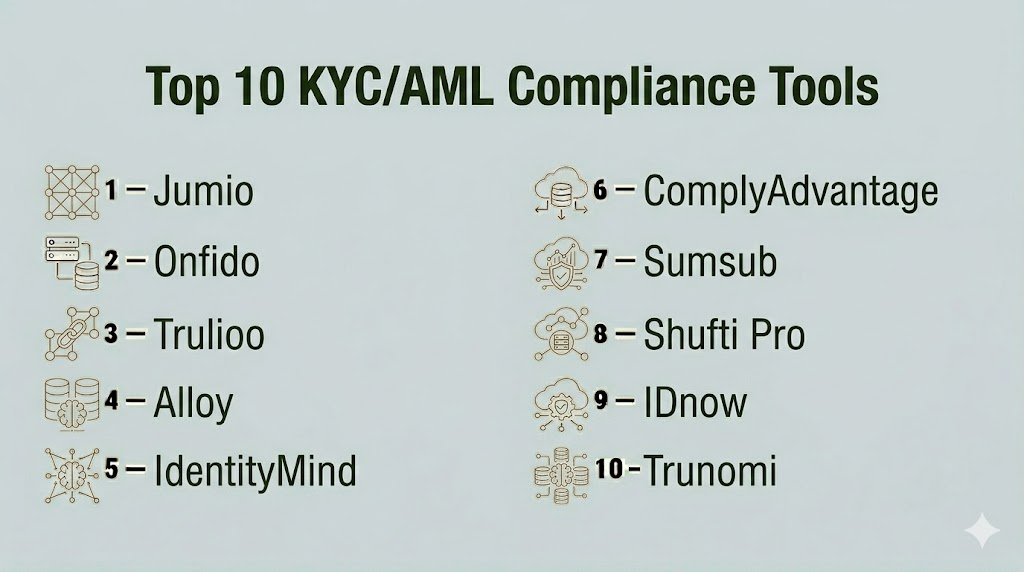
Top 10 KYC/AML Compliance Tools
#1 — Jumio
Short description: Jumio provides AI-powered identity verification and AML screening for global enterprises. It is ideal for fintech, banking, and e-commerce platforms seeking secure, scalable KYC solutions.
Key Features
- AI-based identity verification
- Document and biometric authentication
- AML and PEP (Politically Exposed Persons) screening
- Real-time risk scoring
- Integration with payment gateways and banking systems
Pros
- High accuracy with AI and biometric verification
- Rapid onboarding process
Cons
- Premium pricing may be high for small businesses
- Customization requires technical expertise
Platforms / Deployment
- Web / Cloud
Security & Compliance
- SOC 2, ISO 27001, GDPR
Integrations & Ecosystem
Integrates with banking, fintech, and payment platforms:
- Stripe, PayPal
- Core banking APIs
- CRM systems
Support & Community
Varies / Not publicly stated
#2 — Onfido
Short description: Onfido offers automated identity verification and risk assessment using machine learning, suitable for fintech, cryptocurrency, and digital banking platforms.
Key Features
- AI-driven document verification
- Biometric facial recognition
- AML and watchlist screening
- Automated risk scoring
- API integrations for fast onboarding
Pros
- Fast, automated KYC process
- Accurate fraud detection
Cons
- Limited offline verification capabilities
- May require integration support
Platforms / Deployment
- Web / Cloud
Security & Compliance
- SOC 2, GDPR
Integrations & Ecosystem
- Banking APIs
- Fintech platforms
- Identity verification services
Support & Community
Varies / Not publicly stated
#3 — Trulioo
Short description: Trulioo provides global identity verification and AML compliance solutions for enterprises, enabling real-time KYC checks across multiple countries.
Key Features
- Global identity coverage
- AML and PEP screening
- Real-time KYC verification
- API-first integration
- Automated compliance reporting
Pros
- Broad international coverage
- Scalable for large enterprises
Cons
- Setup complexity for smaller teams
- Premium pricing for high-volume usage
Platforms / Deployment
- Web / Cloud
Security & Compliance
- SOC 2, ISO 27001, GDPR
Integrations & Ecosystem
- Banking APIs
- Payment processors
- CRM and onboarding systems
Support & Community
Varies / Not publicly stated
#4 — Alloy
Short description: Alloy automates KYC, AML, and risk management workflows for fintech and digital banks, combining API integrations and advanced analytics.
Key Features
- Automated KYC verification
- AML screening and monitoring
- Risk scoring and workflows
- Real-time transaction monitoring
- API integrations
Pros
- Streamlined onboarding
- Flexible automation rules
Cons
- May require developer resources for full integration
- Cost scales with transaction volume
Platforms / Deployment
- Web / Cloud
Security & Compliance
- SOC 2, GDPR
Integrations & Ecosystem
- Payment processors
- Banking APIs
- Identity providers
Support & Community
Varies / Not publicly stated
#5 — IdentityMind
Short description: IdentityMind provides digital identity risk management, combining AML, KYC, and transaction monitoring for financial services.
Key Features
- Digital identity scoring
- AML and KYC compliance
- Transaction monitoring
- Multi-channel risk assessment
- API integration for banking and fintech systems
Pros
- Comprehensive compliance coverage
- Supports multiple industries
Cons
- Enterprise-focused pricing
- Technical integration required
Platforms / Deployment
- Web / Cloud
Security & Compliance
- SOC 2, GDPR, ISO 27001
Integrations & Ecosystem
- Core banking systems
- Payment platforms
- KYC/AML providers
Support & Community
Varies / Not publicly stated
#6 — ComplyAdvantage
Short description: ComplyAdvantage offers AML screening, transaction monitoring, and KYC automation for financial institutions and fintech companies.
Key Features
- AML watchlists and sanctions screening
- Transaction monitoring
- KYC automation
- API integrations
- Risk scoring dashboards
Pros
- Strong AML compliance tools
- Automated alerts for suspicious activity
Cons
- Smaller enterprises may find cost high
- Advanced reporting may require training
Platforms / Deployment
- Web / Cloud
Security & Compliance
- SOC 2, ISO 27001, GDPR
Integrations & Ecosystem
- Banking APIs
- Payment processors
- Core financial systems
Support & Community
Varies / Not publicly stated
#7 — Sumsub
Short description: Sumsub provides AI-powered KYC and AML solutions, with identity verification and regulatory compliance for digital finance platforms.
Key Features
- AI-based document verification
- Facial recognition
- AML and sanctions screening
- Compliance reporting
- API integrations
Pros
- Fast onboarding and verification
- Multi-country coverage
Cons
- Pricing scales with volume
- Advanced customization may need technical support
Platforms / Deployment
- Web / Cloud
Security & Compliance
- SOC 2, ISO 27001, GDPR
Integrations & Ecosystem
- Payment systems
- Banking APIs
- Identity verification services
Support & Community
Varies / Not publicly stated
#8 — Shufti Pro
Short description: Shufti Pro offers AI and ML-powered identity verification and AML compliance solutions for global businesses.
Key Features
- Document verification
- Facial recognition
- AML screening
- KYC automation
- API-first integration
Pros
- Global coverage
- High accuracy with AI
Cons
- Enterprise pricing
- Requires integration setup
Platforms / Deployment
- Web / Cloud
Security & Compliance
- SOC 2, GDPR
Integrations & Ecosystem
- Banking APIs
- Payment processors
- CRM systems
Support & Community
Varies / Not publicly stated
#9 — IDnow
Short description: IDnow provides automated and video-based KYC verification for European financial institutions and digital service providers.
Key Features
- Video KYC verification
- AI-powered document checks
- AML compliance
- API integrations
- Risk scoring
Pros
- Strong European regulatory compliance
- Flexible verification methods
Cons
- Focused on EU regulations
- Integration requires development resources
Platforms / Deployment
- Web / Cloud
Security & Compliance
- SOC 2, GDPR
Integrations & Ecosystem
- Banking systems
- Payment platforms
- Fintech APIs
Support & Community
Varies / Not publicly stated
#10 — Trunomi
Short description: Trunomi specializes in customer consent management, KYC identity verification, and AML compliance for digital services and fintech.
Key Features
- KYC verification
- AML screening
- Customer consent management
- API integrations
- Real-time monitoring
Pros
- Consent management integrated with KYC
- Supports fintech compliance
Cons
- Smaller enterprise focus
- Limited advanced analytics
Platforms / Deployment
- Web / Cloud
Security & Compliance
- SOC 2, GDPR
Integrations & Ecosystem
- Payment gateways
- Core banking APIs
- Identity providers
Support & Community
Varies / Not publicly stated
Comparison Table (Top 10)
| Tool Name | Best For | Platform(s) Supported | Deployment | Standout Feature | Public Rating |
|---|---|---|---|---|---|
| Jumio | Fintech & e-commerce | Web | Cloud | AI + biometric verification | N/A |
| Onfido | Fintech & digital banking | Web | Cloud | Automated identity verification | N/A |
| Trulioo | Global enterprises | Web | Cloud | Multi-country KYC coverage | N/A |
| Alloy | Fintech & banks | Web | Cloud | Automated workflow & risk scoring | N/A |
| IdentityMind | Financial services | Web | Cloud | AML + transaction monitoring | N/A |
| ComplyAdvantage | Banks & fintech | Web | Cloud | AML watchlists & monitoring | N/A |
| Sumsub | Fintech & global platforms | Web | Cloud | AI-powered KYC & AML | N/A |
| Shufti Pro | Global businesses | Web | Cloud | ML + AI identity verification | N/A |
| IDnow | European banks | Web | Cloud | Video KYC & AML compliance | N/A |
| Trunomi | Digital services & fintech | Web | Cloud | Consent + KYC integration | N/A |
Evaluation & Scoring of KYC/AML Compliance Tools
| Tool Name | Core (25%) | Ease (15%) | Integrations (15%) | Security (10%) | Performance (10%) | Support (10%) | Value (15%) | Weighted Total (0–10) |
|---|---|---|---|---|---|---|---|---|
| Jumio | 9 | 8 | 8 | 9 | 9 | 8 | 8 | 8.7 |
| Onfido | 8 | 8 | 8 | 8 | 8 | 8 | 8 | 8.0 |
| Trulioo | 9 | 7 | 8 | 9 | 8 | 8 | 7 | 8.2 |
| Alloy | 8 | 7 | 8 | 8 | 8 | 8 | 7 | 7.9 |
| IdentityMind | 8 | 7 | 7 | 8 | 8 | 7 | 7 | 7.7 |
| ComplyAdvantage | 8 | 7 | 7 | 8 | 8 | 7 | 7 | 7.7 |
| Sumsub | 8 | 7 | 8 | 8 | 8 | 7 | 7 | 7.9 |
| Shufti Pro | 8 | 7 | 7 | 8 | 7 | 7 | 7 | 7.6 |
| IDnow | 8 | 7 | 7 | 8 | 7 | 7 | 7 | 7.6 |
| Trunomi | 7 | 7 | 7 | 7 | 7 | 7 | 7 | 7.0 |
Scores are comparative based on core features, ease of use, integrations, security, performance, support, and value.
Which KYC/AML Compliance Tools Tool Is Right for You?
Solo / Freelancer
- Lightweight solutions like Jumio or Onfido are suitable for small-scale onboarding.
SMB
- Platforms like Alloy and Sumsub provide automation with affordable scaling.
Mid-Market
- Trulioo and ComplyAdvantage offer global coverage with AML and KYC capabilities.
Enterprise
- IdentityMind, IDnow, and Trunomi provide full compliance, risk monitoring, and regulatory reporting.
Budget vs Premium
- Budget tools handle basic KYC; premium tools include AI, global compliance, and risk analytics.
Feature Depth vs Ease of Use
- Jumio and Onfido balance advanced detection with simple UX.
Integrations & Scalability
- Enterprises should choose API-first platforms that integrate with payment gateways, banking systems, and identity providers.
Security & Compliance Needs
- Choose platforms aligned with SOC 2, ISO 27001, GDPR, and AML regulations.
Frequently Asked Questions (FAQs)
1. What is a KYC/AML Compliance Tool?
Software that automates customer identity verification and monitors financial transactions to prevent fraud and ensure regulatory compliance.
2. How do these platforms detect risks?
They use AI, ML, behavioral analytics, and rule-based engines to flag high-risk accounts or transactions.
3. Are these tools suitable for small businesses?
Some tools like Jumio and Onfido scale for SMBs; larger enterprise platforms may be overkill.
4. Can these platforms handle global compliance?
Yes, tools like Trulioo and Sumsub support multi-country KYC and AML requirements.
5. Do they integrate with banking systems?
Most platforms provide API integrations with payment gateways, core banking systems, and CRM platforms.
6. How fast is deployment?
Deployment can range from a few days for SMBs to weeks for complex enterprise setups.
7. Can these tools prevent fraud?
Yes, AI-based risk scoring and monitoring can detect suspicious activities and prevent financial fraud.
8. Are they compliant with regulations?
Leading tools comply with GDPR, SOC 2, ISO 27001, and AML regulations.
9. What is the pricing model?
Pricing depends on transaction volume, number of users, and modules selected.
10. Can they adapt to new fraud patterns?
AI and ML-based platforms continuously learn from transaction and verification data to improve detection.
Conclusion
KYC/AML Compliance Tools are essential for financial institutions, fintechs, and digital service providers to prevent fraud, ensure regulatory compliance, and reduce operational risk. Selecting the right platform depends on transaction volume, regulatory environment, and integration needs. Businesses should evaluate AI capabilities, global coverage, automation, and ease of use before deployment. Running a pilot, validating compliance alignment, and monitoring performance are key steps to maximize effectiveness.

Find Trusted Cardiac Hospitals
Compare heart hospitals by city and services — all in one place.
Explore Hospitals
If every unusual transaction creates an alert, compliance teams can quickly become overloaded and miss important cases. Reviewing alert quality regularly and improving rules based on real cases can make the system more useful without adding unnecessary manual work.