Introduction
Physics engines are software systems used in game development and simulation to model and calculate realistic physical behavior of objects. They help simulate gravity, collisions, rigid bodies, soft bodies, joints, fluids, particle systems, and other phenomena that make virtual worlds behave like the real one. By abstracting and solving the laws of physics in real time, these engines save developers years of manual math and ensure believable interactions in games, simulations, VR, and robotics.
In interactive media and simulation development, physics engines matter because they significantly impact immersion, gameplay responsiveness, and realism. Whether simulating a stack of crates tumbling down a slope in a game, creating a believable vehicle suspension system, or training an AI robot to navigate obstacles, physics engines provide foundational behaviors that drive believable worlds.
Real‑world use cases:
- Realistic object collisions and rigid body simulation in games.
- Soft body and cloth dynamics for character apparel and environment details.
- Vehicle dynamics in racing games and simulations.
- Physics‑based puzzles and interactive environments.
- Robotics simulation for testing AI and control systems.
What buyers should evaluate:
- Supported physics types (rigid, soft, cloth, fluid).
- Performance and reliability with complex scenes.
- Numerical stability and accuracy.
- Integration with game engines and toolchains.
- Extensibility and scripting support.
- Cross‑platform support.
- GPU or multi‑threaded acceleration.
- Licensing terms (open source vs commercial).
- Documentation, community, and ecosystem support.
Best for: Game developers, simulation engineers, VR/AR developers, robotics researchers, and technical artists who need realistic physics and interactive behavior.
Not ideal for: Projects that do not require real‑time physics or only need simple static transformations; basic animation tools may suffice instead of a dedicated physics engine.
Key Trends in Physics Engines
- Hybrid CPU/GPU acceleration to handle larger and more complex physics scenes.
- Real‑time fluid dynamics and soft body simulation becoming more accessible.
- Improved numerical stability reducing artifacts in large simulations.
- Visual scripting integration to allow designers to tweak physics without code.
- Cross‑engine and middleware compatibility for reuse across tools.
- Modular and pluggable architectures allowing custom physics stacks.
- Cloud or distributed simulation for large‑scale or multiplayer physics states.
- AI‑assisted parameter tuning to help set physics properties automatically.
- Physics debug visualization integrated into development workflows.
How We Selected These Tools (Methodology)
- Evaluated market recognition and adoption across studios and developers.
- Considered physics capability coverage, including rigid, soft, cloth and fluid.
- Reviewed integration maturity with major game engines and toolchains.
- Assessed performance and optimization features like multi‑threading and GPU support.
- Checked numerical stability and accuracy for real‑world simulations.
- Factored ease of use and scripting support for designers and coders.
- Balanced open‑source and commercial offerings for broad relevance.
- Looked at extensibility and plugin ecosystems.
- Considered support and community resources.
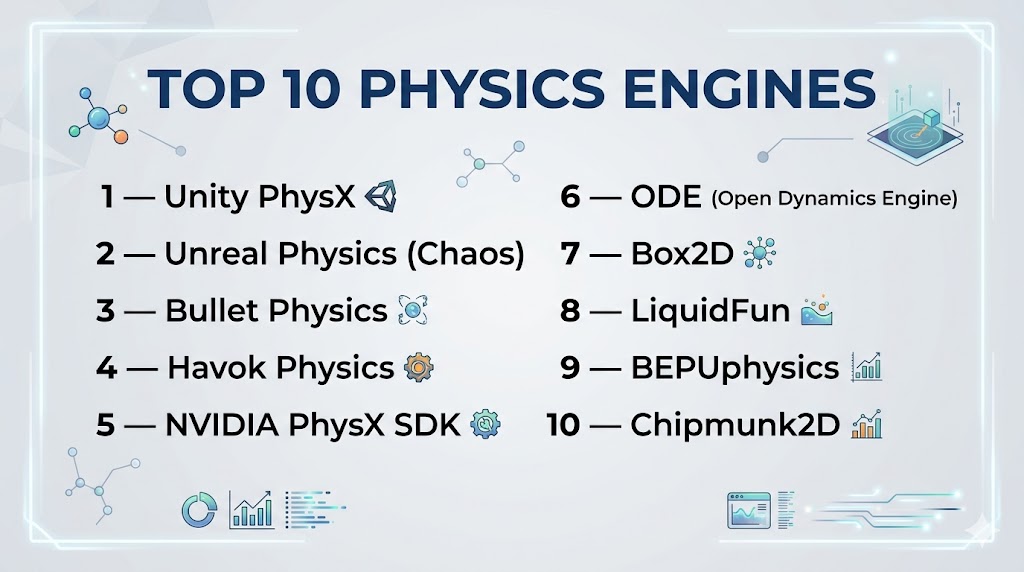
Top 10 Physics Engines
#1 — Unity PhysX
Short description: Unity uses a built‑in integration of PhysX for real‑time physics simulation in games across platforms, offering rigid body dynamics, collisions, joints, and character physics.
Key Features
- Rigid body and collision detection
- Joint systems and constraints
- Character controller physics
- 2D and 3D physics pipelines
- Cross‑platform support
- Editor integration with debugging tools
Pros
- Native integration with Unity Editor
- Broad platform deployment
- Good performance for common game scenarios
Cons
- Limited soft body or fluid simulation out of the box
- Less customizable than standalone engines
Platforms / Deployment
Windows / macOS / Linux / iOS / Android / Consoles
Security & Compliance
Not publicly stated
Integrations & Ecosystem
Unity PhysX is part of Unity’s overall ecosystem, interacting seamlessly with animation, scripting, and rendering.
- Unity Editor tools
- Scripting APIs
- Asset pipelines
- Performance profilers
Support & Community
Strong documentation and community support with extensive tutorials and forums.
#2 — Unreal Physics (Chaos)
Short description: Chaos is Unreal’s next‑generation physics system built for high‑fidelity simulation, designed to handle large worlds, destruction, rigid body and cloth physics.
Key Features
- Destruction and fracture systems
- Rigid body dynamics
- Cloth and soft body support
- Multi‑threaded and optimized performance
- Integration with Unreal Editor
Pros
- Advanced simulation capabilities
- Strong real‑time debugging and visualization
- Deep engine integration
Cons
- Complexity requires learning time
- Performance tuning may be needed for large scenes
Platforms / Deployment
Windows / macOS / Linux / Consoles / Mobile
Security & Compliance
Not publicly stated
Integrations & Ecosystem
Part of Unreal’s comprehensive development environment, integrating with animation, rendering, and visual scripting tools.
- Unreal’s editor tools
- Blueprint integrations
- Asset pipelines
- Profiling tools
Support & Community
Comprehensive documentation and large active community.
#3 — Bullet Physics
Short description: Bullet is an open‑source physics engine used in games, simulations, and robotics for rigid and soft body dynamics.
Key Features
- Rigid body dynamics
- Soft body simulation
- Collision detection
- Multi‑threaded support
- Debug drawing tools
Pros
- Free and open‑source
- Used in many engines and tools
- Active development
Cons
- Setup can be complex
- Soft body and fluid features are less polished
Platforms / Deployment
Cross‑platform (Windows/macOS/Linux and more)
Security & Compliance
Not publicly stated
Integrations & Ecosystem
Widely embedded in other engines (e.g., Blender, Godot).
- Engine integrations
- Plugin support
- Community tools
Support & Community
Strong open‑source community and widespread adoption.
#4 — Havok Physics
Short description: Havok is a commercial physics engine used in many AAA games for rigid body dynamics, collision, and real‑time simulation.
Key Features
- Rigid body physics
- Collision detection
- Broad platform support
- Performance optimization
- Middleware integrations
Pros
- Trusted in enterprise and AAA workflows
- Highly optimized performance
- Strong quality and reliability
Cons
- Licensing cost
- Less accessible for indie developers
Platforms / Deployment
Windows / macOS / Linux / Consoles / Mobile
Security & Compliance
Not publicly stated
Integrations & Ecosystem
Often integrates as middleware within proprietary engines.
- Engine plugins
- Performance tools
- Asset pipelines
Support & Community
Professional support and commercial documentation available.
#5 — NVIDIA PhysX SDK
Short description: NVIDIA’s standalone PhysX SDK offers real‑time physics with hardware acceleration on compatible GPUs.
Key Features
- Rigid and soft body simulation
- Cloth and particle systems
- Hardware acceleration
- Multi‑threaded processing
Pros
- GPU acceleration potential
- Broad physics coverage
- Used widely in games and simulation
Cons
- Hardware acceleration only where supported
- Setup complexity
Platforms / Deployment
Cross‑platform with GPU support
Security & Compliance
Not publicly stated
Integrations & Ecosystem
Integrates with many engines and middleware tools.
- GPU acceleration pipelines
- Plugin interfaces
- Utility libraries
Support & Community
Vendor documentation and community forums.
#6 — ODE (Open Dynamics Engine)
Short description: ODE is an open‑source physics engine tailored for rigid body dynamics and collision detection.
Key Features
- Rigid body physics
- Collision detection
- Simple API
- Lightweight footprint
Pros
- Simple and lightweight
- Free and open‑source
- Used in robotics and simulations
Cons
- Limited advanced features
- Less active development
Platforms / Deployment
Cross‑platform
Security & Compliance
Not publicly stated
Integrations & Ecosystem
Compatible with simulation frameworks.
- Robotics simulations
- Plugin extensions
- Lightweight integrations
Support & Community
Moderate open‑source documentation and examples.
#7 — Box2D
Short description: Box2D is a widely used 2D physics engine for games, offering reliable rigid body simulation, collision detection, and easy integration.
Key Features
- 2D rigid body simulation
- Collision detection
- Joints and constraints
- Lightweight and fast
Pros
- Excellent for 2D games
- Beginner‑friendly API
- Broad adoption
Cons
- 2D only
- No 3D capabilities
Platforms / Deployment
Cross‑platform
Security & Compliance
Not publicly stated
Integrations & Ecosystem
Used in many engines and frameworks.
- Game engine bindings
- Lightweight integration
- Physics utilities
Support & Community
Large community and tutorials.
#8 — LiquidFun
Short description: LiquidFun extends Box2D with particle simulation, enabling fluid‑like behaviors in 2D environments.
Key Features
- Particle systems
- 2D rigid body integration
- Collision with fluid particles
- Lightweight design
Pros
- Realistic fluid‑like simulation in 2D
- Good for effects and gameplay features
- Free and open‑source
Cons
- 2D only
- Non‑rigid body behaviors are limited
Platforms / Deployment
Cross‑platform
Security & Compliance
Not publicly stated
Integrations & Ecosystem
Integrates where Box2D is used.
- Particle system libraries
- Engine bindings
- 2D physics frameworks
Support & Community
Open‑source community support.
#9 — BEPUphysics
Short description: BEPUphysics is a C#‑based physics engine optimized for .NET and game frameworks using that ecosystem.
Key Features
- Rigid body simulation
- Collision detection
- C# integration
- Modular architecture
Pros
- Seamless C# ecosystem fit
- Good performance for .NET games
- Easy API for developers
Cons
- Limited soft body and advanced dynamics
- Smaller ecosystem beyond .NET
Platforms / Deployment
Cross‑platform with .NET runtimes
Security & Compliance
Not publicly stated
Integrations & Ecosystem
Works especially with C# game frameworks.
- .NET bindings
- Game framework plugins
- Physics utilities
Support & Community
Niche community around .NET game development.
#10 — Chipmunk2D
Short description: Chipmunk2D is a fast and lightweight 2D physics engine with broad cross‑platform support and simple API.
Key Features
- 2D rigid body physics
- Collision handling
- Joints and constraints
- Real‑time performance focus
Pros
- Lightweight and fast
- Ideal for 2D games
- Very easy to embed
Cons
- Limited to 2D environments
- Fewer advanced simulation features
Platforms / Deployment
Cross‑platform
Security & Compliance
Not publicly stated
Integrations & Ecosystem
Supports many language bindings and engine use.
- Game framework integration
- Lightweight utilities
- Plugin support
Support & Community
Active community with documentation and examples.
Comparison Table (Top 10)
| Tool Name | Best For | Platform(s) Supported | Deployment | Standout Feature | Public Rating |
|---|---|---|---|---|---|
| Unity PhysX | Integrated engine physics | Multiple | Engine‑embedded | Ready‑to‑use physics | N/A |
| Unreal Physics (Chaos) | AAA real‑time simulation | Multiple | Engine‑embedded | Advanced simulation | N/A |
| Bullet Physics | Open‑source 3D physics | Multiple | Hybrid | Rigid & soft bodies | N/A |
| Havok Physics | AAA game physics middleware | Multiple | Hybrid | Optimized performance | N/A |
| NVIDIA PhysX SDK | Hardware‑accelerated physics | Multiple | Hybrid | GPU acceleration | N/A |
| ODE | Lightweight 3D physics | Multiple | Self‑hosted | Simple rigid body | N/A |
| Box2D | 2D physics | Multiple | Self‑hosted | Efficient 2D simulation | N/A |
| LiquidFun | 2D fluid/particle physics | Multiple | Self‑hosted | Particle systems | N/A |
| BEPUphysics | C# 3D physics | Multiple | Self‑hosted | .NET integration | N/A |
| Chipmunk2D | Lightweight 2D physics | Multiple | Self‑hosted | Fast 2D rigid physics | N/A |
Evaluation & Scoring of Physics Engines
| Tool Name | Core (25%) | Ease (15%) | Integrations (15%) | Security (10%) | Performance (10%) | Support (10%) | Value (15%) | Weighted Total (0–10) |
|---|---|---|---|---|---|---|---|---|
| Unity PhysX | 9 | 9 | 9 | 6 | 8 | 9 | 8 | 8.35 |
| Unreal Physics (Chaos) | 10 | 7 | 8 | 6 | 9 | 9 | 7 | 8.10 |
| Bullet Physics | 8 | 7 | 8 | 5 | 7 | 8 | 10 | 7.85 |
| Havok Physics | 9 | 6 | 8 | 6 | 9 | 8 | 6 | 7.75 |
| NVIDIA PhysX SDK | 9 | 6 | 7 | 6 | 9 | 7 | 7 | 7.70 |
| ODE | 6 | 8 | 6 | 5 | 6 | 7 | 10 | 6.95 |
| Box2D | 8 | 9 | 7 | 5 | 8 | 8 | 9 | 8.10 |
| LiquidFun | 7 | 8 | 6 | 5 | 7 | 7 | 9 | 7.25 |
| BEPUphysics | 6 | 8 | 6 | 5 | 6 | 7 | 9 | 7.05 |
| Chipmunk2D | 8 | 9 | 6 | 5 | 8 | 7 | 9 | 7.75 |
How to interpret the scores:
- Scores are comparative editorial assessments across capability, ease, integration, and value.
- Higher scores generally indicate broader use cases, richer features, and better ecosystem support.
- Lower scores reflect more specialized or lightweight engines that serve narrower needs well.
Which Physics Engine Tool Is Right for You?
Solo / Freelancer
- Box2D, Chipmunk2D, Bullet Physics offer lightweight and flexible options for indie and hobby projects.
SMB
- Unity PhysX and NVIDIA PhysX SDK give strong general‑purpose physics with engine and hardware support.
Mid‑Market
- Bullet Physics, Unreal Physics (Chaos) and Havok Physics balance performance, features, and robustness for commercial titles.
Enterprise
- Unreal Physics (Chaos) and Havok Physics are well‑validated for large‑scale games and real‑time simulations requiring reliability and optimization.
Budget vs Premium
- Budget/Open‑Source: Bullet Physics, Box2D, Chipmunk2D, LiquidFun
- Premium: Havok Physics, Unity PhysX (commercial use scenarios)
Feature Depth vs Ease of Use
- Depth: Unreal Physics (Chaos), Havok Physics
- Ease: Unity PhysX, Box2D, Chipmunk2D
Integrations & Scalability
- Unity PhysX and Unreal Physics (Chaos) offer deep engine‑level integration and scalable workflows.
Security & Compliance Needs
- Physics engines typically don’t handle security controls directly; evaluate based on the platforms and ecosystems in which they operate.
Frequently Asked Questions (FAQs)
1. What is a physics engine?
A physics engine simulates real‑world physical behavior (like movement, collisions, and forces) in digital environments.
2. Do physics engines require coding?
Yes, they generally require scripting or code integration, though some engines include visual tools.
3. Which engines are best for 2D games?
Box2D, Chipmunk2D, and LiquidFun are optimized 2D choices.
4. Are there open‑source physics engines?
Yes — Bullet Physics, Box2D, and LiquidFun are open‑source engines.
5. Can physics engines simulate cloth and soft bodies?
Some can; for example, Unreal Physics and NVIDIA PhysX support soft body and cloth simulation.
6. Do physics engines impact performance?
Yes — complex simulations require optimization and may benefit from hardware acceleration.
7. Which physics engine is best for AAA games?
Unreal Physics (Chaos) and Havok Physics are commonly used in high‑end production.
8. Are physics engines used outside games?
Yes — simulation, robotics, training systems, and VR applications use physics engines.
9. Can physics engines run in the cloud?
Simulations can be run in distributed or cloud environments with proper setup.
10. Is GPU acceleration important?
GPU acceleration can significantly improve performance for complex or many‑object simulations.
Conclusion
Physics engines are essential for any project seeking believable, interactive motion and behavior, whether it’s a casual indie title or a large‑scale AAA game or simulation. Unity PhysX and Unreal Physics (Chaos) stand out for real‑time game development with strong ecosystem support, while engines like Box2D and Bullet Physics remain favorites for 2D and open‑source needs. Specialized middleware like Havok Physics serves enterprise environments with optimized performance and professional support. Start by identifying your simulation needs — 2D vs 3D, real‑time performance, engine integration, and extensibility — then shortlist two or three engines to prototype real scenarios. Validate integration, accuracy, and performance with your workflow to make the best choice for your team.

Find Trusted Cardiac Hospitals
Compare heart hospitals by city and services — all in one place.
Explore Hospitals