Introduction
DDoS Protection Tools help organizations detect, absorb, filter, and mitigate distributed denial-of-service attacks before they disrupt websites, applications, APIs, DNS infrastructure, gaming platforms, payment systems, and enterprise networks. These tools defend against traffic floods, protocol attacks, bot-driven abuse, volumetric attacks, and application-layer disruption attempts that can overwhelm infrastructure and make digital services unavailable. DDoS protection matters now because businesses depend on always-on digital access, cloud applications, e-commerce portals, SaaS platforms, APIs, remote work services, and global customer-facing systems. Attackers increasingly use botnets, compromised devices, reflection attacks, and multi-vector attack campaigns to target availability. A strong DDoS protection platform helps maintain uptime, reduce revenue loss, protect brand reputation, and support incident response.
Common Real-world use cases include:
- Protecting websites, APIs, and SaaS applications from traffic floods
- Defending DNS infrastructure and edge services from disruption
- Securing gaming, fintech, media, and e-commerce platforms
- Protecting enterprise networks and data centers from volumetric attacks
- Supporting compliance and business continuity requirements
Key Evaluation criteria buyers should consider include:
- Network capacity and global mitigation coverage
- Layer 3, Layer 4, and Layer 7 protection
- Application and API protection capabilities
- DNS and edge security support
- False positive handling
- Time to mitigation
- Traffic analytics and reporting
- Integration with WAF, CDN, SIEM, and SOC tools
- Deployment model and routing flexibility
- Support quality and managed response options
Best for: Enterprises, SaaS companies, e-commerce businesses, financial institutions, gaming platforms, telecom providers, media companies, managed security service providers, and any organization where website, application, API, or network availability is business-critical.
Not ideal for: Very small personal websites or internal-only systems with low exposure and minimal availability risk, unless they are already being targeted or require managed security coverage.
Key Trends in DDoS Protection Tools
- AI-assisted attack detection is improving the speed of identifying abnormal traffic patterns, bot-driven floods, and multi-vector attacks.
- Application-layer DDoS protection is becoming more important because attackers increasingly target login pages, APIs, search endpoints, and checkout flows.
- DDoS and WAF convergence is growing as organizations want one platform for availability protection and application security.
- API DDoS mitigation is becoming essential for SaaS, fintech, mobile, and partner-integrated platforms.
- Always-on protection models are replacing reactive on-demand mitigation for businesses with strict uptime requirements.
- Edge-based mitigation is gaining adoption because attacks can be filtered closer to the source before reaching origin infrastructure.
- Managed DDoS response services are becoming valuable for organizations without in-house security operations teams.
- Cloud-native DDoS protection is expanding as more workloads run across AWS, Azure, Google Cloud, Kubernetes, and hybrid cloud networks.
- Bot and abuse protection is increasingly bundled with DDoS defense to stop scraping, credential stuffing, fake signups, and resource exhaustion.
- Real-time attack analytics are becoming important for post-incident reviews, executive reporting, and compliance evidence.
How We Selected These Tools Methodology
The tools below were selected using practical security, networking, and availability-focused evaluation criteria including:
- Market adoption and security industry reputation
- Layer 3, Layer 4, and Layer 7 mitigation capabilities
- Global network scale and mitigation capacity
- DDoS detection accuracy and false positive handling
- Integration with WAF, CDN, DNS, cloud, SIEM, and SOC workflows
- Suitability for SMB, mid-market, and enterprise environments
- Managed security and incident response options
- Performance impact and traffic routing flexibility
- Security reporting and analytics maturity
- Support quality, documentation, and operational usability
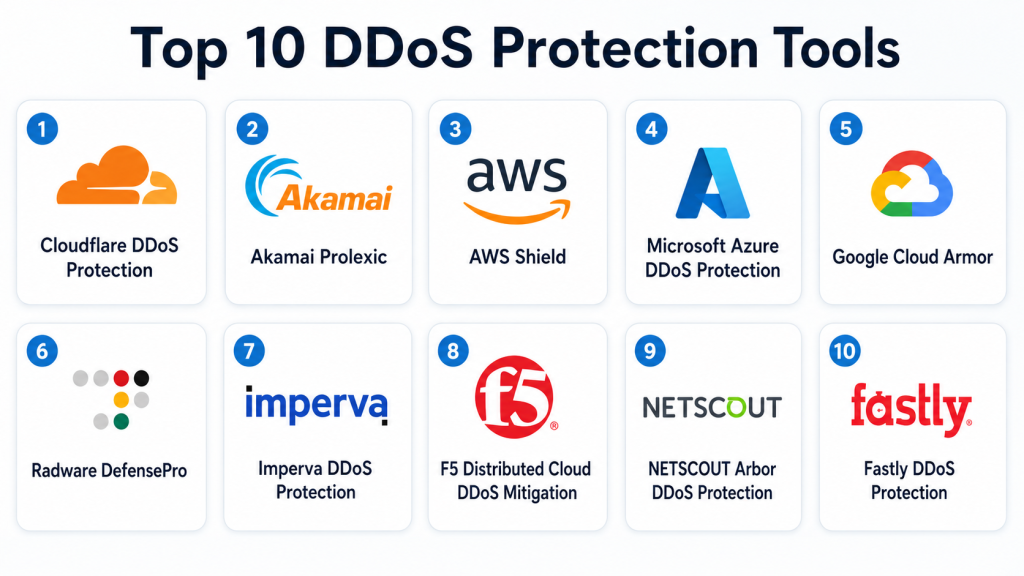
Top 10 DDoS Protection Tools
1- Cloudflare DDoS Protection
Short description: Cloudflare DDoS Protection is a cloud-based mitigation platform delivered through Cloudflare’s global edge network. It protects websites, APIs, DNS, and network services from volumetric, protocol, and application-layer attacks.
Key Features
- Layer 3, Layer 4, and Layer 7 DDoS protection
- Global Anycast edge network
- Integrated WAF and bot protection
- DNS protection
- Always-on mitigation
- Real-time traffic analytics
- Custom security rules
Pros
- Strong global edge performance
- Easy deployment for web applications and APIs
- Broad security and performance ecosystem
Cons
- Advanced enterprise controls may require higher-tier plans
- Complex policies may need careful tuning
- Some deep network protection use cases require enterprise configuration
Platforms / Deployment
- Web
- Cloud
Security & Compliance
- MFA
- SSO/SAML support
- RBAC
- Audit logging
- Encryption
- DDoS mitigation
Integrations & Ecosystem
Cloudflare integrates DDoS protection with DNS, CDN, WAF, bot management, zero-trust access, and developer workflows. It is useful for organizations that want a unified edge security and performance layer.
- DNS management
- WAF
- Bot management
- SIEM integrations
- Terraform
- Cloud hosting platforms
Support & Community
Cloudflare provides strong documentation, community resources, developer guidance, and enterprise support tiers. It is widely adopted across startups, SaaS platforms, e-commerce teams, and large enterprises.
2- Akamai Prolexic
Short description: Akamai Prolexic is an enterprise-grade DDoS protection platform designed to defend large organizations against high-volume and complex attacks. It is commonly used by financial services, gaming, media, and global digital businesses.
Key Features
- High-capacity DDoS mitigation
- Always-on and on-demand protection
- Layer 3, Layer 4, and Layer 7 defense
- Managed security operations
- Attack traffic scrubbing
- Global mitigation infrastructure
- Real-time monitoring and reporting
Pros
- Strong enterprise-scale protection
- Excellent managed mitigation expertise
- Suitable for high-risk and high-traffic environments
Cons
- Premium enterprise pricing
- Implementation may require routing and network planning
- More complex than lightweight cloud WAF-based options
Platforms / Deployment
- Cloud
- Hybrid
Security & Compliance
- RBAC
- Audit logging
- Encryption
- Secure access controls
- Managed security workflows
Integrations & Ecosystem
Akamai Prolexic integrates with Akamai’s broader edge, CDN, WAF, DNS, and application security ecosystem. It works well for organizations that need global edge delivery and enterprise-grade availability protection.
- Akamai CDN
- Akamai WAF
- DNS protection
- SIEM integrations
- Managed SOC workflows
- Network routing integrations
Support & Community
Akamai provides enterprise support, managed security response, professional services, and strong documentation for complex DDoS defense environments.
3- AWS Shield
Short description: AWS Shield is Amazon’s DDoS protection service for applications and infrastructure hosted on AWS. It provides automatic protection for many AWS services and advanced features for organizations requiring stronger mitigation and response support.
Key Features
- AWS-native DDoS protection
- Automatic traffic monitoring
- Protection for AWS edge and application services
- Advanced mitigation options
- Cost protection options for eligible attacks
- Integration with AWS WAF
- Attack visibility and reporting
Pros
- Deep AWS ecosystem integration
- Good fit for cloud-native AWS applications
- Strong alignment with AWS security services
Cons
- Best suited for AWS-hosted workloads
- Multi-cloud protection is limited
- Advanced configuration requires AWS security knowledge
Platforms / Deployment
- Web
- Cloud
Security & Compliance
- IAM-based access controls
- Audit logging through AWS services
- Encryption support
- Integration with AWS security monitoring
Integrations & Ecosystem
AWS Shield integrates tightly with AWS networking, edge delivery, application security, and monitoring tools. It is best for organizations already operating critical workloads on AWS.
- Amazon CloudFront
- Elastic Load Balancing
- Amazon Route 53
- AWS WAF
- AWS CloudWatch
- AWS Security Hub
Support & Community
AWS provides extensive documentation, partner resources, support plans, and cloud security guidance. Advanced support options are available for organizations with critical production workloads.
4- Microsoft Azure DDoS Protection
Short description: Microsoft Azure DDoS Protection helps protect Azure-hosted applications, virtual networks, and public endpoints from network-layer DDoS attacks. It is designed for organizations operating cloud services in Azure environments.
Key Features
- Azure-native DDoS mitigation
- Protection for Azure virtual networks
- Adaptive traffic monitoring
- Attack analytics and reporting
- Integration with Azure security tools
- Always-on network protection
- Incident response support options
Pros
- Strong Azure ecosystem integration
- Good fit for Microsoft-centric enterprises
- Centralized visibility through Azure tools
Cons
- Primarily focused on Azure environments
- Advanced configuration requires Azure networking expertise
- Multi-cloud defense may require additional platforms
Platforms / Deployment
- Web
- Cloud
Security & Compliance
- Azure RBAC
- Audit logging
- Encryption support
- Azure identity integration
- Security monitoring integrations
Integrations & Ecosystem
Azure DDoS Protection integrates with Microsoft cloud networking, monitoring, and security tools. It is best suited for organizations standardized on Azure infrastructure.
- Azure Virtual Network
- Azure Monitor
- Microsoft Sentinel
- Azure Firewall
- Azure Application Gateway
- Azure Policy
Support & Community
Microsoft provides enterprise support, technical documentation, partner services, and strong cloud administration resources.
5- Google Cloud Armor
Short description: Google Cloud Armor provides DDoS protection, WAF capabilities, and edge security for workloads running on Google Cloud. It helps protect applications from network and application-layer threats using Google’s global infrastructure.
Key Features
- DDoS protection
- Web application firewall capabilities
- Adaptive protection features
- Edge-based filtering
- Rate limiting
- Custom security policies
- Logging and monitoring integration
Pros
- Strong Google Cloud integration
- Good edge-based security controls
- Useful for cloud-native applications
Cons
- Best suited for Google Cloud environments
- Cross-cloud use cases may need additional tools
- Advanced policy tuning requires expertise
Platforms / Deployment
- Web
- Cloud
Security & Compliance
- IAM integration
- Audit logging
- Encryption support
- Policy-based access controls
Integrations & Ecosystem
Google Cloud Armor integrates with Google Cloud load balancing, logging, monitoring, and security operations. It is best for teams already using Google Cloud infrastructure.
- Google Cloud Load Balancing
- Cloud Logging
- Cloud Monitoring
- Security Command Center
- Terraform
- API integrations
Support & Community
Google Cloud provides technical documentation, support plans, partner resources, and cloud security best-practice guidance.
6- Radware DefensePro
Short description: Radware DefensePro is an enterprise DDoS protection platform focused on network-layer and application-layer attack mitigation. It is used by enterprises, service providers, and organizations with demanding availability requirements.
Key Features
- Behavioral DDoS detection
- Network-layer attack mitigation
- Application-layer protection
- SSL attack protection options
- Automated mitigation policies
- Real-time attack analytics
- Hybrid deployment support
Pros
- Strong enterprise DDoS mitigation depth
- Good behavioral attack detection
- Suitable for service providers and data centers
Cons
- Deployment and tuning can be complex
- Premium enterprise focus
- Requires experienced network security teams
Platforms / Deployment
- Self-hosted
- Hybrid
- Cloud
Security & Compliance
- RBAC
- Audit logging
- Encryption support
- Secure policy management
- Reporting for security operations
Integrations & Ecosystem
Radware DefensePro integrates with Radware’s application delivery, WAF, bot management, and security analytics ecosystem. It is useful for organizations that want strong control over mitigation policies.
- Radware AppWall
- SIEM integrations
- Network monitoring tools
- Cloud environments
- Security analytics
- DDoS scrubbing services
Support & Community
Radware provides enterprise support, security expertise, managed service options, documentation, and professional services for complex deployments.
7- Imperva DDoS Protection
Short description: Imperva DDoS Protection helps organizations protect websites, DNS, applications, and networks from DDoS attacks. It is commonly used by enterprises that also need WAF, bot protection, and application security controls.
Key Features
- Network and application DDoS protection
- Website protection
- DNS protection
- WAF integration
- Bot mitigation integration
- Always-on protection
- Attack analytics and reporting
Pros
- Strong application security ecosystem
- Good fit for regulated and high-risk businesses
- Useful combination of WAF, bot, and DDoS defense
Cons
- Enterprise pricing may be high
- Advanced deployments require planning
- Some configurations may need managed support
Platforms / Deployment
- Cloud
- Hybrid
Security & Compliance
- RBAC
- Audit logging
- Encryption
- Secure access controls
- Compliance reporting support
Integrations & Ecosystem
Imperva integrates DDoS protection with its broader WAF, bot protection, API security, and security analytics ecosystem. It is strong for organizations that want application security and availability defense together.
- Imperva WAF
- Bot protection
- SIEM integrations
- API integrations
- DNS protection
- Cloud security workflows
Support & Community
Imperva provides enterprise support, managed security options, onboarding assistance, and documentation for security operations teams.
8- F5 Distributed Cloud DDoS Mitigation
Short description: F5 Distributed Cloud DDoS Mitigation provides DDoS protection for applications, APIs, and infrastructure across distributed and hybrid environments. It is useful for organizations already using F5 application delivery and security technologies.
Key Features
- Cloud-based DDoS mitigation
- Application and API protection
- Layer 3, Layer 4, and Layer 7 defense
- Edge security integration
- Hybrid application protection
- Real-time visibility
- Managed mitigation options
Pros
- Strong integration with F5 ecosystem
- Good fit for hybrid application environments
- Supports advanced enterprise use cases
Cons
- Can be complex for smaller teams
- Premium enterprise focus
- Best value for organizations with distributed application architectures
Platforms / Deployment
- Cloud
- Hybrid
Security & Compliance
- RBAC
- Audit logging
- Encryption support
- Secure policy controls
Integrations & Ecosystem
F5 integrates DDoS mitigation with application delivery, WAF, API security, and hybrid cloud networking workflows. It works well for organizations with existing F5 infrastructure or advanced application delivery needs.
- F5 Advanced WAF
- BIG-IP ecosystem
- Cloud security tools
- SIEM integrations
- API integrations
- Application delivery controllers
Support & Community
F5 provides enterprise support, technical documentation, training resources, certifications, and professional services for complex application environments.
9- NETSCOUT Arbor DDoS Protection
Short description: NETSCOUT Arbor DDoS Protection is widely used by service providers, large enterprises, and network operators for high-scale DDoS detection and mitigation. It focuses on network visibility, traffic analysis, and infrastructure-level protection.
Key Features
- Network-layer DDoS detection
- Traffic visibility and analytics
- Service provider-scale mitigation
- Threat intelligence support
- Hybrid protection models
- Attack reporting
- Infrastructure protection
Pros
- Strong fit for telecom and service providers
- Deep network traffic visibility
- Good for large-scale infrastructure defense
Cons
- Not ideal for small businesses
- Complex deployment and operations
- Enterprise and carrier-focused pricing
Platforms / Deployment
- Self-hosted
- Hybrid
- Cloud
Security & Compliance
- RBAC
- Audit logging
- Secure access controls
- Threat intelligence integration
Integrations & Ecosystem
NETSCOUT Arbor integrates with network infrastructure, monitoring systems, scrubbing centers, and security operations workflows. It is especially strong for organizations that need traffic intelligence at scale.
- Network routers
- Scrubbing centers
- SIEM platforms
- Threat intelligence tools
- Network monitoring tools
- Service provider operations
Support & Community
NETSCOUT provides enterprise and service provider support, technical documentation, expert services, and mature operational guidance for large-scale DDoS environments.
10- Fastly DDoS Protection
Short description: Fastly DDoS Protection helps protect applications and APIs using Fastly’s edge cloud infrastructure. It is designed for modern web platforms, media companies, SaaS providers, and developer-focused teams.
Key Features
- Edge-based DDoS mitigation
- Application-layer protection
- Real-time traffic visibility
- API protection support
- CDN and edge integration
- Custom security controls
- Rapid traffic filtering
Pros
- Strong edge performance
- Developer-friendly workflows
- Good fit for modern web applications
Cons
- Advanced security features may require tuning
- Best value when used with Fastly edge services
- Enterprise requirements may need careful configuration
Platforms / Deployment
- Web
- Cloud
Security & Compliance
- RBAC
- Audit logging
- Encryption support
- Secure access controls
Integrations & Ecosystem
Fastly integrates DDoS protection with edge delivery, WAF, API security, observability, and DevOps workflows. It is suitable for teams that want security controls close to application delivery.
- Fastly CDN
- Fastly Next-Gen WAF
- APIs
- Observability tools
- SIEM integrations
- CI/CD workflows
Support & Community
Fastly provides technical documentation, developer resources, enterprise support, and implementation guidance for edge security and application delivery teams.
Comparison Table
| Tool Name | Best For | Platform Supported | Deployment | Standout Feature | Public Rating |
|---|---|---|---|---|---|
| Cloudflare DDoS Protection | Websites, APIs, DNS, and edge protection | Web | Cloud | Global edge-based mitigation | N/A |
| Akamai Prolexic | Enterprise and high-risk digital businesses | Web | Cloud, Hybrid | Managed enterprise DDoS mitigation | N/A |
| AWS Shield | AWS-hosted applications | Web | Cloud | AWS-native DDoS defense | N/A |
| Microsoft Azure DDoS Protection | Azure virtual networks and workloads | Web | Cloud | Azure-native network protection | N/A |
| Google Cloud Armor | Google Cloud applications | Web | Cloud | Edge security and adaptive protection | N/A |
| Radware DefensePro | Enterprises and service providers | Web, Appliance | Cloud, Self-hosted, Hybrid | Behavioral DDoS detection | N/A |
| Imperva DDoS Protection | Application security and DDoS defense | Web | Cloud, Hybrid | WAF, bot, and DDoS integration | N/A |
| F5 Distributed Cloud DDoS Mitigation | Hybrid application environments | Web | Cloud, Hybrid | Distributed application protection | N/A |
| NETSCOUT Arbor DDoS Protection | Telecom and large network operators | Web, Appliance | Cloud, Self-hosted, Hybrid | Carrier-grade traffic visibility | N/A |
| Fastly DDoS Protection | Developer-focused edge applications | Web | Cloud | Edge-native traffic filtering | N/A |
Evaluation & Scoring of DDoS Protection Tools
| Tool Name | Core | Ease | Integrations | Security | Performance | Support | Value | Weighted Total |
|---|---|---|---|---|---|---|---|---|
| Cloudflare DDoS Protection | 9 | 9 | 9 | 9 | 10 | 8 | 9 | 9.1 |
| Akamai Prolexic | 10 | 7 | 8 | 9 | 10 | 9 | 7 | 8.7 |
| AWS Shield | 8 | 8 | 9 | 8 | 9 | 8 | 8 | 8.3 |
| Microsoft Azure DDoS Protection | 8 | 8 | 8 | 8 | 8 | 8 | 8 | 8.0 |
| Google Cloud Armor | 8 | 8 | 8 | 8 | 9 | 8 | 8 | 8.2 |
| Radware DefensePro | 9 | 6 | 8 | 9 | 9 | 8 | 7 | 8.0 |
| Imperva DDoS Protection | 9 | 7 | 8 | 9 | 9 | 8 | 7 | 8.1 |
| F5 Distributed Cloud DDoS Mitigation | 8 | 7 | 8 | 9 | 8 | 8 | 7 | 7.8 |
| NETSCOUT Arbor DDoS Protection | 9 | 6 | 8 | 9 | 9 | 8 | 6 | 7.8 |
| Fastly DDoS Protection | 8 | 8 | 8 | 8 | 9 | 8 | 8 | 8.1 |
These scores are comparative and should be interpreted based on business risk, infrastructure model, attack exposure, and operational maturity. Edge-based cloud platforms often score strongly for speed, ease of deployment, and performance. Carrier-grade and enterprise appliance-based platforms provide deep network control but may require more expertise. Cloud-native tools are ideal when workloads are concentrated in one cloud provider. Organizations with high-risk digital services should prioritize mitigation scale, managed response, analytics, and integration with WAF and SOC workflows.
Which DDoS Protection Tool Is Right for You?
Solo / Freelancer
Solo website owners, small developers, and freelancers usually need simple cloud-based DDoS protection that is easy to enable. Cloudflare DDoS Protection or a basic cloud-native protection layer can be practical when the goal is affordable availability protection without complex routing.
SMB
SMBs should prioritize simple deployment, DNS and website protection, WAF integration, and predictable support. Cloudflare, Fastly, Imperva, or a cloud-native option like AWS Shield, Azure DDoS Protection, or Google Cloud Armor can work well depending on where the application is hosted.
Mid-Market
Mid-market organizations often need stronger analytics, WAF integration, bot protection, and incident response support. Cloudflare, Imperva, Fastly, Radware, and F5 can be strong choices depending on application architecture, traffic patterns, and security team maturity.
Enterprise
Enterprises should prioritize global mitigation capacity, always-on protection, managed response, hybrid routing, compliance reporting, and integration with security operations. Akamai Prolexic, Cloudflare, Radware DefensePro, Imperva, NETSCOUT Arbor, and F5 Distributed Cloud DDoS Mitigation are strong candidates for complex environments.
Budget vs Premium
Budget-conscious teams may start with cloud-native or edge-based protection included in existing infrastructure. Premium enterprise tools usually offer higher mitigation capacity, managed security response, deeper analytics, advanced routing, and stronger support during active attacks.
Feature Depth vs Ease of Use
Cloud-based tools such as Cloudflare, Fastly, AWS Shield, Azure DDoS Protection, and Google Cloud Armor are typically easier to deploy for cloud or web workloads. Enterprise tools such as Akamai Prolexic, Radware, NETSCOUT Arbor, and F5 provide deeper mitigation control but require more planning.
Integrations & Scalability
Organizations should prioritize platforms that integrate with WAF, CDN, DNS, SIEM, cloud logging, SOC workflows, and incident response tools. Scalability is especially important for businesses with global traffic, multiple cloud regions, or high-value public-facing applications.
Security & Compliance Needs
Regulated industries should prioritize audit logging, access controls, reporting, managed response, encryption, incident documentation, and attack analytics. DDoS protection should support business continuity and compliance evidence, not just traffic filtering.
Frequently Asked Questions FAQs
1. What are DDoS Protection Tools?
DDoS Protection Tools detect and mitigate distributed denial-of-service attacks that attempt to overwhelm websites, applications, APIs, DNS services, or networks. They filter malicious traffic while allowing legitimate users to continue accessing services.
2. Why do businesses need DDoS protection?
Businesses need DDoS protection because downtime can cause lost revenue, customer frustration, brand damage, and operational disruption. Public-facing applications, APIs, and digital platforms are common targets.
3. What is the difference between network-layer and application-layer DDoS attacks?
Network-layer attacks target infrastructure bandwidth, protocols, and transport layers, while application-layer attacks target web pages, APIs, login forms, search functions, and other application resources.
4. Can a WAF stop DDoS attacks?
A WAF can help with application-layer DDoS attacks, but high-volume network-layer attacks usually require dedicated DDoS mitigation capacity. Many platforms combine WAF and DDoS protection for broader defense.
5. Are cloud-based DDoS protection tools reliable?
Cloud-based DDoS tools can be highly effective because they filter malicious traffic at large distributed edge networks. Their reliability depends on provider capacity, routing model, configuration, and support quality.
6. What does always-on DDoS protection mean?
Always-on protection continuously monitors and filters traffic instead of waiting for an attack to trigger manual redirection. This model is useful for businesses with strict uptime requirements.
7. How difficult is DDoS protection deployment?
Deployment complexity depends on the protection model. DNS-based and edge-based services are usually faster to deploy, while BGP routing, scrubbing centers, and hybrid models require more planning.
8. What integrations should buyers look for?
Buyers should look for integrations with WAF, CDN, DNS, SIEM, cloud monitoring, incident management, and SOC workflows. These integrations improve detection, response, and post-incident analysis.
9. How should organizations evaluate DDoS vendors?
Organizations should evaluate mitigation capacity, time to mitigation, layer coverage, false positive handling, support response, analytics, routing flexibility, integration ecosystem, and total cost.
10. Are managed DDoS services worth it?
Managed DDoS services can be valuable for teams without dedicated security operations staff. They provide expert support during attacks, tuning guidance, and faster incident response.
Conclusion
DDoS Protection Tools are essential for organizations that depend on always-available websites, APIs, DNS services, SaaS platforms, cloud workloads, and network infrastructure. The best platform depends on business risk, hosting model, traffic scale, security maturity, and the type of assets being protected. Cloudflare, Fastly, AWS Shield, Azure DDoS Protection, and Google Cloud Armor are strong options for cloud and edge-based protection, while Akamai Prolexic, Radware DefensePro, NETSCOUT Arbor, Imperva, and F5 offer deeper enterprise and hybrid mitigation capabilities. Organizations should not choose a tool based only on brand name or mitigation claims. The practical next step is to shortlist two or three platforms, test deployment options, validate WAF, DNS, CDN, SIEM, and cloud integrations, review false positive handling, and confirm support response procedures before an actual attack occurs.

Find Trusted Cardiac Hospitals
Compare heart hospitals by city and services — all in one place.
Explore Hospitals
I am trying to learn more about DDoS protection, and this blog helped me understand how these tools protect websites from traffic-based attacks.