Introduction
Identity & Access Management IAM tools help organizations control who can access applications, systems, cloud resources, data, devices, and business workflows. In simple terms, IAM ensures the right users get the right access at the right time, while unauthorized users, risky sessions, and excessive permissions are blocked or reviewed. IAM matters now because modern businesses operate across SaaS apps, hybrid cloud, remote work, contractors, APIs, privileged users, and machine identities. Password-only access is no longer enough, and manual user provisioning creates security gaps. IAM platforms help enforce single sign-on, multi-factor authentication, lifecycle automation, access governance, privileged access controls, and zero-trust access policies.
Common Real-world use cases include:
- Centralized single sign-on for business applications
- Multi-factor authentication for employees and partners
- Automated onboarding and offboarding
- Access reviews and compliance audits
- Privileged and high-risk access control
Key Evaluation criteria buyers should consider include:
- SSO and MFA capabilities
- User lifecycle automation
- Identity governance and access reviews
- Privileged access management support
- Adaptive and risk-based authentication
- App integrations and directory support
- Cloud and hybrid deployment flexibility
- Compliance reporting and audit logs
- API and automation capabilities
- Ease of administration and support quality
Best for: Enterprises, SMBs, SaaS companies, IT teams, security teams, compliance teams, healthcare organizations, financial institutions, educational institutions, and any business managing employee, contractor, partner, or customer access at scale.
Not ideal for: Very small businesses with only a few users and minimal application access needs, unless they require stronger security, compliance controls, or automated user lifecycle management.
Key Trends in Identity & Access Management IAM
- Passwordless authentication is becoming more important as organizations reduce reliance on passwords and shared secrets.
- Zero-trust identity controls are now central to enterprise security strategies, requiring continuous verification and least-privilege access.
- AI-assisted identity analytics are helping detect unusual login behavior, risky entitlements, and access anomalies.
- Identity governance and administration is becoming more closely connected with SSO, MFA, and lifecycle automation.
- Machine identity management is growing as APIs, service accounts, workloads, and automation bots require secure access control.
- Cloud-native IAM adoption is increasing as businesses move more applications to SaaS and public cloud platforms.
- Privileged access management convergence is becoming important as organizations want unified control over normal and high-risk accounts.
- Adaptive MFA is replacing static authentication rules by using context such as device, location, risk level, and user behavior.
- Compliance-ready access reviews are becoming essential for regulated industries.
- Identity threat detection and response is emerging as a key capability for identifying compromised accounts and risky access patterns.
How We Selected These Tools Methodology
The tools below were selected using practical identity security and enterprise IT evaluation criteria including:
- Market adoption and enterprise recognition
- SSO, MFA, and access management maturity
- Identity governance and lifecycle automation depth
- Security posture and risk-based access capabilities
- Privileged access and high-risk account controls
- App integration ecosystem and API flexibility
- Cloud, hybrid, and directory compatibility
- Reporting, compliance, and audit readiness
- Customer fit across SMB, mid-market, and enterprise segments
- Documentation, onboarding support, and administrator usability
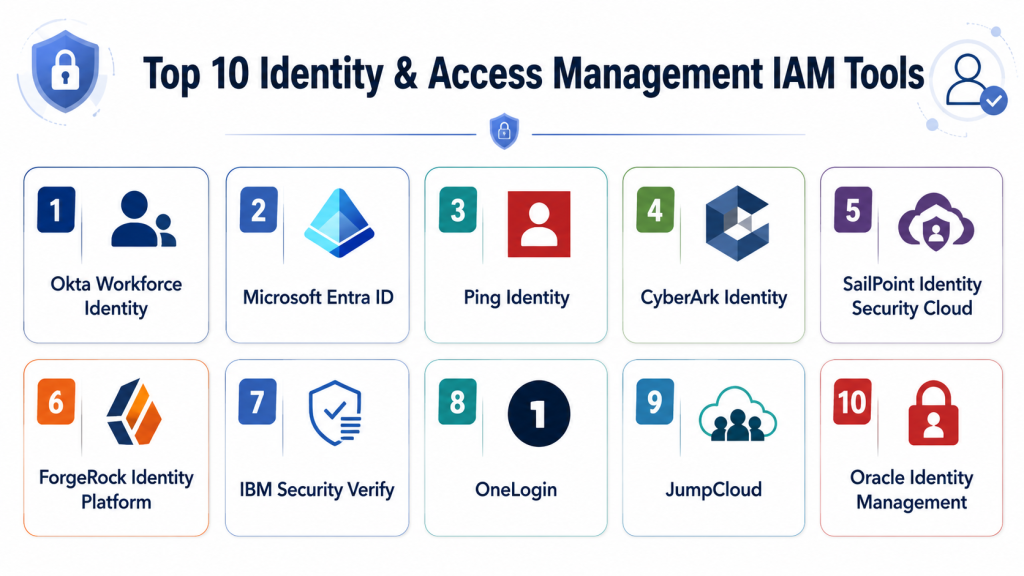
Top 10 Identity & Access Management IAM Tools
1- Okta Workforce Identity
Short description: Okta Workforce Identity is a widely used cloud-based IAM platform focused on SSO, MFA, lifecycle management, adaptive access, and application integrations. It is popular with SaaS-first organizations and enterprises needing centralized workforce access control.
Key Features
- Single sign-on for business applications
- Adaptive multi-factor authentication
- Lifecycle management and provisioning
- Universal directory capabilities
- API access management
- Workflow automation
- Large application integration catalog
Pros
- Strong SaaS application ecosystem
- User-friendly administration experience
- Good fit for cloud-first organizations
Cons
- Advanced features may increase licensing cost
- Complex enterprise deployments require planning
- Governance depth may require additional modules or tools
Platforms / Deployment
- Web
- Cloud
Security & Compliance
- SSO/SAML
- MFA
- RBAC
- Audit logs
- Encryption
- Compliance support varies by plan
Integrations & Ecosystem
Okta integrates with SaaS applications, directories, HR platforms, security tools, and DevOps systems. Its ecosystem is especially strong for organizations that need fast app onboarding and centralized identity controls.
- Microsoft 365
- Google Workspace
- Salesforce
- ServiceNow
- Workday
- SIEM and security tools
Support & Community
Okta provides strong documentation, onboarding resources, administrator training, community support, and enterprise support tiers.
2- Microsoft Entra ID
Short description: Microsoft Entra ID is Microsoft’s cloud identity and access management platform for workforce identity, SSO, MFA, conditional access, and Microsoft ecosystem security. It is especially strong for organizations already using Microsoft 365, Azure, and Windows environments.
Key Features
- Single sign-on
- Multi-factor authentication
- Conditional access policies
- Identity protection
- Privileged identity management
- Hybrid directory support
- Microsoft ecosystem integration
Pros
- Deep Microsoft 365 and Azure integration
- Strong conditional access capabilities
- Good value for Microsoft-centric organizations
Cons
- Best suited for Microsoft-heavy environments
- Advanced configuration can be complex
- Non-Microsoft app governance may require extra planning
Platforms / Deployment
- Web
- Cloud
- Hybrid
Security & Compliance
- SSO/SAML
- MFA
- RBAC
- Audit logs
- Encryption
- Conditional access
Integrations & Ecosystem
Microsoft Entra ID integrates deeply with Microsoft 365, Azure, Windows, security tools, and thousands of enterprise applications. It is a strong choice for companies standardizing around Microsoft identity.
- Microsoft 365
- Azure
- Windows Server Active Directory
- Microsoft Defender
- Microsoft Sentinel
- SaaS applications
Support & Community
Microsoft offers enterprise support, extensive documentation, partner services, training resources, and a large administrator community.
3- Ping Identity
Short description: Ping Identity provides enterprise-grade IAM, SSO, MFA, federation, API security, and customer identity capabilities. It is well suited for large organizations with complex hybrid, legacy, and modern application environments.
Key Features
- Enterprise SSO
- Adaptive MFA
- Identity federation
- API access management
- Customer identity support
- Hybrid identity deployment
- Risk-based authentication
Pros
- Strong enterprise federation capabilities
- Good hybrid and complex environment support
- Flexible identity architecture
Cons
- May require specialist implementation skills
- Not always the simplest option for smaller teams
- Advanced configurations can be complex
Platforms / Deployment
- Cloud
- Self-hosted
- Hybrid
Security & Compliance
- SSO/SAML
- MFA
- RBAC
- Audit logs
- Encryption
- Secure federation controls
Integrations & Ecosystem
Ping Identity integrates with enterprise directories, legacy applications, cloud platforms, customer apps, and security tools. It is useful for organizations with complex identity federation requirements.
- LDAP directories
- Active Directory
- SaaS applications
- API gateways
- SIEM tools
- Customer identity systems
Support & Community
Ping Identity provides enterprise support, professional services, documentation, and implementation guidance for complex IAM environments.
4- CyberArk Identity
Short description: CyberArk Identity combines workforce IAM, SSO, adaptive MFA, lifecycle automation, and privileged access alignment. It is suitable for organizations that want identity security connected closely with privileged access management.
Key Features
- Single sign-on
- Adaptive MFA
- Lifecycle management
- Privileged access integration
- Identity security analytics
- App access controls
- Directory integrations
Pros
- Strong privileged access security alignment
- Good adaptive access capabilities
- Useful for security-focused enterprises
Cons
- Best value for organizations needing broader CyberArk security
- May be more than required for simple SSO needs
- Advanced deployment requires planning
Platforms / Deployment
- Web
- Cloud
- Hybrid
Security & Compliance
- SSO/SAML
- MFA
- RBAC
- Audit logs
- Encryption
- Privileged access controls
Integrations & Ecosystem
CyberArk Identity integrates with business apps, directories, security tools, and privileged access workflows. It is especially relevant for organizations treating identity as a core security control.
- Active Directory
- Microsoft 365
- SaaS apps
- CyberArk PAM
- SIEM tools
- HR systems
Support & Community
CyberArk provides enterprise support, documentation, professional services, and a strong identity security community.
5- SailPoint Identity Security Cloud
Short description: SailPoint Identity Security Cloud focuses on identity governance, access reviews, lifecycle management, compliance, and entitlement visibility. It is best for organizations that need strong governance over who has access to what.
Key Features
- Identity governance and administration
- Access certifications
- Lifecycle management
- Role-based access modeling
- Separation of duties support
- Risk-based access insights
- Compliance reporting
Pros
- Strong governance and compliance capabilities
- Excellent for large entitlement environments
- Useful access review workflows
Cons
- Not primarily a simple SSO platform
- Implementation can require identity governance maturity
- Best suited for mid-market and enterprise organizations
Platforms / Deployment
- Web
- Cloud
- Hybrid
Security & Compliance
- RBAC
- Audit logs
- Encryption
- Access certification workflows
- Compliance reporting
Integrations & Ecosystem
SailPoint integrates with HR systems, directories, SaaS apps, enterprise applications, and IT service workflows. It is strongest when organizations need governance across many systems and roles.
- Workday
- ServiceNow
- Microsoft Entra ID
- Active Directory
- SaaS applications
- ERP systems
Support & Community
SailPoint provides enterprise support, implementation partners, documentation, training, and a mature identity governance ecosystem.
6- ForgeRock Identity Platform
Short description: ForgeRock Identity Platform, now part of OpenText, provides identity orchestration, access management, customer identity, workforce identity, and identity governance capabilities. It is suited for complex enterprise and customer-facing identity use cases.
Key Features
- Access management
- Identity orchestration
- Customer identity support
- Workforce IAM capabilities
- API security support
- Adaptive authentication
- Hybrid deployment flexibility
Pros
- Strong identity orchestration capabilities
- Flexible for complex enterprise use cases
- Good customer identity support
Cons
- Requires technical expertise for advanced deployments
- May be too complex for small organizations
- Implementation effort can be significant
Platforms / Deployment
- Cloud
- Self-hosted
- Hybrid
Security & Compliance
- SSO/SAML
- MFA
- RBAC
- Audit logs
- Encryption
- Adaptive access controls
Integrations & Ecosystem
ForgeRock integrates with enterprise applications, directories, customer platforms, APIs, and digital experience systems. It is valuable for organizations building custom identity journeys.
- Active Directory
- LDAP
- API gateways
- Customer apps
- SaaS tools
- Security platforms
Support & Community
Enterprise support, documentation, implementation partners, and identity architecture resources are available through the vendor ecosystem.
7- IBM Security Verify
Short description: IBM Security Verify provides identity governance, SSO, MFA, adaptive access, and identity analytics for enterprise security teams. It is suitable for organizations that need identity controls connected with broader security and compliance programs.
Key Features
- Single sign-on
- Multi-factor authentication
- Identity governance
- Adaptive access policies
- User lifecycle management
- Identity analytics
- Compliance reporting
Pros
- Strong enterprise security alignment
- Useful governance and access controls
- Good fit for complex enterprise environments
Cons
- May require implementation expertise
- Interface and setup can feel complex for smaller teams
- Best suited for organizations already using enterprise IBM security tools
Platforms / Deployment
- Cloud
- Hybrid
Security & Compliance
- SSO/SAML
- MFA
- RBAC
- Audit logs
- Encryption
- Access governance support
Integrations & Ecosystem
IBM Security Verify integrates with enterprise apps, security operations platforms, directories, and compliance workflows. It is useful where identity is part of a broader enterprise risk program.
- IBM security tools
- Active Directory
- SaaS applications
- SIEM systems
- HR platforms
- Cloud applications
Support & Community
IBM provides enterprise support, professional services, documentation, and large-scale implementation resources.
8- OneLogin
Short description: OneLogin provides SSO, MFA, user provisioning, directory integration, and access management for businesses looking for practical workforce identity control. It is often used by SMB and mid-market teams that need simpler IAM administration.
Key Features
- Single sign-on
- Multi-factor authentication
- User provisioning
- Directory integration
- App access policies
- Adaptive authentication
- Reporting and audit logs
Pros
- Easy to use for common IAM needs
- Good app integration coverage
- Suitable for SMB and mid-market environments
Cons
- Enterprise governance depth may be limited
- Advanced security features may require higher plans
- Less broad than some large enterprise IAM suites
Platforms / Deployment
- Web
- Cloud
Security & Compliance
- SSO/SAML
- MFA
- RBAC
- Audit logs
- Encryption
Integrations & Ecosystem
OneLogin integrates with SaaS apps, directories, HR platforms, and security tools. It works well for companies wanting quick SSO and access management rollout.
- Google Workspace
- Microsoft 365
- Active Directory
- Workday
- Salesforce
- SaaS applications
Support & Community
OneLogin offers documentation, support resources, onboarding assistance, and administrator guidance for common IAM workflows.
9- JumpCloud
Short description: JumpCloud is an open directory and IAM platform that combines identity, device management, SSO, MFA, and access control for modern IT teams. It is especially useful for SMBs and distributed teams managing users, devices, and applications together.
Key Features
- Cloud directory
- SSO and MFA
- Device management
- User lifecycle controls
- LDAP and RADIUS support
- Conditional access
- Cross-platform endpoint support
Pros
- Strong fit for SMB and modern IT teams
- Combines identity and device management
- Flexible cross-platform support
Cons
- Enterprise governance depth may be limited
- Not a pure large-enterprise IGA platform
- Advanced use cases may require integrations
Platforms / Deployment
- Web
- Windows
- macOS
- Linux
- Cloud
Security & Compliance
- SSO/SAML
- MFA
- RBAC
- Audit logs
- Encryption
- Device-based access controls
Integrations & Ecosystem
JumpCloud integrates with SaaS applications, endpoints, directories, and IT administration workflows. It is valuable for teams that want identity and device control in one platform.
- Microsoft 365
- Google Workspace
- LDAP
- RADIUS
- MDM workflows
- SaaS applications
Support & Community
JumpCloud provides documentation, IT admin resources, community content, and support options for SMB and mid-market teams.
10- Oracle Identity Management
Short description: Oracle Identity Management provides enterprise identity governance, access management, directory services, and lifecycle management for large organizations. It is especially relevant for companies operating Oracle applications, databases, and enterprise systems.
Key Features
- Access management
- Identity governance
- User provisioning
- Directory services
- Federation support
- Compliance reporting
- Enterprise application integration
Pros
- Strong Oracle ecosystem integration
- Suitable for complex enterprise environments
- Good governance and lifecycle support
Cons
- Can be complex to deploy and administer
- Best suited for Oracle-heavy enterprises
- Smaller teams may find it too heavy
Platforms / Deployment
- Cloud
- Self-hosted
- Hybrid
Security & Compliance
- SSO/SAML
- MFA support varies by deployment
- RBAC
- Audit logs
- Encryption
- Governance workflows
Integrations & Ecosystem
Oracle Identity Management integrates with Oracle enterprise applications, databases, cloud services, directories, and enterprise workflows. It is strongest where Oracle systems are central to business operations.
- Oracle Cloud
- Oracle applications
- Enterprise directories
- SaaS tools
- ERP systems
- Security platforms
Support & Community
Oracle provides enterprise support, documentation, partner services, and implementation resources for large-scale identity environments.
Comparison Table
| Tool Name | Best For | Platform Supported | Deployment | Standout Feature | Public Rating |
|---|---|---|---|---|---|
| Okta Workforce Identity | SaaS-first workforce IAM | Web | Cloud | Large application integration ecosystem | N/A |
| Microsoft Entra ID | Microsoft-centric enterprises | Web | Cloud, Hybrid | Conditional access and Microsoft integration | N/A |
| Ping Identity | Complex enterprise federation | Web | Cloud, Self-hosted, Hybrid | Advanced identity federation | N/A |
| CyberArk Identity | Identity security and privileged access alignment | Web | Cloud, Hybrid | Strong PAM-connected identity security | N/A |
| SailPoint Identity Security Cloud | Identity governance and access reviews | Web | Cloud, Hybrid | Deep governance and certification workflows | N/A |
| ForgeRock Identity Platform | Complex workforce and customer identity | Web | Cloud, Self-hosted, Hybrid | Flexible identity orchestration | N/A |
| IBM Security Verify | Enterprise security and governance | Web | Cloud, Hybrid | Identity analytics and governance | N/A |
| OneLogin | SMB and mid-market SSO | Web | Cloud | Simple workforce access management | N/A |
| JumpCloud | SMB identity and device management | Web, Windows, macOS, Linux | Cloud | Cloud directory and device access | N/A |
| Oracle Identity Management | Oracle-heavy enterprises | Web | Cloud, Self-hosted, Hybrid | Enterprise identity and Oracle integration | N/A |
Evaluation & Scoring of Identity & Access Management IAM Tools
| Tool Name | Core | Ease | Integrations | Security | Performance | Support | Value | Weighted Total |
|---|---|---|---|---|---|---|---|---|
| Okta Workforce Identity | 9 | 9 | 10 | 9 | 9 | 8 | 8 | 8.9 |
| Microsoft Entra ID | 9 | 8 | 9 | 9 | 9 | 9 | 9 | 8.9 |
| Ping Identity | 9 | 7 | 9 | 9 | 8 | 8 | 7 | 8.1 |
| CyberArk Identity | 8 | 7 | 8 | 10 | 8 | 8 | 7 | 8.0 |
| SailPoint Identity Security Cloud | 9 | 7 | 8 | 9 | 8 | 8 | 7 | 8.1 |
| ForgeRock Identity Platform | 9 | 6 | 8 | 9 | 8 | 8 | 6 | 7.7 |
| IBM Security Verify | 8 | 7 | 8 | 9 | 8 | 8 | 7 | 7.8 |
| OneLogin | 7 | 8 | 8 | 8 | 8 | 7 | 8 | 7.7 |
| JumpCloud | 8 | 8 | 7 | 8 | 8 | 8 | 9 | 8.0 |
| Oracle Identity Management | 8 | 6 | 8 | 8 | 8 | 8 | 6 | 7.4 |
These scores are comparative and should be interpreted based on company size, application ecosystem, regulatory needs, and identity maturity. Okta and Microsoft Entra ID are strong for broad workforce IAM, while SailPoint is stronger for identity governance. CyberArk is stronger where privileged access risk is central. JumpCloud and OneLogin are practical for SMB and mid-market environments. Large enterprises with complex legacy or hybrid architecture may value Ping, ForgeRock, IBM, or Oracle more highly.
Which Identity & Access Management IAM Tool Is Right for You?
Solo / Freelancer
Solo professionals usually do not need a full enterprise IAM suite. A simple SSO provider, password manager, and MFA setup may be enough. If managing multiple client apps or devices, JumpCloud or basic Microsoft Entra ID capabilities can be practical.
SMB
SMBs should prioritize ease of administration, SSO, MFA, device support, and simple provisioning. JumpCloud, OneLogin, Okta, and Microsoft Entra ID are strong choices depending on whether the business is SaaS-first, Microsoft-heavy, or device-management focused.
Mid-Market
Mid-market organizations often need stronger lifecycle automation, HR integrations, app provisioning, and compliance reporting. Okta, Microsoft Entra ID, CyberArk Identity, Ping Identity, and SailPoint can be strong options depending on governance and security needs.
Enterprise
Enterprises should prioritize scalability, governance, access reviews, adaptive authentication, privileged access controls, hybrid deployment support, and deep integration with existing systems. Okta, Microsoft Entra ID, SailPoint, CyberArk, Ping Identity, ForgeRock, IBM Security Verify, and Oracle Identity Management are strong candidates.
Budget vs Premium
Budget-conscious teams may prefer IAM tools included in existing Microsoft or cloud subscriptions. Premium IAM platforms usually provide deeper governance, adaptive access, automation, identity analytics, and enterprise support.
Feature Depth vs Ease of Use
Okta, OneLogin, JumpCloud, and Microsoft Entra ID are generally easier to start with for common workforce IAM use cases. SailPoint, CyberArk, Ping, ForgeRock, IBM, and Oracle may provide deeper enterprise functionality but require more planning and expertise.
Integrations & Scalability
Organizations should prioritize integrations with HR systems, directories, SaaS apps, cloud platforms, SIEM tools, ITSM platforms, and privileged access systems. Strong integration support is critical for automated onboarding, offboarding, access reviews, and incident response.
Security & Compliance Needs
Regulated organizations should prioritize MFA, conditional access, audit logs, access reviews, lifecycle controls, privileged access governance, separation of duties, and compliance reporting. IAM should reduce risk while giving auditors clear evidence of access control.
Frequently Asked Questions FAQs
1. What is Identity & Access Management IAM?
Identity & Access Management IAM is a set of tools and processes that control who can access applications, systems, data, and infrastructure. It helps verify users, enforce access policies, and manage identity lifecycles.
2. Why do businesses need IAM tools?
Businesses need IAM tools to reduce unauthorized access, simplify logins, automate user provisioning, enforce MFA, support compliance, and improve security visibility across applications and users.
3. What is the difference between IAM and SSO?
SSO is one capability within IAM that lets users access multiple applications with one login. IAM is broader and may include MFA, lifecycle management, governance, access reviews, and privileged access controls.
4. What is MFA in IAM?
MFA means multi-factor authentication. It requires users to verify identity using more than one factor, such as a password plus a mobile approval, security key, or biometric method.
5. What is identity governance?
Identity governance focuses on ensuring users have appropriate access and that access is reviewed, approved, and audited. It is important for compliance, least privilege, and access risk reduction.
6. Are IAM tools useful for small businesses?
Yes. SMBs can benefit from SSO, MFA, automated onboarding, and centralized access control. However, they should choose tools that are easy to manage and not overly complex.
7. What is privileged access management?
Privileged access management controls high-risk accounts such as administrators, database owners, cloud admins, and service accounts. It helps reduce the risk of misuse or compromise of powerful credentials.
8. Can IAM tools support remote work?
Yes. IAM tools support remote work by enforcing secure authentication, device checks, conditional access, and centralized application access from different locations.
9. What integrations should IAM buyers look for?
Buyers should look for integrations with HR systems, directories, SaaS apps, cloud platforms, ITSM tools, SIEM platforms, device management tools, and privileged access systems.
10. How should organizations choose the best IAM tool?
Organizations should evaluate business size, application ecosystem, compliance needs, security maturity, deployment model, user lifecycle workflows, integrations, and total cost before selecting an IAM platform.
Conclusion
Identity & Access Management IAM tools are now foundational to modern security, compliance, productivity, and zero-trust architecture. The best IAM platform depends on business size, cloud strategy, application ecosystem, user lifecycle complexity, and security requirements. Okta and Microsoft Entra ID are strong choices for workforce access management, while SailPoint is better suited for deep identity governance and access reviews. CyberArk is valuable where privileged access risk is a major concern, while Ping, ForgeRock, IBM, and Oracle fit complex enterprise environments. OneLogin and JumpCloud are practical options for SMB and mid-market teams that need simpler identity administration. The practical next step is to shortlist two or three platforms, test SSO and MFA workflows, validate HR and directory integrations, review compliance reporting, and run a pilot with real user groups before full deployment.

Find Trusted Cardiac Hospitals
Compare heart hospitals by city and services — all in one place.
Explore Hospitals
I am trying to learn more about Identity and Access Management, and this blog helped me understand how IAM improves both security and user access control.