Introduction
Network Detection & Response NDR tools help security teams monitor network traffic, detect suspicious behavior, investigate threats, and respond to attacks that may not be visible through endpoint or identity tools alone. NDR platforms analyze network packets, metadata, flows, east-west traffic, cloud traffic, encrypted traffic patterns, and communication behavior to identify threats such as lateral movement, command-and-control activity, data exfiltration, rogue devices, malware communication, and insider risk. NDR matters now because modern attacks often move quietly across networks after initial compromise. Endpoints may be unmanaged, identity signals may be incomplete, and cloud workloads may communicate in complex ways. NDR gives security teams a broader view of what is happening across hybrid, cloud, data center, IoT, OT, and remote environments.
Common Real-world use cases include:
- Detecting lateral movement across internal networks
- Finding command-and-control communication
- Monitoring cloud and data center traffic
- Identifying data exfiltration attempts
- Supporting threat hunting and incident response
Key Evaluation criteria buyers should consider include:
- Network visibility depth
- Encrypted traffic analysis
- Behavioral analytics and anomaly detection
- Cloud and hybrid network support
- East-west traffic monitoring
- Threat hunting and investigation workflows
- SIEM, SOAR, EDR, XDR, and firewall integrations
- Response automation and containment options
- Performance at high network scale
- Analyst usability and support quality
Best for: SOC teams, security analysts, network security teams, enterprises, cloud security teams, managed security providers, healthcare organizations, financial services, government agencies, telecom teams, industrial environments, and any organization that needs deeper network visibility beyond endpoint and log-based detection.
Not ideal for: Very small businesses with simple networks and limited security operations capacity, unless they use a managed security provider. NDR is most valuable when teams can monitor alerts, investigate traffic patterns, and connect findings to response workflows.
Key Trends in Network Detection & Response NDR
- AI-assisted network analytics are helping analysts identify abnormal traffic patterns, suspicious behavior, and attacker movement faster.
- Encrypted traffic analysis is becoming more important as more network activity is encrypted and cannot be inspected through traditional content-based methods.
- Cloud NDR adoption is increasing as organizations need visibility across AWS, Azure, Google Cloud, Kubernetes, containers, and hybrid workloads.
- NDR and XDR convergence is growing as network telemetry connects with endpoint, identity, email, cloud, and SaaS security data.
- East-west traffic monitoring is becoming essential because attackers often move laterally inside internal and cloud networks.
- Behavior-based detection is replacing static rule-heavy approaches by identifying deviations from normal communication patterns.
- OT and IoT visibility is expanding as organizations need to detect threats across unmanaged devices, industrial systems, and connected assets.
- Response automation is improving through integrations with firewalls, NAC, SOAR, EDR, and identity tools.
- Network metadata analytics are becoming popular because they provide scalable visibility without storing every packet forever.
- Threat hunting workflows are becoming more visual, helping analysts trace attacker paths, impacted assets, and suspicious conversations.
How We Selected These Tools Methodology
The tools below were selected using practical NDR, SOC, and network security evaluation criteria including:
- Market adoption and network security recognition
- Depth of network traffic visibility and behavioral detection
- Support for hybrid, cloud, data center, IoT, and OT environments
- Ability to detect lateral movement, command-and-control, and exfiltration
- Threat hunting, investigation, and analyst workflow quality
- Integrations with SIEM, SOAR, EDR, XDR, firewalls, and cloud tools
- Performance and scalability for high-volume networks
- Deployment flexibility across sensors, cloud, appliances, and virtual environments
- Reporting, compliance, and incident response support
- Documentation, onboarding, support, and ecosystem maturity
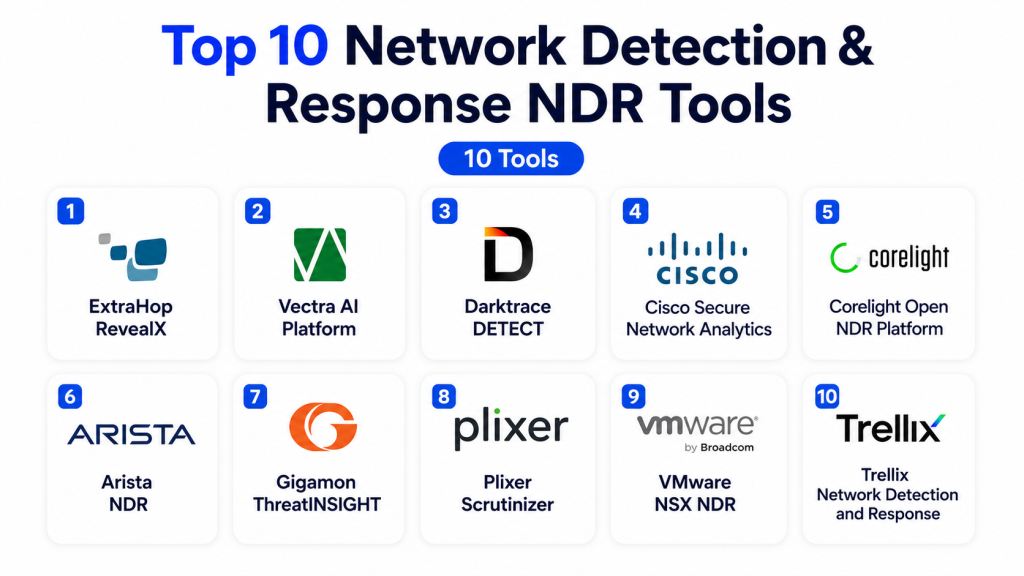
Top 10 Network Detection & Response NDR Tools
1- ExtraHop RevealX
Short description: ExtraHop RevealX is an NDR platform focused on real-time network visibility, behavioral detection, encrypted traffic analysis, and threat investigation. It is well suited for enterprises that need deep visibility across hybrid, cloud, and data center environments.
Key Features
- Real-time network traffic analysis
- Behavioral threat detection
- Encrypted traffic insights
- Cloud and hybrid visibility
- Lateral movement detection
- Investigation timelines
- Integration with SIEM, SOAR, and security tools
Pros
- Strong network visibility and analytics
- Useful for enterprise SOC investigations
- Good fit for hybrid and cloud environments
Cons
- Enterprise pricing may be high
- Deployment planning is important for large networks
- Analysts may need training to use advanced workflows fully
Platforms / Deployment
- Web
- Cloud
- Self-hosted
- Hybrid
Security & Compliance
- RBAC
- Audit logs
- Encryption
- SSO/SAML support varies by deployment
- Compliance support varies by plan
- MFA support varies by identity integration
Integrations & Ecosystem
ExtraHop integrates network detection with enterprise security operations, incident response, and cloud workflows. It is useful when SOC teams need to connect network behavior with broader threat investigation.
- SIEM platforms
- SOAR tools
- EDR platforms
- Cloud environments
- Firewalls
- Threat intelligence workflows
Support & Community
ExtraHop provides enterprise documentation, technical support, onboarding assistance, partner resources, and SOC-focused implementation guidance.
2- Vectra AI Platform
Short description: Vectra AI Platform provides AI-driven threat detection across network, identity, cloud, and hybrid environments. It is designed for security teams that need attacker behavior detection and prioritization across complex environments.
Key Features
- AI-driven behavioral detection
- Network threat analytics
- Cloud and identity detection support
- Lateral movement detection
- Attack prioritization
- Threat hunting workflows
- SOC integration support
Pros
- Strong attacker behavior detection
- Good prioritization for SOC teams
- Useful across network, identity, and cloud signals
Cons
- Advanced value depends on SOC maturity
- Deployment and tuning require planning
- Pricing may be premium for smaller teams
Platforms / Deployment
- Web
- Cloud
- Hybrid
Security & Compliance
- RBAC
- Audit logs
- Encryption
- SSO/SAML support varies by deployment
- Compliance support varies by package
- MFA support varies by identity provider
Integrations & Ecosystem
Vectra integrates with SIEM, SOAR, EDR, cloud, identity, and security operations platforms. It is useful for organizations that want NDR connected with identity and cloud detection.
- SIEM platforms
- SOAR tools
- EDR platforms
- Microsoft security tools
- Cloud platforms
- Identity providers
Support & Community
Vectra provides enterprise support, documentation, threat research, onboarding resources, and customer success assistance for security teams.
3- Darktrace DETECT
Short description: Darktrace DETECT uses self-learning AI to identify unusual behavior across network, cloud, email, SaaS, and endpoint environments. Its NDR capabilities are suited for organizations seeking anomaly-based detection and broad behavioral visibility.
Key Features
- Self-learning behavioral analytics
- Network anomaly detection
- Cloud and SaaS visibility
- Lateral movement detection
- Threat visualization
- Autonomous response options
- Investigation and reporting workflows
Pros
- Strong anomaly detection approach
- Useful for unknown and unusual behavior discovery
- Broad security visibility across environments
Cons
- Alert tuning and interpretation require care
- Some teams may need analyst training
- Best value appears when integrated into broader detection workflows
Platforms / Deployment
- Web
- Cloud
- Self-hosted
- Hybrid
Security & Compliance
- RBAC
- Audit logs
- Encryption
- SSO/SAML support varies by deployment
- Compliance support varies by plan
- MFA support varies by identity integration
Integrations & Ecosystem
Darktrace integrates with security operations, cloud, email, network, and response workflows. It is helpful where teams want behavioral analytics across multiple environments.
- SIEM platforms
- SOAR tools
- Email security workflows
- Cloud platforms
- Firewalls
- Security operations tools
Support & Community
Darktrace provides documentation, enterprise support, onboarding resources, managed service options, and customer success guidance.
4- Cisco Secure Network Analytics
Short description: Cisco Secure Network Analytics, formerly known as Stealthwatch, helps organizations detect threats using network telemetry, flow data, behavioral analytics, and security context. It is well suited for Cisco-centric enterprise networks.
Key Features
- Network flow analysis
- Behavioral anomaly detection
- Internal threat detection
- Encrypted traffic analytics support
- Network visibility dashboards
- Integration with Cisco security ecosystem
- Threat investigation workflows
Pros
- Strong fit for Cisco network environments
- Good flow-based visibility
- Useful for large enterprise network monitoring
Cons
- Best value appears in Cisco-heavy environments
- Configuration may require network expertise
- Advanced SOC workflows may need integrations
Platforms / Deployment
- Web
- Self-hosted
- Cloud
- Hybrid
Security & Compliance
- RBAC
- Audit logs
- Encryption support
- SSO/SAML support varies by deployment
- Compliance support varies by configuration
- MFA support varies by identity integration
Integrations & Ecosystem
Cisco Secure Network Analytics integrates with Cisco networking, firewall, identity, and security operations tools. It is practical for organizations already using Cisco infrastructure.
- Cisco SecureX
- Cisco ISE
- Cisco firewalls
- SIEM tools
- Network infrastructure
- Threat intelligence workflows
Support & Community
Cisco provides enterprise support, technical documentation, certifications, partner services, and a large network security administrator community.
5- Corelight Open NDR Platform
Short description: Corelight Open NDR Platform provides network evidence, detection, and threat hunting based on open-source Zeek and Suricata technologies. It is popular with mature security teams that need rich network metadata and investigation depth.
Key Features
- Zeek-based network metadata
- Suricata-based detection support
- Threat hunting workflows
- Packet and flow visibility
- Network evidence collection
- SIEM integration
- Custom detection support
Pros
- Strong network evidence and metadata depth
- Good fit for mature SOC and threat hunting teams
- Built around widely respected open-source foundations
Cons
- Requires skilled analysts for full value
- May need SIEM or data platform integration
- Less plug-and-play than some AI-first NDR tools
Platforms / Deployment
- Web
- Linux
- Self-hosted
- Cloud
- Hybrid
Security & Compliance
- RBAC
- Audit logs vary by deployment
- Encryption support
- SSO/SAML support varies by configuration
- Compliance support varies by environment
- MFA support depends on identity integration
Integrations & Ecosystem
Corelight integrates with SIEM, data lake, threat hunting, incident response, and security analytics workflows. It is ideal when teams need high-quality network evidence for investigations.
- SIEM platforms
- Data lakes
- Threat intelligence tools
- Incident response workflows
- Cloud environments
- Detection engineering workflows
Support & Community
Corelight provides enterprise support, documentation, technical resources, and benefits from the broader Zeek and network security community.
6- Arista NDR
Short description: Arista NDR, built from Awake Security technology, provides network detection, asset visibility, behavior analytics, and threat investigation. It is useful for organizations needing visibility into devices, users, and network behavior.
Key Features
- Network behavior analytics
- Asset and device visibility
- Threat detection
- Entity-based investigation
- Lateral movement detection
- Network traffic analysis
- Integration with Arista ecosystem
Pros
- Strong asset and entity visibility
- Useful for network behavior investigation
- Good fit for organizations using Arista networking
Cons
- Best value may appear in Arista-aligned environments
- Smaller mindshare than some larger NDR vendors
- Advanced deployment may require planning
Platforms / Deployment
- Web
- Cloud
- Self-hosted
- Hybrid
Security & Compliance
- RBAC
- Audit logs
- Encryption support
- SSO/SAML support varies by deployment
- Compliance support varies by package
- MFA support varies by identity integration
Integrations & Ecosystem
Arista NDR integrates with network infrastructure, SIEM tools, security operations workflows, and asset visibility programs. It is useful where network context and device behavior are important.
- Arista networking tools
- SIEM platforms
- SOAR tools
- Network infrastructure
- Threat intelligence workflows
- Security operations tools
Support & Community
Arista provides enterprise support, network security documentation, technical resources, and partner assistance.
7- Gigamon ThreatINSIGHT
Short description: Gigamon ThreatINSIGHT is a network detection and response offering focused on threat visibility, investigation, and managed detection support. It is suited for organizations that need network-derived insights with expert assistance.
Key Features
- Network threat detection
- Managed detection support
- Threat investigation workflows
- Network metadata analysis
- Alert triage support
- Incident context
- Integration with security operations
Pros
- Useful managed detection support
- Good network visibility focus
- Helpful for teams with limited analyst capacity
Cons
- Capabilities may vary by service package
- Best value appears when paired with Gigamon visibility strategy
- Smaller organizations should evaluate operational fit
Platforms / Deployment
- Web
- Cloud
- Hybrid
Security & Compliance
- RBAC
- Audit logs vary by deployment
- Encryption support
- SSO/SAML support varies by package
- Compliance support is not publicly stated
- MFA support varies by identity integration
Integrations & Ecosystem
Gigamon ThreatINSIGHT integrates with security operations, network visibility, and investigation workflows. It is useful when teams want to improve network threat detection without building every process internally.
- SIEM platforms
- SOAR tools
- Network visibility tools
- Threat intelligence workflows
- Incident response tools
- Managed detection workflows
Support & Community
Gigamon provides enterprise support, documentation, technical assistance, and expert-led security guidance depending on the selected service model.
8- Plixer Scrutinizer
Short description: Plixer Scrutinizer provides network traffic analytics, flow monitoring, security visibility, and anomaly detection. It is useful for organizations that need traffic behavior insights, network performance visibility, and threat investigation support.
Key Features
- NetFlow and metadata analysis
- Network traffic visibility
- Anomaly detection
- Security reporting
- Threat investigation support
- Network performance insights
- Scalable flow analytics
Pros
- Strong flow-based network visibility
- Useful for both security and network operations
- Practical for traffic analysis and investigation
Cons
- Not as broad as some full AI-first NDR platforms
- Advanced threat detection may require tuning
- Best value depends on flow data quality
Platforms / Deployment
- Web
- Self-hosted
- Cloud
- Hybrid
Security & Compliance
- RBAC
- Audit logs
- Encryption support
- SSO/SAML support varies by deployment
- Compliance support varies by configuration
- MFA support varies by identity integration
Integrations & Ecosystem
Plixer Scrutinizer integrates with network infrastructure, SIEM tools, reporting workflows, and traffic monitoring environments. It is useful for teams that need both operational and security visibility.
- Routers and switches
- Firewalls
- SIEM platforms
- Network operations tools
- Reporting workflows
- Flow exporters
Support & Community
Plixer provides technical support, documentation, onboarding resources, and network analytics guidance for security and network operations teams.
9- VMware NSX NDR
Short description: VMware NSX NDR provides network threat detection for VMware and hybrid environments by analyzing network traffic and suspicious behavior. It is well suited for organizations using VMware networking and security technologies.
Key Features
- Network threat detection
- East-west traffic visibility
- Malware behavior detection
- Cloud and virtual network support
- Incident investigation
- Security analytics
- VMware ecosystem integration
Pros
- Strong fit for VMware environments
- Useful east-west traffic visibility
- Good for virtualized and software-defined networks
Cons
- Best suited for VMware-aligned infrastructure
- Platform strategy may depend on broader VMware ecosystem direction
- Advanced implementation may require specialist expertise
Platforms / Deployment
- Web
- Cloud
- Self-hosted
- Hybrid
Security & Compliance
- RBAC
- Audit logs
- Encryption support
- SSO/SAML support varies by deployment
- Compliance support varies by configuration
- MFA support varies by identity integration
Integrations & Ecosystem
VMware NSX NDR integrates with VMware security, virtualization, cloud, and network workflows. It is useful where east-west visibility inside virtual environments is a priority.
- VMware NSX
- VMware security tools
- SIEM platforms
- Cloud environments
- Network security workflows
- Incident response tools
Support & Community
VMware provides enterprise documentation, technical support, partner services, and implementation guidance through the broader vendor ecosystem.
10- Trellix Network Detection and Response
Short description: Trellix Network Detection and Response provides network security monitoring, threat detection, malware analysis, and security operations alignment. It is suited for organizations using Trellix security products or needing NDR as part of a broader security platform.
Key Features
- Network threat detection
- Malware behavior analysis
- Network traffic visibility
- Security analytics
- Incident investigation support
- Threat intelligence integration
- Enterprise security ecosystem alignment
Pros
- Strong fit for Trellix security environments
- Useful for enterprise detection workflows
- Good connection with broader threat intelligence
Cons
- Best value appears within Trellix ecosystem
- Administration may require security expertise
- Smaller teams may find deployment complex
Platforms / Deployment
- Web
- Cloud
- Self-hosted
- Hybrid
Security & Compliance
- RBAC
- Audit logs
- Encryption support
- SSO/SAML support varies by deployment
- Compliance support varies by package
- MFA support varies by identity integration
Integrations & Ecosystem
Trellix NDR integrates with endpoint, email, SIEM, threat intelligence, and broader security operations workflows. It is useful for organizations aligning network detection with enterprise threat defense.
- Trellix security tools
- SIEM platforms
- Threat intelligence workflows
- Endpoint security tools
- Email security tools
- Security operations platforms
Support & Community
Trellix provides enterprise support, documentation, professional services, partner resources, and security operations guidance.
Comparison Table
| Tool Name | Best For | Platform Supported | Deployment | Standout Feature | Public Rating |
|---|---|---|---|---|---|
| ExtraHop RevealX | Enterprise hybrid network visibility | Web | Cloud, Self-hosted, Hybrid | Real-time network behavior analytics | N/A |
| Vectra AI Platform | AI-driven attacker behavior detection | Web | Cloud, Hybrid | Network, identity, and cloud threat detection | N/A |
| Darktrace DETECT | Anomaly-based behavioral detection | Web | Cloud, Self-hosted, Hybrid | Self-learning AI detection | N/A |
| Cisco Secure Network Analytics | Cisco-centric enterprise networks | Web | Cloud, Self-hosted, Hybrid | Flow-based network threat analytics | N/A |
| Corelight Open NDR Platform | SOC threat hunting and network evidence | Web, Linux | Cloud, Self-hosted, Hybrid | Zeek-based network metadata | N/A |
| Arista NDR | Asset and behavior visibility | Web | Cloud, Self-hosted, Hybrid | Entity-based network investigation | N/A |
| Gigamon ThreatINSIGHT | Managed network detection support | Web | Cloud, Hybrid | Network-derived threat investigation | N/A |
| Plixer Scrutinizer | Flow analytics and network visibility | Web | Cloud, Self-hosted, Hybrid | NetFlow-based traffic analytics | N/A |
| VMware NSX NDR | VMware and virtual network environments | Web | Cloud, Self-hosted, Hybrid | East-west virtual traffic detection | N/A |
| Trellix Network Detection and Response | Trellix enterprise security programs | Web | Cloud, Self-hosted, Hybrid | Network threat detection with Trellix ecosystem | N/A |
Evaluation & Scoring of Network Detection & Response NDR
| Tool Name | Core | Ease | Integrations | Security | Performance | Support | Value | Weighted Total |
|---|---|---|---|---|---|---|---|---|
| ExtraHop RevealX | 9 | 8 | 9 | 9 | 9 | 8 | 7 | 8.4 |
| Vectra AI Platform | 9 | 8 | 9 | 9 | 8 | 8 | 7 | 8.3 |
| Darktrace DETECT | 9 | 8 | 8 | 8 | 8 | 8 | 7 | 8.1 |
| Cisco Secure Network Analytics | 8 | 7 | 9 | 8 | 8 | 9 | 7 | 8.0 |
| Corelight Open NDR Platform | 9 | 6 | 9 | 9 | 9 | 8 | 8 | 8.3 |
| Arista NDR | 8 | 7 | 8 | 8 | 8 | 8 | 7 | 7.7 |
| Gigamon ThreatINSIGHT | 8 | 8 | 8 | 8 | 8 | 8 | 7 | 7.8 |
| Plixer Scrutinizer | 7 | 8 | 8 | 7 | 8 | 8 | 8 | 7.7 |
| VMware NSX NDR | 8 | 7 | 8 | 8 | 8 | 8 | 7 | 7.7 |
| Trellix Network Detection and Response | 8 | 7 | 8 | 8 | 8 | 8 | 7 | 7.7 |
These scores are comparative and should be interpreted based on network size, traffic volume, cloud architecture, SOC maturity, and existing security ecosystem. ExtraHop, Vectra, and Darktrace are strong choices for AI-assisted and behavior-focused enterprise NDR. Corelight is excellent for teams that want deep network evidence and threat hunting. Cisco, VMware, Arista, Gigamon, Plixer, and Trellix can be strong when they align with existing infrastructure and security operations workflows.
Which Network Detection & Response NDR Tool Is Right for You?
Solo / Freelancer
Solo professionals usually do not need a full NDR platform unless they manage client networks or security operations. Basic firewall logging, endpoint protection, DNS security, and cloud monitoring may be enough. For consultants, lighter flow analytics or managed detection services may be more practical than enterprise NDR.
SMB
SMBs should prioritize simplicity, managed detection support, and clear reporting. Gigamon ThreatINSIGHT, Plixer Scrutinizer, Darktrace DETECT, or a managed security provider using NDR technology may be practical depending on network complexity and security staffing.
Mid-Market
Mid-market organizations often need visibility into internal traffic, cloud workloads, ransomware movement, unmanaged devices, and suspicious network behavior. ExtraHop RevealX, Vectra AI Platform, Darktrace DETECT, Corelight, Cisco Secure Network Analytics, and Plixer can be strong options depending on network architecture.
Enterprise
Enterprises should prioritize high-scale visibility, encrypted traffic insights, threat hunting, cloud and data center support, SIEM integration, and response automation. ExtraHop, Vectra, Darktrace, Cisco, Corelight, Arista, VMware NSX NDR, and Trellix are strong enterprise candidates depending on ecosystem fit.
Budget vs Premium
Budget-conscious teams may start with flow analytics, open-source telemetry, or NDR capabilities available through existing security providers. Premium NDR platforms usually provide stronger behavioral analytics, better investigation workflows, cloud visibility, response automation, and enterprise support.
Feature Depth vs Ease of Use
Darktrace, Vectra, and ExtraHop are often easier for teams seeking AI-assisted detection and visual investigations. Corelight offers deep evidence but requires stronger analyst expertise. Cisco, VMware, Arista, and Trellix may fit best when organizations already use those ecosystems.
Integrations & Scalability
Organizations should prioritize integrations with SIEM, SOAR, EDR, XDR, firewalls, NAC, cloud platforms, identity tools, and ticketing systems. NDR becomes more powerful when suspicious network behavior can trigger investigation, containment, and response workflows across the security stack.
Security & Compliance Needs
Regulated organizations should prioritize audit logs, role-based access, evidence collection, incident timelines, reporting, encrypted traffic visibility, and data retention controls. NDR should help prove that network threats are detected, investigated, and escalated properly.
Frequently Asked Questions FAQs
1. What is Network Detection & Response NDR?
Network Detection & Response NDR monitors network traffic and behavior to detect threats, investigate suspicious activity, and support response actions. It helps security teams see attacker movement that may not appear clearly in endpoint or identity tools.
2. How is NDR different from EDR?
EDR focuses on endpoint activity such as processes, files, and device behavior. NDR focuses on network traffic, communications, lateral movement, command-and-control activity, and suspicious connections between systems.
3. Why do businesses need NDR tools?
Businesses need NDR tools because attackers often move through networks after initial compromise. NDR helps identify hidden activity, unmanaged devices, data exfiltration, and suspicious internal communication.
4. Can NDR detect ransomware?
NDR can help detect ransomware-related behavior such as lateral movement, unusual SMB traffic, command-and-control communication, and rapid data movement. It works best alongside EDR, backups, identity security, and incident response processes.
5. What data does NDR analyze?
NDR tools may analyze packets, flow data, metadata, DNS traffic, encrypted traffic patterns, cloud network logs, east-west communication, and device behavior. The exact data depends on the tool and deployment model.
6. Is NDR useful for cloud environments?
Yes. Many NDR tools support cloud traffic visibility, virtual sensors, cloud flow logs, Kubernetes traffic, and hybrid network monitoring. Buyers should validate support for their specific cloud platforms and architectures.
7. What integrations should NDR buyers look for?
Buyers should look for integrations with SIEM, SOAR, EDR, XDR, firewalls, NAC, identity providers, cloud platforms, threat intelligence, and ticketing systems.
8. How difficult is NDR deployment?
Deployment difficulty depends on network architecture, traffic volume, sensor placement, cloud visibility, encryption, and SOC workflows. A phased rollout across critical network segments is usually best.
9. What are common NDR implementation mistakes?
Common mistakes include poor sensor placement, collecting too much data without clear use cases, not integrating with SIEM or response tools, ignoring cloud traffic, and failing to train analysts on network investigations.
10. How should organizations choose the best NDR tool?
Organizations should evaluate network visibility needs, cloud support, detection quality, investigation workflows, integrations, scalability, analyst skill level, deployment model, and total cost before choosing an NDR platform.
Conclusion
Network Detection & Response NDR tools are essential for organizations that need visibility into network behavior, lateral movement, command-and-control activity, suspicious cloud traffic, and data exfiltration risks. The best NDR platform depends on network architecture, SOC maturity, cloud adoption, compliance pressure, and existing security ecosystem. ExtraHop, Vectra, and Darktrace are strong choices for behavior-driven enterprise detection, while Corelight is excellent for teams that need deep network evidence and threat hunting flexibility. Cisco, Arista, VMware, Trellix, Gigamon, and Plixer can be strong options when they align with existing infrastructure, network visibility needs, and operational workflows. The practical next step is to shortlist two or three tools, map critical network segments and cloud traffic sources, run a pilot with real traffic, validate SIEM and response integrations, and confirm that analysts can investigate and act on NDR alerts effectively.

Find Trusted Cardiac Hospitals
Compare heart hospitals by city and services — all in one place.
Explore Hospitals
Before reading this, I didn’t know NDR focuses on network traffic instead of just endpoints. Now I understand its importance.