Introduction
Web Application Firewall WAF platforms protect websites, web applications, APIs, and digital services from malicious traffic, application-layer attacks, bot abuse, data exposure, and vulnerability exploitation. Unlike traditional network firewalls that focus mainly on ports, protocols, and network traffic, WAF platforms inspect HTTP and HTTPS traffic to detect threats such as SQL injection, cross-site scripting, malicious file uploads, credential abuse, API misuse, and automated attack attempts. WAF platforms matter now because businesses rely heavily on web applications, SaaS portals, customer-facing APIs, e-commerce systems, mobile backends, and cloud-native applications. Attackers increasingly target application logic, exposed APIs, authentication flows, and third-party integrations. A strong WAF helps reduce risk by filtering malicious requests, enforcing security policies, improving visibility, and supporting compliance requirements.
Common Real-world use cases include:
- Protecting websites and customer portals from application-layer attacks
- Securing APIs used by mobile apps, SaaS platforms, and partner systems
- Blocking malicious bots, scraping, credential stuffing, and abuse traffic
- Supporting compliance requirements for regulated applications
- Reducing exposure during vulnerability patching windows
Key Evaluation criteria buyers should consider include:
- OWASP Top 10 protection coverage
- API security support
- Bot mitigation capabilities
- DDoS and edge protection
- False positive management
- Deployment flexibility
- Cloud, hybrid, and on-prem support
- Security analytics and reporting
- Integration with SIEM, DevOps, and observability tools
- Ease of policy tuning and administration
Best for: Security teams, DevOps teams, SaaS providers, e-commerce businesses, financial institutions, healthcare organizations, managed security service providers, and enterprises operating public-facing web applications or APIs.
Not ideal for: Very small static websites with minimal traffic and low-risk exposure, or organizations that already rely fully on a managed application security provider and do not need direct WAF policy control.
Key Trends in Web Application Firewall WAF Platforms
- API-first protection is becoming a core requirement as attackers increasingly target API endpoints, tokens, schemas, and business logic.
- AI-assisted threat detection is helping identify abnormal request behavior, automated abuse patterns, and emerging application-layer attacks.
- Bot management and WAF convergence is growing as businesses need protection against scraping, fake account creation, credential stuffing, and inventory abuse.
- Cloud-native WAF adoption is increasing because more applications now run across cloud platforms, containers, Kubernetes, and edge networks.
- Application security automation is improving through integrations with CI/CD pipelines, DevSecOps workflows, and Infrastructure-as-Code.
- WAAP platforms are expanding beyond traditional WAF by combining web application firewall, API security, bot defense, and DDoS mitigation.
- False positive reduction is becoming a major buying factor because overly aggressive rules can block legitimate users and disrupt business operations.
- Zero-trust and identity-aware security are influencing WAF policies by connecting access context, user behavior, and application risk.
- Managed WAF services are gaining adoption among teams that lack dedicated application security specialists.
- Real-time security analytics are becoming more important for incident response, compliance reviews, and executive reporting.
How We Selected These Tools Methodology
The tools below were selected using practical application security and enterprise operations criteria including:
- Market adoption and industry recognition
- Web application and API protection depth
- OWASP Top 10 coverage and rule quality
- Bot mitigation and DDoS protection capabilities
- Cloud, hybrid, and edge deployment flexibility
- Security analytics and reporting maturity
- False positive management and policy tuning experience
- Integration with SIEM, DevOps, cloud, and observability tools
- Scalability for SMB, mid-market, and enterprise use cases
- Support maturity, documentation quality, and operational usability
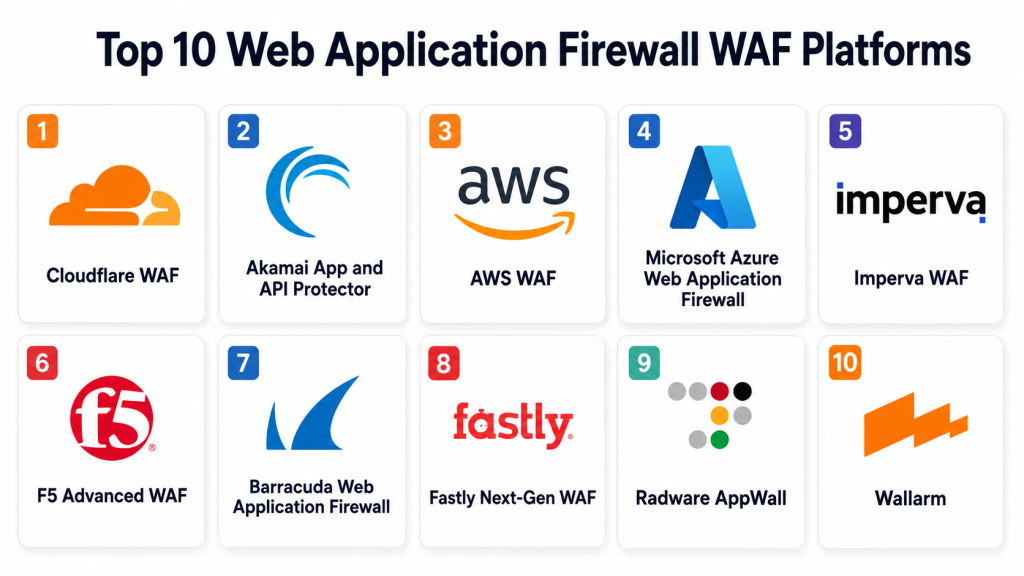
Top 10 Web Application Firewall WAF Platforms
1- Cloudflare WAF
Short description: Cloudflare WAF is a cloud-based web application firewall delivered through Cloudflare’s global edge network. It protects websites, APIs, and applications from application-layer attacks, bots, and malicious traffic while also improving performance and availability.
Key Features
- Managed WAF rulesets
- OWASP Top 10 protection
- API protection capabilities
- Bot mitigation integration
- DDoS protection
- Custom firewall rules
- Edge-based traffic filtering
Pros
- Strong global edge performance
- Easy deployment for websites and APIs
- Broad security and performance ecosystem
Cons
- Advanced controls may require higher-tier plans
- Complex enterprise policies need careful tuning
- Some teams may need support for detailed rule customization
Platforms / Deployment
- Web
- Cloud
Security & Compliance
- MFA
- SSO/SAML support
- RBAC
- Audit logs
- Encryption
- DDoS protection
Integrations & Ecosystem
Cloudflare WAF integrates with cloud platforms, DevOps workflows, SIEM tools, application delivery systems, and security operations platforms. Its ecosystem is especially strong for organizations that want WAF, CDN, bot protection, DNS, and edge security in one platform.
- SIEM integrations
- API integrations
- Terraform support
- CDN and DNS ecosystem
- Cloud hosting platforms
- Bot management tools
Support & Community
Cloudflare provides extensive documentation, active developer resources, community support, and enterprise support tiers. It is popular among startups, SaaS companies, e-commerce teams, and large enterprises.
2- Akamai App and API Protector
Short description: Akamai App and API Protector is an enterprise-grade WAF and API security platform built on Akamai’s global edge network. It helps organizations protect web applications, APIs, and digital services from application attacks, bots, and DDoS threats.
Key Features
- Web application firewall protection
- API security controls
- Bot mitigation integration
- DDoS protection
- Adaptive security rules
- Edge-based protection
- Security analytics and reporting
Pros
- Strong enterprise edge security capabilities
- Excellent global traffic protection
- Good fit for high-traffic digital businesses
Cons
- Premium enterprise pricing
- Configuration may require specialist knowledge
- Best suited for organizations with complex security needs
Platforms / Deployment
- Web
- Cloud
Security & Compliance
- RBAC
- Audit logging
- Encryption
- DDoS protection
- Secure administrative controls
Integrations & Ecosystem
Akamai integrates with enterprise security tools, application delivery workflows, SIEM systems, and managed security operations. It is commonly used by organizations with global traffic, high availability needs, and advanced web security requirements.
- SIEM integrations
- API integrations
- CDN ecosystem
- Bot management
- DDoS protection
- Security analytics tools
Support & Community
Akamai provides enterprise-grade support, professional services, managed security options, and strong documentation for complex application environments.
3- AWS WAF
Short description: AWS WAF is a cloud-native web application firewall for protecting applications and APIs running on AWS services. It allows teams to define security rules that filter malicious web requests before they reach applications.
Key Features
- Managed rule groups
- Custom security rules
- API and web application protection
- Integration with AWS services
- Bot control options
- Rate-based rules
- Logging and monitoring support
Pros
- Deep AWS ecosystem integration
- Flexible rule configuration
- Good fit for cloud-native AWS applications
Cons
- Best suited for AWS-centric environments
- Policy tuning requires cloud security knowledge
- Cross-cloud visibility is limited
Platforms / Deployment
- Web
- Cloud
Security & Compliance
- IAM-based access controls
- Audit logging through AWS services
- Encryption support
- Managed security rule groups
Integrations & Ecosystem
AWS WAF integrates deeply with AWS application delivery and security services. It is a strong fit for teams that already operate applications through AWS-native infrastructure.
- Amazon CloudFront
- Application Load Balancer
- Amazon API Gateway
- AWS CloudWatch
- AWS Security Hub
- Terraform and automation tools
Support & Community
AWS provides large-scale documentation, support plans, partner resources, and a mature cloud security community.
4- Microsoft Azure Web Application Firewall
Short description: Microsoft Azure Web Application Firewall protects web applications hosted in Azure environments through Azure Application Gateway and Azure Front Door. It is designed for organizations already using Microsoft cloud infrastructure.
Key Features
- OWASP rule protection
- Managed rulesets
- Custom WAF rules
- Azure-native integration
- Bot protection options
- Logging and monitoring
- Policy-based configuration
Pros
- Strong Azure ecosystem integration
- Good fit for Microsoft-centric enterprises
- Centralized cloud security management
Cons
- Best suited for Azure environments
- Advanced tuning requires Azure expertise
- Multi-cloud WAF governance may require additional tools
Platforms / Deployment
- Web
- Cloud
Security & Compliance
- Azure RBAC
- Audit logging
- Encryption support
- Azure identity integration
- Managed security rules
Integrations & Ecosystem
Azure WAF integrates with Azure networking, monitoring, security, and application delivery services. It works well for enterprises using Microsoft identity, security, and cloud management tools.
- Azure Front Door
- Azure Application Gateway
- Microsoft Sentinel
- Azure Monitor
- Azure Policy
- DevOps automation tools
Support & Community
Microsoft provides enterprise support, large documentation resources, partner services, and extensive cloud administrator community support.
5- Imperva WAF
Short description: Imperva WAF is an enterprise web application and API protection platform focused on blocking application attacks, bots, DDoS threats, and data exposure risks. It is commonly used in regulated and high-risk application environments.
Key Features
- Web application firewall protection
- API security capabilities
- Bot mitigation
- DDoS protection
- Attack analytics
- Runtime traffic inspection
- Managed security options
Pros
- Strong application security depth
- Good bot and DDoS protection ecosystem
- Suitable for regulated businesses
Cons
- Enterprise pricing can be high
- Advanced policy tuning may require expertise
- Some deployments may need professional services
Platforms / Deployment
- Cloud
- Self-hosted
- Hybrid
Security & Compliance
- RBAC
- Audit logging
- Encryption
- Compliance reporting support
- Secure administrator controls
Integrations & Ecosystem
Imperva integrates with security operations platforms, SIEM tools, cloud infrastructure, and application delivery environments. It is often chosen by organizations that need strong web security governance and managed protection options.
- SIEM integrations
- API integrations
- Cloud platforms
- DDoS protection ecosystem
- Bot management
- Security analytics
Support & Community
Imperva provides enterprise support, managed security services, technical documentation, and onboarding assistance for complex environments.
6- F5 Advanced WAF
Short description: F5 Advanced WAF is an enterprise-grade application security platform designed to protect applications from advanced threats, bots, credential abuse, and application-layer attacks. It is commonly used in hybrid and data center-heavy environments.
Key Features
- Advanced WAF policies
- Bot defense capabilities
- Credential stuffing protection
- Behavioral analytics
- API protection
- Application-layer DDoS defense
- Integration with F5 application delivery ecosystem
Pros
- Strong enterprise application security features
- Good fit for hybrid and on-prem environments
- Deep application delivery integration
Cons
- Can be complex to deploy and tune
- Requires experienced administrators
- Premium enterprise pricing
Platforms / Deployment
- Cloud
- Self-hosted
- Hybrid
Security & Compliance
- RBAC
- Audit logging
- Encryption
- Secure access controls
- Compliance reporting support
Integrations & Ecosystem
F5 Advanced WAF integrates closely with F5 application delivery, load balancing, cloud, and security workflows. It is useful for organizations that already depend on F5 infrastructure.
- F5 BIG-IP ecosystem
- Cloud platforms
- SIEM integrations
- API integrations
- Application delivery controllers
- Security analytics tools
Support & Community
F5 provides enterprise support, documentation, training resources, certifications, and a strong application delivery and security community.
7- Barracuda Web Application Firewall
Short description: Barracuda Web Application Firewall provides application-layer protection for websites, portals, and APIs. It is designed for organizations that need WAF protection with deployment flexibility across cloud, virtual, and appliance-based environments.
Key Features
- Web application firewall rules
- Bot and DDoS protection options
- API protection
- Application access controls
- Threat intelligence integration
- Reporting and analytics
- Flexible deployment models
Pros
- Good deployment flexibility
- Strong fit for mid-market organizations
- Easier administration than some enterprise-heavy tools
Cons
- Advanced enterprise customization may be limited
- Ecosystem depth varies by deployment
- Large complex environments may need additional planning
Platforms / Deployment
- Cloud
- Self-hosted
- Hybrid
Security & Compliance
- RBAC
- Audit logging
- Encryption support
- Authentication integrations
- Compliance reporting support
Integrations & Ecosystem
Barracuda WAF integrates with cloud platforms, security monitoring tools, and broader Barracuda security products. It is commonly used by teams seeking practical WAF protection without extreme deployment complexity.
- AWS
- Azure
- SIEM tools
- API integrations
- Barracuda security ecosystem
- Reporting tools
Support & Community
Barracuda provides documentation, support plans, partner assistance, and practical onboarding resources for SMB and mid-market teams.
8- Fastly Next-Gen WAF
Short description: Fastly Next-Gen WAF is an edge and cloud-friendly WAF platform designed for modern web applications, APIs, and DevOps-driven teams. It focuses on accurate detection, low operational friction, and developer-friendly security workflows.
Key Features
- Next-generation WAF protection
- API security support
- DevOps-friendly deployment
- Low false positive design
- Real-time visibility
- Edge security integration
- Custom detection logic
Pros
- Developer-friendly workflows
- Strong focus on reducing false positives
- Good fit for modern cloud applications
Cons
- Advanced security operations may require tuning
- Enterprise capabilities depend on package and deployment
- Best value for teams comfortable with modern DevOps workflows
Platforms / Deployment
- Web
- Cloud
- Hybrid
Security & Compliance
- RBAC
- Audit logging
- Encryption support
- Secure administrative controls
Integrations & Ecosystem
Fastly integrates with edge delivery, DevOps, observability, and security operations workflows. It is useful for teams that need WAF protection aligned with agile release cycles.
- CI/CD workflows
- SIEM tools
- API integrations
- Edge delivery ecosystem
- Observability platforms
- Cloud environments
Support & Community
Fastly provides technical documentation, developer resources, enterprise support, and implementation assistance for application security teams.
9- Radware AppWall
Short description: Radware AppWall is a web application firewall focused on protecting applications from web attacks, automated threats, and application-layer risk. It is often used alongside Radware’s broader application delivery and DDoS protection ecosystem.
Key Features
- Web application protection
- OWASP Top 10 coverage
- Bot mitigation options
- Application-layer attack detection
- DDoS ecosystem integration
- Policy management
- Security reporting
Pros
- Strong security-focused feature set
- Good DDoS protection alignment
- Suitable for enterprise application environments
Cons
- Smaller mainstream visibility compared to larger cloud providers
- Advanced configuration may require expertise
- Deployment planning is important for complex environments
Platforms / Deployment
- Cloud
- Self-hosted
- Hybrid
Security & Compliance
- RBAC
- Audit logging
- Encryption support
- Secure policy management
Integrations & Ecosystem
Radware AppWall integrates with Radware application delivery, DDoS protection, and enterprise security workflows. It is especially useful where application protection and network-layer defense must work together.
- Radware DDoS protection
- Application delivery tools
- SIEM integrations
- API integrations
- Security analytics
- Cloud platforms
Support & Community
Radware provides enterprise support, security expertise, documentation, and professional services for application protection environments.
10- Wallarm
Short description: Wallarm is a cloud-native application and API security platform focused on WAF, API protection, vulnerability detection, and modern application security workflows. It is suitable for teams running APIs, microservices, and cloud-native applications.
Key Features
- API security protection
- Web application firewall
- Vulnerability detection
- Cloud-native deployment support
- Kubernetes compatibility
- Security analytics
- Automated threat detection
Pros
- Strong API security focus
- Good fit for cloud-native environments
- Useful for DevSecOps teams
Cons
- Smaller market presence than hyperscale vendors
- Enterprise governance depth may vary
- Requires tuning for complex API environments
Platforms / Deployment
- Cloud
- Self-hosted
- Hybrid
Security & Compliance
- RBAC
- Audit logging
- Encryption support
- Secure deployment controls
Integrations & Ecosystem
Wallarm integrates with cloud-native infrastructure, DevOps tools, API gateways, and security operations workflows. It is useful for teams that prioritize API-first application security.
- Kubernetes
- API gateways
- CI/CD tools
- SIEM integrations
- Cloud platforms
- DevSecOps workflows
Support & Community
Wallarm provides documentation, technical support, onboarding resources, and guidance for API security and cloud-native WAF deployments.
Comparison Table
| Tool Name | Best For | Platform Supported | Deployment | Standout Feature | Public Rating |
|---|---|---|---|---|---|
| Cloudflare WAF | Edge-based web and API protection | Web | Cloud | Global edge WAF and DDoS protection | N/A |
| Akamai App and API Protector | Large enterprise application security | Web | Cloud | Enterprise edge and API protection | N/A |
| AWS WAF | AWS-native application protection | Web | Cloud | Deep AWS integration | N/A |
| Microsoft Azure WAF | Azure-hosted applications | Web | Cloud | Azure-native WAF policy control | N/A |
| Imperva WAF | Regulated and high-risk applications | Web | Cloud, Self-hosted, Hybrid | Strong web and bot protection | N/A |
| F5 Advanced WAF | Hybrid enterprise application delivery | Web | Cloud, Self-hosted, Hybrid | Advanced application-layer defense | N/A |
| Barracuda Web Application Firewall | SMB and mid-market WAF protection | Web | Cloud, Self-hosted, Hybrid | Flexible deployment options | N/A |
| Fastly Next-Gen WAF | DevOps and modern application teams | Web | Cloud, Hybrid | Low-friction developer-friendly WAF | N/A |
| Radware AppWall | Enterprise app and DDoS-aligned defense | Web | Cloud, Self-hosted, Hybrid | Application and DDoS ecosystem alignment | N/A |
| Wallarm | API-first cloud-native security | Web | Cloud, Self-hosted, Hybrid | API and microservices protection | N/A |
Evaluation & Scoring of Web Application Firewall WAF Platforms
| Tool Name | Core | Ease | Integrations | Security | Performance | Support | Value | Weighted Total |
|---|---|---|---|---|---|---|---|---|
| Cloudflare WAF | 9 | 9 | 9 | 9 | 10 | 8 | 9 | 9.1 |
| Akamai App and API Protector | 9 | 7 | 8 | 9 | 10 | 9 | 7 | 8.5 |
| AWS WAF | 8 | 7 | 9 | 8 | 9 | 8 | 8 | 8.1 |
| Microsoft Azure WAF | 8 | 7 | 8 | 8 | 8 | 8 | 8 | 7.9 |
| Imperva WAF | 9 | 7 | 8 | 9 | 8 | 8 | 7 | 8.0 |
| F5 Advanced WAF | 9 | 6 | 8 | 9 | 9 | 8 | 6 | 7.9 |
| Barracuda Web Application Firewall | 8 | 8 | 7 | 8 | 8 | 8 | 8 | 7.9 |
| Fastly Next-Gen WAF | 8 | 8 | 8 | 8 | 9 | 8 | 8 | 8.1 |
| Radware AppWall | 8 | 7 | 7 | 8 | 8 | 8 | 7 | 7.6 |
| Wallarm | 8 | 7 | 8 | 8 | 8 | 7 | 8 | 7.8 |
These scores are comparative and should be interpreted based on application architecture, traffic scale, security maturity, and internal team skills. Cloud and edge platforms often score strongly in performance and ease of deployment, while enterprise hybrid platforms may provide deeper control but require more expertise. API-heavy organizations should prioritize API discovery, schema enforcement, and runtime protection. Regulated organizations should focus on reporting, access controls, auditability, and managed security options.
Which Web Application Firewall WAF Platform Is Right for You?
Solo Freelancer
Solo professionals and small website owners should look for simple cloud-based WAF options that are easy to deploy and do not require deep security operations knowledge. Cloudflare WAF and basic managed WAF offerings can be practical choices when simplicity and quick setup matter most.
SMB
SMBs should prioritize easy onboarding, managed rules, bot protection, and clear reporting. Cloudflare WAF, Barracuda Web Application Firewall, and Fastly Next-Gen WAF can work well depending on traffic needs, application architecture, and internal security skill level.
Mid-Market
Mid-market organizations often need stronger policy control, API protection, and integration with existing security tools. AWS WAF, Azure WAF, Imperva WAF, Fastly Next-Gen WAF, and Barracuda WAF are strong options depending on cloud environment and deployment model.
Enterprise
Enterprises should prioritize scalability, global availability, API security, bot mitigation, DDoS protection, SIEM integration, and compliance reporting. Akamai App and API Protector, Cloudflare WAF, Imperva WAF, F5 Advanced WAF, and Radware AppWall are strong candidates for complex application environments.
Budget vs Premium
Budget-conscious teams may prefer cloud-native WAF tools already available within their cloud platform or edge provider. Premium platforms usually add better managed protection, advanced bot defense, stronger analytics, deeper enterprise support, and more flexible policy customization.
Feature Depth vs Ease of Use
Tools like F5 Advanced WAF, Akamai, Imperva, and Radware offer strong enterprise depth but may require experienced administrators. Cloudflare, AWS WAF, Azure WAF, Fastly, and Barracuda may provide faster deployment depending on existing infrastructure.
Integrations & Scalability
Organizations using CI/CD, SIEM, SOAR, observability, API gateways, Kubernetes, and cloud platforms should prioritize WAF solutions with mature APIs and automation support. Strong integrations help security teams apply policies consistently across fast-changing application environments.
Security & Compliance Needs
Regulated industries should prioritize audit logging, access controls, rule change history, compliance reporting, encryption, bot defense, API protection, and managed security support. The WAF should help prove that application traffic is monitored, filtered, and governed consistently.
Frequently Asked Questions FAQs
1. What is a Web Application Firewall WAF?
A Web Application Firewall WAF protects websites, applications, and APIs by inspecting HTTP and HTTPS traffic. It blocks malicious requests before they reach the application.
2. Why do businesses need a WAF platform?
Businesses need WAF platforms to reduce exposure to application-layer attacks such as SQL injection, cross-site scripting, malicious bots, and API abuse. A WAF adds a security layer between users and applications.
3. Is a WAF different from a traditional firewall?
Yes. A traditional firewall focuses mainly on network traffic, ports, and protocols, while a WAF focuses on web application traffic and application-layer threats.
4. Can a WAF protect APIs?
Many modern WAF platforms include API protection capabilities. Buyers should evaluate API discovery, schema validation, authentication context, rate limiting, and abuse detection before selecting a platform.
5. What is OWASP Top 10 protection?
OWASP Top 10 protection refers to defense against common web application security risks such as injection, broken access control, misconfiguration, and cross-site scripting.
6. Do WAF platforms stop DDoS attacks?
Some WAF platforms include DDoS protection, especially edge-based and cloud-delivered platforms. However, large-scale DDoS defense may require dedicated DDoS mitigation capabilities.
7. What are false positives in WAF management?
False positives happen when a WAF blocks legitimate user traffic by mistake. Good WAF platforms provide tuning, learning modes, logging, and rule controls to reduce business disruption.
8. Are cloud-based WAF platforms secure?
Cloud-based WAF platforms can be highly secure when properly configured. Teams should validate access controls, logging, encryption, compliance reporting, and integration with existing security workflows.
9. How difficult is WAF deployment?
Deployment difficulty depends on application complexity, traffic volume, custom rules, API structure, and compliance requirements. Simple websites can be protected quickly, while enterprise applications require careful tuning.
10. How should organizations choose the best WAF platform?
Organizations should evaluate application architecture, cloud environment, API exposure, bot risk, compliance needs, traffic volume, integrations, false positive handling, and total cost before choosing a WAF.
Conclusion
Web Application Firewall WAF platforms are now essential for protecting modern websites, APIs, SaaS products, e-commerce systems, and cloud-native applications from application-layer attacks. The best WAF depends on business context, traffic scale, cloud environment, application complexity, and security maturity. Cloudflare WAF and Fastly Next-Gen WAF are strong options for edge-friendly and developer-focused teams, while AWS WAF and Azure WAF fit organizations already standardized on those cloud ecosystems. Akamai, Imperva, F5, and Radware are stronger for enterprises that need advanced security depth, high traffic protection, and managed options. Barracuda can be a practical fit for SMB and mid-market teams, while Wallarm is useful for API-first and cloud-native environments. The practical next step is to shortlist two or three platforms, test them against real application traffic, validate API and bot protection needs, review false positive handling, and confirm integrations with SIEM, DevOps, and compliance workflows before full rollout.

Find Trusted Cardiac Hospitals
Compare heart hospitals by city and services — all in one place.
Explore Hospitals
I am trying to learn more about web application security, and this blog helped me understand how WAF protects websites from different online attacks.